
Huobi Is Using Chainlink Proof of Reserve To Enhance the Transparency of HBTC

HuobiPublished on 2022-11-23Last updated on 2022-11-23

Abstract

Huobi is a digital asset exchange that serves tens of millions of users across the globe.

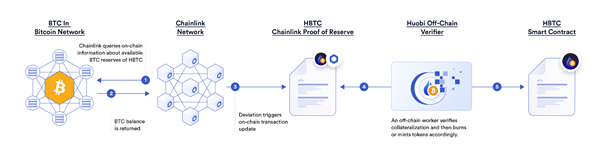
We’re excited to announce that Huobi is using Chainlink Proof of Reserve (PoR) to help provide transparency around its HBTC H-Token on Ethereum mainnet. By using Proof of Reserve, the amount of BTC in Huobi’s reserves wallets on the Bitcoin blockchain can be verified to match the number of HBTC—Huobi’s wrapped BTC token—on Ethereum. Huobi is using Proof of Reserve in its off-chain system to verify HBTC is fully collateralized prior to minting.

0

Huobi is a digital asset exchange that serves tens of millions of users across the globe. As part of our mission to empower a multitude of other industries with blockchain technology and connect the traditional and digital economies, we created H-Tokens. Serving as a bridge between CeFi and DeFi markets that significantly improves liquidity, H-Tokens feature a suite of wrapped assets on Ethereum, backed by digital assets on other blockchains. HBTC is leading the growth of the H-Tokens ecosystem and is already one of the most widely adopted wrapped assets in the blockchain space.

0

Reducing the risk of wrapped assets is essential for greater interoperability within DeFi. Chainlink Proof of Reserve enables the reliable and timely monitoring of off-chain or cross-chain reserves.
“We are pleased that Huobi is using Chainlink Proof of Reserve to help increase transparency into the reserves of HBTC. Bringing more transparency to wrapped assets is critical for the health and continued growth of the DeFi ecosystem.”—Tomasz Wojewoda, Head of Global Sales at Chainlink Labs

0

“Reducing the risks around wrapped assets is critical for the future growth of DeFi, especially as it becomes more interconnected with traditional markets. By using Chainlink Proof of Reserve, we’re now able to increase transparency around HBTC’s collateralization.”— Edward, Head of Asset and Commerical Center

0

About Chainlink

Chainlink is the industry-standard Web3 services platform that has enabled trillions of dollars in transaction volume across DeFi, insurance, gaming, NFTs, and other major industries. As the leading decentralized oracle network, Chainlink enables developers to build feature-rich Web3 applications with seamless access to real-world data and off-chain computation across any blockchain and provides global enterprises with a universal gateway to all blockchains.

0

Learn more about Chainlink by visiting chain.link or reading the developer documentation at docs.chain.link. To discuss an integration, reach out to an expert.

0

About Huobi

Founded in 2013, Huobi Group is a world-leading company in the digital economy industry, with a mission to make breakthroughs in core blockchain technologies and integration of blockchain technology with other industries. Surrounding the upstream and downstream sectors, Huobi Group has expanded into industry blockchain, public chain, digital assets trading and wallet, digital economy research, etc., and has established a global industry ecosystem for the digital economy.

0

Huobi Group is licensed for digital asset services in many countries and regions across the globe. It has established regulated entities in many countries and regions, including Japan, South Korea, Gibraltar, and more. With the principle of globalization, professionalism, compliance, and diversification, Huobi Group is dedicated to providing safe and trustworthy Internet of Value (IoV) services to its tens of millions of users in more than 100 countries and regions.


Related Reads

Second Half of U.S. Crypto Policy: The Clarity Act Aims for 60 Votes, CFTC's "One-Person Commission" Becomes Biggest Variable

In a pivotal year for US crypto policy, the "CLARITY Act" is advancing in the Senate but faces a high hurdle, needing 60 votes to pass. Key challenges include bridging partisan divides on ethics and swaying undecided Republican senators within a tight legislative calendar of only about 40 working days. The policy "second half" involves intense negotiations on a broader framework for Web3 and DeFi, including crypto tax reforms and the Blockchain Regulatory Certainty Act. A significant uncertainty is the understaffed CFTC, operating with four commissioner vacancies, which complicates regulatory clarity. Meanwhile, the departure of key "crypto champions"—SEC Commissioner Hester Peirce and Senator Cynthia Lummis—will impact ongoing policy efforts. Industry experts are cautiously optimistic but realistic. Sara K. Weed notes that while progress is being made, CLARITY is unlikely to pass this Congress, pushing agencies like the SEC and CFTC to provide more guidance. Sulolit Mukherjee suggests meaningful crypto tax legislation is more likely to be attached to larger must-pass bills. Rashan Colbert discusses the jurisdictional debate over prediction markets, emphasizing the need for a regulatory framework that fosters their development as financial tools rather than treating them broadly as gambling. The clock is ticking, but opportunities remain for substantive progress through continued bipartisan dialogue and pragmatic efforts.

marsbit1h ago

Second Half of U.S. Crypto Policy: The Clarity Act Aims for 60 Votes, CFTC's "One-Person Commission" Becomes Biggest Variable

marsbit1h ago

Research Report Analysis: Morgan Stanley Details SanDisk SNDK, The Truth About Cloud Data Center Pricing Power and AI Inference Benefits

Morgan Stanley raised its price target for SanDisk (SNDK) from $1100 to $1750 on June 22, maintaining an Overweight rating. The upgrade is driven by AI inference demand reshaping the NAND market, particularly for KV Cache and context window storage in cloud data centers. These cloud clients exhibit price inelasticity and sign long-term contracts, granting SanDisk significant pricing power. SanDisk's New Business Model (NBM) agreements, covering over one-third of FY27 bit shipments with 3-5 year terms and fixed price/price collar structures, are crucial. They are projected to sustain gross margins around 80% even at floor prices, providing a buffer against cyclical downturns. Morgan Stanley forecasts gross margins to surge from 30.3% in FY25 to 86.7% in FY27e. With NAND supply expected to remain tight into 2026/2027 and cloud/data centers becoming the largest end-market, SanDisk holds supply-side pricing power. The company targets 15-19% bit growth via technology transitions, not capacity expansion. Revenue is projected to grow ~6.6x from FY25 to FY27, with EPS rising from $2.74 to $14.73, driven by high-margin cloud business. Key upside catalysts include faster enterprise SSD adoption and edge AI growth. Downside risks involve slower industry growth, competitor capex increases, market share loss, and competition from Chinese players like YMTC. The investment thesis rests on AI-driven structural demand, NBM's margin protection, and sustained supply tightness. The $1750 target implies ~28x FY27e P/E.

marsbit2h ago

Research Report Analysis: Morgan Stanley Details SanDisk SNDK, The Truth About Cloud Data Center Pricing Power and AI Inference Benefits

marsbit2h ago

Trading

Spot
Futures
活动图片