Ethereum Price Recovery Could Soon Fade If ETH Fails To Surpass $1,300

newsbtcPublished on 2022-11-18Last updated on 2022-11-18

Abstract

Ethereum is consolidating losses above the $1,200 support against the US Dollar. ETH could start a steady increase if there is a clear move above the $1,300 resistance. Ethereum is...

Ethereum is consolidating losses above the $1,200 support against the US Dollar. ETH could start a steady increase if there is a clear move above the $1,300 resistance.

  • Ethereum is facing resistance near the $1,240 and $1,250 levels.
  • The price is now trading below $1,240 and the 100 hourly simple moving average.
  • There is a key bearish trend line forming with resistance near $1,240 on the hourly chart of ETH/USD (data feed via Kraken).
  • The pair could start a decent increase if there is a clear move above $1,240 and $1,300.

Ethereum Price Consolidates
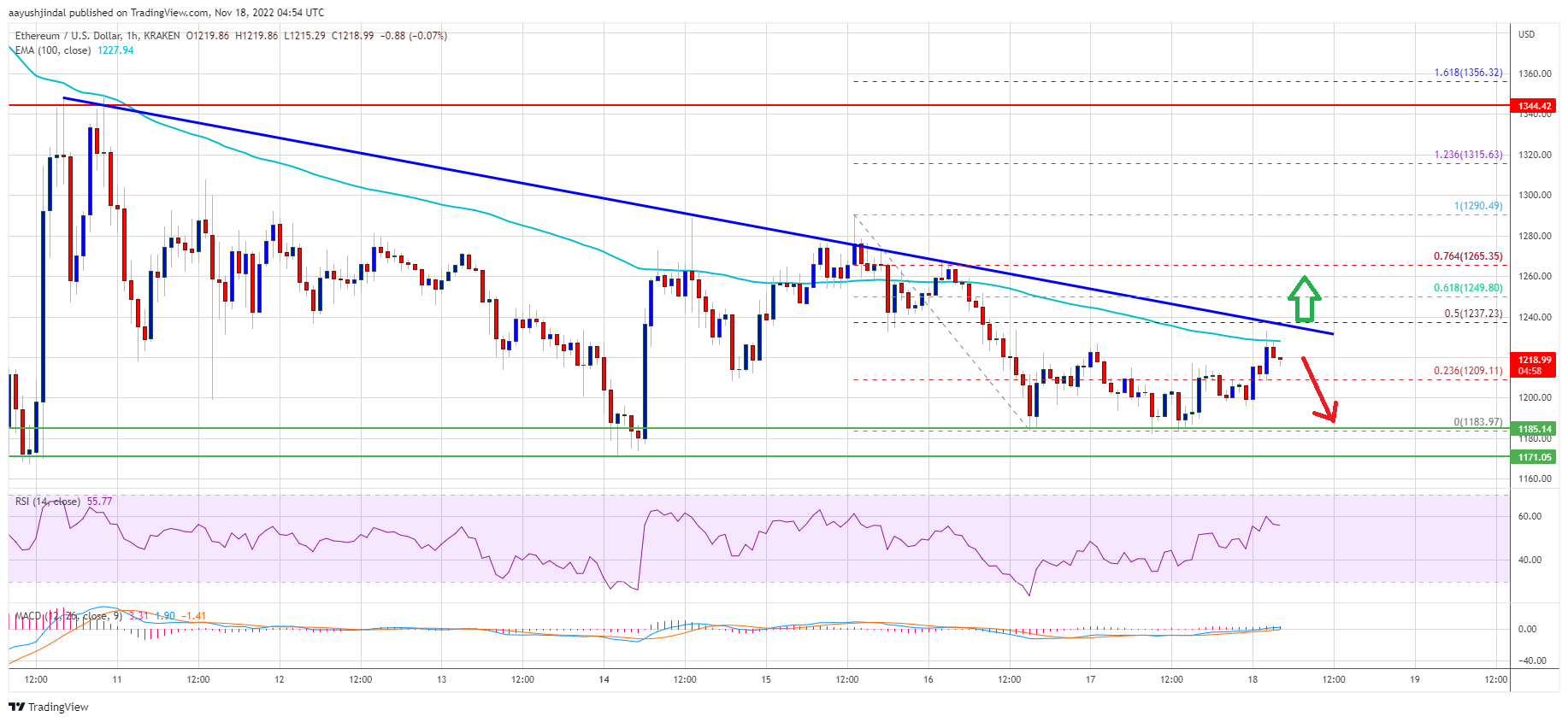
Ethereum price declined from the $1,300 resistance zone but it remained well supported near $1,200, similar to bitcoin. ETH formed a base and recently started a fresh increase above $1,210.
There was a steady increase above the $1,220 level. The price cleared the 23.6% Fib retracement level of the downward move from the $1,290 swing high to $1,184 low. However, ether price is facing resistance near the $1,240 zone.
It is trading below $1,240 and the 100 hourly simple moving average. There is also a key bearish trend line forming with resistance near $1,240 on the hourly chart of ETH/USD.
The trend line is near the 50% Fib retracement level of the downward move from the $1,290 swing high to $1,184 low. An immediate resistance on the upside is near the $1,240 level. The next major resistance is near the $1,250 level.
Ethereum Price

Source: ETHUSD on TradingView.com
A clear break above the $1,250 resistance could send the price towards the $1,300 resistance zone. If the bulls remain in action and the price settles above $1,300, the price could start a steady increase towards the $1,400 level in the coming sessions.
Fresh Decline in ETH?
If ethereum fails to climb above the $1,250 resistance, it could start another decline. An initial support on the downside is near the $1,200 level.
The next major support is near the $1,170 level, below which ether price may perhaps gain bearish momentum. In the stated scenario, the price could drop towards the $1,100 support zone in the near term. The next major support sits near the $1,000 zone.
Technical Indicators
Hourly MACDThe MACD for ETH/USD is now losing momentum in the bearish zone.
Hourly RSIThe RSI for ETH/USD is now above the 50 level.
Major Support Level – $1,170
Major Resistance Level – $1,250



Related Reads

Deep Insight: Decentralized Inference is Not Hype, but a Key Track for AI to Break Through Centralized Monopoly

Decentralized Reasoning: Beyond the Hype, a Key to Breaking AI's Centralized Monopoly A future scenario where a powerful AI model is banned by a major government illustrates the core value proposition of decentralized AI: resistance to censorship. The core bet of decentralized inference networks is mitigating this risk, with other benefits like cost being secondary. The path is extremely difficult, involving four key challenges: 1. **Running Massive Models:** Distributing a single model across a decentralized GPU swarm requires sophisticated techniques like pipeline and speculative decoding to overcome crippling network latency, aiming for usable speeds (e.g., 30-40 tokens/second). 2. **Proving Model Integrity:** Verifying that a node runs the correct model is critical. Solutions range from cryptographically secure but slow ZKML to faster, economically-secure methods like statistical fingerprints, deterministic re-execution, or live-weight proofs, each involving trade-offs between integrity, latency, and cost. 3. **Ensuring Prompt Privacy:** Simply sharding a model does not protect user inputs from nodes. Robust solutions currently require trusted hardware (TEEs) or advanced cryptography (FHE), which are not yet widely deployed in consumer swarms. 4. **Building a Real Market:** Identifying the ideal customer is tough. Beyond speculative AI agents, the viable market currently consists of startups embedding AI and projects needing batch processing (e.g., synthetic data generation), where decentralized aggregation can be an advantage over low-latency needs. The article analyzes several projects tackling these problems, such as Dolphin Network (live-weight proofs), Inference.net (statistical verification), Morpheus (TEE-based), and Darkbloom (Apple Secure Enclave). It provides a framework: decentralization is a "tax" for latency-sensitive applications (e.g., chat) but a potential supply-side advantage for throughput-oriented tasks (e.g., batch processing). The long-term vision is a closed data loop where decentralized inference generates valuable data (traces, preferences) to feed decentralized training networks, which in turn produce better open-weight models for the inference networks. A due diligence checklist advises focusing on projects that: are truly decentralized at specific layers; have a credible integrity method; offer real cost benefits; ensure genuine privacy; handle node reliability; have paying users; and are built by teams with deep AI expertise. The ultimate goal should be products that appeal beyond the crypto-native audience, using crypto mechanisms invisibly to deliver better cost, performance, or privacy.

Foresight News12m ago

Deep Insight: Decentralized Inference is Not Hype, but a Key Track for AI to Break Through Centralized Monopoly

Foresight News12m ago

The Final Piece of Franklin Templeton's Crypto Ambition

Franklin Templeton Completes Crypto Ambition with Acquisition of 250 Digital On June 22, Franklin Templeton announced the acquisition of 250 Digital and established Franklin Crypto, a new division focused on actively managed cryptocurrency strategies for institutional investors. The unit is led by Christopher Perkins and Seth Ginns. This acquisition marks a key piece in Franklin Templeton's multi-year crypto strategy, which began in 2018 with a digital assets team. The firm's crypto product suite now spans three layers: tokenized funds like the blockchain-based money market fund BENJI (~$831M AUM); a series of passive ETFs including Bitcoin (EZBC, ~$368M), Ethereum (EZET), XRP (XRPZ, ~$252M), Solana (SOEZ), and a multi-crypto index fund (EZPZ); and the newly added active management strategies from Franklin Crypto. The company has also expanded its crypto ecosystem through investments in projects like Ethena and Crossmint, and collaborations with blockchains such as Aptos and Sui. With approximately $18B in digital asset AUM and a total firm AUM of ~$1.78T, Franklin Templeton is positioning itself as a comprehensive crypto asset manager for pensions and sovereign wealth funds. In contrast, competitor Fidelity Investments has taken a different path, focusing early on building its own custody and trading infrastructure. Fidelity's Bitcoin ETF (FBTC) holds over $11B, significantly larger than Franklin Templeton's equivalent offering. Both giants' moves underscore the deepening trend of traditional finance entering the crypto space.

Foresight News36m ago

The Final Piece of Franklin Templeton's Crypto Ambition

Foresight News36m ago

Trading

Spot
Futures
活动图片