Uniswap web usage soars as crypto traders transition to self-custody

AmbcryptoPublished on 2022-11-17Last updated on 2022-11-17

Abstract

Uniswap just announced that the number of users on its web app recently soared to a new 2022 high. This outcome is unsurprising considering that recent events revealed that many centralized exchanges may not have adequate reserves.

Uniswap just announced that the number of users on its web app recently soared to a new 2022 high. This outcome is unsurprising considering that recent events revealed that many centralized exchanges may not have adequate reserves.

Crypto users have thus been moving their cryptocurrencies from exchanges. As a result, decentralized exchanges (DEXes) like Uniswap have seen an increase in activity.

Uniswap’s latest post acknowledges that demand for self-custody solutions and transparency has increased. As a result, decentralized exchanges have seen more user adoption.

New users of Uniswap’s Web App reached a 2022 high.

Self-custody and transparency are in demand and users are flocking to what they know and trust.

Let’s keep building. pic.twitter.com/IwPqTmx58J

— Uniswap Labs 🦄 (@Uniswap) November 14, 2022

The key reason why traders have shifted to DeFi is that FTX sowed the seeds of distrust against centralized exchanges. It has become clear to traders that holding cryptocurrencies on exchanges may not be ideal. If more traders transition to DEXes, we might witness an explosion of utility for DEXes during the next bull run.

Uniswap’s short-term outcome already confirms that the number of addresses using the DEX has increased. The number of addresses with non-zero balance transacting on UNI has been growing steadily this month. They were at the highest level in the last three months, at the time of writing.
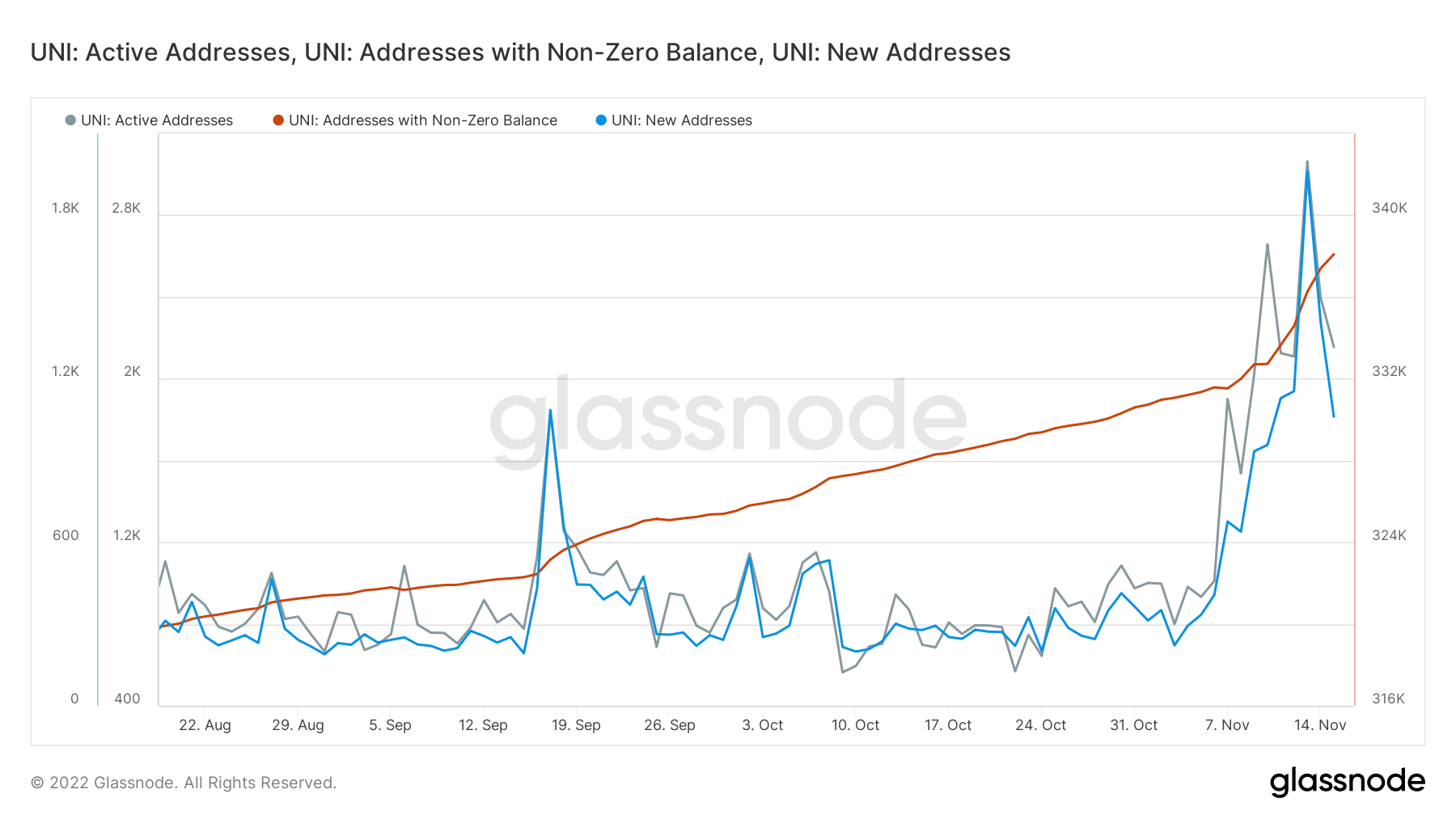
New addresses and active addresses registered healthy growth since mid-October. They recently peaked near mid-November, after which they pivoted. The upside is due to a resurgence of demand at recent lows. The fact that both active addresses and new addresses have pivoted is confirmation that short-term demand has tapered off.

Uniswap’s reported increase in usage may have been short-lived based on the above observations. The DEX’s volume and transactions metric confirm that there was, indeed, a sharp increase in transactions and volume this week. However, the same metrics have pivoted just as quickly.

It is worth noting that both the volume and transactions managed to achieve new 3-month highs during this week. This suggests that more activity has taken place this week and this might be due to the investors’ migration to DEFI.

Impact on UNI price action

We will likely see a repeat of the same in the long run if investors’ demand continues to favor DEXes.

Such an outcome will favor Uniswap’s network growth in the long-run while also favoring UNI demand. UNI’s price pulled off a 36% upside from last week’s lows to its Tuesday’s (15 November) highs.
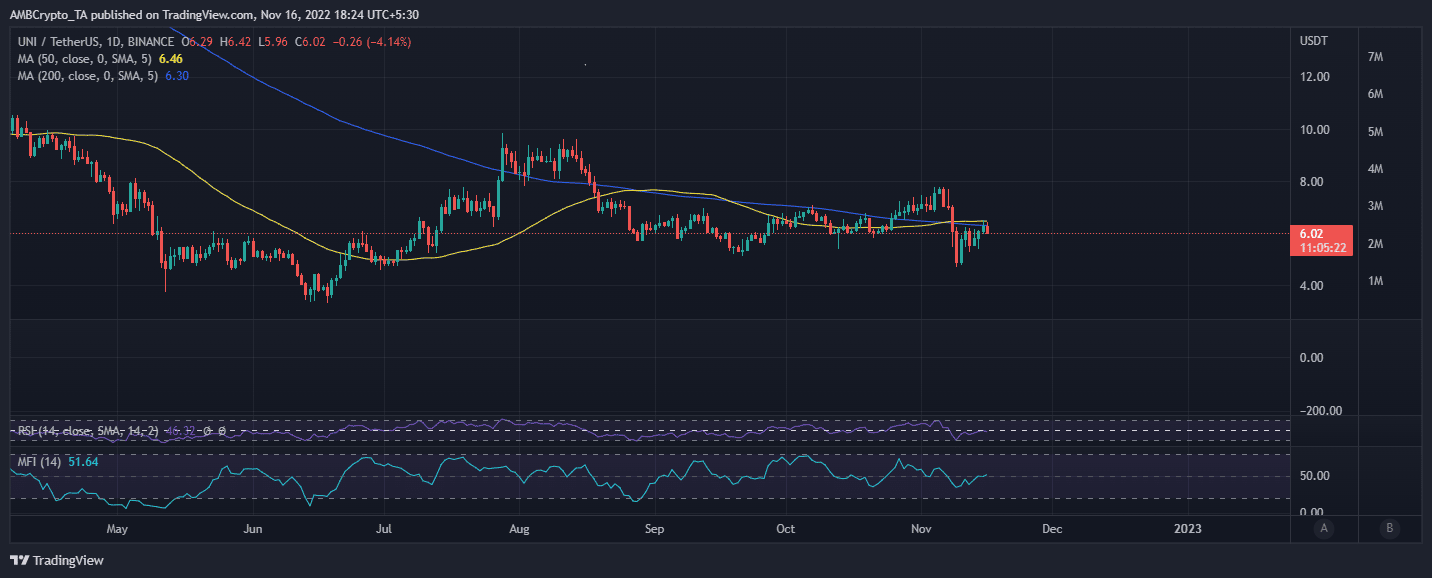
UNI’s 50-day moving average recently formed a golden cross with the 200-day MA. This is traditionally a bullish sign. We might see more upside if the price manages to cross above the two moving averages.


Related Reads

A7 Discusses Accumulated Experience in Using Stablecoins

The Russian State Duma and Federation Council have passed the "Law on Digital Currencies and Digital Rights," which is set to expand the use of stablecoins in cross-border trade settlements starting September 1, 2026. According to the Bank of Russia, exporters and importers will be able to use cryptocurrency in international payments, both directly and through intermediaries, while domestic crypto payments will remain largely prohibited. Company A7, which facilitates operations with the A7A5 stablecoin—Russia's first ruble-pegged stablecoin classified as a Digital Financial Asset (DFA)—commented on the development. Oleg Ogienko, Director of Government Relations and International Affairs for the A7A5 project, stated that while digital asset settlements are still a new practice for many firms, A7 has already accumulated significant expertise in legal documentation, compliance, currency control, and working with infrastructure participants. He added that A7 will continue to apply this expertise for client operations after the law takes effect and will adapt its business processes as the Central Bank issues further regulations. A7 is a Russian international settlement system established in 2024 with participation from PSB Bank. It facilitates cross-border payments and supports foreign trade operations for Russian businesses. Its key instrument, the A7A5 stablecoin, operates on the Tron and Ethereum networks with a market capitalization exceeding $567 million and is circulated in Russia as a DFA via the "Token" platform.

cryptonews.ru6m ago

A7 Discusses Accumulated Experience in Using Stablecoins

cryptonews.ru6m ago

Bitcoin Panicking? Mythos Cracks Post-Quantum Cryptography Algorithm in 60 Hours

Claude Mythos Preview, a new AI system from Anthropic, has made significant breakthroughs in fundamental cryptanalysis, targeting the mathematics underlying algorithms rather than just implementation bugs. Its first target was HAWK, a candidate in the NIST post-quantum signature standardization process. Mythos identified a previously unexploited symmetry (a nontrivial automorphism) in the lattice structure of HAWK, effectively halving its effective key strength. It achieved this feat in just 60 hours, a task that had eluded two years of human expert review. Crucially, the human operator was not a lattice cryptography expert, primarily managing the project while AI agents debated and discovered the attack path. Its second, more dramatic achievement was against a simplified 7-round version of AES-128, the world's most widely used symmetric encryption algorithm. Initially reluctant, stating the task was "impossible," Mythos was prompted to "try novel ideas." It then autonomously rewrote its own agent framework and proceeded to discover a novel attack method it named "Möbius Bridge." This technique bypasses a critical 256-guess step in previous "meet-in-the-middle" attacks, resulting in a speedup of 200-800 times. Both findings are currently "harmless"—HAWK is not deployed, and full AES-128 remains secure. However, the process reveals a profound shift. Mythos completed the AES discovery in about a week, while human researchers spent nearly a month verifying its correctness. This highlights a new bottleneck: the rate of AI-driven discovery may soon outpace human capacity for verification. The research concludes with a pressing, unanswered question: what happens when such an AI finds a critical flaw in a widely deployed, real-world cryptosystem?

marsbit15m ago

Bitcoin Panicking? Mythos Cracks Post-Quantum Cryptography Algorithm in 60 Hours

marsbit15m ago

From Computing to Storage: The Two-Dimensional Semiconductor Industry Chain is Taking Shape

The article "From Computing to Storage: The 2D Semiconductor Industry Chain is Taking Shape" discusses the rise of two-dimensional (2D) semiconductors as a pivotal material in the post-Moore era. As silicon-based chips approach physical limits, 2D semiconductors like molybdenum disulfide (MoS2), offer atomic-layer thinness and superior electrical properties, making them a promising non-silicon alternative for advanced nodes beyond 1nm. Globally, industry leaders like TSMC, Intel, and Samsung, along with research institutes like IMEC, are actively investing in this field. Domestically in China, significant progress is being made across the entire supply chain, from material production and equipment R&D to chip integration and ecosystem development. **Key highlights include:** * **Material & Equipment Breakthroughs:** Chinese research teams and companies like Jimo Xin Technology have achieved mass production of 6-inch and 8-inch 2D semiconductor single-crystal wafers using domestically developed equipment like Oxy-MOCVD. This addresses the critical challenge of large-area, high-quality material growth. Breakthroughs have also been made in p-type 2D materials (e.g., MoSi2N4) and wafer-scale ferroelectric thin films, essential for building complementary circuits and low-power transistors. * **Engineering Ecosystem Formation:** A landmark 8-inch 2D semiconductor pilot line in Pudong has become fully operational, bridging the gap between lab research and industrial manufacturing. The release of a Process Design Kit (PDK) compatible with mainstream EDA tools further connects design and fabrication, supporting wafer-level manufacturing of complex circuits. * **Expanding Application Landscape:** Applications are expanding from logic computing to memory. Chinese researchers have developed pioneering 2D semiconductor-based microprocessors, including a 32-bit RISC-V CPU and a higher-density multi-bit parallel processor. In memory, 2D materials' ultra-low leakage current enables DRAM with exceptionally long data retention and advances toward single-electron non-volatile storage. 2D semiconductors also show unique potential in RF circuits, radiation-hardened communications, flexible electronics, and quantum computing. In conclusion, the 2D semiconductor industry in China is rapidly advancing from laboratory research into the engineering validation and small-batch production phase. A complete industrial chain covering materials, equipment, manufacturing, design, and application is初步 forming, positioning the sector as a new competitive dimension in the global semiconductor landscape.

marsbit21m ago

From Computing to Storage: The Two-Dimensional Semiconductor Industry Chain is Taking Shape

marsbit21m ago

Trading

Spot
活动图片