8.5 Million USDT Flees Overnight, Can High-Yield Stablecoin Vaults Still Be Trusted for Deposits?

marsbitPublished on 2026-06-24Last updated on 2026-06-24

Abstract

Amid a market-wide crisis of confidence in the stablecoin yield sector, Altura experienced a significant bank run, with users withdrawing over 8.5 million USDT within 24 hours. This occurred despite Altura clarifying it held no direct exposure to MainStreet, another yield protocol whose partnership with a third-party auditor had ended. The event highlights a critical vulnerability in yield-generating products: a disconnect between user expectations for instant liquidity and the underlying assets' varied, often illiquid, settlement cycles (e.g., exchange holdings, private credit, RWA). Even without asset losses, the mere fear of delayed redemptions can trigger a self-fulfilling liquidity crisis. The incident underscores that in DeFi, market confidence is a hard operational metric, as users may prioritize exiting over waiting for assets to mature, forcing protocols into unfavorable liquidations. The key test for Altura and the broader industry will be managing orderly redemptions and transparent communication to rebuild trust.

Written by: Liam Akiba Wright

Compiled by: Chopper, Foresight News

TL;DR

  • Altura stated that users withdrew over 8.5 million USDT within 24 hours before it began an orderly vault shutdown.
  • This run indicates that even if a stablecoin yield product has no direct asset link to disputes with other protocols, it can still face liquidity run pressure.
  • The unresolved question is: Can the platform's remaining positions fulfill redemptions on time? Different investment strategies have significantly varying liquidation cycles.

The MainStreet reserve audit controversy has triggered a collapse in market confidence across the entire stablecoin yield sector, with Altura experiencing a single-day outflow exceeding 8.5 million USDT, leading the project team to decide to wind down its vaults in an orderly manner.

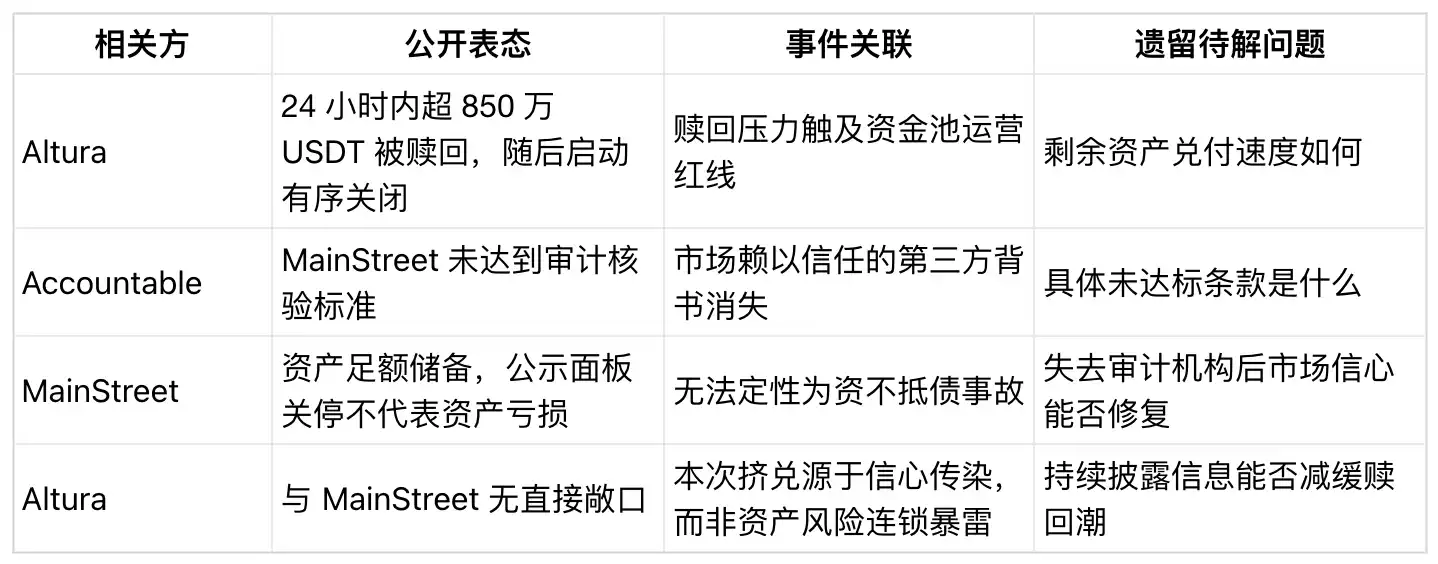
Altura CEO Ranveer Arora said the total user redemptions before the vault shutdown exceeded $8.5 million. Altura also stated it has no connection whatsoever to MainStreet or its underlying investment strategies. The core of this run is not asset risk contagion but a chain reaction triggered by collective loss of confidence in similar yield products.

The trigger was third-party audit firm Accountable terminating its cooperation with MainStreet, citing MainStreet's failure to meet audit verification standards. MainStreet publicly claimed its assets are fully reserved. However, the lack of third-party audit backing led to widespread skepticism among users holding similar yield products: If everyone redeems at once, can the fund pool fulfill redemptions quickly?

This is precisely the operational risk exposed by the Altura incident. From a user's perspective, the redemption action seems simple. However, the platform's assets are dispersed across different segments like exchange positions, private credit loans, and real-world asset (RWA) settlements, each with vastly different capital return cycles.

MainStreet later stated that shutting down the third-party reserve dashboard does not indicate asset losses or portfolio impairment.

Altura's own risk disclaimer is also crucial: the project explicitly stated it does not hold any MainStreet-related assets, and its HyperEVM lending pools, USDT/AVLT trading markets, and Ethereum lending positions were unaffected by this event.

But when users see an audit firm terminating cooperation with a stablecoin yield product, the focus shifts. It's no longer about whether a neighboring protocol has risk exposure, but whether all similar products can withstand a concentrated redemption wave.
Under a Concentrated Redemption Wave, Liquidity Becomes the Core Contradiction

Stablecoin users often focus only on the token itself; USDT in this event is also a core settlement medium in the crypto market. USDT's peg to $1 has remained stable, with a total market cap of approximately $186 billion and a 24-hour trading volume exceeding $51 billion.

This market scale has a dual impact: on one hand, the underlying liquidity for USDT is extremely ample, making it difficult for a single USDT-denominated fund pool to shake the overall stablecoin market; but on the other hand, the fund pool's own liquidity depends entirely on its capital allocation, asset placement channels, settlement rules, and whether counterparties can match users' expected redemption speed.

Altura's announcement also highlights this reality: funds held on exchanges can be liquidated more quickly compared to private credit or RWA investments; but exchange withdrawals are also subject to platform procedures, transfer channels, and market conditions. Private credit and RWA assets have fixed repayment cycles, where loan recovery, share redemption, and settlement windows cannot match DeFi users' demand for instant withdrawals.

The mismatch in capital return cycles across different assets means that even without actual asset losses, market sentiment can determine a product's survival. Users who redeem first can withdraw instantly, while those who redeem later must wait for asset maturity and liquidation. This expectation drives everyone to redeem early. The mere possibility of staged payouts is enough to accelerate a bank run.

The redemption scale in this event is significant. Altura's overall fund pool is valued at tens of millions of dollars, with the 8.5 million USDT single-day redemption representing a very high proportion. Large-scale concentrated withdrawals force an investment portfolio originally focused on yield generation to pivot towards liquidity-prioritized asset allocation.

Redemption Cycle: The Next Key Observation Metric

Looking at the entire stablecoin sector, this lesson cannot be ignored. The total stablecoin market cap is hundreds of billions, with daily trading volumes in the tens of billions. Various yield-generating stablecoin products promise principal stability plus yield, but most underlying investment strategies cannot be liquidated instantly.

Such products are operationally viable, but risks are concentrated at the operational level. Reserve proof disclosures, third-party audits, exchange holdings, private credit, RWA investments—the liquidity shortcomings of these links are only fully exposed when users abandon the pursuit of yield and simply want their cash back.

For Altura, the core observation point moving forward is the wind-down process: whether assets can be redeemed orderly, the frequency of platform disclosure updates, the scale of capital inflows at each stage, and whether it can prevent users from fire-selling long-term assets to exit hastily. Current information only suggests liquidity vulnerabilities; it cannot prove underlying asset losses at Altura.

For stablecoin yield products industry-wide, the test from this event is whether third-party audit backing can stabilize confidence during market volatility, rather than becoming a trigger for panic. Reserve dashboards and third-party verification are tools meant to reduce market uncertainty, but negative news about terminated audit cooperation spreads far faster than project clarifications.

This is the insight the Altura run offers the industry: in the DeFi fund pool sector, market confidence is by no means an irrelevant soft metric. It directly determines whether users are willing to deposit funds long-term, allowing sufficient liquidation cycles for the underlying investment strategies.


Related Questions

QWhat was the main cause of the massive withdrawal of over 8.5 million USDT from Altura?

AThe massive withdrawal was primarily caused by a collective loss of market confidence across the stablecoin yield sector, triggered when third-party auditor Accountable terminated its partnership with another yield platform, MainStreet, due to unmet audit verification standards. This raised widespread user concerns about the liquidity and ability of all similar yield products to handle concentrated redemptions, leading to a bank run on Altura, despite it having no direct asset exposure to MainStreet.

QWhat key risk did the Altura incident expose regarding stablecoin yield products?

AThe incident exposed the critical liquidity risk inherent in stablecoin yield products. These products invest assets across various strategies (exchange holdings, private credit, real-world assets) with mismatched settlement cycles. While profitable under normal conditions, they cannot instantly liquidate these assets to meet a sudden, concentrated demand for redemptions, turning market confidence into a decisive factor for survival.

QAccording to the article, what is the next crucial indicator to watch for Altura following the bank run?

AThe next crucial indicator is the wind-down process and redemption timeline. Key aspects to observe include whether assets can be redeemed in an orderly manner, the frequency of platform updates on progress, the scale of funds returned at each stage, and whether the process avoids forcing users to sell long-term assets at a discount to exit hastily.

QHow did the article describe the paradoxical role of third-party audits and reserve proofs in this event?

AThe article described them as having a paradoxical role. While intended to reduce market uncertainty and build trust, the negative news of an audit partnership termination (with MainStreet) spread much faster than any project's clarifying statements. This turned a tool for stability into a potential trigger for panic, demonstrating that in a crisis, market confidence can be fragile and heavily influenced by perception.

QWhat fundamental operational reality do stablecoin yield products face, as highlighted by the Altura case?

AThey face the fundamental reality that their underlying investment strategies, which generate yield, are largely incompatible with instant liquidation. The promise of 'stable principal + yield' relies on users not simultaneously demanding their cash back. The mismatch between long-duration, illiquid investments and the potential for immediate, mass redemptions creates an inherent operational vulnerability that is only tested during a loss of confidence.

Related Reads

Base Under Pressure

**Title: The Pressure Mounts for Base** Base, the Ethereum Layer 2 scaling solution backed by Coinbase, is facing significant pressure and public scrutiny from its leadership following the launch of Robinhood Chain. Base co-founder Jesse Pollak recently acknowledged strategic missteps, admitting that the chain's past focus on social and creator tokens (e.g., through Farcaster, Zora) failed to deliver sustainable adoption. He has refocused on core infrastructure, handing leadership of the Base App back to Coinbase's Cobie. While Base remains a top L2 contender alongside OP Mainnet and Arbitrum, and boasts the highest TVL (nearly $12B), its weaknesses are being highlighted by the new competitor. Key criticisms include its slow progress on decentralization. Base has faced issues with its single sequencer causing block production halts, and L2BEAT is reportedly considering downgrading its decentralization rating from Stage 1 to Stage 0. This contrasts sharply with the rapid initial success of Robinhood Chain, whose DEX quickly entered the top five by volume. The leadership styles of the parent companies are also being compared: Robinhood's CEO actively engages with new projects, while a recent incident where Coinbase's Brian Armstrong briefly changed his profile picture—sparking and then crashing a related meme token—drew community ire and mockery. Pollak stated Base is working with Coinbase on tokenized stocks backed 1:1 by real equity, differentiating it from Robinhood's derivatives model. However, the article argues that Base's most urgent task is to address its long-standing technical and trust issues. With more traditional finance players likely to emulate Robinhood's path, Base must use this competitive pressure to solidify its position as long-term financial infrastructure.

Foresight News7m ago

Base Under Pressure

Foresight News7m ago

White House Concession Removes Ethical Hurdle, Clarity Act Races Against Final Window Before Recess?

On July 21st, industry sources reported that the Trump administration has agreed to include an ethics provision in the "Clarity Act" (Digital Asset Market Clarity Act of 2025). This concession addresses the long-standing conflict-of-interest concerns regarding government officials and the crypto industry, potentially removing the final major obstacle to the bill's progress. Additionally, Patrick Witt, the executive director of the White House's Digital Asset Advisory Committee, confirmed he will remain in his role to help finalize the bill, alleviating previous concerns about his potential departure. The Clarity Act aims to establish a unified federal regulatory framework for the U.S. digital asset market. Its core objective is to resolve regulatory ambiguity by defining different types of digital assets (digital commodities, investment contract assets, and permitted payment stablecoins) and clarifying the respective oversight roles of the SEC and CFTC. This would end the long-running jurisdictional dispute between the two agencies and provide clearer compliance paths for the industry. With the ethics issue moving toward resolution, the most urgent challenge now is time. The U.S. Congress is set to begin its August recess in mid-August, leaving only a few working weeks to finalize the text and advance the bill through the Senate. Industry advocates, like the Blockchain Association's Kristin Smith, stress that this is a critical moment. If negotiations conclude successfully in the coming weeks, the Clarity Act could pass a key hurdle before the recess; otherwise, it may face significant delays. If enacted, the Clarity Act could mark a historic turning point in crypto regulation. By providing a clearer and more predictable legal framework, it aims to reduce uncertainty for businesses, developers, and traditional financial institutions looking to enter the digital asset space, potentially setting a global benchmark for market structure regulation.

Odaily星球日报12m ago

White House Concession Removes Ethical Hurdle, Clarity Act Races Against Final Window Before Recess?

Odaily星球日报12m ago

AI Era, Industrial Revolution, and Future Civilization Interview — Zhang Dingwen: The Future Does Not Belong to Chasers

"AI Era, Industrial Revolution and Future Civilization: An Interview with Zhang Dingwen – The Future Does Not Belong to Those Who Chase" In this interview, entrepreneur Zhang Dingwen reflects on his entrepreneurial journey and philosophy, moving beyond discussions of financing or success to emphasize understanding the "era" itself. He argues that true entrepreneurs should not chase short-term trends ("winds"), but position themselves in the direction of long-term technological and societal evolution. Zhang shares key lessons from his early days, including the realization that user value does not automatically translate to commercial value. For him, the core of entrepreneurship is not building a company but constantly upgrading one's own "cognition" – the ability to interpret information, ask the right questions, and understand the underlying "causes" behind business outcomes, not just the effects. His thinking has evolved from a focus on creating good products to a strategic focus on building "entrances" – platforms that naturally connect users to digital services. He sees smart wearables, like watches, not merely as hardware but as potential future gateways combining technological, financial, social, and even fashion attributes to create sustained user relationships and ecosystems. Ultimately, Zhang's vision transcends individual products or companies. He discusses business competition in three stages: product, platform, and finally, "civilization" – where the greatest companies influence how society operates by defining new rules and ways of life. He believes the mission of a truly great enterprise is to solve problems of its time, build enduring trust, and contribute lasting value, leaving behind not just wealth but a positive impact on how the world works. The future, he concludes, belongs not to the fastest, but to those with the correct long-term direction and a commitment to continuous learning and evolution.

marsbit24m ago

AI Era, Industrial Revolution, and Future Civilization Interview — Zhang Dingwen: The Future Does Not Belong to Chasers

marsbit24m ago

Cryptocurrency & Stock Market Barometer丨Strategy Cash Reserves Increase to $3.23 Billion, Halting BTC Purchases; Vanguard and Other Asset Managers Increase Holdings in Strategy Stock (July 21)

Market Overview & Warnings: The article warns of high volatility in South Korean stocks and continued dependence on U.S. stocks on geopolitics. Chinese A-shares remain under pressure. It advises against using leverage in current equity markets. For crypto-linked stocks, most have limited growth except Robinhood, with caution advised. U.S. Stock Market: Bearish bets on U.S. stocks, particularly targeting AI-related companies, have reached record highs since 2010, signaling deep skepticism about the sustainability of the AI-driven rally. Tech and chip stocks led a market decline, with the Philadelphia Semiconductor Index potentially entering a bear market. Increased expectations for Federal Reserve interest rate hikes and geopolitical tensions contributed to the negative sentiment. Bitcoin Treasury Company Updates: * Strategy: Increased its cash reserves to $3.23 billion and paused Bitcoin purchases. Several major asset managers, including Vanguard Group and Capital Group, increased their holdings of Strategy (MSTR) stock. * Global corporate Bitcoin buying slowed significantly to just $1.33 million last week. * Other notable activity: Strive purchased 21 BTC; ORANGE JUICE raised $40 million for Bitcoin acquisitions; Bitcoin Japan Corp. raised $60 million, allocating $4.08 million for its first BTC purchase. Other Crypto Treasury Holdings: * Ethereum: BitMine increased its ETH holdings to 5.78 million, nearing its 5% of supply goal. Its total crypto assets, cash, and securities are valued at $11.5 billion. * Solana: No significant corporate treasury activity reported. * Altcoins: HypeStrat made no adjustments to its treasury; its mNAV ratio fell to a long-term low. (Note: This summary is for informational purposes only and does not constitute investment advice.)

marsbit24m ago

Cryptocurrency & Stock Market Barometer丨Strategy Cash Reserves Increase to $3.23 Billion, Halting BTC Purchases; Vanguard and Other Asset Managers Increase Holdings in Strategy Stock (July 21)

marsbit24m ago

Trading

Spot
活动图片