8.5 Million USDT Flees Overnight: Can High-Yield Stablecoin Vaults Still Be Safely Deposited?

Foresight NewsPublished on 2026-06-23Last updated on 2026-06-23

Abstract

$8.5M USDT Exodus Triggers High-Yield Stablecoin Vault Shutdown Fears of a liquidity crunch following a third-party auditor's withdrawal from competitor MainStreet triggered over $8.5 million in user withdrawals from Altura's stablecoin vault in 24 hours, forcing it to begin an orderly wind-down. Altura clarified it holds no MainStreet assets, indicating the crisis stemmed from a sector-wide loss of confidence rather than direct asset contagion. The incident highlights a critical vulnerability in high-yield stablecoin products: a mismatch between user expectations for instant redemptions and the illiquid, long-duration nature of underlying investments like private credit and real-world assets (RWA). Even without actual losses, the mere prospect of being last in line for repayment can spark a debilitating bank run. The key lesson is that operational liquidity risk and market confidence are decisive factors. Tools like reserve audits, intended to reduce uncertainty, can backfire if their withdrawal accelerates panic faster than assurances can spread. The industry must now observe how Altura manages its asset liquidation and user reimbursements, a process that will test the feasibility of offering DeFi-native speeds on traditionally illiquid yield strategies.


Author: Liam Akiba Wright

Compiled by: Chopper, Foresight News


TL;DR:


  • Altura stated that users withdrew over 8.5 million USDT within 24 hours before the platform began an orderly closure of the vault.
  • This bank run indicates that even high-yield stablecoin products with no direct asset connection to other protocol disputes can still face liquidity pressure from a run.
  • The lingering question is: Can the platform's remaining positions be paid out on time? There are significant time differences in the liquidation cycles of different investment strategies.


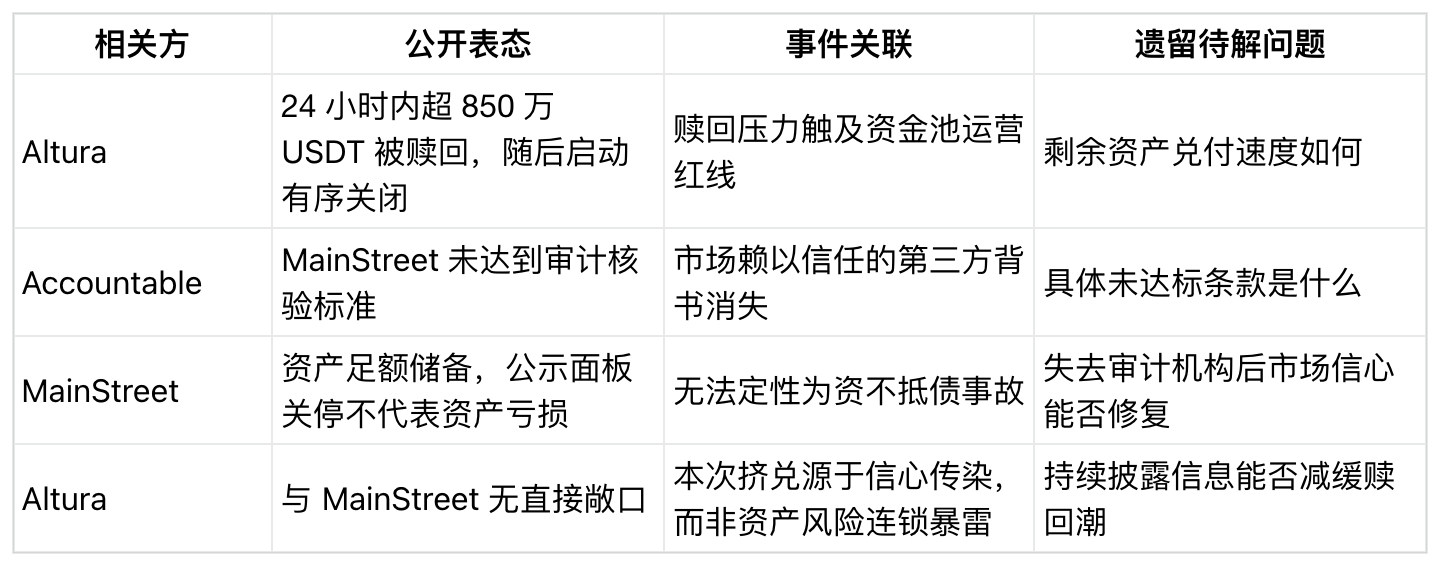
The reserve audit controversy at MainStreet triggered a collapse of market confidence across the entire stablecoin yield sector, with Altura experiencing outflows exceeding 8.5 million USDT in a single day, leading the project to decide on an orderly vault closure.


Altura CEO Ranveer Arora stated that user redemptions exceeded $8.5 million before the vault closure. Altura also asserted that it has no connection whatsoever with MainStreet or its underlying investment strategies. The core of this bank run incident is not the transmission of asset risk, but rather a chain reaction triggered by a collective loss of confidence in similar yield products.


The catalyst for the event was the termination of cooperation between MainStreet and the third-party audit firm Accountable, citing MainStreet's failure to meet audit verification standards. MainStreet publicly claimed to have sufficient asset reserves, but the lack of third-party audit endorsement led to widespread skepticism among users holding similar yield products: If everyone redeems at once, can the fund pool achieve rapid payout?


This is precisely the operational risk exposed by the Altura incident. From a user's perspective, redemption operations seem simple, but the platform's assets are dispersed across different segments such as exchange holdings, private credit lending, and real-world asset (RWA) settlements, each with completely unsynchronized repayment cycles.


MainStreet later stated that the shutdown of the third-party reserve display panel does not indicate asset losses or impairment in the investment portfolio.


Altura's own risk disclaimer is equally crucial: The project explicitly stated that it holds no MainStreet-related assets, and its HyperEVM lending pool, USDT/AVLT trading market, and Ethereum lending targets were unaffected by this event.


However, when users see an audit firm terminate cooperation with a certain stablecoin yield product, their focus shifts from whether a neighboring protocol has risk exposure to whether all similar products can withstand a concentrated redemption wave.


Liquidity Becomes the Core Contradiction in a Concentrated Redemption Wave


Stablecoin users often focus only on the token itself, and the USDT in this incident is also a core settlement vehicle in the crypto market. USDT's peg to the US dollar remains solid, with a total market cap of approximately $186 billion and a 24-hour trading volume exceeding $51 billion.


This market scale has a dual impact: on one hand, USDT's underlying liquidity is extremely abundant, making it difficult for a single USDT-denominated fund pool to shake the overall stablecoin market; but on the other hand, the liquidity of the fund pool itself depends entirely on capital allocation, asset storage channels, settlement rules, and whether counterparties can match users' expected redemption speeds.


Altura's announcement also highlighted this reality: funds stored on exchanges are easier to liquidate quickly compared to private credit or real-world asset (RWA) investments; however, exchange withdrawals are also subject to platform procedures, transfer channels, and market conditions. Private credit and RWA assets have fixed repayment cycles, and processes like loan recovery, share redemption, and settlement windows cannot match DeFi users' demand for instant withdrawals.


The misalignment of repayment cycles for different assets means that even in the absence of actual asset losses, market sentiment can dictate a product's survival. Users who redeem first can withdraw instantly, while those who redeem later can only wait for assets to mature and be liquidated. This expectation drives everyone to redeem early. The mere possibility of batch payouts is enough to accelerate a bank run stampede.


The scale of redemptions in this case is significant. Altura's overall fund pool size reaches tens of millions of dollars, making the 8.5 million USDT single-day redemption a very high proportion. Large-scale concentrated withdrawals force investment portfolios originally focused on yield enhancement to shift towards asset allocation prioritizing liquidity.


Redemption Cycle: The Next Key Indicator to Watch


Looking at the entire stablecoin sector, this lesson cannot be ignored. The total stablecoin market cap is hundreds of billions, with daily trading volumes in the tens of billions. Various yield-bearing stablecoin products promise principal stability plus yield, but their underlying investment strategies often cannot be liquidated instantly.


Such products are operationally feasible, but risks are concentrated at the operational level. Reserve proof displays, third-party audits, exchange holdings, private credit, RWA investments—the liquidity shortcomings of these links are only fully exposed when users abandon the pursuit of yield and simply want to retrieve their cash.


For Altura, the core observation point moving forward is the liquidation process: whether assets can be redeemed orderly, the frequency of platform updates and disclosures, the scale of funds returned at each stage, and whether the platform can prevent users from panic-selling long-term assets at low prices to exit hastily. Current information can only confirm liquidity risks, not prove underlying asset losses at Altura.


For the entire industry's stablecoin yield products, the test from this incident lies in whether third-party audit endorsements can stabilize confidence during market volatility, rather than becoming a trigger for panic. Reserve display panels and third-party verification are tools meant to reduce market uncertainty, but negative news about terminated audit partnerships spreads much faster than project clarifications.


This is the revelation the Altura bank run brings to the industry. In the DeFi fund pool sector, market confidence is by no means an insignificant soft metric; it directly determines whether users are willing to deposit funds long-term, allowing sufficient liquidation cycles for underlying investment strategies.


Related Questions

QWhat event triggered the user panic and the subsequent mass withdrawal of over 8.5 million USDT from Altura?

AThe panic was triggered by the news that the third-party audit firm Accountable terminated its cooperation with another stablecoin yield platform, MainStreet, citing MainStreet's failure to meet audit verification standards. This eroded confidence in the entire stablecoin yield sector, leading users to question the liquidity and safety of similar platforms, including Altura.

QAccording to the article, what is the fundamental reason for the liquidity crisis at Altura, despite having no direct exposure to MainStreet's assets?

AThe fundamental reason is a collective loss of confidence in the stablecoin yield sector, leading to a bank run. The crisis is not due to direct asset risk transmission from MainStreet, but rather the mismatch between user expectations for instant withdrawals and the platform's underlying investment assets, which have different and often longer settlement cycles (e.g., exchange holdings vs. private credit or RWA investments).

QWhat key operational risk did the Altura incident expose for stablecoin yield platforms?

AThe incident exposed the liquidity mismatch risk. While platforms invest user funds into various assets (exchange holdings, private credit, RWAs) to generate yield, these assets have different redemption and settlement timelines. These timelines cannot match the DeFi user's expectation for instant withdrawals, creating a vulnerability during periods of mass redemption requests.

QWhat will be a critical indicator to watch regarding Altura's future, as mentioned in the article?

AA critical indicator will be the platform's redemption and wind-down process. This includes observing whether assets can be redeemed in an orderly manner, the frequency of platform updates, the scale of funds returned at each stage, and whether the process can avoid forcing users to sell long-term assets at a discount to exit quickly.

QWhat broader lesson for the stablecoin yield industry does the article draw from the Altura event?

AThe lesson is that market confidence is a critical, hard metric, not a soft one. Tools like third-party audit reports and reserve proof dashboards, intended to reduce uncertainty, can themselves become triggers for panic if their status changes negatively. Confidence directly determines whether users are willing to leave funds deposited long enough for the underlying investment strategies to reach their settlement cycles.

Related Reads

Goldman Sachs In-Depth Report: Who Will Be the Long-Term Winners in China's AI Large Model Industry?

Goldman Sachs Report: China's AI Models at an Inflection Point China's open-source/open-weight large language models (LLMs) have reached performance parity with top global proprietary models, according to a Goldman Sachs report. This is driven by architectural innovations and higher parameter efficiency, allowing Chinese models to achieve comparable capabilities at 2%-10% the parameter size and significantly lower cost. The market is evolving into a two-tiered structure: a high-end segment (e.g., GLM5.2, Qwen3.7 Max) with premium pricing and a low-end, price-sensitive segment for global SMEs and individual users. Key points: * **Cost & Performance:** Innovations like Mixture of Experts (MoE) enable high performance with smaller models. Projects like Meituan's LongCat 2.0, trained on domestic hardware, highlight progress in tech self-sufficiency. * **Open-Source Strategy:** Most Chinese players use open-source/open-weight models for flexibility and ecosystem growth. However, Goldman notes this may underreport actual deployment and revenue. A shift toward "open-weight + community license" models with revenue sharing (e.g., MiniMax) could improve monetization. * **Market Shift & Global Expansion:** Enterprise AI adoption is shifting from "token maximization" to "ROI-first." International expansion, especially in non-US markets, is a major growth driver. Chinese models are increasingly available on global platforms like AWS Bedrock and Microsoft Copilot. * **Competitive Landscape:** Using a framework based on pricing power, cost advantage, and financial strength, Goldman identifies **Zhipu AI and DeepSeek** as the strongest in foundational text models, and **ByteDance** as the leader in multimodal/video generation. The report maintains Buy ratings on MiniMax and Kuaishou. * **Market Growth:** China's AI model API and subscription revenue is projected to grow from an estimated ¥35 billion in 2026 to ¥879 billion by 2030.

marsbit12m ago

Goldman Sachs In-Depth Report: Who Will Be the Long-Term Winners in China's AI Large Model Industry?

marsbit12m ago

Goldman Sachs Deep Dive Report: Who Will Become the Long-Term Winners in China's AI Large Model Industry?

Goldman Sachs Report: Who Will Be the Long-Term Winners in China's AI Large Model Industry? China's AI large model sector is at a historic inflection point. Goldman Sachs argues that the intelligence of Chinese open-source/open-weight models is approaching top global proprietary models. Rapid adoption by domestic enterprises and global SMEs is creating a data flywheel effect that will further drive model iteration. The evolution is summarized as moving from "DeepSeek's cost-efficiency moment last year to GLM's model-intelligence moment this year." Chinese models achieve near-state-of-the-art performance at significantly lower cost, primarily due to architectural innovations like Mixture of Experts (MoE) and higher parameter efficiency. Models like DeepSeek V4 Pro (1.6T params), GLM5.2 (0.7T), and MiniMax M3 (0.4T) are much smaller than global leaders. Recent advancements in coding capability are attributed to better data curation and RLHF. Landmarks like Meituan's LongCat 2.0, trained fully on domestic AI chips, demonstrate progress in hardware stack independence. The market is forming a "two-tiered structure." The high-end tier (e.g., GLM5.2, Alibaba's Qwen3.7 Max) prices around $1 per million tokens, about 10-25% of US top models, with estimated inference gross margins of 10-20%. The low-end tier (priced as low as $0.06-$0.2 per million tokens) targets price-sensitive global SMEs and individuals. MiniMax derives 60-70% of revenue overseas. Goldman forecasts China's AI model API/subscription revenue to grow from an estimated RMB 35bn in 2026 to RMB 879bn by 2030. Most Chinese players adopt open-source/open-weight strategies for deployment flexibility and community feedback, though this limits monetization as deployments on third-party platforms (e.g., Alibaba Cloud) may not generate direct revenue. A shift towards "open-weight + community license" models with revenue-sharing agreements (like MiniMax's approach) could improve unit economics. International expansion, particularly in non-US markets, is the key growth driver. The global enterprise AI paradigm is shifting from "token maximization" to "ROI prioritization." Chinese models are already hosted on major global platforms like AWS Bedrock and are under consideration for integration into Microsoft Copilot. Using a competitive framework based on pricing power, cost advantage, and financial strength, Goldman identifies the strongest players: In foundational text models, Zhipu AI (initiated coverage) and DeepSeek lead. In multimodal/video generation, ByteDance's Seed is the frontrunner, with Kuaishou's Kling and MiniMax's Hailuo also well-positioned. Goldman maintains a Buy rating on MiniMax, citing its attractive valuation.

链捕手17m ago

Goldman Sachs Deep Dive Report: Who Will Become the Long-Term Winners in China's AI Large Model Industry?

链捕手17m ago

Is Ethereum Truly a "World Computer"?

Title: Is Ethereum Really a "World Computer"? Ethereum, envisioned as a "world computer" by its founder Vitalik Buterin, aims to be a decentralized platform for global applications. However, a recent analysis by Four Pillars raises questions about whether it is more accurately a "Western computer," based on the geographical distribution of its validators. Currently, the United States dominates with 38.19% of all validators, followed by Germany at 13.04%. Combined, these two countries account for over half of the network. In contrast, Asian representation is minimal, with Singapore holding only 3.15%. The concentration is partly due to affordable cloud hosting services like Hetzner and OVH in Europe and North America, as well as the prevalence of residential validators in the U.S., where individuals run nodes via home internet connections. When examining professionally operated validators, the distribution becomes more balanced. The U.S. share drops to 25.81%, while Asian countries like Singapore (7.28%), Hong Kong (6.44%), Japan (6.38%), and South Korea (4.59%) collectively approach the U.S. level. This shift reflects strategic deployments by institutions to meet regulatory requirements and reduce latency for local users. However, regions like South America, the Middle East, and Africa remain underrepresented. Ethereum's peer-to-peer network mechanisms, such as gossipsub, disadvantage areas with low node density, creating a feedback loop where delayed message propagation reduces validator performance and rewards. This imbalance challenges Ethereum's promises of censorship resistance and global accessibility. Despite these issues, opportunities exist for growth in underrepresented regions. As demand for localized staking infrastructure rises, early entrants in areas like the Middle East could establish dominant positions by offering compliant, low-latency solutions. The evolving validator landscape highlights both the structural challenges and the potential for Ethereum to move closer to its "world computer" ideal.

Foresight News2h ago

Is Ethereum Truly a "World Computer"?

Foresight News2h ago

Trading

Spot
活动图片