Топ-3 биткоин-индикатора, за которыми стоит следить

BeInCryptoPublished on 2022-10-18Last updated on 2022-10-18

Abstract

Редакция BeInCrypto рассмотрела три основных индикатора для биткоина, которые играют немаловажную роль при развитии криптовалюты.

Крупнейшая по рыночной капитализации криптовалюта биткоин (BTC) уже давно сформировала целый спектр различных офчейн и ончейн-индикаторов. Блокчейн-исследователи и трейдеры используют их по-разному: кто-то для анализа конъюнктуры рынка, а кто-то для построения инвестиционных стратегий. Редакция BeInCrypto рассмотрела три наиболее важных индикатора ведущей криптовалюты.

Индикатор доминирования биткоина

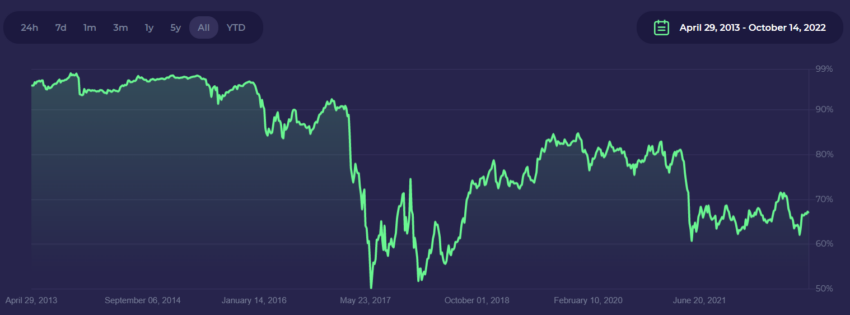
Индикатор доминирования биткоина показывает соотношение между рыночной капитализацией биткоина и всего рынка криптовалют. Фактически этот индикатор дает понять, насколько инвесторы уверены в биткоине.

Источник: buybitcoinworldwide.com

Чем выше процент доминирования биткоина, тем больше денег на всем рынке криптовалют сфокусировано именно на нем. Если же показатель падает, это может означать, что инвесторы либо перешли на альткоины (любые другие криптовалюты помимо биткоина), либо же вовсе ушли с рынка.

Индикатор 200-недельной скользящей средней биткоина

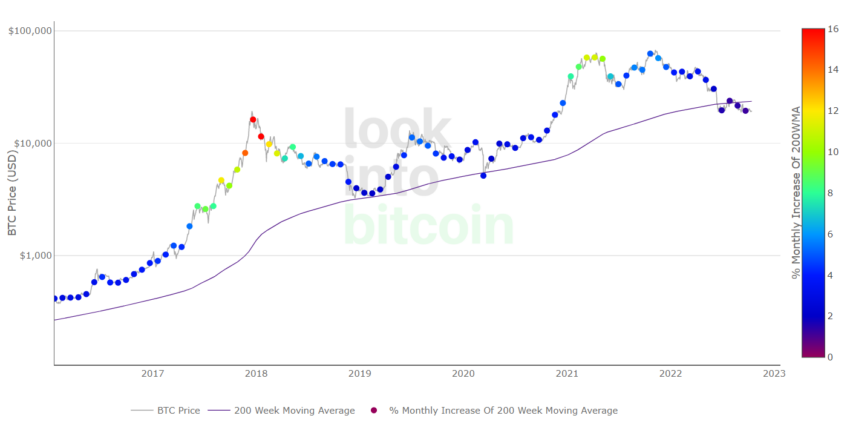
200-недельная скользящая средняя (англ. 200WMA) используется трейдерами и рыночными аналитиками для определения долгосрочных рыночных тенденций. Для расчета графика берутся данные котировок за сорок недель торговли.

Источник: lookintobitcoin.com

До тех пор, пока курс актива находится выше скользящей средней, сохраняется восходящий тренд монеты. Если же котировки падают ниже показателей 200WMA, это может сигнализировать о потенциальном развороте тренда. В истории биткоина курс криптовалюты лишь пару раз опускался ниже 200WMA, но всегда возвращался выше индикатора в течение пары недель.

В данный момент курс биткоина находится ниже 200WMA вот уже второй месяц подряд, что является абсолютным рекордом для криптовалюты. Чтобы быть выше 200WMA, криптовалюта должна преодолеть курс хотя бы в $23 580.

Индикатор соотношения рыночной капитализации к реализованной

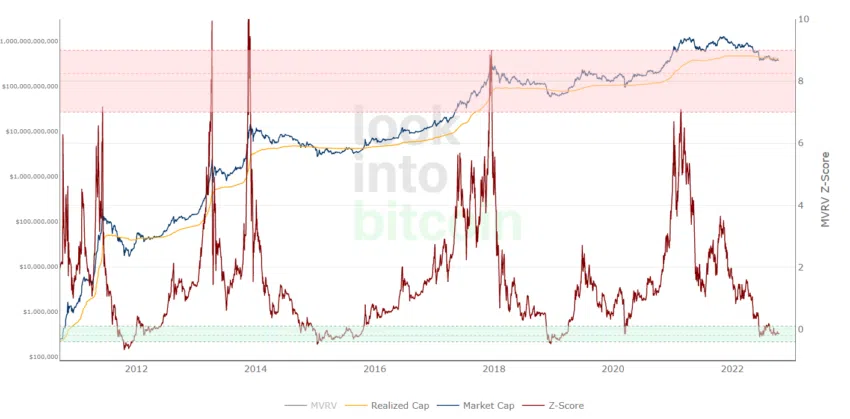
Легендарный индикатор соотношения рыночной капитализации к реализованной (MVRV). Исторически именно этот индикатор давал понять, когда биткоин переоценен, а когда, наоборот, лишен внимания инвесторов. Есть также модификация индикатора под названием MVRV Z-Score. Она отличается от оригинала тем, что отображает определенные зоны перекупленности или перепроданности актива.

Источник: lookintobitcoin.com

Как видно на графике выше, каждый раз, когда биткоин падал в «светло-зеленую зону» — он обязательно из нее выбирался. Однако этого же нельзя сказать про «красную зону» перепроданности. Например, на графике видно, что в рамках цикла 2020-2024 биткоин едва ли дорос до этой зоны в феврале 2021 года, однако почти сразу обвалился. Даже последующее краткосрочное обновление биткоина в ноябре того же года не помогло индикатору MVRV Z-Score вернуться к прежним значениям.

Денис Омельченко для BeInCrypto.

Related Reads

Circle: From Issuance to Infrastructure

Title: Circle: From Issuance to Infrastructure Circle, the issuer of the USDC stablecoin, is undergoing a strategic transformation to reduce its dependence on interest income from reserve holdings, which is declining due to falling interest rates. Historically, Circle's revenue came primarily from the yield on US Treasury reserves backing USDC. However, it also paid significant fees (approximately 60 cents of every dollar earned) to partners like Coinbase for distributing and settling USDC. To capture more value across the financial stack, Circle is vertically integrating into three new layers: 1. **Settlement Layer:** It is launching **Arc**, a native Layer-1 blockchain. Arc, which uses USDC as its gas token, aims to capture transaction fees currently paid to other blockchains (like Ethereum and Solana) and offers features like privacy for institutional payments. 2. **Distribution Layer:** The **Circle Payments Network (CPN)** connects financial institutions directly to Circle, reducing reliance on exchanges like Coinbase. While not yet monetized, CPN growth has improved Circle's margins. 3. **Application Layer:** Circle is building an **AI Agent Economy** infrastructure with products like Agent Wallets and Nanopayments. The goal is to capture fees from high-volume, automated transactions executed by AI agents, a market where USDC already dominates. These moves represent Circle's shift from a single-product company (USDC issuance) to a full-stack financial platform. The strategy faces challenges, including market competition from players like Stripe and Tether, and potential internal tension regarding how value created by the new Arc blockchain and token (ARC) will accrue to Circle's public shareholders (CRCL). Circle's long-term success depends on its ability to successfully execute this vertical integration and diversify its revenue streams away from interest income.

marsbit6m ago

Circle: From Issuance to Infrastructure

marsbit6m ago

Circle: From Issuance to Infrastructure

Title: Circle: From Issuance to Infrastructure Circle, the issuer of the USDC stablecoin, is undergoing a strategic transformation from a single-product company dependent on reserve interest income to a vertically integrated, full-stack financial platform. Its primary revenue source, earnings from US Treasury reserves backing USDC, is under pressure from declining Federal Reserve interest rates. Furthermore, Circle pays out a significant portion (~60 cents per dollar earned) to partners like Coinbase for distribution and settlement, leading to value leakage. To address these challenges and capture more value across the payment stack, Circle announced three key initiatives in Q1 2026: 1. **Settlement Layer**: Launching its own Layer-1 blockchain, **Arc**. Designed for institutional use with configurable privacy and quantum-resistant architecture, Arc uses USDC as its native gas token, allowing Circle to capture transaction fees currently paid to other blockchains like Ethereum. 2. **Distribution Layer**: Expanding the **Circle Payments Network (CPN)**, which connects financial institutions directly to Circle, reducing reliance on third-party exchanges for USDC distribution and on/off-ramps. 3. **Application Layer**: Building infrastructure for an **AI agent economy**, including tools for agent wallets, nanopayments, and a marketplace. Circle aims to monetize the high volume of AI-driven microtransactions predominantly settled in USDC. This vertical integration strategy aims to diversify Circle's revenue away from volatile interest income. However, a key challenge remains: aligning the value capture of the new ARC token with the interests of existing public market shareholders (CRCL) who invested primarily for reserve yields. The success of this stack-wide expansion hinges on Arc's adoption and Circle's ability to balance value distribution between its core corporate entity and its new blockchain ecosystem.

链捕手13m ago

Circle: From Issuance to Infrastructure

链捕手13m ago

Nvidia's Wednesday 'Big Test': The Battle That Will Determine the Fate of the AI Bull Market is Here!

NVIDIA Faces Key AI Bull Market Test with Wednesday Earnings Report NVIDIA is set to release its quarterly earnings after the market close on Wednesday, May 20th (US Eastern Time). This report is seen as a critical stress test for the current AI-driven bull market cycle. The semiconductor sector is technically severely overbought, with extremely bullish options positioning. The rare signal of stock prices and implied volatility rising simultaneously indicates significantly amplified two-way risk around this earnings event. The core tension identified by analysts is strong fundamental demand for AI versus mounting technical pressures. The Philadelphia Semiconductor Index (SOX) is trading approximately 60% above its 200-day moving average, a deviation not seen since the peak of the dot-com bubble in 1999/2000. While NVIDIA's current quarter revenue is expected to beat estimates by a substantial margin, market focus is intensely on the guidance for the next quarter. Historically, NVIDIA's stock has frequently declined on the day following its last five earnings reports. The options market presents contradictory signals: extreme bullish call skew persists, yet there is notable activity in tail-risk hedging via put options on broader indices and semiconductor ETFs. This suggests traders are chasing gains while simultaneously preparing for potential sharp volatility. A broader market concern is narrowing breadth. Despite the S&P 500's YTD gain, only about half of its constituents are positive, with leadership heavily concentrated in a few mega-cap AI and semiconductor names like NVIDIA. Analysts question whether this reflects market health or a "funding source" effect, where money flows out of lagging sectors into the AI trade. The earnings outcome and, crucially, the forward guidance will test the market's conviction in the AI compute super-cycle thesis. Given NVIDIA's high correlation with the semiconductor and broader tech sector, its results are poised to trigger widespread market moves in either direction.

marsbit21m ago

Nvidia's Wednesday 'Big Test': The Battle That Will Determine the Fate of the AI Bull Market is Here!

marsbit21m ago

The AI-Era Power Arms Race: Energy Order Reshuffle Behind NextEra's Acquisition of Dominion

The AI arms race is shifting from a focus on chips and models to a fundamental battle over electricity. NextEra Energy's proposed $66.8 billion acquisition of Dominion Energy highlights this profound change, as AI's explosive growth is rewriting the growth logic for the power sector. The deal is less about traditional utility consolidation and more about securing a strategic gateway to Virginia’s "Data Center Alley," a critical hub where tech giants have massive, signed load requirements. The core challenge is a growing disconnect: data center construction cycles are far shorter than the years needed to build new power generation and transmission infrastructure. Morgan Stanley predicts a 49GW gap in power availability for U.S. data centers by 2028. Electricity, once a taken-for-granted commodity, is now a scarce and strategic resource. This transforms the competitive landscape—future AI competitiveness may hinge not just on algorithms but on a company's ability to secure long-term, stable, and affordable power supply. The transaction signals a broader revaluation of the entire energy infrastructure chain, from natural gas and nuclear power for base load to storage and transmission equipment. However, the largest variable is regulation. Balancing rapid AI-driven grid expansion with public concerns over costs, fairness, and environmental impact will be a complex political and social challenge. The true value in the coming AI era may lie not just in power generation assets, but in owning the crucial infrastructure nodes, grid access rights, and the regulatory relationships needed to deliver electricity where it's needed most.

marsbit27m ago

The AI-Era Power Arms Race: Energy Order Reshuffle Behind NextEra's Acquisition of Dominion

marsbit27m ago

Trading

Spot
Futures
活动图片