[Key interpretation] The Federal Reserve will raise interest rates to 5%,Where is the BTC low point?

HuobiPublished on 2022-10-17Last updated on 2022-10-18

Abstract

BTC rebounded from a low position, did it reach the point of purchase?

1. BTC is still at an absolute low

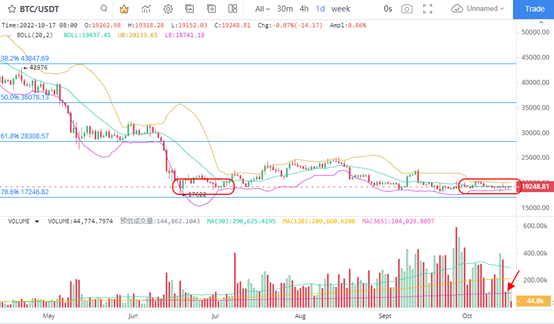
The daily K line chart of BTC shows that BTC has been at an absolute low from the perspective of closing price. In addition, although the volatility has continued to decline recently, the break of the low price has never occurred. In terms of trading volume, BTC's recent trading volume has hit a low point in three consecutive months. At present, it is the second time that the market has reached a low level, so the market is highly likely to change at this time.
2. BTC large transactions fall back

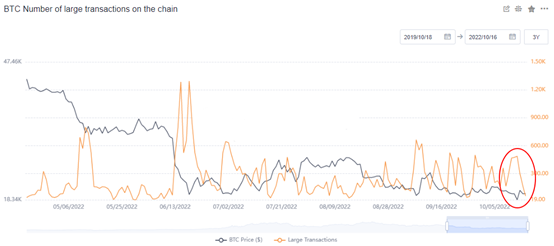
In the short term, the heat of major transactions has cooled again, and the number of large transactions per day has dropped from 488 to 60. At the same time, the number of BTCs traded in large amount per day also decreased from 244000 BTCs to 29280 BTCs, a decline of 87.7%. The cooling of the main trading heat means that the market performance is more sluggish in the short term. After the number of large transactions fell back, it means that the recent upswing of transaction heat since September 5 has shown signs of ending.

On the news side, although the Federal Reserve has raised interest rates sharply for many times in a row, the US CPI data remains firm, inflation expectations rebound again, releasing a "unfriendly" signal. The Fed is expected to raise interest rates to a high point close to 5% (previously predicted to be 4~4.5%), which may be the "last effort" of the Fed to fight inflation. This also means that the pace of interest rate increase by the Federal Reserve may not slow down in the fourth quarter. In the short term, BTC is more likely to show a technical rebound than a price reversal. Before the Federal Reserve further raises interest rates and the dollar index further strengthens, BTC has more opportunities to rebound.
3. ETH represents an upward breakthrough

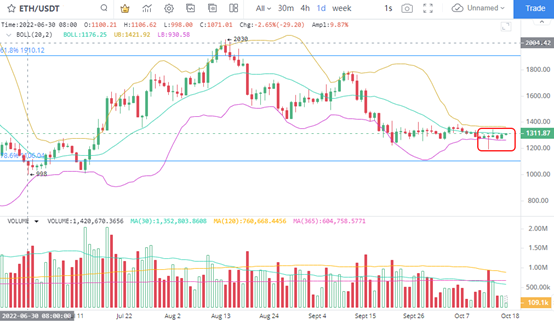
In terms of the daily K line, the intensity of ETH price fluctuation remains low, but the closing price has shown signs of recovery. Especially after the bottom of ETH hit $1190 on October 13, ETH closed up 2.43% on October 16, indicating that the market was in a moderate and strong state. Although the trading volume is not high, the recent short-term trend of ETH deserves attention. Because the price volatility can no longer be retreated, we can pay attention to the low suction signal in the rebound phase.
4. The number of new ETH addresses remains high

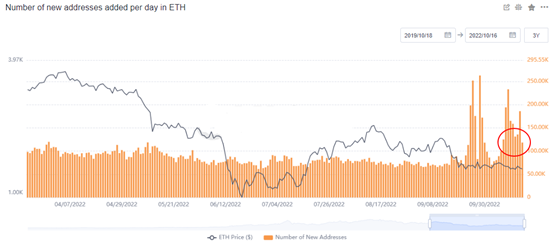
The number of new addresses in ETH is maintained at a high level, which is significantly higher than the average level since 2022. The growth of the number of new addresses started on September 16, which is now the second amplification of this indicator. Therefore, ETH's price strength will be maintained in the short term. In terms of price, ETH has little room for fluctuation in the near future, but the number of newly added addresses has remained active in the near future, indicating that the receiver is willing to enter the market at the current point, which also provides a respite for the rebound. In terms of pressure level, focus on the possible selling of $1400. On the news side, we continued to pay attention to the negative impact of the Federal Reserve's interest rate hike on the market.
5. QNT is steadily rising

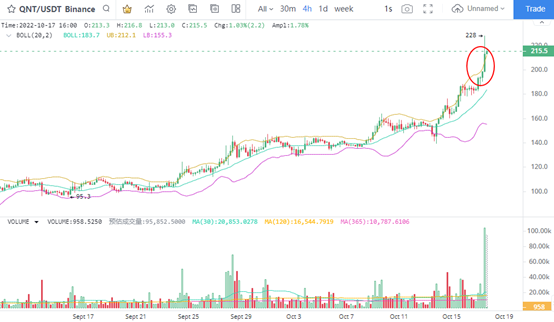
QNT has maintained the upward rhythm of prices recently. Although the current price rise shows signs of acceleration, the volatility and trading volume are significantly higher than expected. It is judged that the price recovery of QNT may continue. The trading volume of QNT in 4 hours will be more than 6 times larger when the amplitude of the short line after the 4-hour K line drawing reaches 15%. At this point, QNT is near $220 in the short term, which is still far from the historical high of $430. Since the trend of QNT is stable, and the main force with the largest number of coins increased its holdings of QNT on the 7th, it means that the price may still perform more strongly at a high level.

Related Reads

Two Giants' Credit Expansion: Loan Balances of $9.9 Billion vs. $14.6 Billion, Brazil Emerges as the Main Battlefield

Title: Two Giants "Credit" Surge: Loan Balances of 99 Billion vs. 146 Billion USD, Brazil Emerges as Main Battlefield Summary: The article compares the rapid expansion of credit businesses by two major e-commerce and fintech players, Sea (via Monee) and Mercado Libre (via Mercado Pago), in overseas markets like Southeast Asia and Latin America, contrasting with a slowing domestic Chinese credit market. Using Q1 2026 financial data, it highlights their significant growth. Sea's Monee reached a loan balance of $99 billion, up 71% year-over-year (YoY), contributing 17.5% to Sea's total revenue. Mercado Pago's loan balance hit $146 billion, up 87% YoY, contributing 45% to its parent company's revenue. Both maintained stable risk metrics (e.g., Monee's 90+ day NPL at 1.1%) despite rapid scaling. Brazil is identified as a key and accelerating growth market for both. Sea's Brazilian operations saw loan volumes exceed $10 billion, growing 250% YoY, with SPayLater GMV penetration still low (~10%) indicating high potential. Sea also secured a key Brazilian financial credit license (SCFI). Mercado Libre's Brazil segment contributed over half (54%) of total group revenue, with its credit business there generating $11.24 billion in revenue, up 89% YoY and accounting for 12.7% of global revenue. Mercado Pago's credit portfolio, especially credit cards (46% of loans, +105% YoY), is a strategic focus, described as crucial as building logistics was a decade ago. Its net interest margin after loss (NIMAL) remains high at 17.8%. The article concludes that while Brazil presents immense opportunities, the success is largely driven by these integrated "e-commerce + fintech" giants with proprietary transaction data and ecosystems, making it challenging for standalone fintech players to compete effectively.

链捕手13m ago

Two Giants' Credit Expansion: Loan Balances of $9.9 Billion vs. $14.6 Billion, Brazil Emerges as the Main Battlefield

链捕手13m ago

Research Report Analysis: Is Intel Making a Comeback with Apple? Bernstein's Calculations Show the Right Direction, but the Price Is Already Overvalued

Bernstein analyst Stacy A. Rasgon published a report on June 18 regarding Intel, assessing the potential impact of recent political support for a US-based PC chip design and manufacturing collaboration between Apple and Intel. The report views this as a significant signal for the foundry landscape shift but concludes the initial financial contribution would be minimal. Key conclusions: 1) An Apple deal is seen as a small-scale "proof of concept." Even if Intel wins 40% of Apple's premium notebook chip orders (~5 million units/year), Bernstein estimates it would generate only about $500M in annual revenue and ~$0.03 EPS, negligible against Intel's ~$55B revenue. 2) Political encouragement is not equivalent to enforceable mandates. Winning orders ultimately depends on Intel demonstrating competitive technology (like its 18A node), cost, and reliable supply. 3) The path from validation to large-scale production involves significant challenges, capital investment, and time. Due to these uncertainties, Bernstein maintains a Market-Perform (Hold) rating with a $100 price target, implying potential downside from the ~$121.10 price at the report date. The analysis highlights the tension between near-term validation value—serving as a crucial trust signal for Intel's foundry ambitions and US supply chain resilience—and the long-term opportunity to attract larger cloud and AI chip customers. The investment thesis hinges on successful 18A execution and sustained policy support, not on immediate financial gains from Apple.

marsbit37m ago

Research Report Analysis: Is Intel Making a Comeback with Apple? Bernstein's Calculations Show the Right Direction, but the Price Is Already Overvalued

marsbit37m ago

27-Year Reign Ends: SK Hynix Market Cap Surpasses Samsung for First Time, an AI-Driven Reshuffle of Korean Chip Power

On June 22, 2026, SK Hynix made history by surpassing Samsung Electronics in market capitalization, ending Samsung's 27-year reign as South Korea's most valuable company. This dramatic reversal is powered by the AI boom and SK Hynix's dominant position in High Bandwidth Memory (HBM), a critical component for AI model training. Once a heavily indebted firm on the brink of bankruptcy, SK Hynix bet early on HBM, which has evolved from a niche product to essential AI infrastructure. It now commands a 59% share of the global HBM market. Its financial performance is staggering, with Q1 2026 net profit soaring nearly fourfold year-over-year to KRW 40.35 trillion, translating to over 2 billion RMB in daily net profit. HBM now drives roughly 40% of its revenue with exceptionally high margins. In contrast, Samsung, with its broad portfolio spanning memory chips, smartphones, and foundry services, has lagged in the HBM race while facing headwinds in other divisions. This shift signifies a deeper restructuring of South Korea's economy, moving from consumer electronics to AI-driven growth. However, the future remains competitive. With major capacity expansions planned industry-wide by 2028 and Samsung aiming to catch up in HBM technology, the new market leader cannot afford complacency. This event marks a pivotal moment in the global semiconductor industry's ongoing power realignment.

marsbit49m ago

27-Year Reign Ends: SK Hynix Market Cap Surpasses Samsung for First Time, an AI-Driven Reshuffle of Korean Chip Power

marsbit49m ago

Trading

Spot
Futures
活动图片