[Key interpretation] There are still 167000 BTC flowing out of the whale account, and ENS and QNT are accelerating

HuobiPublished on 2022-10-14Last updated on 2022-10-17

Abstract

BTC Whale's holding of currency is still divergent, and the price trend is subject to the expectation of the Federal Reserve's interest rate increase, so the adjustment is still continuing.

1. BTC rebounded slightly

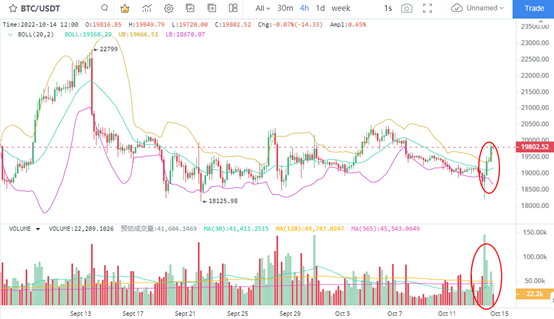
BTC's 4-hour K chart shows that the price is in a short-term rebound state. After the BTC hit the minimum of 18190 dollars during the continuous decline, a technical rebound occurred soon. The rebound speed is very fast. BTC has returned to more than 19000 dollars, and it is currently operating around 19802 dollars. This shows that although BTC has a weak trend, it still operates within the range. The limited volume of BTC in the rebound stage also indicates that the possibility of market strength is not very high.
2. BTC is still issuing coins

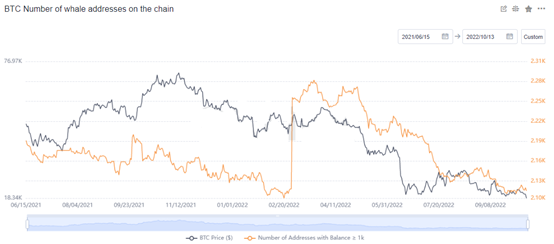
From the perspective of the main players' coin holding direction, the number of addresses of whale accounts has not changed much recently, and they are still operating at a low level after continuous decline. The data on October 13 showed that the number of megawhales remained at 2115, the lowest since March 21. On March 21, there were 2282 addresses of the whale with more than 1000 BTCs, which is still reduced by 167 to 167000 BTCs. Therefore, BTC is currently in the low adjustment stage, and the main force has not yet shown signs of increasing its shareholding.

On the news side, the US inflation rate, according to the data released by the US Department of Labor on October 13, the US consumer price index (CPI) in September this year increased by 8.2% year-on-year, 0.4% higher than that in August, higher than the expectations of US economists. The core inflation rate in the United States reached the highest growth rate in 40 years. The sharp rise of inflation rate shows that the five interest rate hikes by the Federal Reserve this year have little effect on easing inflation pressure. Therefore, the expectation of interest rate increase is still strong, the expectation of US dollar rise and BTC callback still exists, and the current rebound of BTC may not last too long.
3. ETH Bollinger Line starts to expand

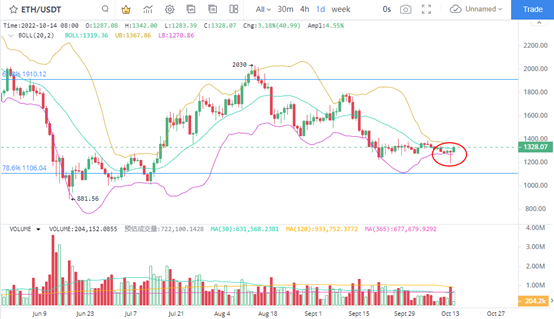
In terms of the daily K line, ETH prices and BTC rebounded at the bottom simultaneously, and prices completed a reverse pattern in the short term. During the bottoming period, ETH reached the lowest level of $1190. After the turnover rebounded in a short time, the turnover rate of ETH was limited. Prices are still fluctuating in the range. It is expected that ETH has a high upward space, but the price recovery needs the support of the overall market strength. In particular, the successful bottoming of BTC can further promote the ETH price.
4. ENS Strong Breakthrough

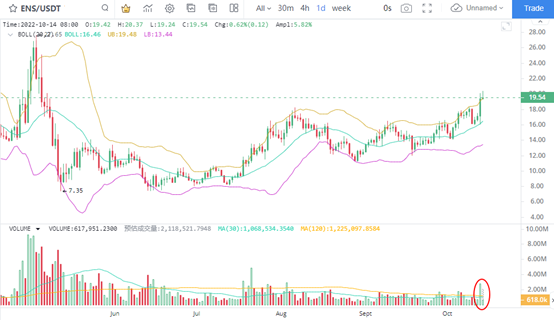
The price of ENS increased to 18.2 ¥ within 24 hours, which was the currency with the highest increase among the top 100 currencies with market value. In terms of trading volume, the trading volume corresponding to ENS's daily K line was effectively enlarged, more than 5 times that of the previous day, so the daily K line closed up 23.8%. In fact, during the period when the price was in a clear recovery state, the cumulative increase of ENS since the bottom reached in June reached 135%. It is expected that the price can still challenge the previous high of $27, so holding the currency can continue to gain gains.
5. QNT is steadily rising

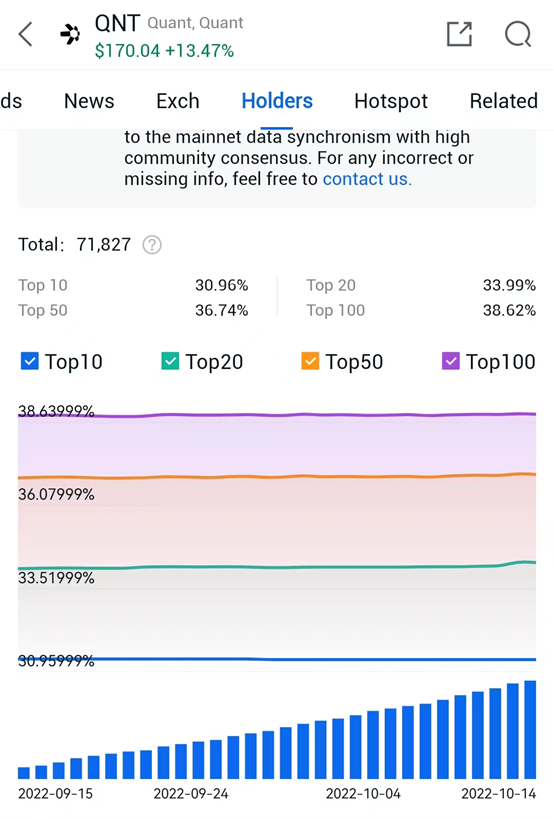
QNT's recent seven day increase has expanded to 23%, and prices remain strong. From the perspective of the number of coins held, the main players within the first 100 coins held did not show signs of continuous position reduction, indicating that the price rising trend of QNT may continue. Although the price rebounded from $40 to a maximum of $171, with a cumulative increase of 327%, it is still the stage of accelerated growth of QNT.

Related Reads

Uniswap v4 Hook Analysis: Architecture Design, Common Vulnerabilities, and Protection Practices

Uniswap v4's Hook mechanism is a major innovation, enabling custom logic injection into liquidity pool lifecycle events like swaps and liquidity provisioning. This transforms the AMM into programmable infrastructure, shifting the security model from protocol-level to pool-level, as each pool's safety now depends on its bound Hook contract. The core architecture revolves around the singleton PoolManager contract, which manages all pools via a flash accounting system. State changes are tracked in transient storage and must be settled by the end of a transaction. Hook contracts are permanently bound to pools via a PoolKey, with their permissions encoded directly into their address via specific low-order bits. This design introduces unique security considerations and challenges for future upgrades. Key vulnerabilities and best practices identified include: - **Access Control Gaps:** Early versions of the BaseHook abstract contract only protect `unlockCallback()`, leaving other lifecycle functions (`beforeSwap`, `afterSwap`, etc.) exposed unless explicitly secured by developers. - **Unrestricted Pool Binding:** The `initialize()` function does not validate if a Hook "consents" to a new pool. Hooks must implement their own whitelisting in `beforeInitialize` to prevent unauthorized pool creation. - **Async/Custom Curve Hooks:** These high-risk Hooks can completely replace Uniswap's swap logic. Their security depends entirely on their own implementation, as they operate outside the native protocol's pricing safeguards. - **Delta Accounting Risks:** The system ensures final balance (NonzeroDeltaCount == 0) but cannot guarantee the *correctness* of intermediate delta states, which attackers could manipulate. - **Token Confusion:** Protocols must implement semantic validation for tokens in user-created markets, not just interface checks, to prevent cross-market confusion attacks. The article emphasizes that Hook auditing requires a "sub-protocol" approach due to extended interaction chains, highlighting a significant shift in security methodology for the v4 ecosystem.

marsbit52m ago

Uniswap v4 Hook Analysis: Architecture Design, Common Vulnerabilities, and Protection Practices

marsbit52m ago

Chips, Open-Source Models, and $50 Trillion: Joe Tsai Reassesses Alibaba Once Again

Alibaba Executive Chairman Joe Tsai recently outlined the company's comprehensive AI strategy in a public discussion. He believes AI represents a massive opportunity, estimating its potential economic impact at up to $50 trillion, stemming from the automation of human intelligence and productivity. Tsai detailed Alibaba's four-layer investment approach across the AI stack: starting from the chip level, moving to cloud infrastructure (Alibaba Cloud), then the model layer with its open-source Qwen model, and finally applications within its vast digital ecosystem (e-commerce, logistics, etc.). The company avoids the energy layer due to China's efficient infrastructure. This broad strategy is designed to ensure Alibaba captures value regardless of where it ultimately concentrates in the AI value chain. He dismissed concerns about an AI investment bubble, pointing to the enormous $50 trillion opportunity. While acknowledging U.S. cloud giants' higher capital expenditure, he argued Chinese firms, including Alibaba (funded by its cash-generative e-commerce core), need to invest more in AI infrastructure. A key theme was technological sovereignty. Tsai positioned open-source models like Qwen as a solution for companies, especially in Europe, seeking independence from proprietary U.S. models and greater data privacy control. He contrasted this with the trend of U.S. giants keeping their models closed-source. Tsai highlighted Alibaba's collaborations with European manufacturers like Bosch and Siemens, using AI for design and quality control. He concluded with an optimistic vision of AI agents enhancing productivity, ultimately freeing up human time for leisure, family, and experiences like live entertainment.

marsbit1h ago

Chips, Open-Source Models, and $50 Trillion: Joe Tsai Reassesses Alibaba Once Again

marsbit1h ago

Trading

Spot
Futures
活动图片