[Key interpretation] BTC fell by 1% strangely, and high leverage ratio implied super amplitude.

HuobiPublished on 2022-10-10Last updated on 2022-10-11

Abstract

The leverage ratio of BTC soared to a historical high, and there was great uncertainty in the price.

1. BTC shrinkage adjustment or in place

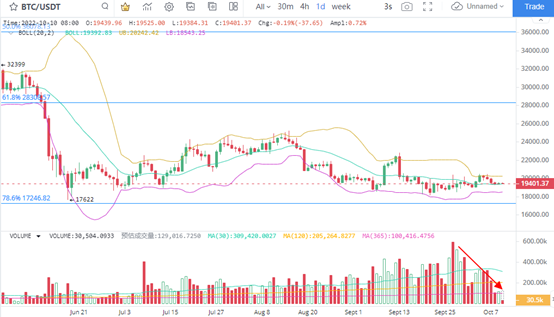
In the daily K line chart of BTC, the trading volume has shrunk for two consecutive trading days during the period when the price sideways moves near the middle track of the Bollinger Line. At the same time, the daily trading volume of BTC has shrunk since September 27, and is now at a very low level. The current trading volume is almost the lowest level since July, so the long short competition has been at the node of the change. At present, the withdrawal of BTC volume is beneficial to short sellers, and the price trend is also inclined to fall.
2. BTC estimated that leverage ratio rose significantly

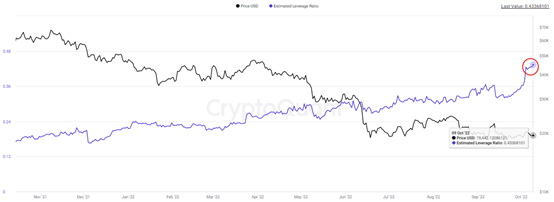
After more BTCs left the exchange recently, the estimated leverage ratio of BTC has been pushed up. The estimated leverage ratio displayed on October 9 has reached a recent high of 0.43, the highest level in two years. This shows that the leverage ratio of investors is rising rapidly, which is beneficial to the change of BTC. In the calculation of estimated leverage ratio, the market value of contract position and spot currency is used to compare, so it is better to judge the leverage ratio of investors. At present, the estimated leverage ratio of investors has risen to a higher position, so it is necessary to pay attention to the possible strong volatility of BTC.
3. ETH volatility drops below 2%

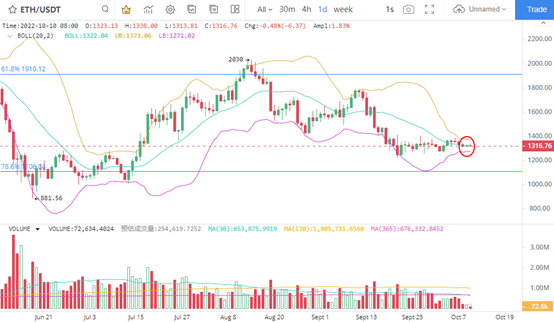
In terms of daily K line, the fluctuation intensity of ETH on October 8 and 9, 2022 is only 1.65% and 1.83%. Obviously, the volatility of ETH has been very low, and the daily trading volume of K-line has also dropped to the lowest level since April 23. It can be seen that the trend of ETH is quite low, indicating that such volume price performance or duration will not be too long, and there will be direction selection signals.
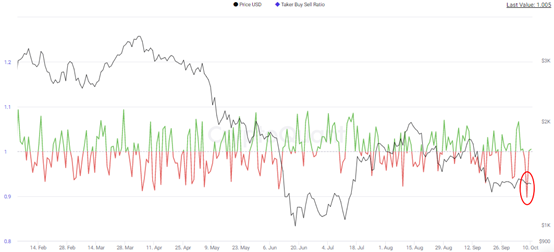
4. A new low of ETH multiple air ratio

In terms of contract positions, ETH's long short ratio fell to its lowest level recently, reaching 0.897 on October 8. Looking back on the long empty performance in the past year, the long empty ratio on November 4, 2021 is 0.895, and the current lowest value is very close to this. At that time, after the long short ratio low point of ETH continued, the price reached a historical peak of $4810 on November 8, 2021, and then the price began to fall continuously. The current situation is similar to this, which means that the risk of ETH rollback is also increasing.
5. ENS has strong short-term performance

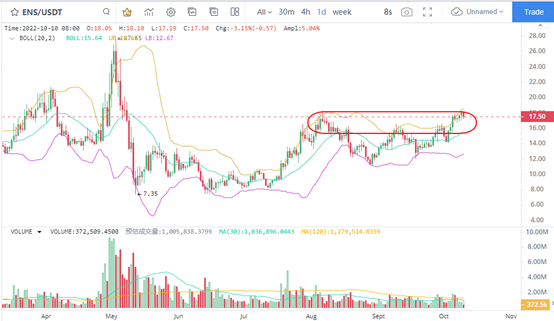
With the overall market in the adjustment stage, ENS has a strong price performance. At present, the Japanese K Line has been at a breakthrough point. The trading volume of ENS was stable near USD 17.5, preparing for further price rise.

In terms of data, the number of new domain names registered by ENS in September exceeded 430000, a record high.

According to data from Dune Analytics, the number of newly registered domain names of Ethereum domain name service ENS in September exceeded 430000, reaching 437365, setting a record for the highest number of registered domain names in a month. In addition, the total number of domain names registered by ENS has reached 2642046, which is a good factor for ENS price rise and can continue to be concerned.

Related Reads

Idle Macs Can Also Make Money? An Overview of Eigen Labs' Decentralized AI Inference Network Darkbloom

AI inference is becoming a crucial layer of internet infrastructure, yet it remains largely dependent on costly, capacity-limited centralized systems with potential security risks. Meanwhile, millions of powerful computers sit idle globally. Eigen Labs' Darkbloom network aims to utilize this idle capacity by enabling distributed AI inference on Mac computers, specifically those with Apple Silicon chips. Darkbloom's architecture consists of three components: users who send inference requests, a coordinator (operated by Eigen Labs) that routes these requests, and providers (Mac owners) whose machines run the models and return outputs without being able to see the request content. The system prioritizes privacy through a hardened provider process, software integrity checks, and hardware-supported attestation based on Apple's security architecture to ensure verifiable privacy. Economically, Darkbloom differs from traditional models. It leverages existing hardware, with marginal costs primarily driven by electricity, allowing it to offer pricing roughly 50% lower than major API aggregators. Providers keep 100% of the inference revenue, and the project does not rely on token subsidies; earnings come solely from real AI inference demand. However, early-stage earnings are modest, with top providers currently earning under $6 per day, influenced by factors like hardware specs, uptime, and network demand. The network currently supports models like Google's Gemma 4 and OpenAI's GPT-OSS via OpenRouter. To participate as a provider, users need an Apple Silicon Mac running macOS 14 or later, must install the Darkbloom provider software, and keep the machine online with a stable internet connection.

marsbit5m ago

Idle Macs Can Also Make Money? An Overview of Eigen Labs' Decentralized AI Inference Network Darkbloom

marsbit5m ago

Which Crypto Sectors Have Been "Eaten" by AI Agents?

The article examines which crypto sectors have been increasingly dominated by AI Agents and which remain human-centric. In certain high-speed, efficiency-driven areas, AI Agents have taken clear control. This includes derivatives/perpetuals trading, where bots outperform humans significantly (e.g., a contest showed 0% of AI Agents were liquidated vs. 43% of humans), arbitrage/MEV extraction, and yield optimization (with ~68% of new DeFi protocols in Q1 2026 featuring autonomous AI Agents). Spot trading and portfolio optimization are also seeing heavy Agent adoption. However, the shift is not universal. In "battleground" sectors, both Agents and humans coexist. In prediction markets, Agents dominate short-term arbitrage, but humans still outperform in long-term, nuanced judgment calls. In DeFi lending, while liquidation is automated, core deposit/borrow decisions remain largely human-driven. Sectors still firmly led by human activity include stablecoin payments and card-based spending (driven by real-world economic activity and remittances) and wallets, which serve as the crucial human-verification and approval layer. The rise of Agents increases the need for robust human-Agent verification layers. Projects like World/AgentKit, t54, Self Protocol, and Kite AI are building infrastructure to create trust, security, and accountability by binding Agents to verified human identities. In conclusion, while AI Agents have decisively "eaten" speed and optimization-focused crypto sectors, human judgment, trust, and real-world context remain dominant in areas that create broad economic value, such as payments and identity. The future likely involves a symbiotic relationship where Agents require human verification and oversight to operate effectively.

Foresight News12m ago

Which Crypto Sectors Have Been "Eaten" by AI Agents?

Foresight News12m ago

After Rising 11 Times in a Year, Micron's Earnings Report Becomes a Stress Test for the AI Memory Market

**Micron's Upcoming Earnings: A Crucial Test for the AI Memory Rally** Investors in AI memory stocks face a critical moment on June 24th, when Micron Technology reports quarterly earnings. The stock, having surged approximately 11-fold from $103 to $1,134 over the past year, carries immense market expectations. Wall Street consensus forecasts a staggering ~932% year-over-year jump in EPS to around $19.72 and ~270% revenue growth to ~$345 billion, largely driven by sold-out HBM (High Bandwidth Memory) capacity through 2026. Analysts have aggressively revised estimates upward over the last 90 days, with EPS expectations rising 68%. This creates a high bar: even strong results risk a sell-off if they fail to meet these elevated projections. Notably, price forecasts from institutions like Citi (predicting ~200% DRAM price increases in 2026) are already among the most bullish on Wall Street, not conservative. The key metric to watch is gross margin, guided to a record ~81%. Such peak profitability raises questions about sustainability in the historically cyclical memory sector. While management has signaled continued strength, the stock's direction post-earnings will likely hinge more on forward guidance for the next quarter and details on HBM capacity expansion for 2027, rather than the already-anticipated stellar past results. The report represents a major pressure test for the high-flying AI memory trade.

marsbit16m ago

After Rising 11 Times in a Year, Micron's Earnings Report Becomes a Stress Test for the AI Memory Market

marsbit16m ago

Trading

Spot
Futures
活动图片