70% Bear Market Signal Flashes in the U.S. Stock Market. Time to Run?

marsbitPublished on 2026-06-10Last updated on 2026-06-10

Abstract

TL;DR: The US stock market faces a complex dilemma: a major bearish warning from Bank of America (BofA) versus strong fundamental growth driven by AI. BofA's equity strategy team warns that about 70% of its bear market indicators have been triggered, a level historically associated with market tops. The S&P 500 shows extreme valuation on multiple metrics, with narrow market breadth and extreme leadership concentration (e.g., top vs. bottom tech stock performance gap at its widest since 2000). This signals deteriorating reward-to-risk odds for investors, as the index advance relies on fewer stocks, reducing portfolio margin for error. However, the current AI boom differs fundamentally from the 2000 dot-com bubble. Today's leading companies (Microsoft, Google, Amazon, Meta, Nvidia) have substantial cash flows, profits, and concrete orders, underpinned by real data center and cloud capital expenditure. Nvidia's massive data center revenue growth offers tangible evidence of demand. The optimism is based on a real infrastructure build-out cycle. The core issue has thus shifted. It's no longer a simple debate about an AI bubble. The market is transitioning from a "buy the growth story" phase to a "prove the growth speed" phase. While AI fundamentals may remain robust, high valuations have priced in significant future success. The key test ahead is whether upcoming earnings can demonstrate that AI-related revenues and cash flows are growing fast enough to justify current prices a...

TL;DR

U.S. stock investors now face a problem that goes beyond simple bullishness or bearishness.

On one side is Bank of America's US Equity & Quant Strategy team. Led by Savita Subramanian, the team released a client report on June 5th titled 'Too many red flags. Take profits.' According to a June 9th report by Axios, the report argues there are too many risk signals in U.S. stocks and offers a more direct position suggestion: take profits.

On the other side, there are still strong AI fundamentals. Microsoft, Google, Amazon, and Meta are still increasing AI and data center capital expenditures, and Nvidia's data center demand remains the core anchor of the semiconductor cycle. Unlike the 2000 dot-com bubble, the leaders of this rally have been replaced by giants with cash flow, profits, cloud revenue, and chip orders.

So the real question has shifted from 'Is AI a bubble?' or 'Is BofA calling a top?' to another, harder-to-answer question: when historical top signals and real AI growth coexist, how should investors understand the current risks in U.S. stocks?

The answer may be more uncomfortable than simply being bearish: the AI bull market may not be over, but it has moved from the 'buying growth' phase to the phase of 'testing the speed of growth realization.'

BofA Warns of Worsening Odds

The value of BofA's report lies in placing the current market within a historical risk structure, not in giving a precise top timing.

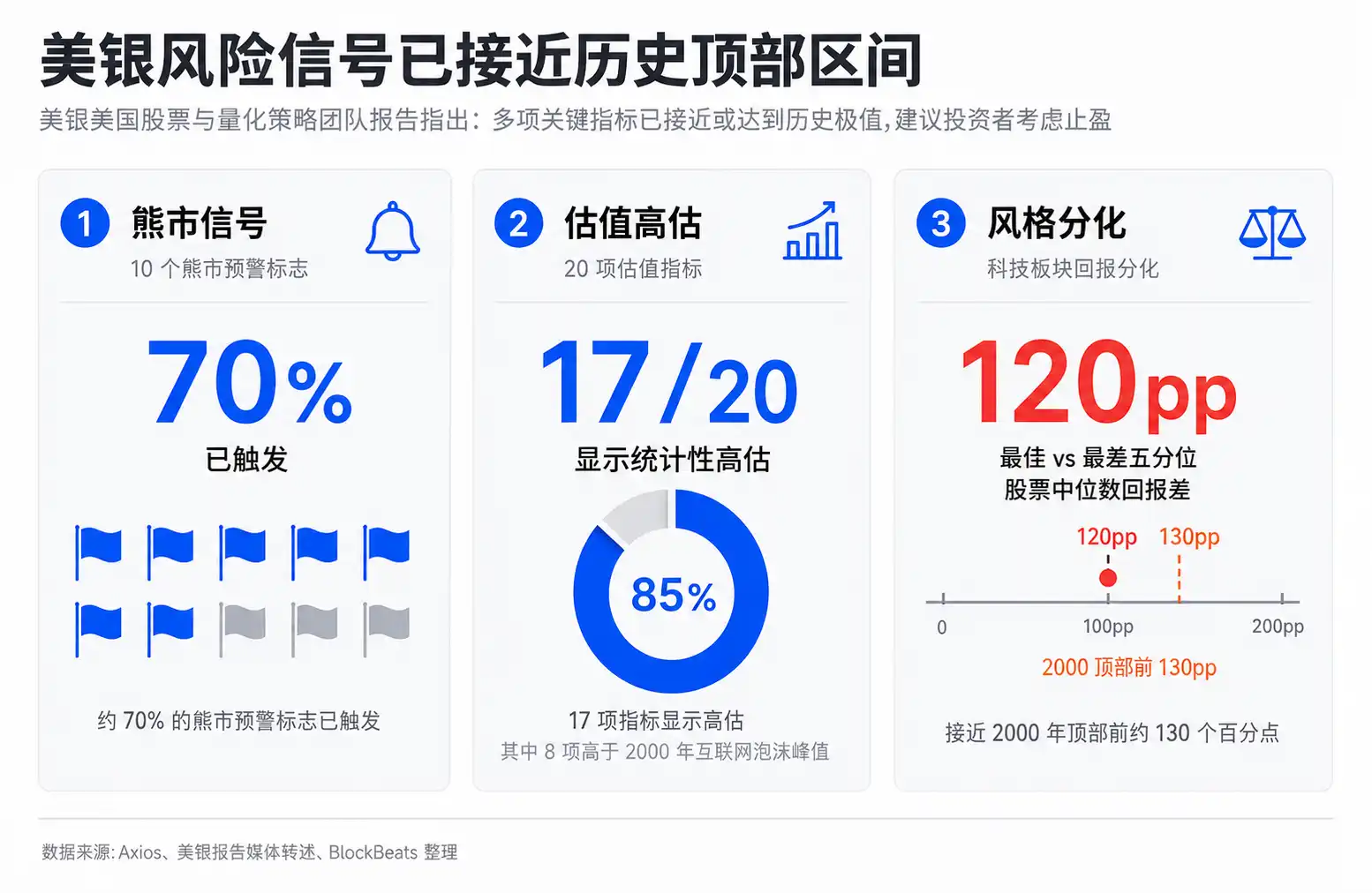
According to numerous financial media outlets citing the BofA report, about 70% of its tracked 10 bear market warning signs have been triggered. This ratio is close to the average level before multiple S&P 500 tops since 1990. The BofA framework also shows that the S&P 500 is statistically overvalued in 17 out of 20 valuation metrics, with 8 higher than the peak of the 2000 internet bubble. The CAPE (Cyclically Adjusted P/E Ratio) or P/E10 is around 40, residing in a historically extreme range.

Each of these numbers can be refuted individually. High valuation doesn't mean a decline tomorrow. Effective historical signals don't mean they're right every time. Stronger profits from AI companies do indeed make today different from 2000. But when valuation, market breadth, style divergence, and momentum simultaneously show extreme readings, BofA's main point is closer to: the market can still be held, but the odds have worsened.

Market breadth is key here. The indices are still high, but the rally relies increasingly on a handful of AI and tech leaders. The current U.S. market shows narrow leadership characteristics similar to historical top phases: a few stocks contribute the majority of index gains, the proportion of S&P components above key moving averages is receding, and many individual stocks are not near their own highs. Strength at the index level masks declining internal participation.

Style divergence reinforces the same signal. BofA noted that the median return differential between the top quintile and bottom quintile of tech stocks is about 120 percentage points, the highest since February 2000, approaching the 130 percentage points just before the March 2000 peak. This looks more like a concentrated bet by capital on a few certain narratives, rather than the broad dispersion typical of a normal bull market.
For investors holding SPY, QQQ, NVDA, or SOXX, the most dangerous aspect of this structure is reduced margin for error. The indices could certainly continue to rise, but as gains depend more on fewer stocks, any deviation in a leading company's earnings, guidance, capex returns, or valuation assumptions could be amplified into a pullback for the entire portfolio.

This AI Rally Can't Simply Mirror 2000

Looking only at BofA's valuation and breadth signals, it's easy to directly compare the current rally to 2000. But that comparison is only half right.

The typical feature of the 2000 internet bubble was that many companies lacked mature business models, and investors mainly traded on the imagination of 'the internet changing the world.' Today's AI leaders are different. The cloud and AI businesses of Microsoft, Google, Amazon, and Meta are already reflected in real revenue, capex plans, and data center demand. Nvidia is not just a narrative center but also a chip supplier with highly concentrated profits and cash flow.

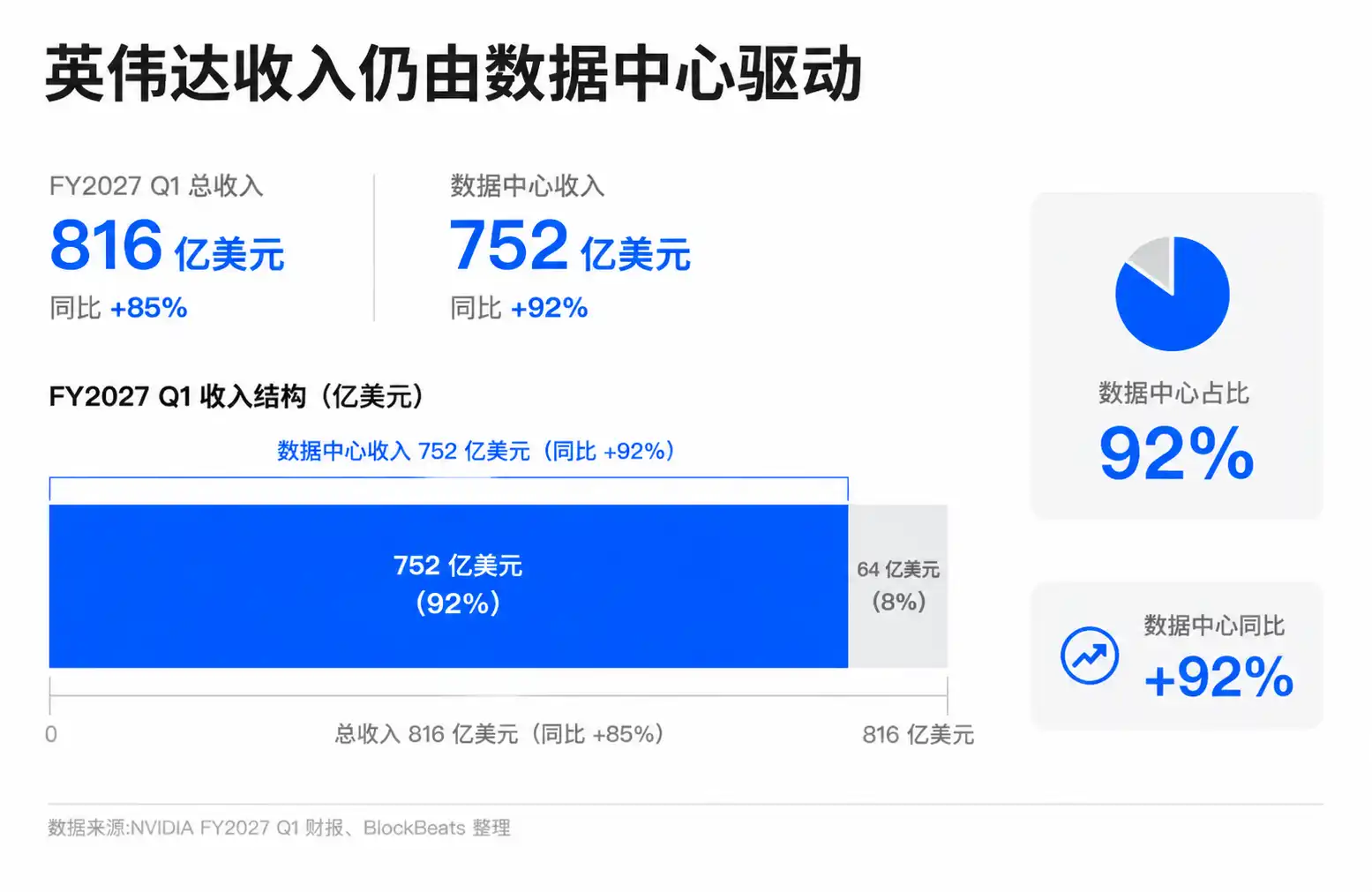
Nvidia's latest earnings report gave bulls their strongest support. The company's FY2027 Q1 report released in May 2026 showed quarterly revenue of $81.6 billion and data center revenue of $75.2 billion, a 92% year-over-year increase. In the face of these numbers, simply calling the AI rally a 'bubble without fundamentals' is not very convincing.
AI optimists, including large tech company management and growth investors, refute the bubble argument precisely based on this. They believe this rally is more like an infrastructure cycle: training and inference demand drives GPU, networking, storage, power, and data center construction; cloud vendors use higher capital expenditures to secure future AI service revenue; and enterprises then integrate AI into software, advertising, search, office, and development processes.

This framework has a factual basis. Over the past few earnings seasons, large cloud vendors have consistently emphasized strong AI demand, with cloud business maintaining growth. Nvidia's data center revenue has become a key pillar of the U.S. earnings growth narrative. Broadcom, AMD, and data center and power infrastructure companies are also incorporated into the same investment chain. The market's willingness to give these companies higher valuations is not just because the story sounds good; orders, revenue, and profits are also being delivered.

This is why BofA's signals cannot be crudely interpreted as 'the AI bull market is already over.' If underlying fundamentals are still improving, a high-valuation regime can last longer than historical experience suggests. Especially in a market where passive funds, index weightings, and institutional allocations collectively reinforce leader status, the strong getting stronger is itself part of the capital flow mechanism.

But AI being real does not equal valuations being safe. A common misconception easily arises here: as long as the technological revolution is real, the price is not expensive. Historically, many bubbles were precisely built on real technology being priced in too early and too fully. The internet truly changed the world, but investors who bought many internet stocks in 2000 still experienced prolonged valuation compression.

The core divergence in the current AI rally is shifting from 'Is AI useful?' to 'How many years of future good news has the market already priced in?' The importance of BofA's historical signals lies precisely in reminding investors: even if fundamentals are real, when the price already reflects too much future good news, risk can still rise.

Pressure Shifts to Revenue and Cash Flow

The AI bull market is entering its hardest phase, not because demand suddenly disappears. The real change is that the market is starting to demand more proof.

Over the past two years, investors were willing to pay high valuations for AI leaders because the growth path seemed clear: cloud vendors increased capex, chip companies sold more high-end GPUs, data center and networking equipment companies received orders, and future enterprise applications would release even greater revenue. Entering 2026, the market needs to see not just continued investment, but also whether that investment can translate into sufficiently high revenue, profit margins, and free cash flow.

Capital expenditure is the focal point of this question. The direction of increased AI and data center investments by Microsoft, Google, Amazon, and Meta is generally clear, but estimates of specific scale vary widely among different institutions and media. More importantly, investors are already starting to worry about the pressure higher capex puts on free cash flow and return on investment. This cannot simply be framed as 'AI investments cannot be recouped,' but as the investment curve steepens, market demands on the return curve will also increase.

For Microsoft, Google, Amazon, and Meta, continuing to increase AI investment is strategically necessary. Whoever stops risks falling behind in cloud, search, advertising, office, models, and developer ecosystems. But from a shareholder perspective, the higher the capex, the more future earnings reports need to prove these investments can bring revenue growth, stable margins, and cash flow resilience.

For the semiconductor chain represented by Nvidia, Broadcom, AMD, and SOXX, the logic is slightly different. They are direct beneficiaries of the AI investment cycle, with orders and profits realized earlier. But precisely because the market already views them as core winners of the AI infrastructure cycle, once downstream cloud vendors slow capex, delay purchases, or start emphasizing investment discipline, semiconductor valuations will react first.

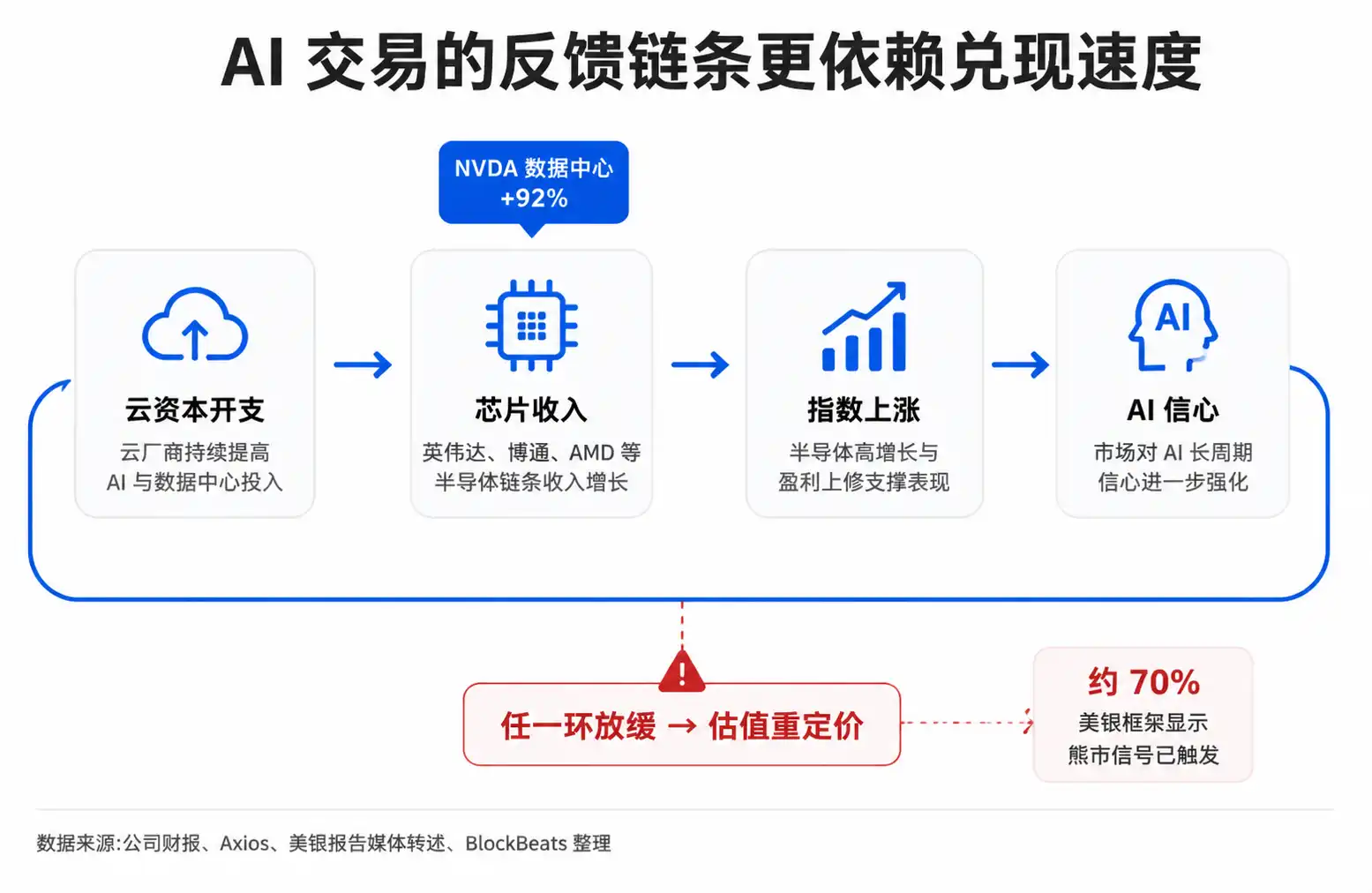
This creates a more fragile feedback loop. Cloud giants increase capex, supporting chip company revenue. High growth from chip companies supports index gains. Index gains and earnings revisions reinforce market confidence in the AI long cycle. If any link in this chain shows signs of slowing, the market may face not an 'AI end,' but more likely a need for valuations to re-match the pace of realization.
Second-Half Earnings Need to Prove Growth Can Cover Risks

BofA's 70% bear market signal won't automatically turn into a top, and strong earnings from AI leaders won't automatically eliminate valuation risks. What really needs to be verified next is whether sustained growth can cover these risk signals in valuation and market structure.

The most direct observation window is the second-half 2026 earnings season. Investors need to see AI revenue from large tech companies continue to grow, while profit margins aren't significantly eroded by capex and depreciation pressures. Cloud vendors, while continuing to invest, also need to prove customer demand is strong enough. The orders and guidance from semiconductor companies like Nvidia, Broadcom, and AMD will reflect whether downstream investment momentum is slowing.

Another variable is market breadth. If the S&P and Nasdaq continue to hit new highs but fewer stocks participate in the rally, and high-P/E stocks continue to systematically outperform low-P/E stocks, the historical top structure BofA mentions will be harder to ignore. Conversely, if earnings diffusion spreads to more sectors and indices no longer rely solely on a few AI leaders, risk signals have a chance to be digested slowly by time and performance.

For ordinary investors, now is a more suitable time to check portfolio positioning and concentration. Using a simple 'bullish on AI' or 'bearish on U.S. stocks' doesn't solve the problem. AI may still be the most important investment theme for the next few years, but with valuations, breadth, and capex pressures simultaneously rising, continuing to hold it has shifted from early trend discovery to a bet on the speed of realization.


Related Questions

QAccording to Bank of America's report, what percentage of bear market warning signals have been triggered, and what does this indicate for the market?

ABank of America's report states that approximately 70% of its tracked bear market warning signals have been triggered. This indicates that market conditions are showing a high concentration of historical risk indicators, suggesting that while a market downturn is not guaranteed, the probability or 'odds' of success for investors have worsened.

QHow does the current AI-led market rally differ fundamentally from the dot-com bubble of 2000?

AUnlike the dot-com bubble where many companies lacked mature business models and profits, today's leading AI companies like Microsoft, Google, Amazon, Meta, and Nvidia have strong underlying fundamentals. They possess substantial cash flows, profits, visible revenue from cloud and AI services, and concrete capital expenditure plans and chip orders, making the rally more grounded in real business growth rather than pure speculation.

QWhat is the 'market breadth' signal mentioned by Bank of America, and why is it considered a risk?

AMarket breadth refers to how many individual stocks are participating in a market index's rise. Bank of America notes that the current market shows narrow leadership, meaning the index's gains are increasingly concentrated in a small number of AI and tech giants, while many other stocks are lagging. This is risky because it lowers the market's resilience; any disappointment in earnings or guidance from these few leading stocks could disproportionately impact the entire index.

QWhat key transition has the AI investment narrative undergone, according to the article?

AThe AI investment narrative has transitioned from a 'buy growth' phase, where investors were willing to pay high valuations based on the promise of future growth, to a phase of 'testing the speed of growth realization.' The market now demands more proof that heavy capital investments in AI will translate into sufficient revenue growth, profit margins, and free cash flow.

QWhat does the article suggest investors should focus on in the upcoming 2026 H2 earnings season to gauge market health?

AInvestors should focus on whether the continued growth from AI can cover existing valuation and structural risks. Key things to watch include: continued growth in AI-related revenues for big tech companies without significant erosion of profit margins due to capital expenditures; strong customer demand for cloud services; and order books and guidance from semiconductor companies like Nvidia, Broadcom, and AMD to see if downstream investment momentum is slowing. Additionally, an improvement in market breadth would be a positive sign.

Related Reads

7 Months After the Collapse of Huiwang, Southeast Asia's Escrow Platforms Undergo a Major Reshuffle

Following the collapse of Huione Pay—dubbed the "Alipay of Southeast Asia"—seven months ago, the region's underground financial guarantee platform sector is undergoing a significant reshuffle. This power vacuum has been swiftly filled by emerging platforms such as XinBi, Tiger/Navigator, JinBei (renamed JinBo), Dali/Tiancheng, and FullyLight. These platforms, operating largely via Telegram and offering services like escrow for illicit transactions, have absorbed the vast user base and markets left behind by Huione. While positioning themselves as "trust intermediaries," their primary clientele consists of networks involved in online scams, money laundering, illegal gambling, and even human trafficking. For instance, the Tiger/Navigator platform explicitly provides "escrow" services for kidnapping-for-ransom operations ("强押车交易"). Data underscores the immense scale: Huione alone processed over $103 billion in cryptocurrency payments and facilitated over $31 billion through its escrow market before its downfall, linking it to Cambodia's notorious Prince Group. Since its collapse, competitors have seen explosive growth. For example, the XinBi platform has accumulated over $1.6 billion in total USDT revenue, while platforms like NewPay, OkPay (under Dali), and FullyLight Wallet collectively processed over $4.8 billion in USDT in a single year. This ecosystem thrives in regions like Cambodia and Myanmar, where regulatory gaps allow these platforms to act as critical financial infrastructure for sprawling cybercrime industries, from scam compounds to online casinos. The article concludes that the moniker "Southeast Asian Alipay" is a misnomer, obscuring the platforms' fundamental role in enabling serious criminal enterprises rather than representing legitimate financial innovation.

Odaily星球日报33m ago

7 Months After the Collapse of Huiwang, Southeast Asia's Escrow Platforms Undergo a Major Reshuffle

Odaily星球日报33m ago

The Changing Landscape: What Are Crypto VCs Experiencing?

Title: The Shifting Landscape of Crypto Venture Capital The era of dedicated crypto venture capital funds is undergoing a significant transformation. Once essential for navigating the sector's complexity and high risk, these specialized funds are now facing an identity crisis as the market matures. This shift mirrors historical patterns in other specialized investment classes like cleantech and SPACs, where initial information advantages dissipate as technologies become mainstream and integrated into existing industry frameworks. The article argues that crypto is reaching a critical inflection point, transitioning from a "building phase" to an "integration phase." Major players like Stripe, BlackRock, and Visa now engage with crypto not for its novel mechanics but as a foundational financial infrastructure. Their needs—regulatory compliance, banking partnerships, distribution channels—align with traditional fintech, a domain easily understood by large, generalist funds like Sequoia and Founders Fund. This evolution creates a "barbell effect" within the VC landscape. On one end are massive, diversified platforms that can incorporate crypto as one vertical among many. On the other are small, nimble funds focused on niche, experimental projects. The middle ground—medium-sized dedicated crypto funds—is being squeezed out. Their typical fund size makes it impossible to generate sufficient returns solely from early-stage crypto bets, yet they cannot compete with giants for later-stage deals. Consequently, leading crypto-native firms like Paradigm and Framework Ventures are expanding into AI, robotics, and other sectors, driven partly by LP pressure for better returns amid a broader VC DPI crisis. Others, like Dragonfly and a16z, have narrowed their crypto focus predominantly to financial infrastructure like stablecoins, reframing the sector's core narrative. For crypto entrepreneurs, this consolidation presents challenges. While generalist funds offer larger checks and broader resources, crypto projects now compete fiercely with AI for attention and capital within these firms. Furthermore, the long-term, non-commercial foundational work that built the ecosystem—funded by dedicated crypto VCs—is less likely to attract generalist capital focused on direct returns. The conclusion is that "crypto investor" as a standalone category is becoming obsolete, akin to "internet investor." Crypto is becoming a baseline infrastructure layer. The future will see a barbell structure: large-scale growth financing handled by generalist funds, while pioneering, speculative projects are funded by small, specialized vehicles. The dedicated crypto funds of the 2017-2021 boom, which incubated core infrastructure, are giving way to this new, bifurcated reality.

Foresight News50m ago

The Changing Landscape: What Are Crypto VCs Experiencing?

Foresight News50m ago

As Consensus Accelerates, What Are Young Investors Betting On?

Title: As Consensus Forms Faster, What Are Young Investors Betting On? In the rapid evolution of tech investment, a new generation of young investors is navigating a landscape where AI, robotics, commercial aerospace, and quantum computing are advancing simultaneously. Traditional investment logic based on financial models is giving way to a need for deep technical understanding and the ability to act before industry consensus forms. An analysis of trends from the "WAIC FUTURE TECH" list of young investment leaders reveals key shifts in focus. The first major trend is the movement of AI from the digital screen into the physical world. Investment is shifting from large language models and chatbots towards embodied AI, robotics, AI hardware, and edge computing. While demonstrations generate excitement, the real challenge lies in achieving scalable, reliable, and cost-effective delivery in complex real-world environments like factories and logistics. Success depends not just on algorithms but on the integration of sensors, actuators, and control systems. Second, the competitive focus for large models is moving beyond raw capability toward building an "intelligence flywheel." The goal is to create self-reinforcing systems where user interaction generates data, improving the model, which in turn enhances the user experience and attracts more engagement. Companies that successfully embed AI into workflows to create these closed-loop systems can build lasting value that isn't easily erased by the next model upgrade. Third, facing a potential bottleneck in high-quality human-generated data, investors are looking at new underlying technologies. Reinforcement learning and self-play, as demonstrated by AlphaGo Zero, offer paths for AI to generate its own experience. Scientific foundation models, which aim to build general AI capabilities for fields like life sciences and materials discovery, represent a non-consensus direction that could unlock new frontiers of knowledge and data. Finally, in deep-tech areas like quantum computing, commercial aerospace, and space-based infrastructure, patient capital is essential. These fields have long, uncertain development and validation cycles involving complex engineering, supply chains, and regulations. Investment here requires a long-term view, focusing on foundational team capabilities and the eventual emergence of market demand, even if commercial returns are distant. Collectively, these trends illustrate how young investors are adapting to a new era. They are learning to make earlier, technically-informed judgments, balance hype with real-world viability, and provide the patient capital needed to build the deep-tech foundations of the future.

marsbit1h ago

As Consensus Accelerates, What Are Young Investors Betting On?

marsbit1h ago

Trading

Spot
活动图片




