$635M in, $405M out – How the Fed quietly shook the crypto market

ambcryptoPublished on 2026-03-25Last updated on 2026-03-25

Abstract

The crypto market slowed last week, with many attributing the decline to Middle East tensions. However, the primary driver was the U.S. Federal Reserve's cautious policy signals. According to CoinShares, digital asset investments saw $230 million in inflows—significantly lower than previous weeks. Notably, $635 million entered just before the Fed meeting, but $405 million exited shortly after, indicating investors are highly sensitive to interest rate expectations. Bitcoin led with $219 million in weekly inflows, though short-Bitcoin products also gained $6 million, reflecting mixed sentiment. Solana remained strong with $17 million inflows over seven weeks, while Ethereum saw $27.5 million in outflows. Chainlink and Hyperliquid attracted $9.1 million combined. Despite price declines—ETH and HYPE fell ~6.7%, BTC dropped ~4%, and SOL dipped only 2%—capital continued flowing in. User activity was highest for Chainlink, while Solana maintained steady social volume. The Altcoin Season Index read 47, below the 75 threshold for a confirmed altcoin season, but sustained inflows suggest a potential buildup toward a broader rally. Institutional behavior showed a "buy the dip" mindset rather than panic selling.

The crypto market slowed down last week. And, while many blamed global tensions in the Middle East, the real reason behind the same might have been the U.S. Federal Reserve.

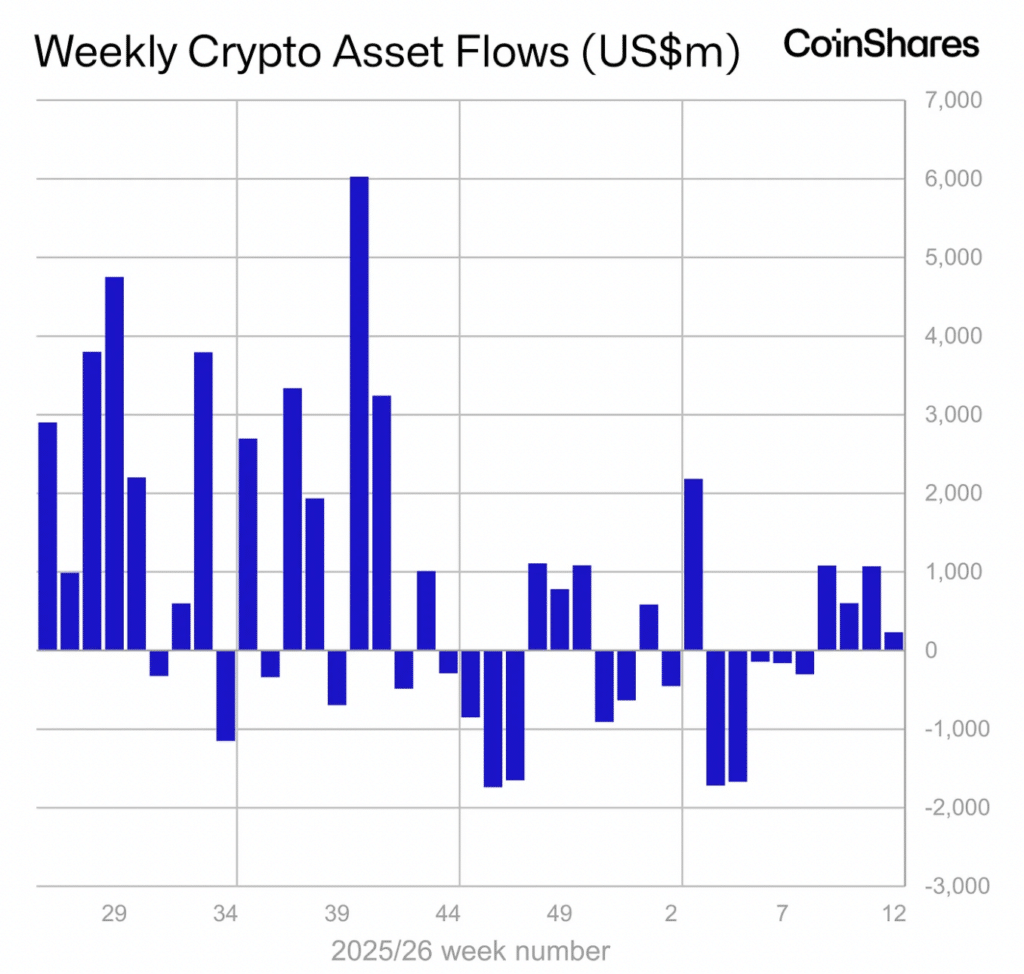
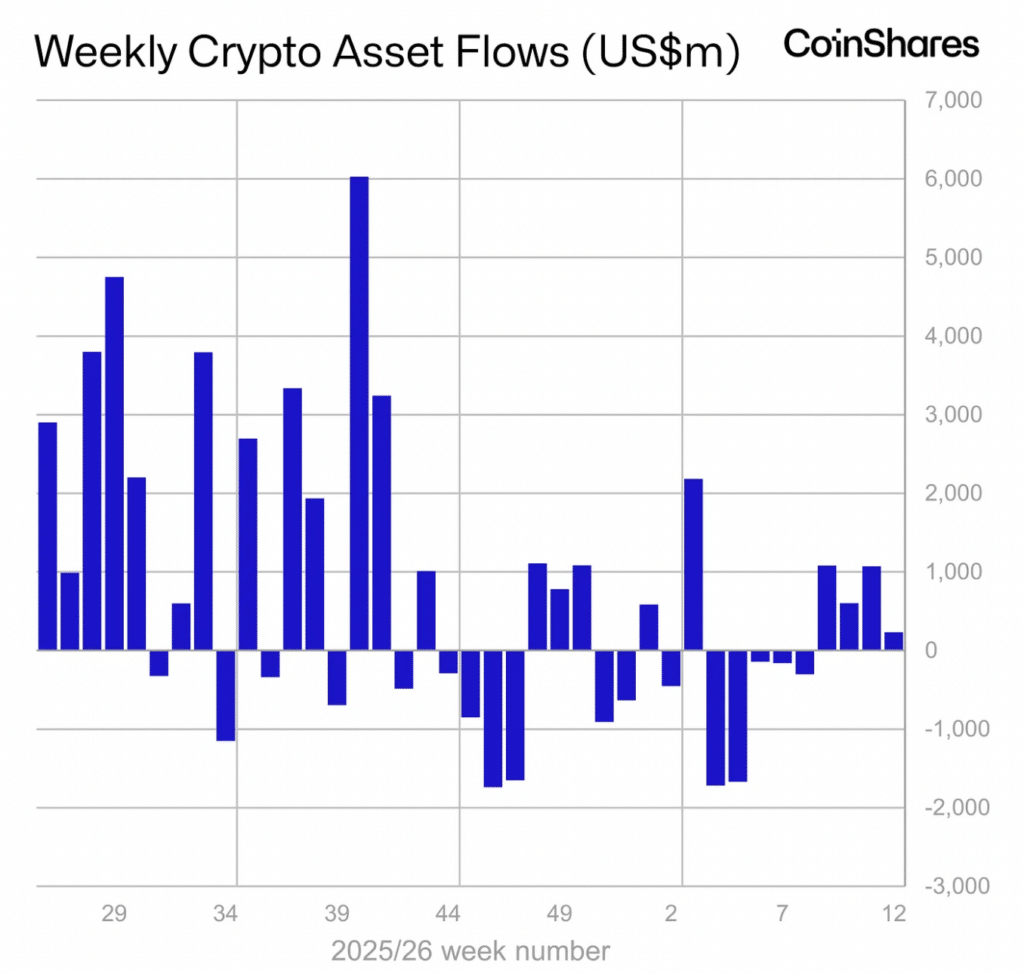
According to a report from CoinShares, digital asset investment products saw $230 million in inflows. However, this figure was much lower than the ones seen in previous weeks.
Source: CoinShares

Looking closer, most of the money came in before the Fed’s meeting, with $635 million added in just two days. After the Fed signaled a more cautious approach, about $405 million quickly left the market.

This suggested that investors may be reacting more to interest rate expectations than global conflicts, adjusting their positions based on future monetary policy.

While total inflows of $230 million hinted at a recovering market, the data showed that investor sentiment is still mixed.

Analysis of different coins and their performance over the past week

Bitcoin [BTC] is still leading the market, bringing in about $219 million in weekly inflows. However, the overall picture revealed that investors are unsure about what comes next.

Interestingly, short-Bitcoin products also saw $6 million in inflows, which means some investors are betting on a price drop while others are buying the dip.

At the same time, Chainlink [LINK] and Hyperliquid [HYPE] have been gaining attention, bringing in a combined $9.1 million.

Notably, Solana [SOL] has been strong, bringing in $17 million and extending its inflow streak to seven weeks. Ethereum [ETH], however, saw $27.5 million in outflows.
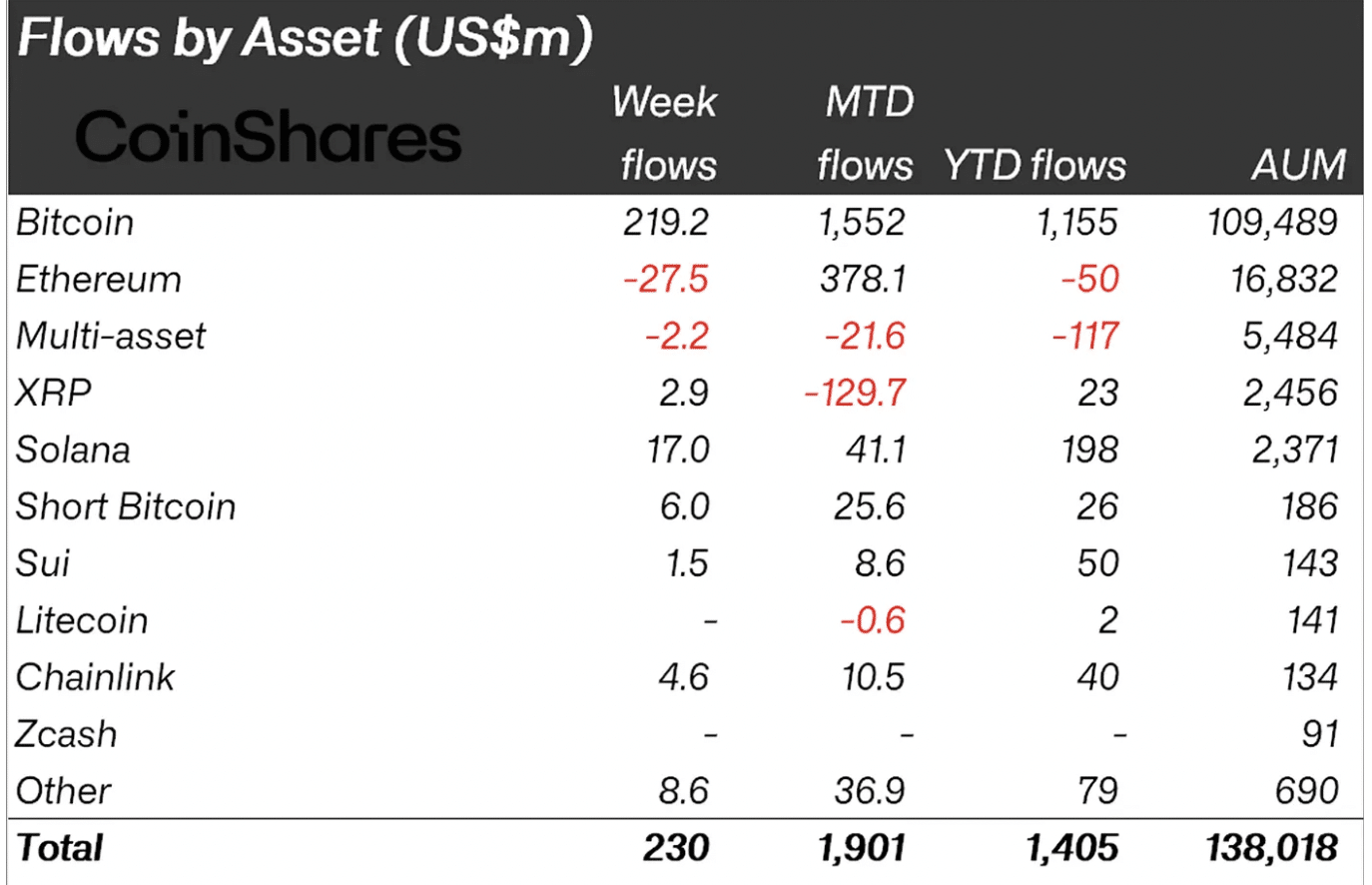
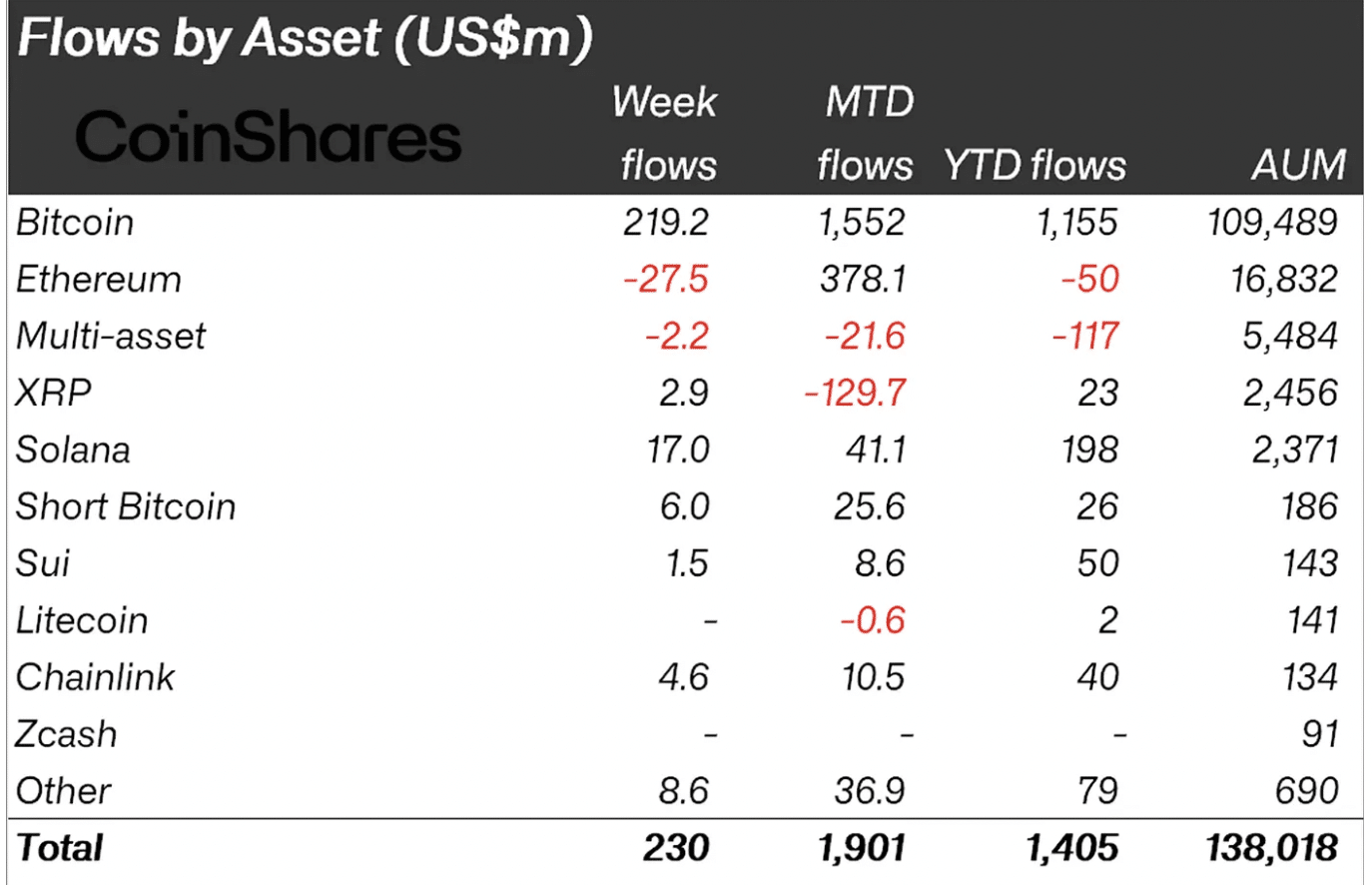
Source: CoinShares

Overall, this suggsted that the investors are being cautious after the recent signals from the FOMC.

Price action and more

These figures come on the back of most cryptocurrencies falling on the charts over the past week. ETH and HYPE were hit the hardest, both falling by around 6.69%.

LINK also dropped by about 5.21% over the past week. BTC performed a bit better, with a smaller decline of 3.97%. Meanwhile, SOL exhibited the most strength, slipping only 2.03% over the same period.

However, even though prices were falling, money was still flowing into the market.

In fact, Santiment’s 7-day active addresses suggested that Chainlink was leading in terms of user activity. All while Ethereum and Bitcoin showed more moderate and stable usage patterns.
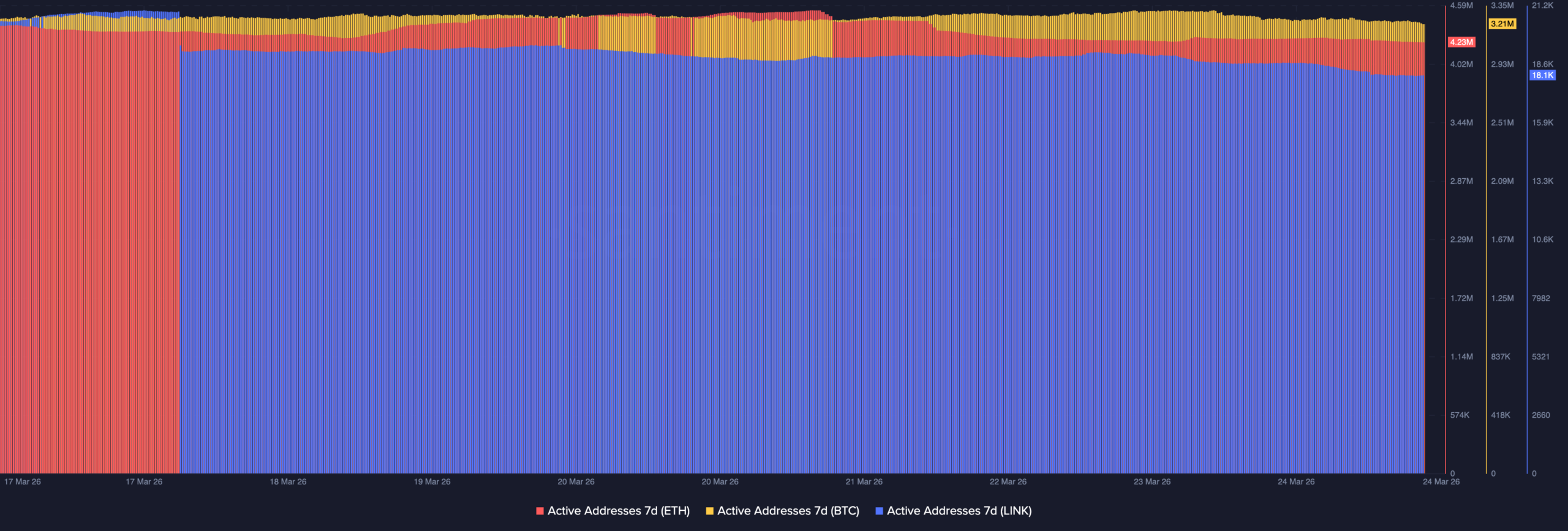
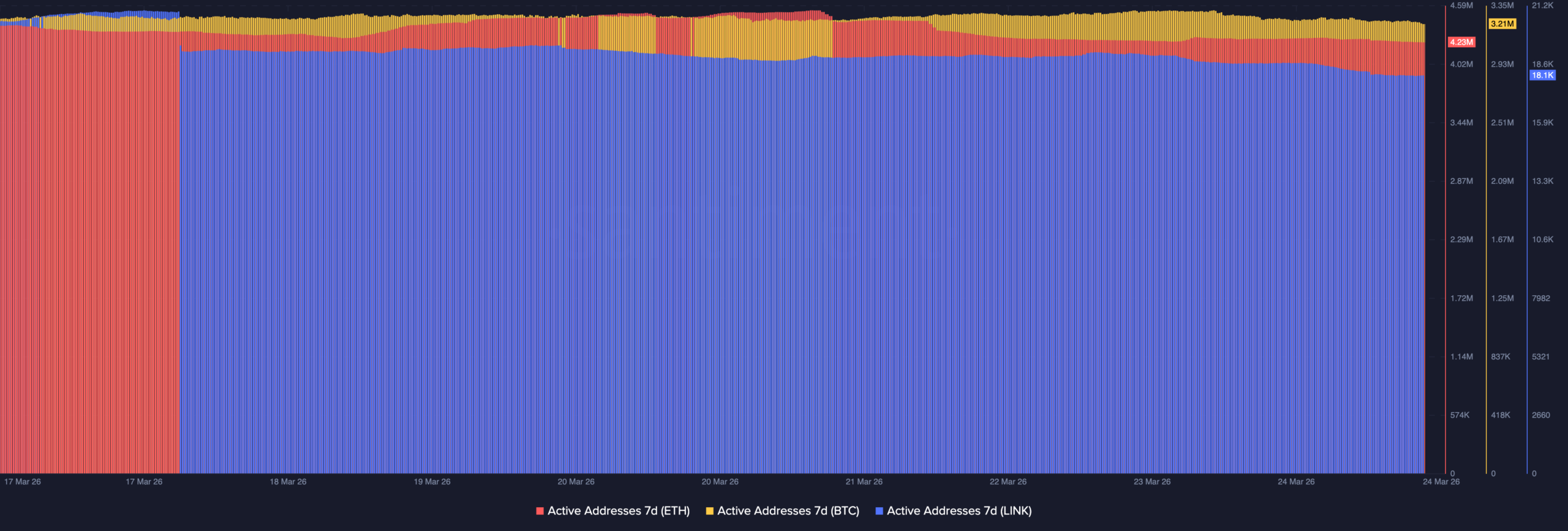
Source: Santiment

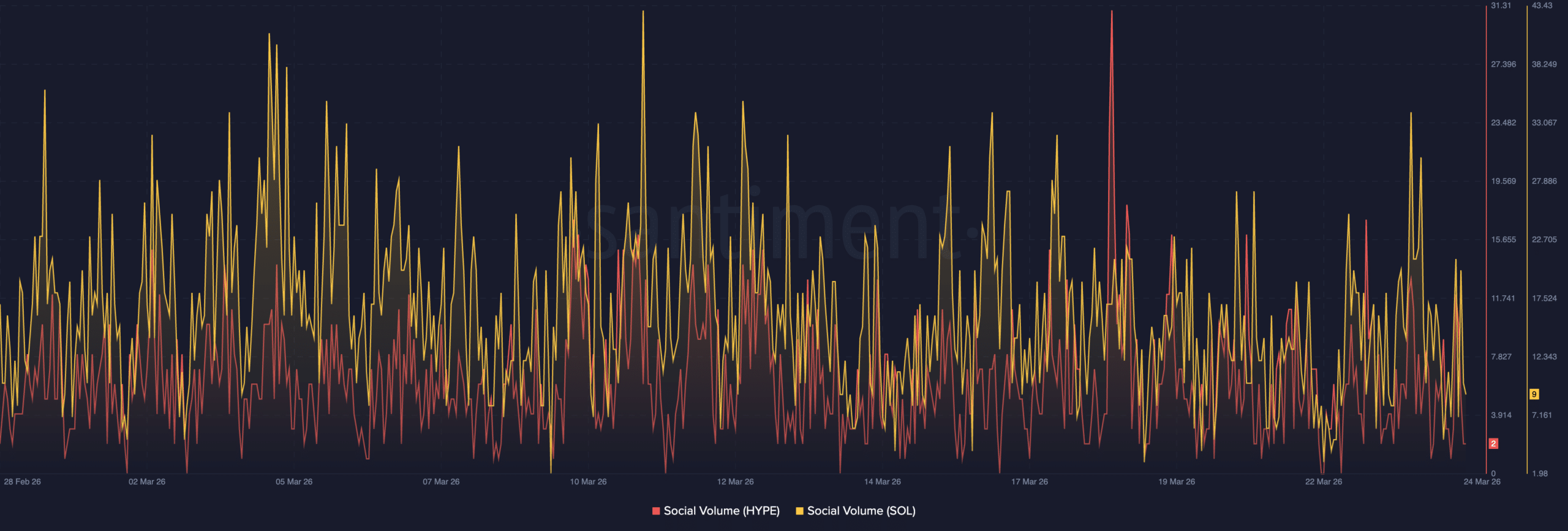
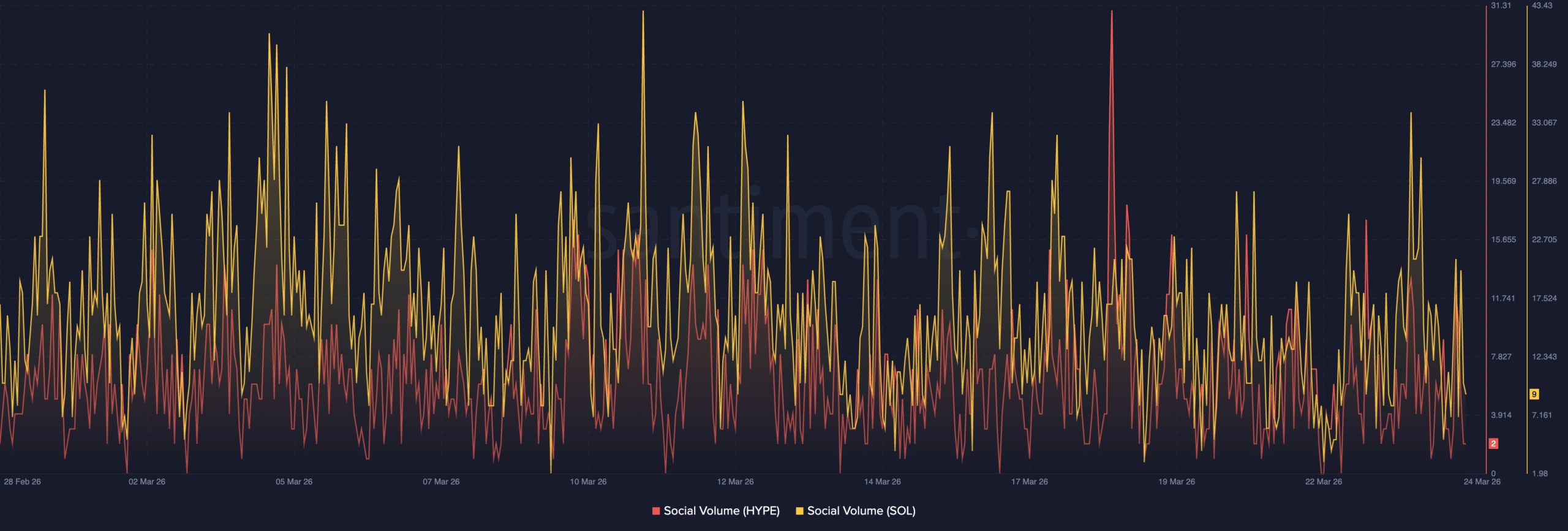
Additionally, the social volume data suggested that Solana has maintained a steady and strong presence in discussions over time.

On the contrary, while Hyperliquid has seen short bursts of attention, it has struggled to sustain any consistent momentum.
Source: Santiment

Is altcoin season around the corner?

All this has also pushed analysts to think that the altcoin season is imminent.

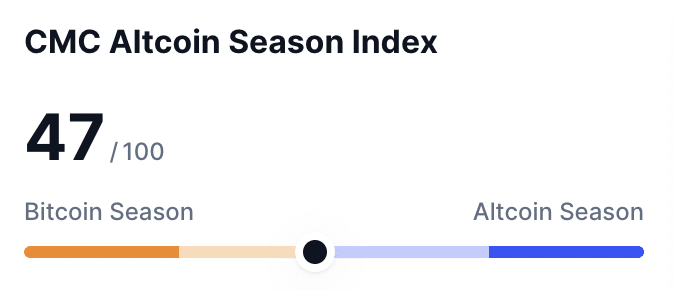
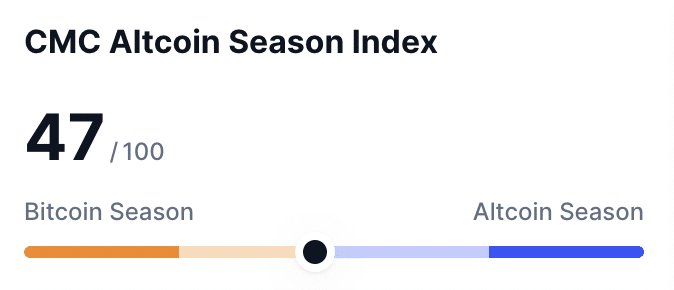
For its part though, the Altcoin Season Index, with a press time reading of 47, needs to reach 75 to confirm a full altcoin season.
Source: CoinMarketCap

Hence, if inflows from regions like the U.S and Europe continue, this phase could be the final buildup before a broader altcoin rally begins.


Final Summary

  • Institutional behavior hinted at a “buy the dip” mindset, rather than panic selling.
  • Gap between price action and capital inflows alluded to hidden strength beneath short-term market weakness.


Related Questions

QWhat was the main reason behind the crypto market slowdown last week, according to the article?

AThe main reason was the U.S. Federal Reserve's cautious approach, as investors reacted more to interest rate expectations than global conflicts.

QHow much money flowed into digital asset investment products before the Fed's meeting, and how much left after?

A$635 million flowed in before the Fed's meeting, and about $405 million left after the Fed signaled a more cautious approach.

QWhich cryptocurrency saw the largest weekly inflows, and how much was it?

ABitcoin [BTC) saw the largest weekly inflows, bringing in about $219 million.

QWhat does the Altcoin Season Index need to reach to confirm a full altcoin season?

AThe Altcoin Season Index needs to reach 75 to confirm a full altcoin season.

QWhat was the overall net inflow for digital asset investment products last week?

AThe overall net inflow for digital asset investment products last week was $230 million.

Related Reads

Has Hook Summer Really Arrived? sato, Lo0p, FLOOD Ignite the New Narrative of Uniswap v4

"Hook Summer" Arrives? Sato, Lo0p, FLOOD Ignite Uniswap v4 Narrative Amidst a slight market recovery, attention within the Ethereum ecosystem has shifted to Meme coins built on Uniswap v4's Hook protocol. Following ASTEROID, tokens like sato, sat1, Lo0p, and FLOOD have become market focal points, with market caps ranging from millions to tens of millions, bringing concentrated liquidity to a narrative-dry market. Uniswap v4 Hooks are "plugin smart contracts" that allow developers to inject custom logic at key points in a liquidity pool's lifecycle (initialization, adding/removing liquidity, swaps, etc.), making the AMM programmable. Recent representative projects include: * **sato**: Market cap peaked over $38M; uses a v4 curve mechanism for minting/burning, locking ETH as reserve. * **sat1**: Market cap briefly exceeded $10M, positioning as an "optimized sato," but later declined significantly. * **Lo0p**: Market cap neared $6.6M; a "lending AMM protocol" allowing users to borrow ETH against deposited LO0P tokens without immediate selling pressure. * **FLOOD**: Market cap approached $6M; channels trading reserves into Aave v3 to generate yield, which is retained in the pool. The emergence of these Hook-based tokens could drive long-term growth for the Uniswap ecosystem by attracting users and liquidity to v4 pools. Combined with Uniswap's activated fee switch (partially used to burn UNI), the long-term outlook for UNI appears positive. However, short-term UNI price appreciation is not directly guaranteed. Factors include the sustainability and lifecycle of these new tokens, their price volatility, overall market conditions, and regulatory pressures. Currently, Uniswap v4's TVL ($595M) lags behind v3 and v2, indicating Hook adoption still requires time to mature. In summary, the Hook ecosystem serves as "long-term nourishment" for UNI, but acts more as a "catalyst" than a direct "booster" in the short term. Note: These are early-stage experimental tokens and may carry unknown risks.

marsbit14m ago

Has Hook Summer Really Arrived? sato, Lo0p, FLOOD Ignite the New Narrative of Uniswap v4

marsbit14m ago

Has Hook Summer Truly Arrived? sato, Lo0p, FLOOD Ignite the New Uniswap v4 Narrative

With the broader market showing signs of recovery, a new wave of interest has emerged around Ethereum-based meme coins. Following ASTEROID, tokens like sato, sat1, Lo0p, and FLOOD, built upon the Uniswap v4 Hook protocol, are capturing market attention. Their market capitalizations range from millions to tens of millions of dollars, injecting much-needed focused liquidity into a market lacking narratives. This article explores whether this trend signifies an incoming "Hook Summer" and its potential impact on UNI's price. Hooks are essentially plug-in smart contracts for Uniswap v4 liquidity pools, allowing developers to inject custom logic at key points in a pool's lifecycle (like initialization, adding/removing liquidity, swaps). This transforms the AMM into programmable building blocks. Key highlighted projects include: * **sato**: Peaked over $38M market cap. It utilizes a v4 curve for minting/burning; buying locks ETH as reserve to mint new tokens, while selling redeems ETH from the reserve and burns tokens. * **sat1**: Market cap briefly exceeded $10M, promoted as an "optimized sato," but later declined significantly. * **Lo0p**: Reached nearly $6.6M. It's a lending AMM protocol where buying LO0P tokens locks them as collateral, allowing users to borrow ETH from the pool reserve at 40% LTV, aiming to improve capital efficiency for idle ETH in LPs. * **FLOOD**: Peaked near $6M. Its mechanism directs asset reserves from buys into Aave v3 to generate yield, with fees and interest retained in the pool to potentially influence the token's price long-term. In the long term, the development of the Hook ecosystem can attract users and liquidity to Uniswap v4, benefiting UNI's fundamentals—especially combined with the recent activation of the protocol fee switch, where a portion of fees is used to burn UNI. However, in the short term, these Hook-based tokens are unlikely to directly drive significant UNI price appreciation. Their impact is moderated by factors like token sustainability, price volatility, and broader market and regulatory conditions. Currently, Uniswap v4's TVL ($595M) still trails behind v2 and v3, indicating adoption and growth will take time. The article concludes that while the Hook ecosystem provides long-term "nourishment" for UNI, its short-term role is more of a "catalyst" than a "booster." Readers are cautioned that these are early-stage experimental tokens and may carry unknown risks.

Odaily星球日报26m ago

Has Hook Summer Truly Arrived? sato, Lo0p, FLOOD Ignite the New Uniswap v4 Narrative

Odaily星球日报26m ago

Interview with Michael Saylor: I Did Say I Would Sell Bitcoin, But Never a Net Sale

Interview with Michael Saylor: I Said We'd Sell Bitcoin, But Never Be a Net Seller In a recent podcast, MicroStrategy Executive Chairman Michael Saylor clarified the company's stance on potentially selling Bitcoin. Following MicroStrategy's earnings call statement about being prepared to sell BTC to fund dividends for its STRC (Strategic) credit product, Saylor emphasized the distinction between selling and being a "net seller." Saylor explained the core business model: MicroStrategy sells credit instruments like STRC and uses the proceeds to buy Bitcoin, which is viewed as "digital capital" expected to appreciate around 30-40% annually. A portion of these capital gains can then be used to pay the dividends on the credit products. He stressed that even if the company sells some Bitcoin for dividends, it simultaneously buys much more with new credit issuance. For example, after raising $3.2 billion from STRC sales in April, the dividend obligation was only $80-90 million, making the company a net buyer. The clarification aims to counter market narratives questioning the value of Bitcoin on MicroStrategy's balance sheet if it were never sold, and to dismiss claims of a "Ponzi scheme." Saylor reiterated his personal philosophy for investors: "Don't be a net seller of bitcoin" and ensure your Bitcoin holdings increase each year. Saylor also discussed Bitcoin's role as the foundation for "digital credit," noting that STRC has become the largest and most liquid preferred stock issue in the U.S., offering high risk-adjusted returns (Sharpe ratio). He highlighted Bitcoin's deep liquidity, stating that even large purchases by MicroStrategy do not move the market significantly, which is driven by macro factors, geopolitical tensions, and capital flows from ETFs and credit products. Finally, Saylor reflected on his early inspiration from sci-fi books, which motivated his path to MIT, and maintained his fundamental thesis on Bitcoin remains unchanged: it is superior digital capital enabling superior digital credit.

链捕手30m ago

Interview with Michael Saylor: I Did Say I Would Sell Bitcoin, But Never a Net Sale

链捕手30m ago

Beaten SK Hynix Employees in China: Year-end Bonus Less Than 5% of Korean Staff's

"SK Hynix Chinese Staff Hit Hard: Bonuses Less Than 5% of Korean Counterparts" Driven by the AI boom, South Korea's SK Hynix is experiencing record performance, with media reports predicting massive year-end bonuses for its employees, making them highly desirable in the matchmaking market. However, this prosperity starkly contrasts with the situation for the company's Chinese employees. According to reports, SK Hynix operates under a rule allocating 10% of operating profit for employee bonuses. While projections suggest Korean employees could receive bonuses reaching millions of RMB, a Chinese employee with over a decade of technical experience revealed the disparity: "If they get 3 million, Chinese staff get less than 5% of that." After adjustments based on KPI ratings, this employee's highest bonus was slightly over 100,000 RMB. Bonuses are paid annually in Korea but semi-annually in China. During the industry downturn in 2023-2024, Chinese employees received no bonus at all. The gap extends beyond bonuses. Recruitment posts for SK Hynix's Chinese factories (in Wuxi, Dalian, Chongqing) show engineer monthly salaries ranging from 10,000 to 35,000 RMB, with a 13th-month salary promised. Chinese employees also receive standard benefits like annual leave but lack stock incentives, which are reportedly unavailable to them. Furthermore, management positions in China are predominantly held by Korean personnel, though industry observers note a gradual increase in local middle managers over time. SK Hynix has confirmed the 10% bonus rule but cautioned that specific future bonus amounts remain unpredictable. The company forecasts strong demand for HBM and other high-value enterprise products for the next 2-3 years, driven by AI infrastructure investment. This focus on business-to-business markets may continue to constrain supply for consumer products, potentially prolonging price increases for components like memory.

链捕手44m ago

Beaten SK Hynix Employees in China: Year-end Bonus Less Than 5% of Korean Staff's

链捕手44m ago

Trading

Spot
Futures
活动图片