Bitcoin Rainbow Chart updated with new lower band after second breach

cryptoslatePublished on 2022-09-20Last updated on 2022-09-21

Abstract

Bitcoin Rainbow Chart updated with new lower band after second breach

The infamous Bitcoin Rainbow Chart has been updated to include a new lower band called “1BTC = 1BTC.” The chart echoes PlanB’s stock-to-flow model in terms of sentiment, with bands indicating when to buy and sell Bitcoin.
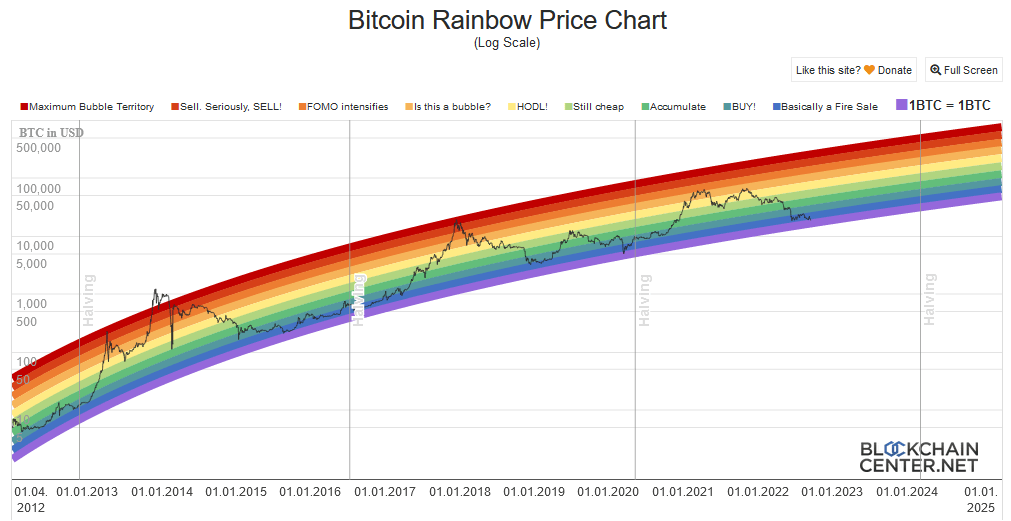
Bitcoin Rainbow Chart

Source: blockchaincenter.net

The original Rainbow Chart is dead. Long live the Rainbow Chart with the new indigo color band!”

Twitter account @rohmeo_de commented that the new indigo band “was always missing.” Its inclusion now accounts for the 2020 dip, which saw the Bitcoin price breach the previous lowest band.

In November 2013, BTC breached the upper band before returning within the parameters, only for another upper breach to occur in January 2014.

However, referencing the bearish macro backdrop and invalidation of the Stock-to-Flow predictive price model, @omgbruce mocked the update, implying it was a desperate attempt to stay valid.

The Bitcoin Rainbow Chart

The Bitcoin Rainbow Chart documents the BTC price logarithmically across ten bands, denoting different stages of sentiment. The general idea is that price would move between bands and indicate possible calls to action, such as sell during a red-hot market.

As with all predictive price models, the price should not breach the upper or lower bands. Otherwise, the calculations that derive the bands’ positions must be invalid or, at the least, incomplete.

Its creators warn that the chart is not investment advice, past performance does not indicate future results, and the chart is a fun way of looking at long-term price movements.

Before the addition of the new lowest, “1BTC = 1BTC” band, “Basically a Fire Sale” was the previous lowest band.

September 19 sees Bitcoin dip into the new “1BTC = 1BTC” band amid a weekend sell-off that has continued into Monday. At 08:00 UTC, bulls stepped in at $18,200 to stop the slide, sending BTC to $18,800.

Since then, there have been two further retests of $18,800 resistance, with bulls so far unable to break through.
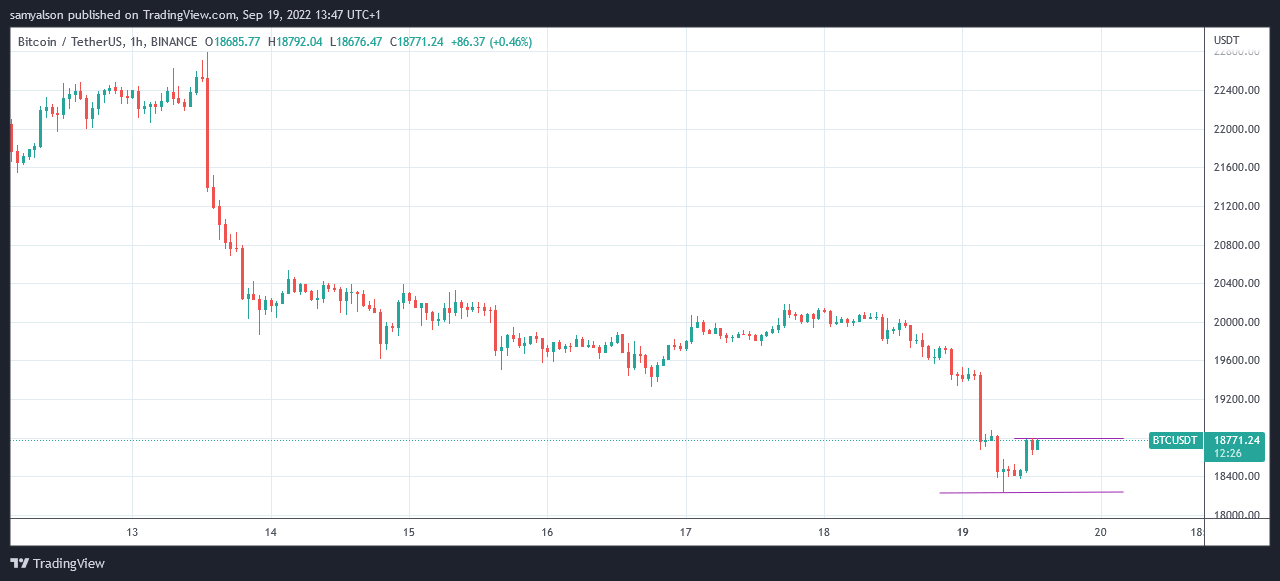
Bitcoin hourly chart

Source: BTCUSDT on TradingView.com

With macro factors weighing heavily on crypto markets, the likelihood of a return back above $20,000 in the near term is low.

The revised Rainbow Chart has a bottom price of around $16,900.

Stock-to-Flow (S2F) gets invalidated

Plan B’s S2F model predicts the price of Bitcoin based on the current production rate. It assumes a $100,000 BTC price between now and May 2024.

Despite deviations in the past, the model saw a significant divergence around June, leading to some calling the model invalid, even harmful, due to the false sense of hope price predictive models can give.

In response, Plan B recently took to Twitter, saying he believes S2F is still valid and expects it to snap back in line before the next halving.

Related Reads

More and More People Are Using Xiaohongshu as an AI Incubator

"More and more people are turning Xiaohongshu into an AI incubator," observes an article exploring a shift in China’s tech innovation landscape. The AI wave is no longer dominated by experienced tech experts; instead, young people—often with humanities backgrounds, and increasingly Gen Z or even younger—are driving creativity. This reflects a broader trend: AI is transforming entrepreneurship from a capital-heavy, top-down model into a lightweight, accessible process. The rise of "AI Native" creators was highlighted at a recent Xiaohongshu hackathon, where diverse teams showcased projects targeting highly specific, everyday problems—from AI-generated PPT improvements to brain-controlled wheelchairs and apps that simplify communication with hairstylists. The winning project, "Pocket Guitar," offers a portable, user-friendly music tool that mimics real guitar playing. These innovators embrace a "Build in Public" approach: they share ideas, progress, and failures openly on Xiaohongshu, turning development into a collaborative, community-driven process. This method helps validate demand, recruit team members, and grow user bases organically. For instance, one 23-year-old founder assembled a distributed team through technical discussions on the platform, while a 13-year-old award winner used AI to learn coding and solve real-world problems. Two key factors enable this movement: AI democratization (lowering technical barriers) and the power of social communities (enabling open collaboration and instant feedback). Xiaohongshu, originally a lifestyle and shopping guide platform, has thus evolved into a vital innovation infrastructure. It connects creators with real user needs, facilitates low-cost prototyping, and fosters a culture of co-creation. This shift signals a new era of innovation—defined not by grand narratives and scale, but by granular insights, individual creativity, and trust-based community support. Xiaohongshu’s role is expanding from answering "what to buy" to "what to create," positioning it as a potential "App Store for the AI era."

marsbit33m ago

More and More People Are Using Xiaohongshu as an AI Incubator

marsbit33m ago

Institutional Adoption of Prediction Markets Stuck at the Third Stage

Prediction markets are transitioning from niche platforms focused on elections and sports to mainstream financial tools, as highlighted at Kalshi Research's inaugural conference. While sports still dominate trading volume (around 80%), non-sports categories like macroeconomics, politics, and entertainment are growing faster, signaling a shift from entertainment-based trading to information and risk management tools. Institutions, including Wall Street firms, are increasingly using prediction markets for data reference (Stage 1 adoption), with some progressing to system integration (Stage 2). However, full-scale trading (Stage 3) is limited due to the lack of margin trading, requiring full collateral for positions—a barrier for leverage-dependent entities. Kalshi is working with regulators to introduce margin mechanisms. Key insights from participants like Goldman Sachs and CNBC emphasize the value of real-time pricing for events (e.g., Fed decisions, tariffs), providing benchmarks previously unavailable. The path to maturity mirrors historical financial instruments like options, with expectations that prediction markets will become institutional staples within five years. Political leaders, including Trump and Schumer, now cite Kalshi odds, underscoring its growing influence. The platform rewards domain expertise over traditional finance backgrounds, attracting diverse participants from fields like music and poker. Ultimately, prediction markets are evolving into critical infrastructure for pricing uncertainty.

marsbit1h ago

Institutional Adoption of Prediction Markets Stuck at the Third Stage

marsbit1h ago

Trading

Spot
Futures
活动图片