[Анализ рынка от Huobi] Покупатели вернулись на рынок биткоина. Эфир замер в ожидании «Слияния»

HTX NewsPublished on 2022-09-13Last updated on 2022-09-13

Abstract

7 сентября биткоин и Ethereum опустились к локальным минимумам $18 500 и $1490 соответственно, после чего рынок начал быстро восстанавливаться. 12 сентября цена первой криптовалюты преодолела уровень $22 000, а Ethereum вырос до $1790 в ожидании активации обновления The Merge.

1. BTC показал высокий объем торгов

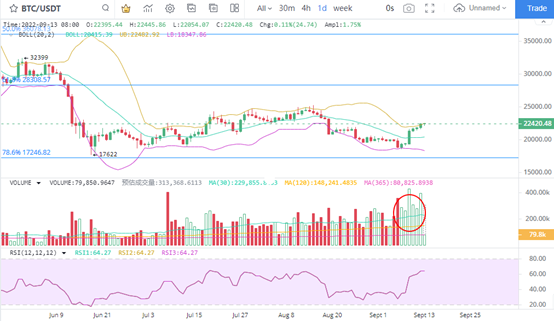
После непродолжительной коррекции цена BTC восстановилась и показывает бычью динамику: рост с 18 799 до 22 400 долл, где, как видно на графике, проходит средняя скользящая полосы Боллинджера. Всё это сопровождалось значительным увеличением объёма торгов за последние 7 дней, что явно указывает на возобновление активности трейдеров после двух месяцев штиля.

Это также происходит на фоне выигрышной недели для американских акций. Биткоин тесно коррелирует с фондовыми рынками, в частности с Nasdaq. При этом, на рынке ждут отчета по индексу потребительских цен США, который должен быть опубликован во вторник, чтобы увидеть, в каком направлении движется инфляция, что может дать подсказки относительно будущих шагов Федеральной резервной системы США.
2. Среднесрочные и краткосрочные BTC-инвесторы продают

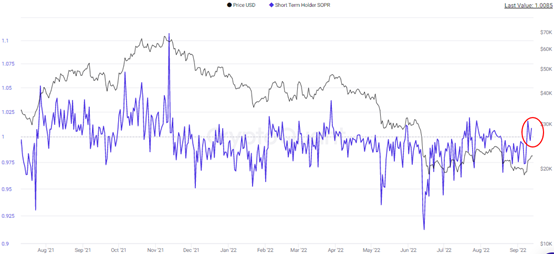
SOPR (Spent Output Profit Ratio) — инструмент, позволяющий отслеживать общее состояние прибыли/убытка рынка в целом. Соотношение получается путем деления цены, по которой продаются монеты, на цену, уплаченную за эти монеты.

Когда SOPR>1 находится выше 0, что свидетельствует о том, что инвесторы в целом получили прибыль. И чем выше этот показатель, тем большего давления со стороны медведей можно ожидать. SOPR больше 1 находится уже несколько дней подряд – с 9 сентября, что означает участники рынка уже несколько дней подряд фиксируют прибыль, и всё больше краткосрочных и среднесрочных инвесторов будут намерены продавать монету в ближайшее время, что окажет на цену определенное «медвежье» давление.
3. Нереализованный убыток BTC-держателей значительно сократился

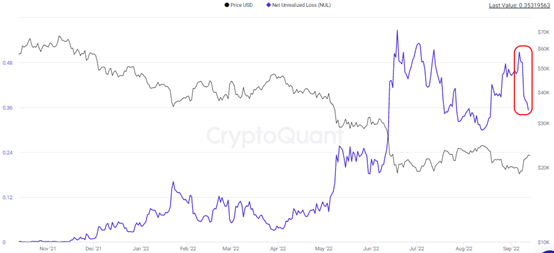
Одновременно с тем, как цена отскочила с уровня ниже 19 000 до более, чем 22 000 долларов, также значительно снизился нереализованный убыток держателей BTC, с недавнего локального максимума 0,507, зафиксированного 6 сентября до примерно 0,353. Это указывает на то, что множество убыточных ордеров исчезло, а значит и давление продаж быстро снижается.

Тем не менее, в абсолютном исчислении доля нереализованного убытка все еще находится на высоком уровне – 35,5%.
4. Эфир немного растёт. Рынок в ожидании «Слияния»

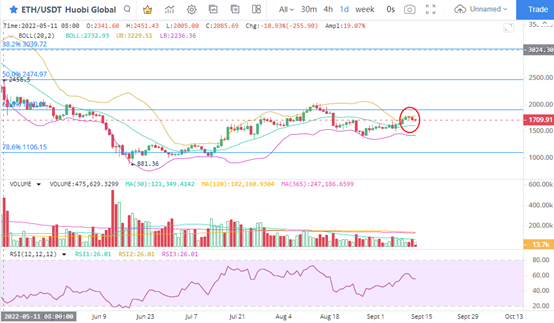
Несмотря на грядущее обновление, динамика Эфира выглядит хуже: с минимума 7 сентября актив прибавил 15%. После достижения локального максимума на отметке 1790 долларов цена повторно протестировала поддержку на уровне 1700 долларов.

При этом, внутридневной объем торгов по-прежнему сокращается, что указывает на то, что рынок по-прежнему находится в ожидании грядущей процедуры «Слияния» Ethereum, в ходе которой предусматривается переход сети с алгоритма консенсуса Proof-of-Work (PoW, доказательство выполнения работы) на Proof-of-Stake (PoS, доказательство доли владения).

Для пробития сопротивления на отметке 2000 долларов нужно удержать отметку 1700 долларов. Рост выше 2000 возможен только при условии, что «Слияние» пройдёт успешно. В обратном случае цена может обновить локальные минимумы ниже 1400 долларов.
Related Reads

a16z: In the AI Era, Company Competition for Talent Starts with Job Title Naming

The article discusses how companies in the AI era are competing for talent through strategic "title arbitrage," or the renaming of key roles to reflect and attract new, high-value capabilities. It uses Palantir's creation of the "Forward-Deployed Engineer" (FDE) as a prime example. This title reframed client-facing technical work from a peripheral "implementation" role into a core, high-status engineering function. The move was strategic, allowing Palantir to attract talent that blended technical skill with business acumen and to dominate the market's perception of this capability. The piece argues that job titles are an organizational language that signals the value and authority of certain work. Effective new titles, like "Data Scientist" or "Site Reliability Engineer," emerge when a role's strategic importance genuinely outgrows its old name. Conversely, mere title inflation without substantive change is ineffective. For AI companies, particularly in B2B, this is a crucial strategy. AI transformation creates new high-leverage roles (e.g., "Legal Engineer," "GTM Engineer") that combine domain expertise with technical automation. By naming these roles, a company can help clients internally legitimize these change-makers. This, in turn, builds market mindshare, associating the company with the new capability. In conclusion, as AI blurs the lines between product and service, the ability to accurately name and organize the critical, client-adjacent work that defines product learning will be a key competitive advantage. The first to define this new organizational language plants a flag in the market's mind.

marsbit30m ago

a16z: In the AI Era, Company Competition for Talent Starts with Job Title Naming

marsbit30m ago

Interview with Strategy CEO: Can STRC Recover After Selling Bitcoin?

Interview with Strategy CEO Phong Le on the recent sale of 32 Bitcoin and its impact. He clarifies the move was a small, strategic action to demonstrate liquidity to debt holders, test internal processes, and prove operational discipline—not a response to fears of a "death spiral" from DeFi protocols leveraging STRC (Strategy's preferred stock product), which he notes holds less than 10% of STRC. Le emphasizes Strategy’s long-term focus as the largest corporate Bitcoin holder, using the adage that markets are a "voting machine" short-term but a "weighing machine" long-term. Decision-making is data-driven, involving the board, complex modeling, and multiple stakeholder considerations, moving beyond a founder-centric model. He outlines various capital options but stresses the strategic importance of "doing nothing" as a valid choice, citing resilience built during the 2022 bear market. Le expresses unwavering belief in Bitcoin's foundational value for global sovereignty and its future role in an AI-driven economy with trillions of autonomous agents. Addressing STRC's current price below its $100 face value, Le explains recent pressure was due to using dollar reserves for bond buybacks. He expects STRC to return to par as reserves are replenished and its semi-monthly dividend payments begin, noting the product is heavily over-collateralized. Finally, Le confirms the company sold Bitcoin the week prior to May 31st, as disclosed in an 8-K filing, leaving prediction market interpretations to others. The overarching philosophy remains "Spread Bitcoin with love," embracing all methods of gaining Bitcoin exposure.

marsbit1h ago

Interview with Strategy CEO: Can STRC Recover After Selling Bitcoin?

marsbit1h ago

IOSG Founder: Ethereum Doesn't Need Another Leap of Technical Faith, It Needs a Musk-style Compromise

Jocy, founder of IOSG Ventures, argues that Ethereum does not need renewed technological faith but a "Musk-like compromise." The recent formation of ETHLabs—funded by major ETH holders like BitMine and Lubin—highlights a market-driven move to fill a gap left by the Ethereum Foundation (EF), signaling a loss of confidence in its decentralized, hands-off approach. The core critique contrasts Vitalik Buterin's (V) idealistic, technology-first vision with Elon Musk's pragmatic, business-driven execution. The author asserts Ethereum's current shortage is not another technical roadmap but a clear, real-world application narrative and a leader willing to engage directly with commercial realities—like Musk. Internal issues are emphasized, citing EF's management problems and talent drain. While the new decentralized model with independent nodes like ETHLabs addresses the single foundation's limitations, it risks fragmentation without cohesive direction. True cohesion, the author suggests, must come from a shared, compelling narrative around ETH's value, not just from aligned financial interests. Independence claims for new entities are seen as aspirational, needing years of transparency to build trust. The ultimate threat is not competitors like Solana, but the broader shift of attention and talent toward AI. Ethereum has a limited window—12 to 18 months—to recapture focus by delivering tangible, real-world applications. The conclusion urges V to shift from abstract ideals to grounded, pragmatic leadership. The time for this crucial pivot is running out.

marsbit2h ago

IOSG Founder: Ethereum Doesn't Need Another Leap of Technical Faith, It Needs a Musk-style Compromise

marsbit2h ago

Trading

Spot
Futures
活动图片