$500 to Buy OpenAI Stock: Silicon Valley's Most Respectable Liquidity Invitation

marsbitPublished on 2026-04-23Last updated on 2026-04-23

Abstract

Silicon Valley's largest venture capital platform, AngelList, has launched a new fund called USVC, allowing U.S. retail investors to buy into high-profile AI companies like OpenAI, Anthropic, and xAI with a minimum investment of $500—no accredited investor status required. Promoted by AngelList co-founder Naval Ravikant, the fund is framed as an opportunity for ordinary people to access high-growth private tech investments traditionally reserved for VCs. However, critics argue it functions more like an exit vehicle for early insiders. USVC acquires shares not through primary rounds but largely via secondary transactions—purchasing stakes from early investors, VC funds, and employees looking to cash out at peak valuations. With companies like xAI heavily weighted in the portfolio, the fund effectively channels retail money into providing liquidity for insiders who entered at much lower valuations. The fund’s structure raises concerns: shares are illiquid, with no secondary market, and buybacks are limited and discretionary. The actual annual fee reaches 3.61%, far above the advertised 1% management fee. This model parallels the "low float, high fully diluted valuation" strategy seen in crypto, where early investors profit by selling to latecomers at inflated prices. The timing—alongside similar moves by platforms like Robinhood—suggests that Silicon Valley’s sudden interest in retail inclusion may be less about democratizing access and more about securing exits for insider...

Author: David, Shencha TechFlow

When Silicon Valley VCs are finally willing to let ordinary people join the table, it usually means one thing.

The game is almost over.

Yesterday, AngelList launched a fund product called USVC. AngelList is Silicon Valley's largest venture capital infrastructure platform. According to its official data, it manages over $125 billion in assets and has served more than 25,000 funds.

It has now opened a door to all US investors: a minimum investment of $500, no accredited investor certification required, directly allowing holders to own shares in seven AI companies, including OpenAI, Anthropic, and xAI.

Promoting this product is Naval, also a co-founder of AngelList. His book "The Almanack of Naval Ravikant" has made him one of the few figures in Silicon Valley with both a strong investment track record and significant public influence.
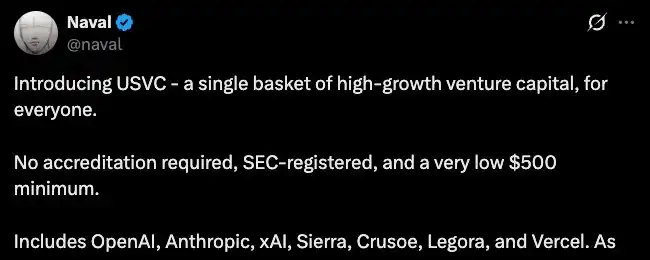
He posted a long thread on X promoting USVC, the gist being that early-stage tech investment is the "adventure capital" of our era, and ordinary people have always been locked out. By the time some great AI companies IPO, their growth is already over. USVC is here to open that door.

Within hours of the tweet, comments emerged asking an uncomfortable question that soured the mood:

These tech companies have been pushed to sky-high valuations, all the explosive growth happened in the private market. Now inviting retail investors to join, what's the difference from looking for exit liquidity?

USVC holds shares in seven companies, with the heaviest weighting in xAI. According to a Decrypt report, as of the end of March, about 44% of USVC's capital had been invested in these seven companies.

However, none of these companies are public. How did they get the shares?

According to the prospectus, USVC has three ways to acquire its targets: investing in emerging fund managers, participating in company growth-round financing, and purchasing secondary shares through AngelList's network.

The first two are straightforward. The third is the key.

Secondary shares mean that the company is not issuing new shares to sell to you; someone who already holds shares is transferring their portion to you. Who is transferring? Early angel investors, VC funds, early employees.

These people might have gotten on board when the company was valued at tens of millions of dollars. Now the company is worth tens or even hundreds of billions. They want to turn paper gains into real money before the IPO. But the private market isn't like a stock exchange; there's no ready queue of buyers waiting to take the other side.

USVC solves this problem perfectly. It raises funds from retail investors and uses that money to buy shares from insiders who want to exit.

AngelList does have a natural advantage for this. According to its website, there are over 4,500 active fund managers on the platform operating more than 25,000 funds, invested in over 13,000 startups.

This network is full of people and shares wanting to be sold, with AngelList sitting right in the middle. This is also the "exclusive access" USVC repeatedly emphasizes.

The access is indeed exclusive, but the direction of the trade doesn't seem to favor retail.

In this trade, the sellers are those who got in when the company was valued at tens of millions. The buyers are those getting in when it's valued at hundreds of billions. The sellers lock in returns of tens or even hundreds of times. The buyers are betting that these already fully-priced companies can still go higher.

Simultaneously, the terms retail investors are getting also say something.

According to the USVC prospectus, the fund is not listed on any exchange, does not anticipate a secondary trading market, may repurchase up to 5% of its net asset value per quarter (solely at the board's discretion, with no guarantees), and has an estimated total annual expense ratio of 3.61%—far higher than the prominently displayed 1% management fee, with the difference coming from layered fees of the underlying funds.
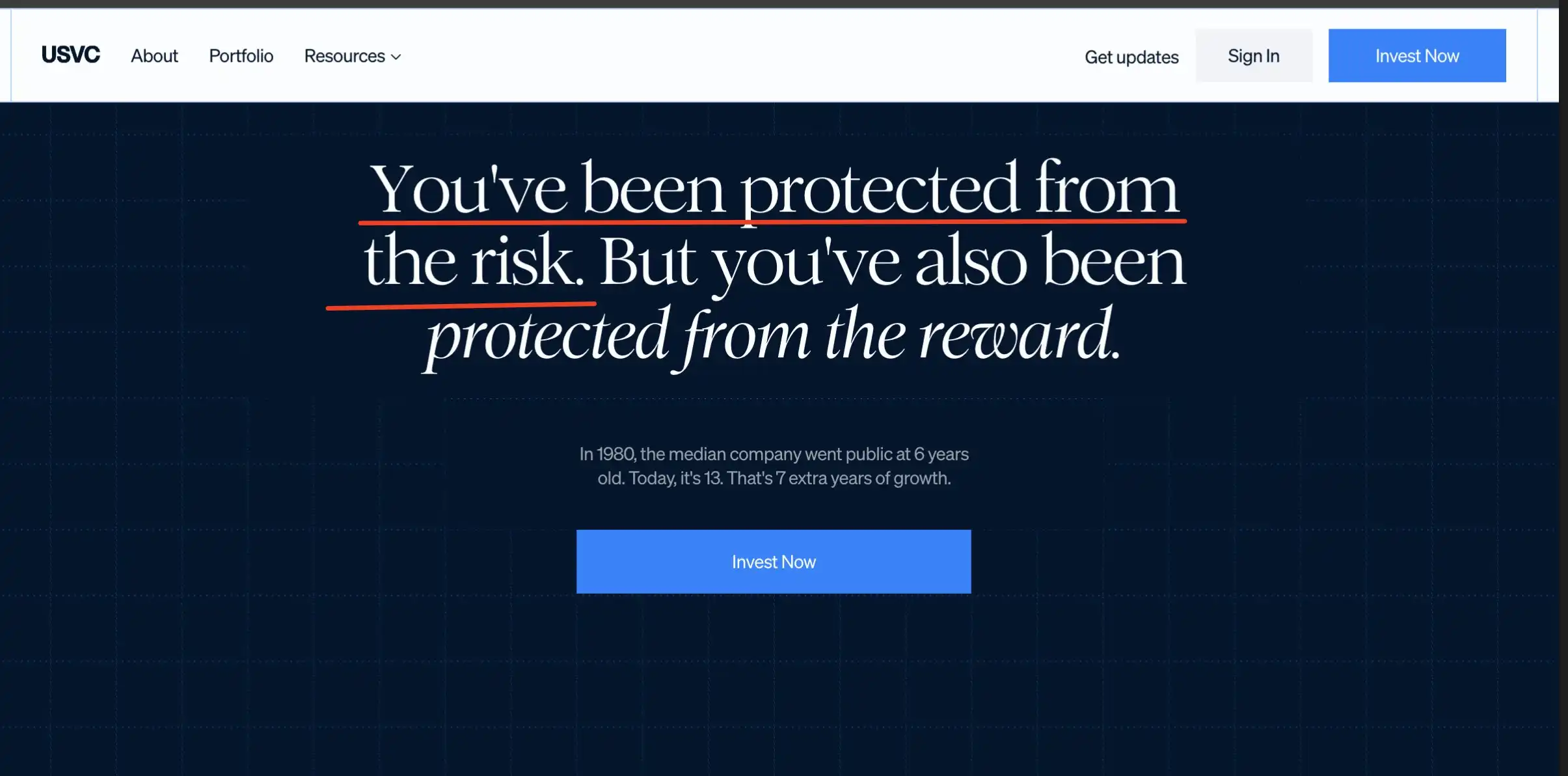
No ability to sell, exit dependent on queuing, and nearly 4% of principal eaten by fees annually. For a product with a $500 minimum investment aimed at ordinary people, this price isn't cheap.

So, the complete picture is likely this.

On one side are the insiders wanting to exit, getting liquidity, locking in profits. On the other side are the retail investors just entering, getting a share that can't be traded, has an exit reliant on queuing, and has an effective fee rate much higher than advertised. The direction of the funds, from start to finish, is only one way: from later arrivals to early arrivals.

The Equity Version of "Low Float, High FDV"

Breaking down the USVC model: insiders accumulate positions at low valuations. After asset prices are pushed high, a channel accessible to retail is packaged, allowing the funds of later arrivals to facilitate the exit of early arrivals.

The crypto industry ran a complete rehearsal of this logic between 2021 and 2024.

During those years, VC-backed token projects had a universal template: seed round valuation a few million, private round rising to tens of millions, and by the time the token listed on exchanges, the Fully Diluted Valuation (FDV) had skyrocketed to tens or even hundreds of billions. But only 2% to 5% of the total supply was in circulation, with the rest locked with VCs and the team, vesting on a schedule.

Low float, high FDV.

What USVC is doing is essentially almost identical to low float, high FDV. Insiders get in when the company is valued at tens of millions. After the company's valuation grows to hundreds of billions, they transfer their shares out through a product aimed at retail.

Naval's own trajectory is also interesting. Last October, he tweeted on X that "Bitcoin is insurance against fiat, Zcash is insurance against Bitcoin." This tweet caused ZEC to surge over 100% in a week. The community then dug up that, according to public reports, Naval had invested $715,000 in the development company behind Zcash as early as 2015 and had served on the Zcash Foundation's board.

The community's conclusion was simple: he was using his personal influence to shill his early investment. Naval did not respond to these质疑 (queries).

From Zcash to USVC, the model hasn't changed. A celebrity uses public credibility to open the demand side and uses a channel to direct that demand towards assets they have a position in.

Of course, in the case of USVC, there doesn't seem to be anything illegal.

USVC is a registered fund, the risk disclosures in the prospectus are ample, and the Zcash tweet didn't constitute investment advice.

But between legal and reasonable, there's always an ambiguous distance. A platform managing a trillion-dollar venture network, using the narrative of "letting ordinary people invest in the future" to raise retail funds, then using those funds to buy out insiders within its own network who want to exit...

Every single part of this is compliant. But all the parts put together easily trigger painful memories for retail investors.

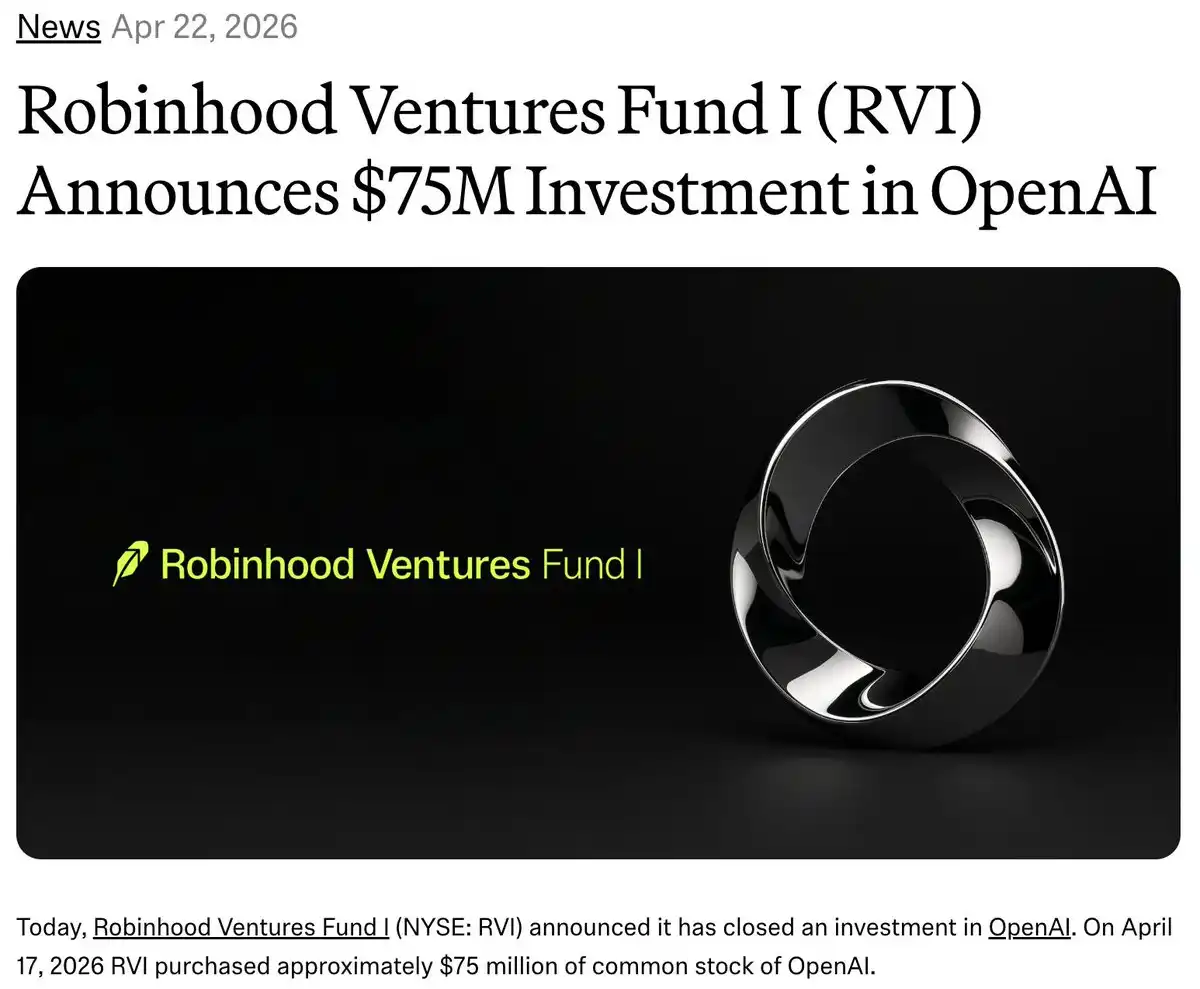
And on the same day USVC launched, Robinhood also announced its fund spent $75 million to buy OpenAI shares, also open to ordinary investors. Two companies did the same thing in the same week: using their respective retail networks to build an exit channel for insiders in the private market.
Every time the financial industry suddenly starts caring about the investment rights of ordinary people, it's often not because the situation for ordinary people has improved, but because the exit channels for insiders have narrowed.

This was true in 2021 when the crypto industry opened its doors wide to retail, and it's true in 2026 when Silicon Valley opens its doors to retail. The timing of the door opening is never decided by those who want to enter.

For ordinary people, there's a simple way to judge if an investment opportunity is meant for you.

Look at the people who got in before you. Are they buying more or are they selling right now? If they are selling, and you are being invited to buy, then you need to think clearly about one question: are you bringing capital, or are you bringing liquidity?


Related Questions

QWhat is the main purpose of the USVC fund launched by AngelList, as per the article?

AThe main purpose of the USVC fund is to allow ordinary US investors, with a minimum investment of $500 and without accredited investor certification, to gain exposure to shares of private AI companies like OpenAI, Anthropic, and xAI. However, the article suggests it primarily functions as a mechanism for early investors and insiders to sell their shares and secure liquidity before an IPO.

QHow does the USVC fund primarily acquire shares in companies like OpenAI and xAI?

AThe USVC fund acquires shares through three main methods: investing in emerging fund managers, participating in growth-round financings, and most importantly, purchasing secondary shares from early investors, venture capital funds, and employees within the AngelList network who are looking to exit their positions.

QWhat are some of the significant drawbacks and risks for retail investors in the USVC fund, according to the article?

ASignificant drawbacks include: the fund shares are not listed on any exchange with no expectation of a secondary market; quarterly repurchases of up to 5% of shares are at the board's discretion and not guaranteed; and the estimated total annual expense ratio is 3.61%, which is much higher than the advertised 1% management fee due to layered underlying fund fees.

QWhat parallel does the article draw between the USVC fund model and a recent trend in the cryptocurrency industry?

AThe article draws a parallel to the 'low float, high fully diluted valuation (FDV)' model prevalent in crypto from 2021-2024. In this model, VCs and insiders accumulated tokens at low valuations, and when the FDV became very high at public listing, only a small percentage of the supply was released to retail market, creating an exit path for early investors.

QWhat is the implied motivation behind financial platforms like AngelList and Robinhood suddenly offering retail investors access to pre-IPO companies, as suggested by the article's conclusion?

AThe article implies that the motivation is not to improve investment opportunities for ordinary people, but rather to create an exit channel and provide liquidity for insiders and early investors (like VCs and employees) who want to cash out their highly appreciated shares before an IPO, as their own exit avenues have narrowed.

Related Reads

STRC Breaks Below $95: Why Does It Continue to Depeg? Is There Default Risk?

"STRC Falls Below $95: Why the Persistent Depegging and Is There Default Risk?" The article discusses the recent decline in the price of STRC, a perpetual preferred stock issued by Strategy (MSTR) designed to trade around a $100 par value. As of publication, STRC traded at $94.65, raising market concerns. STRC is described as a high-yield cash flow product, offering an 11.50% annual dividend paid monthly. Its "preferred" status grants it priority over common stock for dividends and in liquidation. Key reasons cited for the price depegging include: 1. **Bitcoin's Price Drop:** MSTR's assets are heavily tied to Bitcoin (BTC), which fell over 21% from its recent high, pressuring all Strategy-related products. 2. **Competitive Pressure:** Rival Strive Asset Management's similar product, SATA, offers daily dividends and has maintained its $100 par value with a ~13% yield. In response, Strategy has proposed changing STRC's dividend frequency from monthly to bi-weekly, pending shareholder vote. 3. **Technical Selling:** A break below $100 may have triggered algorithmic selling and stop-losses, exacerbating the decline. Regarding default risk, the analysis suggests it is currently low. Strategy founder Michael Saylor confirmed the June 2026 dividend rate remains at 11.50% with no cuts or suspensions. The company's massive reserve of 843,706 BTC provides a significant backstop for its obligations. Industry opinions are mixed. Some analysts view the BTC holdings as reliable support for dividends, while critics like Peter Schiff warn of potential dividend cuts leading to price crashes and lawsuits. Others highlight inflation risk and the company's ability to reduce dividends without a formal default. In summary, STRC's drop is attributed to BTC volatility, competition, and technical factors. While immediate default risk appears contained, the product faces challenges from market conditions and competitive dynamics.

marsbit12m ago

STRC Breaks Below $95: Why Does It Continue to Depeg? Is There Default Risk?

marsbit12m ago

AI Trading Cools, South Korean Stocks Plunge 1.8%, Spot Gold Rises 1%, Bitcoin Dives

A sell-off in AI-related stocks, triggered by Broadcom's disappointing earnings forecast, sent shockwaves through global markets. South Korea's KOSPI led Asia's decline, plunging 1.8% as the risks from concentrated chip stock gains and surging leveraged investments came to the fore. The tech-heavy Nasdaq 100 futures fell 0.5% following Broadcom's 14% after-hours plunge, which signaled a slower-than-expected transition to AI clients. This pullback extended Wall Street's weakness, halting the S&P 500's nine-day rally amid hawkish Fed signals and renewed Middle East tensions. South Korean authorities convened an emergency meeting, pledging "immediate measures" against market volatility and warning of record-high stock margin debt. The adjustment rippled across assets: Bitcoin fell to around $64,000, its lowest since February, while safe-haven gold rose 1% on bargain hunting. Oil prices dipped on Middle East ceasefire news. Market analysts noted the sell-off was driven by profit-taking after massive gains, particularly in chip stocks like Samsung and SK Hynix, which now dominate the KOSPI. Wall Street banks are divided on Korea's outlook, with Goldman Sachs raising its target while Citigroup and others warn of overvaluation and a potential bubble. Bridgewater's Ray Dalio noted that great technological shifts often create bubbles. Meanwhile, Fed officials' hints at potential future rate hikes added to the cautious mood ahead of key U.S. jobs data.

华尔街日报38m ago

AI Trading Cools, South Korean Stocks Plunge 1.8%, Spot Gold Rises 1%, Bitcoin Dives

华尔街日报38m ago

Seeking Alpha's Hot Article: Why Might the U.S. Stock Market Crash in June?

In a recent Seeking Alpha article, financial professor and analyst Damir Tokic argues that the US stock market may be poised for a significant crash in June 2026. The core thesis centers on a "mega-bubble" in equities, particularly within the technology sector, which has driven the S&P 500 to near-record valuations, with a Shiller P/E ratio exceeding 40—a level comparable to the 2000 dot-com bubble. Tokic identifies two primary catalysts for a potential collapse. First, he points to unsustainable market exuberance fueled by what he terms the "Trump Stimulus"—massive AI capital expenditure by tech giants, which he believes is politically driven and cannot last. Second, and more urgently, he highlights the escalating Iran war as a critical threat. The ongoing closure of the Strait of Hormuz has created a severe global energy supply crunch. Strategic petroleum reserves are projected to hit critically low operational levels by June, potentially causing oil prices to spike above $200 per barrel and triggering a severe, supply-driven inflationary shock. This scenario, Tokic warns, would force the Federal Reserve's hand. Despite currently maintaining a dovish bias, the Fed would likely be compelled to officially pivot to a hawkish stance at its June FOMC meeting to combat soaring inflation and bond yields. He contends that such a shift—or even a failure to act, which would destroy Fed credibility—could be the trigger that punctures the market bubble. The resulting downturn, he concludes, could rival the bear markets of 2000 and 2008, advising investors to prepare for a major correction.

marsbit1h ago

Seeking Alpha's Hot Article: Why Might the U.S. Stock Market Crash in June?

marsbit1h ago

Trading

Spot
Futures
活动图片