$50 Million Funding Ignites Airdrop Anticipation, Variational Becomes New Focus of Perp DEX

Odaily星球日报Published on 2026-05-21Last updated on 2026-05-21

Abstract

Variational, a perpetual decentralized exchange (Perp DEX) on Arbitrum, has become a focal point in the crypto community after announcing a $50 million Series A funding round led by Dragonfly Capital, with participation from Bain Capital Crypto and Coinbase Ventures. This news caused a significant pre-listing price surge and increased predictions of a high fully diluted valuation (FDV) upon launch. A key feature of Variational is its zero-trading-fee model. It differentiates itself by aggregating multi-source liquidity, including traditional and crypto-native market makers, to address on-chain liquidity challenges. According to DefiLlama, it ranks fourth among Perp DEXs by open interest and is notable as the only top-five platform yet to issue a token. The primary way for users to engage is through its "Trade-to-Earn" Omni Points program. Points are awarded weekly based on trading activity, with bonuses for early users and a tiered reward system that incentivizes higher trading volumes. The program also includes a referral system offering USDC rewards and extra points. The design emphasizes organic trading over mere volume farming. While an exact Token Generation Event (TGE) date for the VAR token is not confirmed, official documentation states the points program will run at least until the end of Q3 2026. Community and prediction market sentiment generally expects the TGE to occur in Q3 or Q4 of this year.

Original | Odaily Planet Daily (@OdailyChina)

Author | Asher (@Asher_0210)
A funding announcement has made Perp DEX Variational the hot topic in the airdrop farming community.

Last night, Variational announced the completion of a $50 million Series A funding round, led by Dragonfly Capital, with participation from Bain Capital Crypto and Coinbase Ventures. Influenced by this news, Variational's pre-market price surged over 36% briefly, hitting $6.9 at one point (corresponding to an FDV of $690 million). It has since pulled back and is currently quoted at $6.1 (corresponding to an FDV of $610 million).
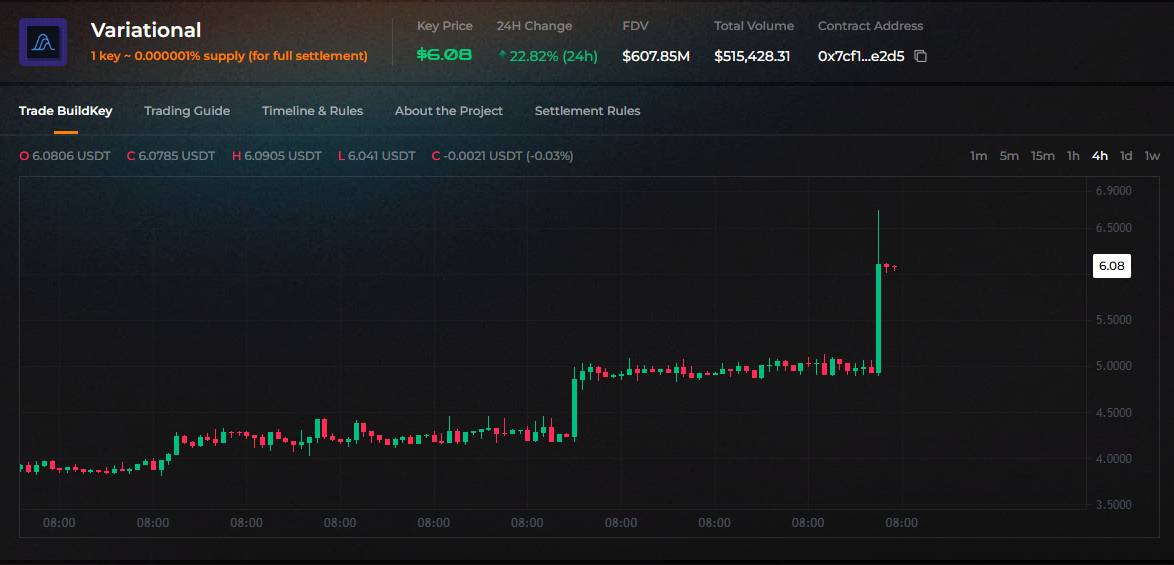
Variational pre-market price movement

Additionally, the probability for the event “Variational's FDV exceeds $500 million one day after listing” on prediction platform predict.fun has risen to 57%; the probability for “Variational's FDV exceeds $1 billion one day after listing” has risen to 27%.
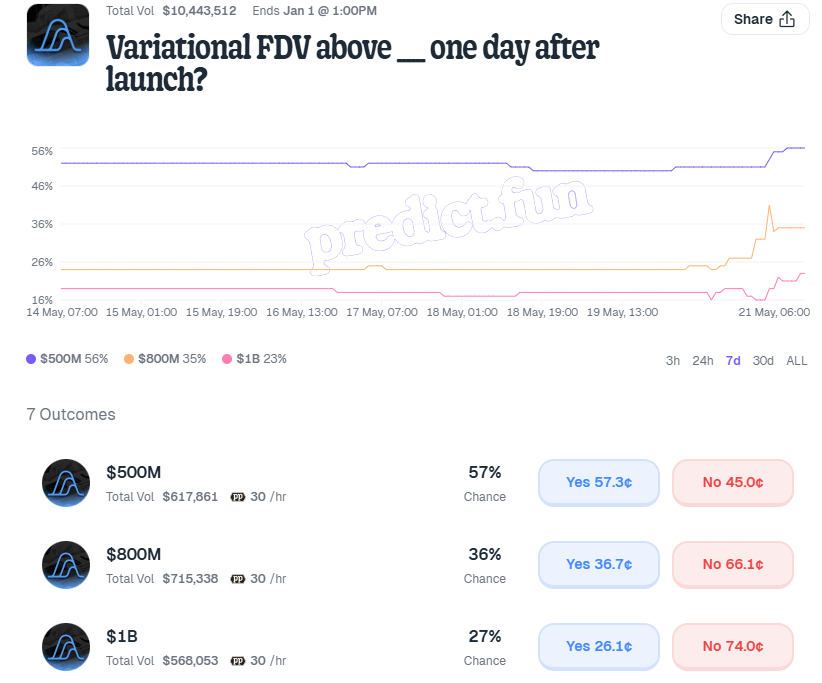
Prediction event for "Variational FDV one day after listing" on predict.fun

Next, Odaily Planet Daily will introduce Variational, its trade-to-earn points rules, and the TGE timeline.

Variational: Zero-Fee Perp DEX Deployed on Arbitrum
Variational is a Perp DEX platform deployed on Arbitrum. The company is headquartered in the Cayman Islands, and its core product is Omni. In simple terms, users can trade perpetual contracts for mainstream crypto assets like BTC, ETH, and SOL on Variational, as well as for long-tail assets, stocks, commodities, volatility indices, and more.

Compared to most Perp DEXs, the most obvious feature of Variational is zero transaction fees. When trading on Omni, the platform does not charge regular transaction fees. The main costs come from spreads, slippage, funding rates, and deposit/withdrawal fees.

Furthermore, Variational's underlying design differs from traditional Perp DEXs. It does not rely solely on internal platform matching or a single liquidity pool to handle trades. Instead, it connects to multi-source liquidity through a "brokerage-like" model, including traditional financial market makers, crypto-native market makers, and major trading platforms, to solve the "liquidity cold start" problem in on-chain markets.

According to DefiLlama data, Variational's trading volume over the past month has exceeded $16 billion, and its current open interest exceeds $800 million, ranking fourth in the Perp DEX sector. Notably, among the top five Perp DEXs by open interest, Variational is the only platform that has not yet issued a token.
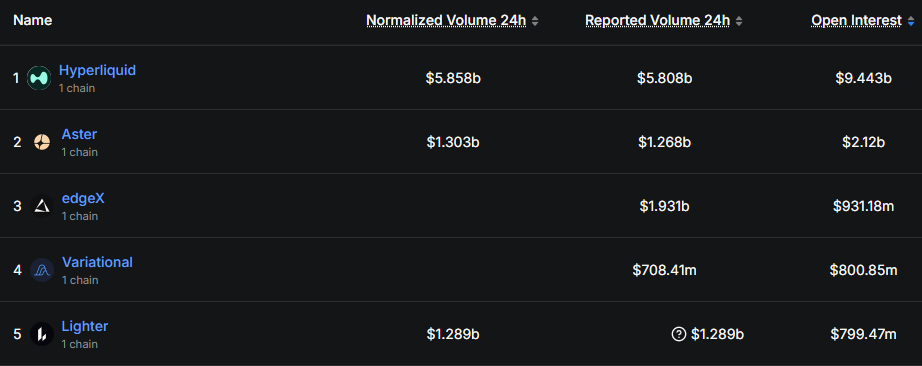
Perp DEX open interest ranking

Trade-to-Earn Points: Detailed Rules for Variational

For ordinary users, the most direct way to participate in Variational currently is still through trading to earn points.

Variational officially launched the Omni Points Program on December 17, 2025, and retroactively distributed 3 million points to historical traders at launch, covering activity up to December 11, 2025. Since then, points are distributed every Friday at 00:00 UTC, accounting for platform activity from the previous cycle ending Thursday at 00:00 UTC.

Additionally, according to the documentation, the project commits to allocating approximately 50% of the token supply to the community (through points, revenue sharing, and other mechanisms, not solely airdrops), while also planning to use at least 30% of protocol revenue for VAR token buybacks and burns.

The core of Variational's points system is not complicated: the more active the trading, the greater the chance to earn more points. However, Variational does not distribute points solely based on trading volume; it incorporates designs that favor trading quality. Specifics include:

  • Points are directly related to user trading activity: The platform rewards page indicates that the points program is designed to reward protocol users, who can earn points through platform activities. The official team reserves the right to adjust points and address non-organic behavior, meaning that obvious meaningless volume farming or arbitrage-style point farming may be subject to reduction or disqualification later;
  • Early users receive an extra bonus: Accounts that traded before the points program launched receive a 10% point bonus on subsequently earned points;
  • Introduction of a Reward Tiers system: A user's total trading volume over the past 30 days affects their tier, calculated as personal trading volume plus 0.2 times the invited trading volume. Different tiers correspond to different point multipliers: Iron at 0%, Bronze at 0.5%, Silver at 1%, Gold at 2%, Platinum at 3%, Diamond at 4%, Infinity at 5%. The thresholds are: Bronze requires $1 million Total Volume in the past 30 days, Silver $5 million, Gold $25 million, Platinum $100 million, Diamond $750 million, Infinity $2.5 billion;
  • Referrals also bring points and USDC rewards: Referrers receive 5% USDC of the spreads paid by the referred users. Additionally, whenever a referred user earns 10 points, the referrer earns 1 point.

Judging from the rules, Variational's points design leans more towards organic trading rather than pure volume farming. For airdrop farmers, the focus is not just on completing a single transaction, but on considering whether their trading frequency, capital efficiency, position risk, and points cost align.

When Will Variational Conduct Its TGE?

Currently, Variational has not announced a clear TGE date for VAR. However, based on information disclosed in the official documentation, points distribution will continue at least until the end of Q3 2026. Therefore, the community generally expects the TGE to occur in Q3 to Q4 of this year.

Data source: Variational official documentation

Furthermore, prediction markets lean towards Q4. Polymarket data shows the probability for the event "Variational will launch its token before September 30 this year" is only 26%, while the probability for "Variational will launch its token before December 31 this year" is 78%.
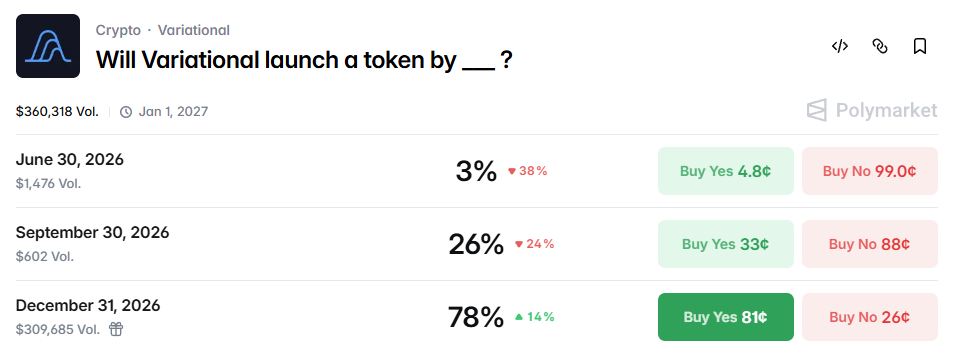
Polymarket prediction event "When will Variational TGE?"


Related Questions

QWhat is the key news that caused a stir in the airdrop farming community regarding Variational?

AThe key news is that Variational announced the completion of a $50 million Series A funding round, led by Dragonfly Capital, with participation from Bain Capital Crypto and CoinBase Ventures.

QWhat is Variational, and what is its most distinctive feature as a Perp DEX?

AVariational is a perpetual decentralized exchange (Perp DEX) deployed on Arbitrum. Its most distinctive feature is that it charges zero trading fees to users. Costs for traders mainly come from the bid-ask spread, slippage, funding rates, and deposit/withdrawal fees.

QHow does Variational's 'Omni' points program work, and what is a key consideration for users farming points?

AThe Omni points program rewards users based on their trading activity on the platform. Points are distributed weekly. A key consideration is that the system is designed to favor 'organic' trading behavior, meaning users should focus on trading frequency and capital efficiency rather than simply high-volume, low-risk arbitrage trades, as such behavior risks having points reduced or invalidated.

QWhat is the current market expectation for Variational's Token Generation Event (TGE) timeline based on the article?

ABased on the article, there is no official TGE date. However, official documentation states the points program will run at least until the end of Q3 2026. Community expectations and prediction market data (e.g., on Polymarket) suggest the TGE is more likely to occur in Q4 2026, with a 78% probability of happening before December 31, 2026.

QAccording to the article, what percentage of the VAR token supply is promised to be allocated to the community, and what is planned for protocol revenue?

AThe project has promised to allocate approximately 50% of the token supply to the community through mechanisms like points and revenue sharing. Furthermore, it plans to use at least 30% of protocol revenue to buy back and burn VAR tokens.

Related Reads

STRC Breaks Below $95: Why Does It Continue to Depeg? Is There Default Risk?

"STRC Falls Below $95: Why the Persistent Depegging and Is There Default Risk?" The article discusses the recent decline in the price of STRC, a perpetual preferred stock issued by Strategy (MSTR) designed to trade around a $100 par value. As of publication, STRC traded at $94.65, raising market concerns. STRC is described as a high-yield cash flow product, offering an 11.50% annual dividend paid monthly. Its "preferred" status grants it priority over common stock for dividends and in liquidation. Key reasons cited for the price depegging include: 1. **Bitcoin's Price Drop:** MSTR's assets are heavily tied to Bitcoin (BTC), which fell over 21% from its recent high, pressuring all Strategy-related products. 2. **Competitive Pressure:** Rival Strive Asset Management's similar product, SATA, offers daily dividends and has maintained its $100 par value with a ~13% yield. In response, Strategy has proposed changing STRC's dividend frequency from monthly to bi-weekly, pending shareholder vote. 3. **Technical Selling:** A break below $100 may have triggered algorithmic selling and stop-losses, exacerbating the decline. Regarding default risk, the analysis suggests it is currently low. Strategy founder Michael Saylor confirmed the June 2026 dividend rate remains at 11.50% with no cuts or suspensions. The company's massive reserve of 843,706 BTC provides a significant backstop for its obligations. Industry opinions are mixed. Some analysts view the BTC holdings as reliable support for dividends, while critics like Peter Schiff warn of potential dividend cuts leading to price crashes and lawsuits. Others highlight inflation risk and the company's ability to reduce dividends without a formal default. In summary, STRC's drop is attributed to BTC volatility, competition, and technical factors. While immediate default risk appears contained, the product faces challenges from market conditions and competitive dynamics.

marsbit12m ago

STRC Breaks Below $95: Why Does It Continue to Depeg? Is There Default Risk?

marsbit12m ago

AI Trading Cools, South Korean Stocks Plunge 1.8%, Spot Gold Rises 1%, Bitcoin Dives

A sell-off in AI-related stocks, triggered by Broadcom's disappointing earnings forecast, sent shockwaves through global markets. South Korea's KOSPI led Asia's decline, plunging 1.8% as the risks from concentrated chip stock gains and surging leveraged investments came to the fore. The tech-heavy Nasdaq 100 futures fell 0.5% following Broadcom's 14% after-hours plunge, which signaled a slower-than-expected transition to AI clients. This pullback extended Wall Street's weakness, halting the S&P 500's nine-day rally amid hawkish Fed signals and renewed Middle East tensions. South Korean authorities convened an emergency meeting, pledging "immediate measures" against market volatility and warning of record-high stock margin debt. The adjustment rippled across assets: Bitcoin fell to around $64,000, its lowest since February, while safe-haven gold rose 1% on bargain hunting. Oil prices dipped on Middle East ceasefire news. Market analysts noted the sell-off was driven by profit-taking after massive gains, particularly in chip stocks like Samsung and SK Hynix, which now dominate the KOSPI. Wall Street banks are divided on Korea's outlook, with Goldman Sachs raising its target while Citigroup and others warn of overvaluation and a potential bubble. Bridgewater's Ray Dalio noted that great technological shifts often create bubbles. Meanwhile, Fed officials' hints at potential future rate hikes added to the cautious mood ahead of key U.S. jobs data.

华尔街日报38m ago

AI Trading Cools, South Korean Stocks Plunge 1.8%, Spot Gold Rises 1%, Bitcoin Dives

华尔街日报38m ago

Seeking Alpha's Hot Article: Why Might the U.S. Stock Market Crash in June?

In a recent Seeking Alpha article, financial professor and analyst Damir Tokic argues that the US stock market may be poised for a significant crash in June 2026. The core thesis centers on a "mega-bubble" in equities, particularly within the technology sector, which has driven the S&P 500 to near-record valuations, with a Shiller P/E ratio exceeding 40—a level comparable to the 2000 dot-com bubble. Tokic identifies two primary catalysts for a potential collapse. First, he points to unsustainable market exuberance fueled by what he terms the "Trump Stimulus"—massive AI capital expenditure by tech giants, which he believes is politically driven and cannot last. Second, and more urgently, he highlights the escalating Iran war as a critical threat. The ongoing closure of the Strait of Hormuz has created a severe global energy supply crunch. Strategic petroleum reserves are projected to hit critically low operational levels by June, potentially causing oil prices to spike above $200 per barrel and triggering a severe, supply-driven inflationary shock. This scenario, Tokic warns, would force the Federal Reserve's hand. Despite currently maintaining a dovish bias, the Fed would likely be compelled to officially pivot to a hawkish stance at its June FOMC meeting to combat soaring inflation and bond yields. He contends that such a shift—or even a failure to act, which would destroy Fed credibility—could be the trigger that punctures the market bubble. The resulting downturn, he concludes, could rival the bear markets of 2000 and 2008, advising investors to prepare for a major correction.

marsbit1h ago

Seeking Alpha's Hot Article: Why Might the U.S. Stock Market Crash in June?

marsbit1h ago

Trading

Spot
Futures
活动图片

