Eric Trump Sets A “Beyond Catastrophic” Bar To Sell Bitcoin — How Far Are We From That?

bitcoinistPublished on 2026-05-25Last updated on 2026-05-25

Abstract

Eric Trump, Chief Strategy Officer of American Bitcoin Corp., has declared that the company would only sell its Bitcoin holdings under circumstances he describes as "beyond catastrophic." In an interview, he framed this as a strategic commitment to permanent accumulation, driven by the goal of increasing "satoshis per share" and competing in both the race for the largest Bitcoin holdings and the lowest acquisition cost. The company mines its Bitcoin at a claimed 53% below spot price and retains all coins, drawing a distinction from Michael Saylor's MicroStrategy, which has signaled some flexibility. Trump's stance sets a new benchmark for long-term commitment in the Bitcoin treasury sector. As of the report, Bitcoin trades near $82,000, with American Bitcoin's treasury holding over 7,000 BTC.

Eric Trump, co-founder and Chief Strategy Officer of American Bitcoin Corp., has revealed the conditions under which he would sell Bitcoin — and the threshold he has set is so extreme it amounts to a declaration that, under any foreseeable market scenario, he is not selling.

Speaking in an interview for the Bonnie Blockchain channel published on May 12, Trump was asked directly about the circumstances that could force American Bitcoin to liquidate its holdings. His answer was unambiguous.

Selling would require something “beyond catastrophic,” per the interview — a framing that places the sell threshold so far outside normal market volatility, regulatory pressure, or even prolonged bear markets that it functions less as a risk management policy and more as a philosophical commitment to permanent accumulation.

The Two Races — And Why Selling Bitcoin Loses Both

The broader context behind Trump’s sell-never posture is the dual competitive framework he laid out in the same interview. According to Trump, the Bitcoin treasury space is defined by two simultaneous races: one for the largest total Bitcoin holdings, and one for the lowest possible acquisition cost. American Bitcoin, he argued, is competing in both — and selling Bitcoin loses ground in the first race immediately while undermining the entire logic of the second.

The company’s north star metric, per Trump’s interview, is growing “satoshis per share” — a measurement of how much Bitcoin each outstanding share of ABTC represents. Every Bitcoin sold dilutes that figure. Every Bitcoin mined and retained compounds it. The accumulation model only works if the coins stay, which makes the “beyond catastrophic” sell threshold not a rhetorical flourish but a structural requirement of the strategy itself.

The Saylor Reference — And The Divergence

Trump acknowledged Michael Saylor’s role in building the Bitcoin treasury category, describing him as a visionary and praising Strategy’s approach, per the interview. But he drew a pointed distinction. Saylor recently suggested that Strategy could sell some Bitcoin to help fund dividend payments — a hint of flexibility in the accumulation model that Trump appears unwilling to replicate.

American Bitcoin, he made clear, is following a stricter retention framework. Where Strategy accumulates primarily through capital markets and has signaled some exit flexibility, ABTC accumulates through mining — at a cost it claims is approximately 53% below spot — and holds without exception, per the interview.

The distinction matters for how investors read both companies. A sell-never posture from a mining-integrated treasury firm is more operationally credible than the same posture from a pure accumulator, because the marginal cost of each new coin is structurally lower and the balance sheet pressure to monetize is reduced accordingly.

For the nascent sector’s growing cohort of Bitcoin treasury companies, Trump’s “beyond catastrophic” framing marks a pivotal benchmark — the most unambiguous long-term accumulation commitment any publicly listed executive has put on record this cycle. Whether the market rewards that conviction or punishes the rigidity will depend on where Bitcoin trades over the next several years.
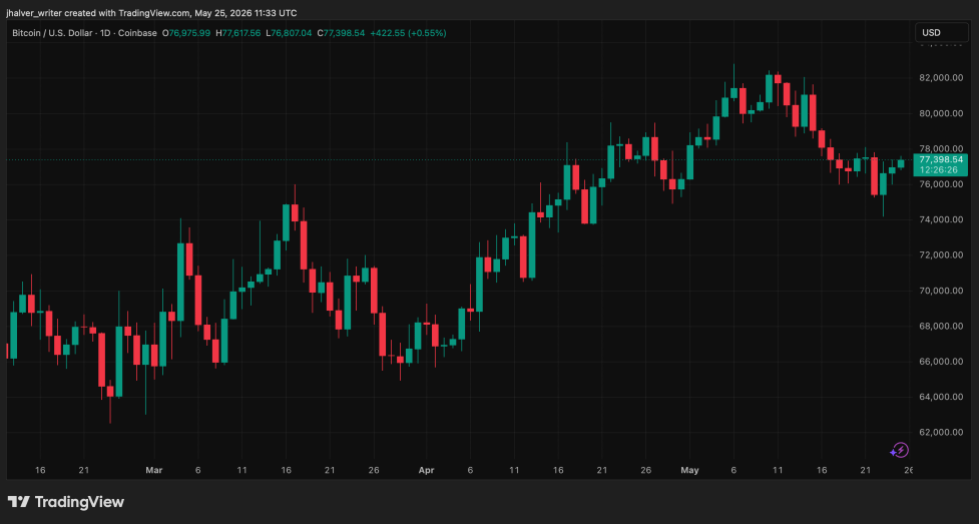
BTC's price trends to the upside, as seen on the daily chart. Source: BTCUSD on Tradingview

As of this writing, Bitcoin trades at around $82,000, with American Bitcoin’s treasury holding over 7,000 BTC as the company continues what its co-founder has now publicly described as an unconditional accumulation strategy.

Cover image from Grok, BTCUSD Chart from Tradingview

Related Questions

QAccording to the article, what is the specific condition under which Eric Trump says he would sell Bitcoin?

AEric Trump would only sell Bitcoin under conditions he describes as "beyond catastrophic," a threshold so extreme it effectively amounts to a commitment to never sell under any foreseeable market scenario.

QWhat are the two key competitive races in the Bitcoin treasury space as outlined by Eric Trump in the interview?

AThe two key competitive races are: 1) the race for the largest total Bitcoin holdings, and 2) the race for the lowest possible acquisition cost for Bitcoin.

QWhat is the key metric American Bitcoin Corp. focuses on, and how does selling Bitcoin affect it?

AAmerican Bitcoin Corp.'s key metric is growing "satoshis per share," which measures how much Bitcoin each outstanding share represents. Selling Bitcoin immediately dilutes this figure.

QWhat is the main operational difference between American Bitcoin Corp.'s and MicroStrategy's Bitcoin accumulation strategies mentioned in the article?

AThe main difference is that American Bitcoin Corp. (ABTC) accumulates Bitcoin primarily through mining at a claimed low cost and follows a strict 'sell-never' policy, while MicroStrategy accumulates primarily through capital markets and has signaled some flexibility to potentially sell Bitcoin to fund dividends.

QHow does the article characterize the credibility of a 'sell-never' posture from a mining company compared to a pure accumulator?

AThe article states that a 'sell-never' posture from a mining-integrated treasury firm is more operationally credible than from a pure accumulator because the marginal cost of each new coin is structurally lower, reducing balance sheet pressure to monetize the holdings.

Related Reads

The Death of the Three-Act Play: AI Ushers Enterprise Software Startups into the ‘Speedrun Era’

The Death of the Three-Act Play: How AI is Ushering in a 'Speedrun Era' for Enterprise Software Startups The traditional three-act play for building an enterprise software company—first, a niche wedge product; second, an expanded suite; third, a dominant platform—is becoming obsolete in the AI era. Previously, startups would spend 3-5 years perfecting a single-point solution to reach tens of millions in ARR (Act 1: The Wedge). Then, over another few years, they'd build adjacent products to form a suite and cross the $100M ARR threshold (Act 2: The Suite). Finally, with scale and user engagement, they could aim to become a foundational platform themselves (Act 3: The Platform). This model assumed a timeline measured in years. However, AI-driven tools have dramatically compressed software development costs and timelines. Companies like Cursor, Clay, and Harvey have scaled from near zero to approaching or surpassing $100M ARR in remarkably short periods, demonstrating a new competitive pace. The core argument is that in this rapidly changing market, relying on a small, "safe" wedge as a protective harbor may now be a conservative, even risky, strategy. The plummeting cost of building software means the time required for Acts 1 and 2 is approaching zero. Consequently, rational strategy now favors planning to build the entire vision from the outset. This shift changes the calculus for early-stage investment. The emphasis is moving from finding a defensible niche to backing founders with "unreasonable, relentless ambition" to reimagine entire workflows or replace incumbent platforms from day one. The age of gradual expansion is giving way to an era of immediate, full-scale ambition.

marsbit15m ago

The Death of the Three-Act Play: AI Ushers Enterprise Software Startups into the ‘Speedrun Era’

marsbit15m ago

After the 'Golden Finger' Points to IBM, the Stock God Trump's Next Target Emerges

The White House occupant is being called a "stock god." Financial disclosures show former President Trump executed 3,642 stock trades in Q1 2026, averaging 58 per trading day. More significantly, a pattern has emerged where companies he publicly praises often see their stock prices rise and frequently overlap with his personal portfolio holdings, government industrial policy, and federal funding. Since a high-profile Tesla event in March 2025, Trump has publicly endorsed at least nine companies, including Intel, Dell, Micron, Palantir, IBM, Apple, Thermo Fisher, Nvidia, and AMD. These "Trump concept stocks" share key traits: they are tied to AI, semiconductors, quantum computing, or "Made in America" narratives; they often receive government contracts, subsidies (like CHIPS Act funding), or regulatory favors; and their CEOs typically have strong personal or political ties to Trump. Timing raises questions. In several instances, such as with Palantir and Dell, Trump's personal account established or increased positions weeks before his public endorsements, which were followed by significant stock price jumps. While his assets are reportedly held in a blind trust managed by his children, the correlation is notable. Based on this pattern, analysis suggests the next companies likely to be endorsed are those where the US government has already taken a strategic equity stake but which haven't yet received a high-profile "call-out." Prime candidates include MP Materials (rare earths, 15% DoD interest), Lithium Americas (lithium, DoE-backed), and quantum computing firms like IonQ, Rigetti, and D-Wave, which are reportedly in talks for government equity-for-funding deals. Other potential names are Oracle (deep political ties) and GlobalFoundries (semiconductors and quantum funding). These stocks carry high political premium, meaning their valuations are highly sensitive to political favor, which can be volatile.

marsbit40m ago

After the 'Golden Finger' Points to IBM, the Stock God Trump's Next Target Emerges

marsbit40m ago

Trading

Spot
Futures
活动图片





