Musk Posted a Recruitment Ad for SpaceX, and After Reading the Comments Section, I Understood

marsbitPublished on 2026-05-21Last updated on 2026-05-21

Abstract

On May 20th, SpaceX filed for a landmark IPO with a $1.75 trillion valuation. Shortly after, Elon Musk posted a recruitment call on X, seeking "world-class engineers and physicists" for SpaceX. The application process was starkly simple: email with three bullet points proving "exceptional ability," with real, complex projects as a plus. Musk promised to review qualifying emails himself. The post garnered millions of views and thousands of replies, revealing a spectrum of responses. Most comments, including a highly-upvoted humorous one listing absurd "skills," merely listed credentials or experiences in a conventional, non-differentiating way. This highlighted a key insight: a traditional resume listing degrees and skills often fails to demonstrate true exceptionalism. Effective self-presentation requires "performance efficiency." A standout reply came from an OpenAI engineering lead, who simply stated "codex." This demonstrated that for those who have built significant, recognized products, the product itself becomes the ultimate resume. The article argues that in the AI era, any tangible, shareable output—a tool, research, or online project—serves as a living, self-evident credential more powerful than a list of attributes. However, a twist emerged when applicants found the provided email address non-functional, leading to speculation that the post might also serve as an IPO publicity stunt, projecting an image of aggressive talent acquisition to investors. Ultimately, t...

Author: Curry, Deep Chao TechFlow

On May 20th after US market close, SpaceX submitted its prospectus to the SEC with a valuation of $1.75 trillion, aiming to list on NASDAQ in June.

This is undoubtedly the largest IPO in history, likely surpassing Saudi Aramco's $29 billion fundraising record set six years ago.

Less than a day after the prospectus was submitted, on the afternoon of May 21st, Musk posted a recruitment message on X.

The gist was that SpaceX is hiring world-class engineers and physicists. Zero experience in AI is fine because smart people learn fast. The application method is incredibly simple:

Send an email listing three bullet points proving you have exceptional ability.
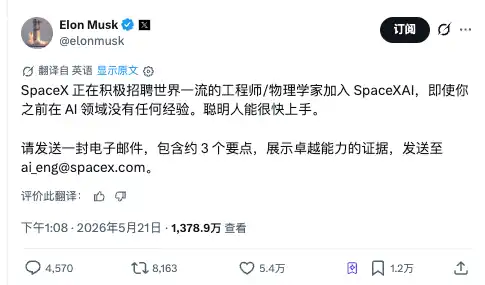
Additionally, Musk noted that having built "something very complex and actually functional" is a plus. Emails passing the basic screening will be reviewed by Musk personally. By the time I wrote this article, the post had over 13 million views and 4,500 replies.

Musk's recruitment stance seems very appealing. Degrees, companies, ten years of experience don't matter, only whether you have "exceptional ability." But upon closer thought, you realize this is actually a much harsher filter than conventional recruitment.

Do you think using 3 bullet points to explain your outstanding qualities is simple or difficult?

A conventionally formatted resume is at least one page long: positions and achievements from past jobs, alma mater, tools you know, awards won... piled together it looks full, but perhaps not a single line directly proves you are "exceptional."

Scrolling through the comments section, you'll also find the vast majority of people cannot do this.

Resumes Are Actually About "Performance Efficiency"

I scrolled through the comments section and roughly understood.

With 4,500 replies, you can probably guess the style—mostly witty one-liners. Currently, the top-rated reply is from a user named Greg who posted a so-called "resume," looking utterly absurd:
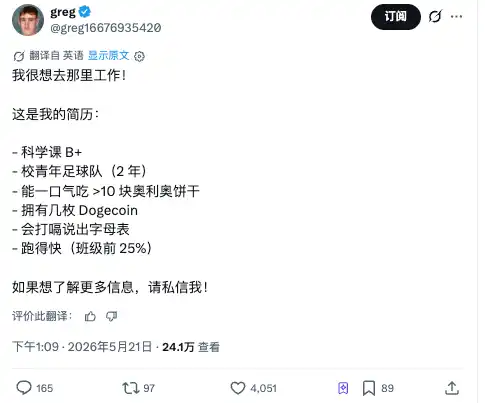
Pure self-deprecating meme is quite funny, and the answer is obviously just a joke, but it also acts as a mirror. Think carefully, the resumes I've submitted in the past seem essentially no different from this?

Replace the content of this resume: top university computer science major GPA 3.8, two years on the school basketball team, proficient in Python and Java, self-studied CFA Level 1, top fifty in school sports meet...

The format is identical, the logic is identical, only the content is less outrageous, but the essence remains listing everything you have point by point indiscriminately.

From Musk's perspective, your Python skill level versus your ability to burp the alphabet—the difference isn't actually that significant.

The comments section isn't just full of jokers. Some seriously posted their degree certificates, others threw in their child's Ivy League acceptance letter, some posted passport photos asking for work visas, and others listed paper publications and conference talks...

Compared to the jokers, these people are surely sincere about applying.

But step back and look: what they are doing is the same as that absurd joke post: listing credentials, piling up experiences, indiscriminately listing any possible shining point, hoping to create an impression of "I am excellent."

Musk asked: what have you built that is complex and useful enough. A typical interviewer in our daily lives might not be that demanding, but similarly hopes for stronger relevance in a resume.

Simply put, a resume is a performance, and performance is about efficiency. What can efficiently impress the other party most of the time is not necessarily long-winded explanations.

Product, The Better Resume

There's actually another highly upvoted comment in the section that I think perfectly satisfies the request in Musk's post: "Please use 3 bullet points to prove your excellence."

And this person even used just 1 bullet point, typing just 1 word:

codex.

Clicking into his profile, I checked—Tibo (full name Thibault Sottiaux) is an Engineering Lead at OpenAI, currently leading the Codex team. Codex is one of the most powerful AI programming tools and something developers worldwide use daily.
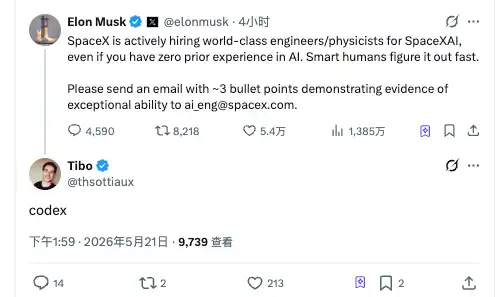
A product name is the entire resume.

The more you need to explain who you are, the less likely you are the person Musk is looking for. People who have truly built things, their name itself is evidence, the product itself is the bullet point. But you might say, he's a project lead at OpenAI, excellent enough to have the capital to reply with just one word. Ordinary people don't have that kind of confidence.

Think from another angle: Tibo can reply like that because he has something others have used, validated, that requires no self-explanation. That thing speaks for him.

Of course, elitism is not to be encouraged, but most of us aren't big shots. Yet sometimes we also just need to productize ourselves, to let the things we've done prove ourselves in a more efficient way.

Pushing this idea one layer down, it's actually unrelated to seniority.

You spent a weekend using vibe coding to build a small tool, consistently shared it and people use it—that's a kind of product; you wrote an industry research post on social media that got cited—that's also a kind of product.

These things are of course small compared to Codex, but they share a common trait: they are things you made, visible to others, requiring no explanation from you.

In the AI era, every work, every output, every tangible result you leave online that others can point to is, in a way, a living resume. It speaks for you.

You don't need to reach Codex's scale, but you should at least have something that can be pointed to.

So, the attachments in resumes today—they themselves might be the better resume.

But, Is the Recruitment Real?

The story actually has a tail end here.

In the comments section, someone, after reading Musk's post, seriously wrote an email and sent it to the address [email protected], only to find it bounced back. The system indicated the address doesn't exist...
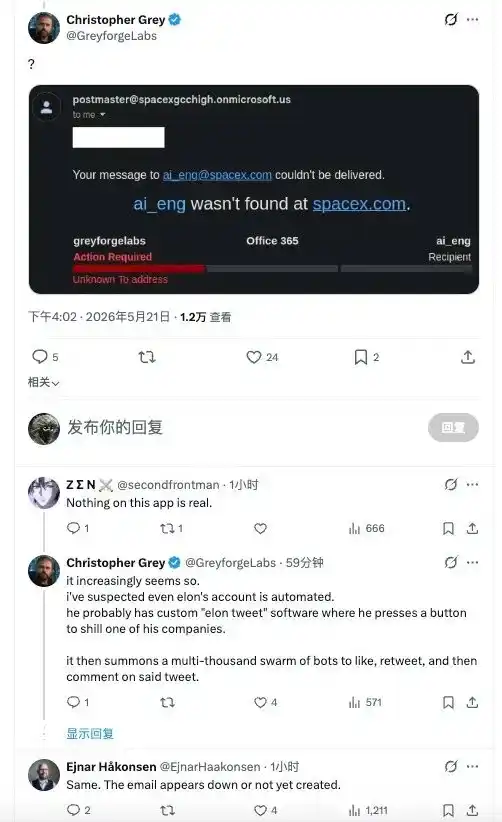
Some suspect Musk's account itself is automated, the recruitment email isn't set up yet, but the recruitment announcement went out first; others think recruiting around an IPO is part of the IPO roadshow, projecting an image of attracting top talent to strengthen the team.

Investors will certainly see Musk's post. So whether the recruitment itself is real can be set aside for now, but the posture the post conveys—"SpaceX is poaching talent"—is clear.

So, is this recruitment post actually hiring or doing a roadshow?

Perhaps the difference between the two isn't that big. In Musk's world, a single tweet can simultaneously be a job posting, an investor relations statement, and a brand advertisement. You see three bullet points; investors see "this company has the ability to attract the world's best talent."

Reading the post and the comments gives a sense of enlightenment. The witty one-liners, the one-word "Codex" self-proof, the bounced emails where applications fail—these are actually three types of roles on the same stage.

Some come to perform, some come to prove themselves, some discover the stage set seems to be made of cardboard...

In an era of scarce attention and cheap content output, finding one's own position and value remains the long-term homework we must do.


Related Questions

QAccording to the article, what was the most effective response to Elon Musk's SpaceX job posting on X, and why was it considered so powerful?

AThe most effective response was from Tibo (Thibault Sottiaux), the engineering lead of OpenAI's Codex team. He simply replied 'codex'. This was powerful because a single word referenced a globally used and complex product he led, which served as irrefutable, self-explanatory proof of his 'exceptional ability'. It demonstrated that a tangible, successful product is the ultimate resume.

QHow does the author describe the fundamental problem with most traditional resumes and the typical responses to Musk's post?

AThe author argues that traditional resumes and many responses to the post follow the same flawed logic: they provide an 'undifferentiated list' of qualifications, degrees, skills, and experiences. This is akin to the satirical resume listing skills like 'burping the alphabet'. The issue is this approach merely proves you have attributes but doesn't directly or efficiently demonstrate exceptional, practical ability to build complex things.

QWhat core piece of advice does the article offer for professionals in the AI era regarding personal branding?

AThe article advises individuals to 'productize' themselves. This means creating tangible, visible outputs—like a useful tool, a well-researched report, or any shareable project—that can act as a 'live resume'. These outputs are evidence of one's abilities that 'speak for themselves' without needing lengthy personal explanation, making them a more efficient form of proof in an attention-scarce world.

QWhat suspicion did some people have about the legitimacy of the SpaceX job posting mentioned at the end of the article?

ASome people suspected the posting might not be entirely genuine. Evidence cited includes that the provided email address ([email protected]) initially bounced back as non-existent. This led to theories that the post could be automated, that the hiring process wasn't fully set up, or that it was partly a publicity move to showcase SpaceX's talent-attraction prowess to investors during its IPO roadshow.

QWhat is the 'three-act play' the author sees in the comments section of Musk's post?

AThe author sees a three-act play: 1) People 'performing' by posting humorous or generic content (like the burping resume). 2) People attempting to genuinely 'prove themselves' by listing credentials and achievements. 3) People discovering the 'stage set might be made of paper' when they find practical issues like the non-functional email address. Together, these represent different engagements with the modern challenge of proving one's value.

Related Reads

Kelp DAO's $400 Million Bad Debt Was Covered, But at a $12 Billion Cost to Aave

On May 26th, Kelp DAO successfully transferred its final batch of rsETH, completing the 37-day process of fully backing rsETH 1:1 after a security incident. However, the resolution came at a significant cost to Aave. The protocol's TVL plummeted by over $12 billion in the following month. Furthermore, a separate legal battle over 30,766 frozen ETH continues in court, posing ongoing reputational risk. The recovery was enabled by an unprecedented, one-time coalition dubbed "DeFi United," involving major contributions from Aave's founder, treasury, Consensys, Mantle, and others. Despite this, the event triggered a major outflow of funds, with whales like Justin Sun moving capital to competitors like Spark. Aave's path to regaining its position relies heavily on the successful execution of its multi-pronged strategy. Its new V4 protocol, designed for open, heterogeneous asset markets, faces delays due to internal governance disputes. Meanwhile, the V3 version remains the core revenue generator, and the permissioned Horizon fork is targeting institutional RWA (Real-World Assets) growth—a segment less impacted by the rsETH incident but dependent on traditional finance adoption timelines. The key takeaway is that while the immediate bad debt was covered, Aave paid a steep price in lost trust and capital. Recovering market share depends on accelerating V4's rollout and advancing its institutional RWA offerings, both of which face external and internal hurdles. The "DeFi United" safety net is unlikely to be replicable for future crises.

marsbit1h ago

Kelp DAO's $400 Million Bad Debt Was Covered, But at a $12 Billion Cost to Aave

marsbit1h ago

TechFlow Intelligence Report: Xiaomi Announces 200 Billion HKD Stock Buyback Plan, Spot Gold Falls Nearly 1%

TechFlow Report: Xiaomi announced a HK$200 billion stock buyback plan, while spot gold fell nearly 1%. A wider range of tech headlines includes Google unveiling its powerful video editing model Gemini Omni and the original "Attention is All You Need" authors advocating for a move beyond Transformer architecture. In other AI news, IBM reported its first successful use of a quantum computer to train an AI model, and Qwen3.5 released uncensored local model versions. The crypto/Web3 sector saw discussions on opaque stablecoin products and DEX fee changes. Major tech companies are under scrutiny: Uber's COO publicly questioned the ROI of AI investments, Motorola was accused of hijacking Amazon app links for affiliate codes, and Google faced criticism for using web data to fuel its AI. U.S. markets are focused on high S&P 500 valuations (31.8x P/E) and an intense concentration of capital in semiconductor stocks, with warnings about the sustainability of the AI data center boom. Geopolitical tensions, featuring simultaneous U.S. airstrikes on Iran and peace talks, caused significant oil price volatility. Other notable developments include Ferrari's first pure EV priced at 4.35 million yuan and Boston Dynamics' Atlas robot learning soccer from videos. The underlying theme suggests the AI narrative is shifting from boundless potential to requiring tangible results, while traditional geopolitical risks remain a powerful force in markets.

marsbit1h ago

TechFlow Intelligence Report: Xiaomi Announces 200 Billion HKD Stock Buyback Plan, Spot Gold Falls Nearly 1%

marsbit1h ago

Coin & Stock Barometer: Bitcoin Miner MARA Holdings Spends Over $860,000 on Bulletproof Vehicle Services for Executives; Bitmine Included in Preliminary List for FTSE Russell 1000 Index (May 19)

Crypto Market Wrap & Key Corporate Updates (May 19) The crypto market saw a decline followed by a minor rebound, while U.S. crypto-related stocks fell broadly. In corporate news: **MARA Holdings**, a Bitcoin miner, disclosed spending over $869,000 on vehicle ballistic armor services for its CEO and CFO under its security program. The board cited higher risks associated with the company's public disclosure of holding substantial Bitcoin assets. According to BitcoinTreasuries.NET, Elon Musk's **SpaceX and Tesla** collectively hold 30,221 BTC ($2.3B), which would rank them as the fifth-largest public company holder if combined. **DDC Enterprise Limited** increased its Bitcoin holdings by 200 BTC, bringing its total to 2,583 BTC. The firm stated it plans to continue accumulating BTC based on liquidity, not short-term price movements. Bitcoin treasury company **Nakamoto** announced a 1-for-40 reverse stock split to regain compliance with Nasdaq's minimum bid price requirement. The company reported a Q1 2026 net loss of $238.8M, partly due to a $102.5M unrealized loss on its Bitcoin holdings. **Tether** acquired SoftBank's stake in **Twenty One Capital (XXI)**, increasing its control. Tether's CEO expressed strengthened confidence in XXI's long-term Bitcoin strategy. Fundstrat's **Tom Lee** stated that **Bitmine (BMNR)** has been included in the preliminary list for the FTSE Russell 1000 Index. Concurrently, two new wallets suspected to be linked to Bitmine withdrew 60,000 ETH ($126M) from Bitgo and Kraken. Solana treasury company **Solmate Infrastructure** announced a registered direct offering of shares to raise approximately $11.4 million. **AI Financial**, a WLFI treasury company, reported a Q1 2026 net loss of $271.5M and raised substantial doubt about its ability to continue as a going concern, partly due to unrealized losses on its WLFI token holdings. **SUI Group** disclosed it holds over 108.7 million SUI tokens (~$115M), with its market cap to net asset value ratio at 0.91x. *Disclaimer: This summary is for informational purposes only and does not constitute investment advice.*

marsbit1h ago

Coin & Stock Barometer: Bitcoin Miner MARA Holdings Spends Over $860,000 on Bulletproof Vehicle Services for Executives; Bitmine Included in Preliminary List for FTSE Russell 1000 Index (May 19)

marsbit1h ago

Trading

Spot
Futures
活动图片