$414mln exits crypto funds – Why sentiment is suddenly shifting

ambcryptoPublished on 2026-03-31Last updated on 2026-03-31

Abstract

In the last week of March, cryptocurrency investment products experienced significant outflows totaling $414 million, marking the first net withdrawals in five weeks. This shift was driven by escalating global tensions, high inflation, and anticipation around Federal Reserve meetings, reducing total assets under management to $129 billion. Ethereum was hit hardest with $222 million in outflows, while Bitcoin saw $194 million withdrawn despite strong year-to-date inflows. Solana also recorded outflows, whereas XRP was the sole asset with inflows of $15.8 million. On-chain metrics showed reduced network engagement for major cryptocurrencies. The U.S. led outflows with $454 million, while Canada and Germany saw modest inflows. Despite a recent market cap rebound to $2.34 trillion, short-term volatility remains high due to macroeconomic uncertainty, cautioning investors against relying on temporary rallies for long-term predictions.

The last week of March (from the 23rd to the 24th) was not good for the cryptocurrency investment product. As per a weekly report from CoinShares, digital assets funds recorded their first outflows in five weeks, worth $414 million.

This has more to do with just investors’ sentiments and price actions.

Escalating global tensions involving the U.S and Iran, accompanied by high inflation and the growing expectations around the upcoming Federal Reserve meetings, are the major reasons behind this shift.

Because of these developments from politics to economics, the total Assets under Management (AuM) have declined to $129 billion. If looked carefully, such levels have already been hit during early February and back in April 2025, when volatility was high due to changing tariff policies.
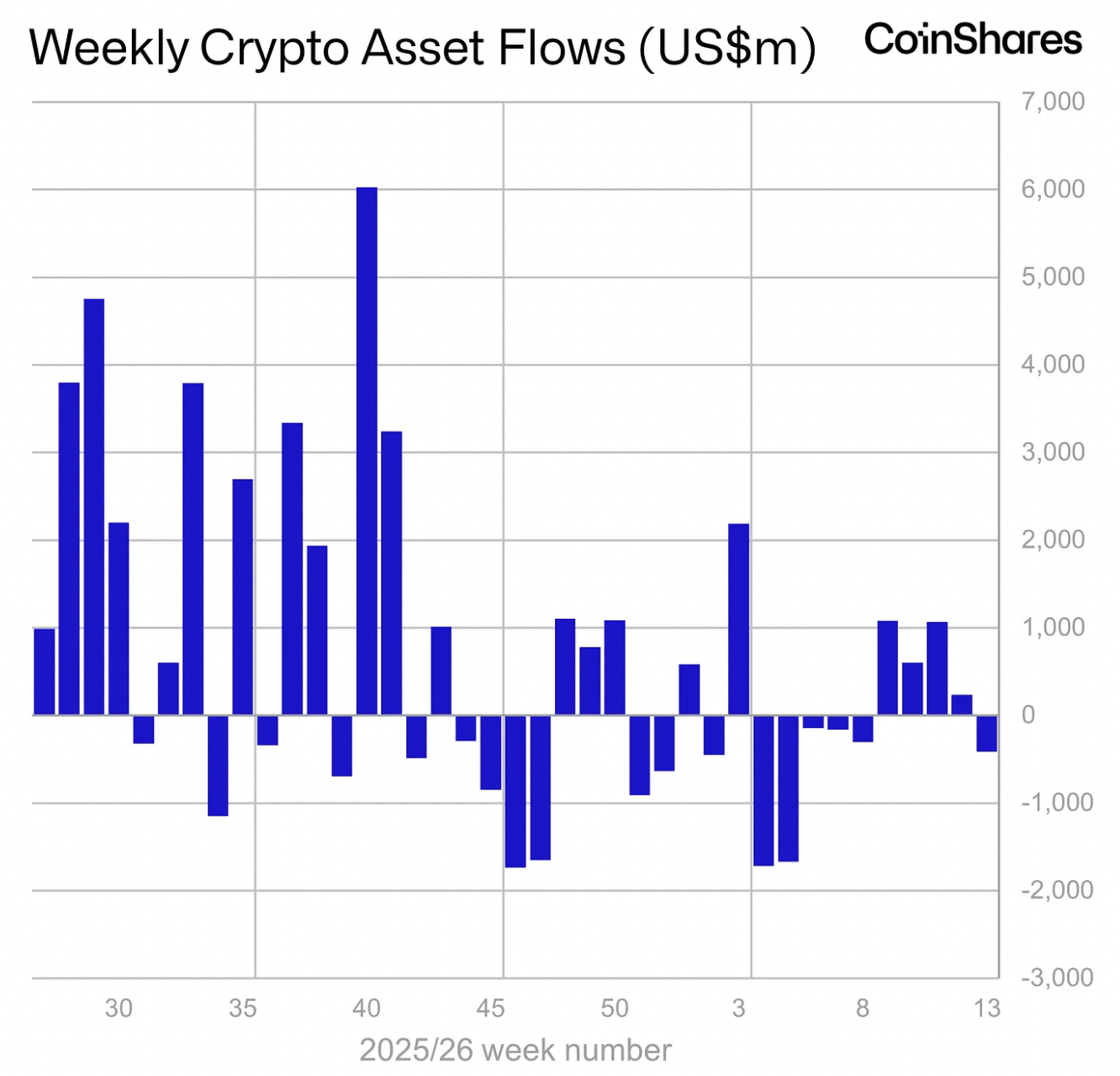
Source: CoinShares

Winners and losers of the last week

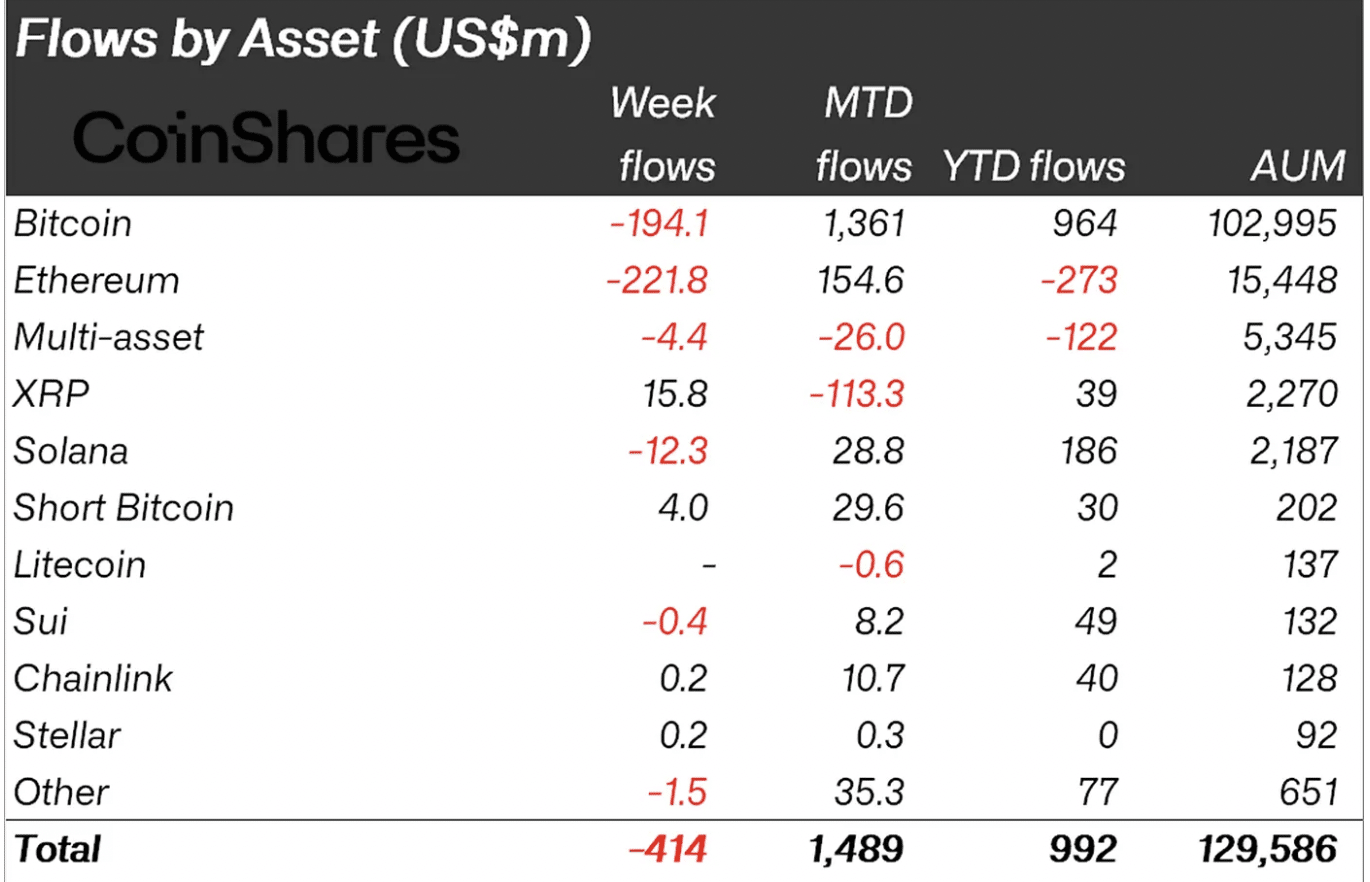
That said, in this outflow, Ethereum [ETH] was hit the hardest, recording $222 million worth of outflows. This further caused its year-to-date outflow to fall to $273 million.

Well, this drop might be due to the ongoing uncertainty around the CLARITY Act. Meanwhile, ETH’s price was also choppy as it faced a downturn of 2.48% in the past week.

Interestingly, Bitcoin [BTC] was standing strong, but the room for caution still remained. The leading cryptocurrency recorded outflows worth $194 million in the last week.

However, if you looked at its year-to-date data, its net inflow stood strong at $964 million. This came as Bitcoin’s price witnessed a weekly drop of 3.48%.
Source: CoinShares

Needless to say, Solana [SOL] was no exception as it too recorded $12.3 million in outflows as its price swung down by 5.97% in the past week.

Interestingly, Ripple’s XRP was the only one to record inflows worth $15.8 million. However, its price mirrored the broader market downturn, dropping by 4.68% in the past week.

Thus, XRP was the winner of the digital asset funds in the past week, whereas ETH was the loser.

Are on-chain metrics in favour?

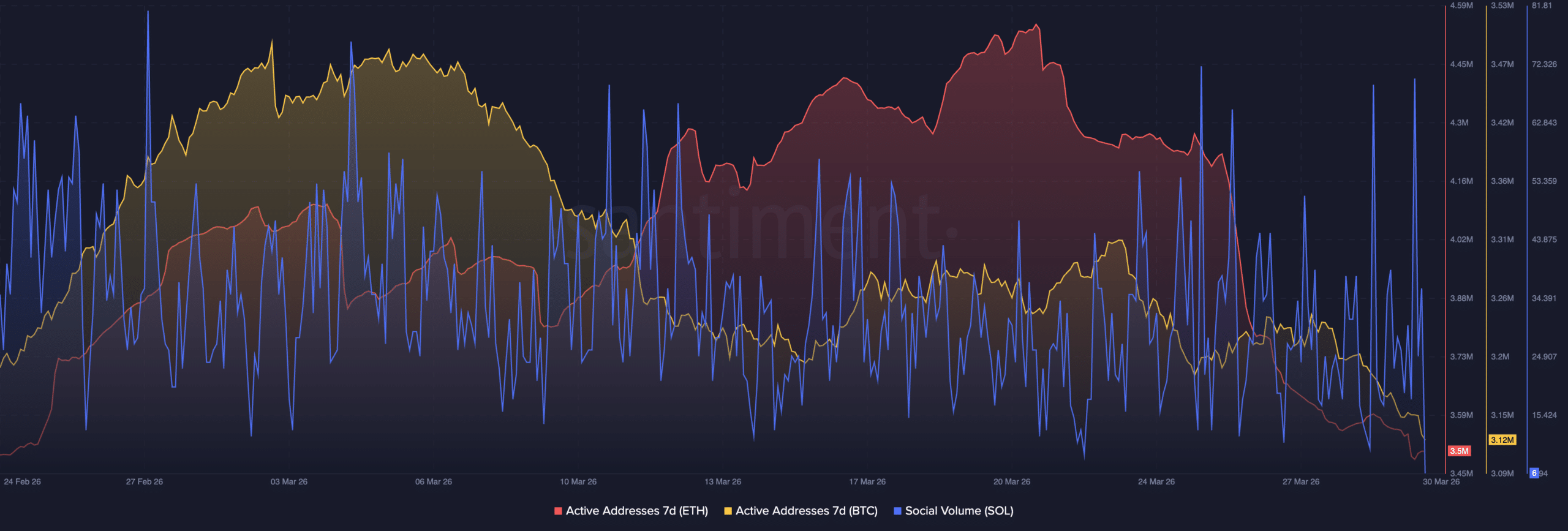
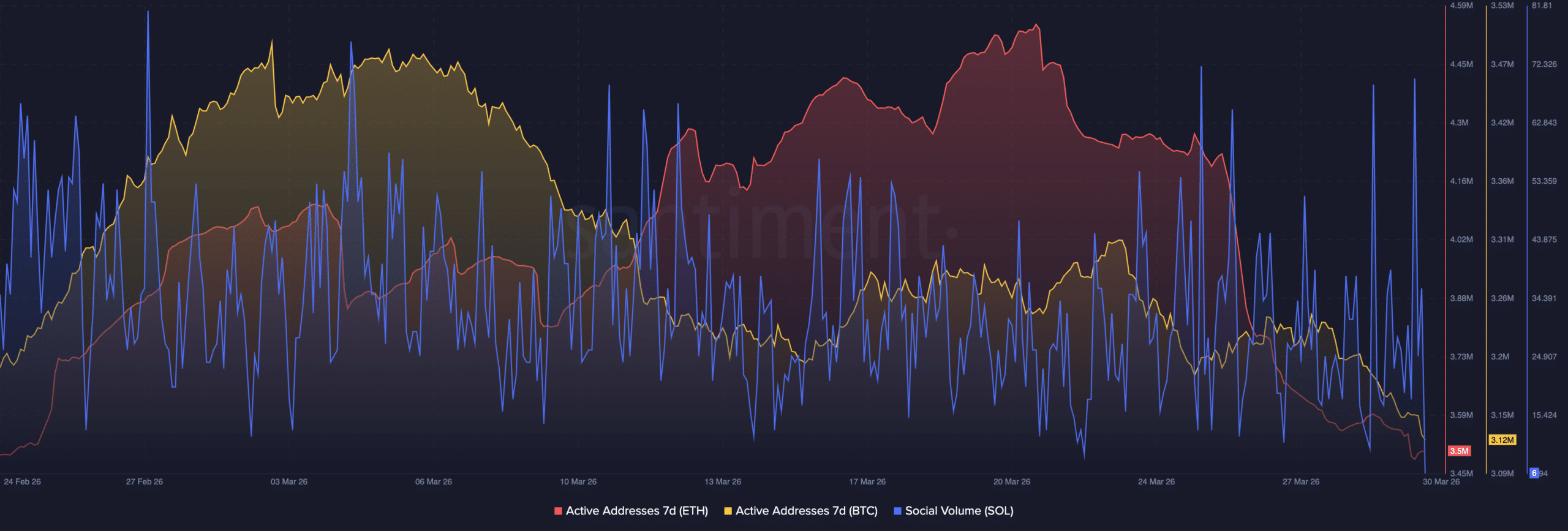
This sentiment was further confirmed by the active address metric by Santiment, wherein Bitcoin and Ethereum had both seen a drop in the aforementioned metric by the end of March.
Source: Santiment

This suggests that only a few people were invested in the network as compared to the high activity seen in early March.

Meanwhile, Solana’s Social Volume has also dropped, meaning fewer people are talking about the altcoin.

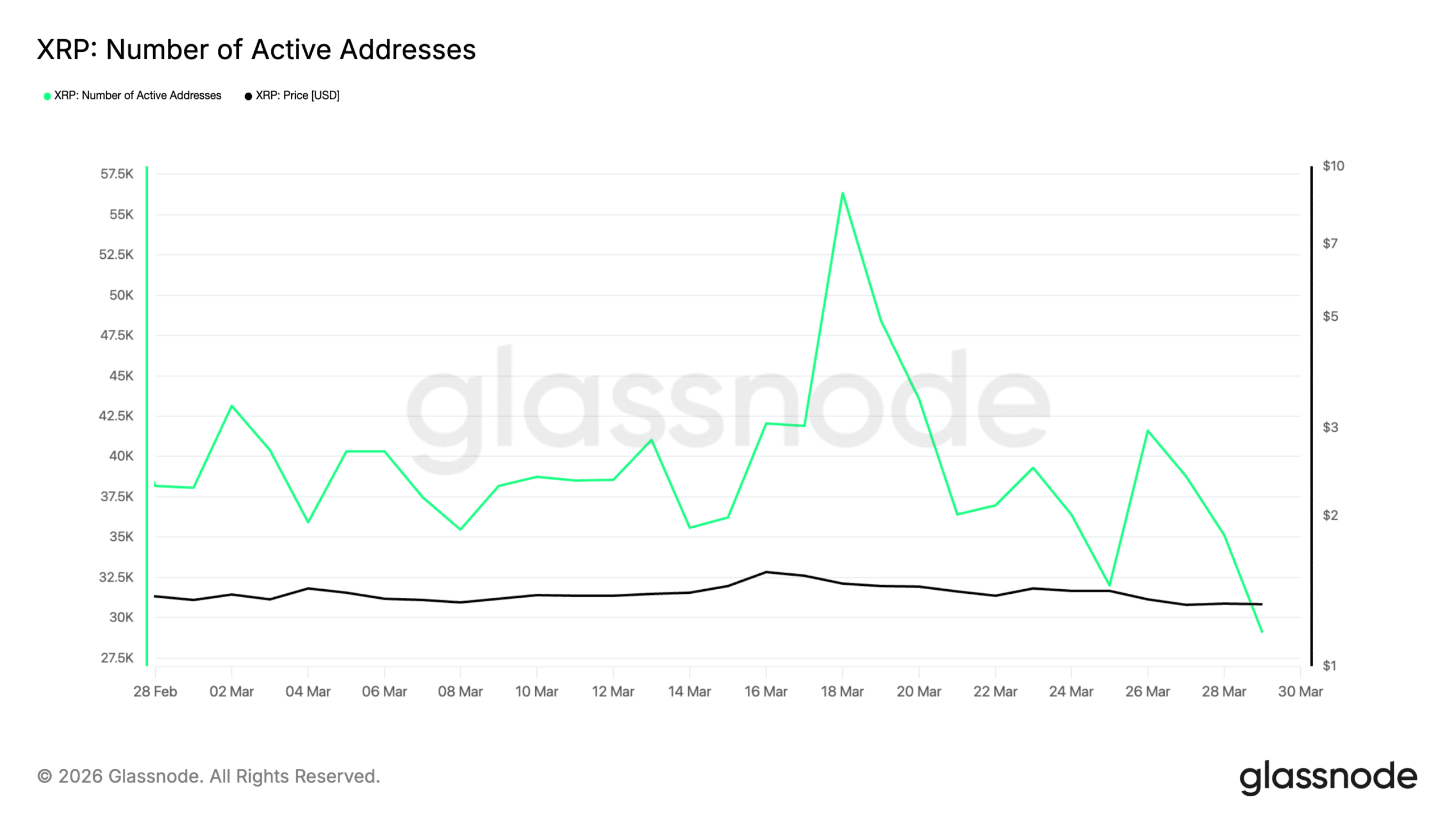
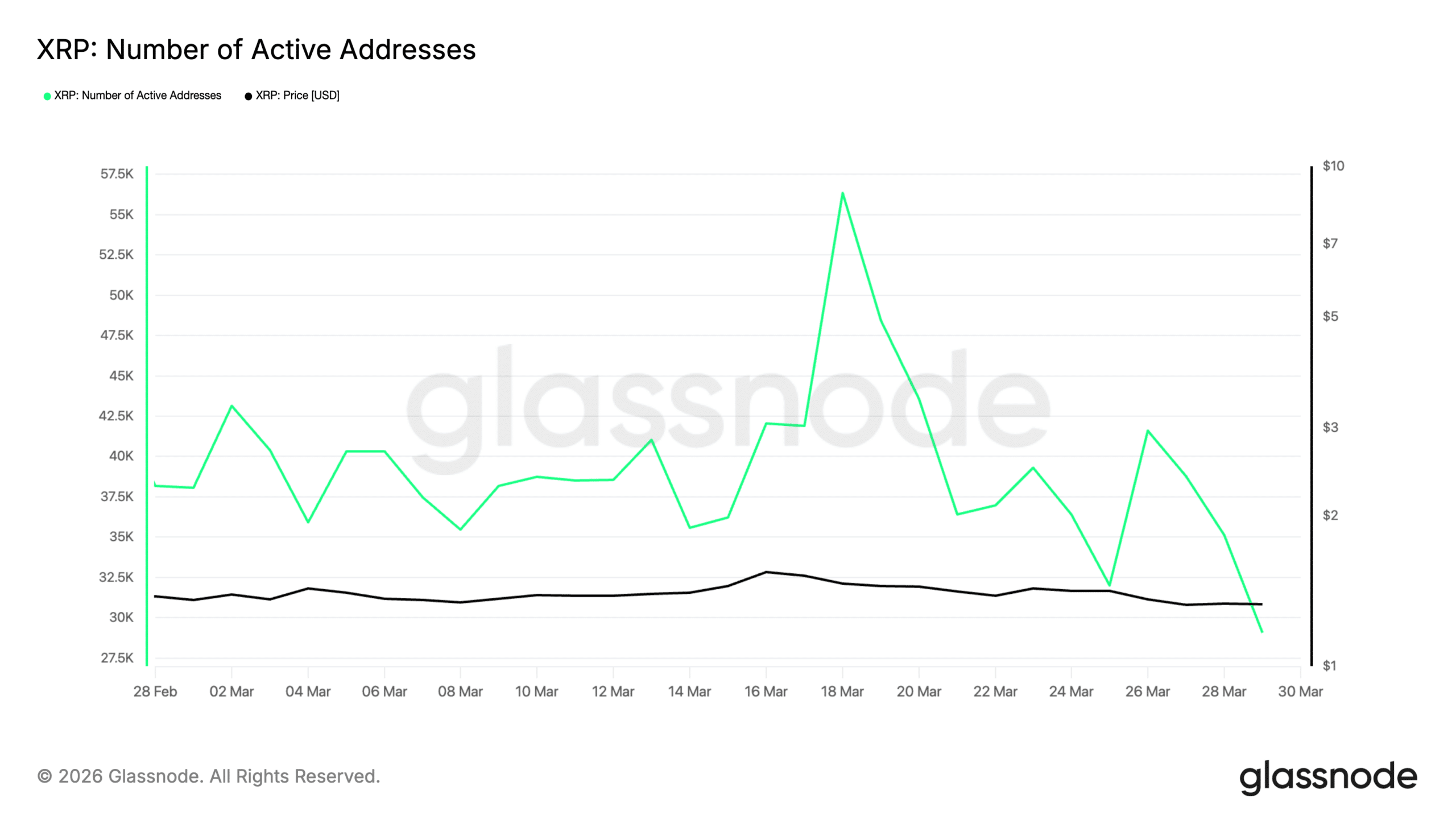
Lastly, though XRP was the winner, its network activity suggests that caution remains due to a sharp drop in active addresses in late March.
Source: Glassnode

The U.S faces the most choppy week

Now, while the U.S saw maximum outflows worth $454 million, Switzerland saw $4 million in outflows. Whereas Canada and Germany saw inflows worth $15.9 million and $21.2 million, respectively

However, as we move towards the end of March and with the 30th of March being the first day of a fresh week, the market is picking up again. The total crypto market cap is back in bullish hands, trading at $2.34 trillion at press time.

Yet despite this surge, investors should not be fooled by short-term booms, as even last week $635 millon had flowed in just before the Fed meeting and created optimism in the market.

However, as soon as the meeting drew to a conclusion, $405 million flowed out of the market, leaving investors in shock. Therefore, until situations calm down globally, short-term prices are not a clear sign for long-term market predictions.


Final Summary

  • The shift from inflows to outflows suggests that there is a lot of FUD in the market, and investors are positioning their bets cautiously.
  • Bitcoin is holding strong, but XRP stealing the spotlight highlights that investors are no longer just betting on Bitcoin.


Related Questions

QWhat was the total value of outflows from cryptocurrency investment funds in the last week of March, and what was the primary reason for this shift?

AThe total value of outflows was $414 million. The primary reasons were escalating global tensions involving the U.S. and Iran, high inflation, and growing expectations around the upcoming Federal Reserve meetings.

QWhich cryptocurrency was hit the hardest with outflows, and what was the specific amount?

AEthereum (ETH) was hit the hardest, recording $222 million worth of outflows.

QDespite the overall outflows, which digital asset was the only one to record inflows, and how much was it?

ARipple's XRP was the only digital asset to record inflows, worth $15.8 million.

QAccording to on-chain metrics from Santiment, what trend was observed for Bitcoin and Ethereum by the end of March?

ABoth Bitcoin and Ethereum saw a drop in their active address metrics by the end of March, suggesting reduced network activity.

QWhich country faced the maximum outflows, and what was the amount? Which countries saw inflows?

AThe U.S. faced the maximum outflows, worth $454 million. Canada and Germany saw inflows of $15.9 million and $21.2 million, respectively.

Related Reads

WeChat AI Card Hands-On Guide: Has the AI Shopping Era Arrived?

**"WeChat AI Card" Practical Test Guide: Has the Era of AI Shopping Arrived?** WeChat has officially launched the "AI Exclusive Card," a feature integrated into its Workbuddy AI assistant. This card is designed to handle payments for AI-initiated purchases. Our hands-on test reveals it's not yet a tool for fully autonomous AI shopping, but rather a controlled payment layer for AI agents. The AI Card functions as an isolated sub-wallet within WeChat Pay. Users must bind the card and transfer funds into it from their main wallet. Crucially, every transaction requires explicit user confirmation via smartphone scan; AI cannot spend autonomously. Currently accessible through the Workbuddy agent, the card targets specific digital consumption scenarios: purchasing paid content (reports, data), calling paid APIs/tools, and subscribing to services. Its design prioritizes security and control by separating funds and mandating approval for each payment. We tested a real-world scenario: ordering bubble tea via Workbuddy using a "Meituan Life Assistant" skill. The process encountered multiple hurdles: high "skill" usage costs (exceeding daily free credits), and most importantly, while a payment was successfully initiated, the AI purchased an incorrect product (a mismatched group-buy coupon instead of the desired drink). This highlights the current limitation: the **AI Card only solves the payment step**. The broader challenge lies in the **AI agent's execution chain**—accurately understanding intent, navigating third-party platforms, selecting the right product, and ensuring proper fulfillment. The payment succeeded, but the purchase failed to meet the user's need. In conclusion, the WeChat AI Exclusive Card is a cautious, early-step experiment in AI commerce. It provides a secure, user-controlled payment method for agent interactions but is not yet capable of reliable, end-to-end complex purchases. For now, it's best used for low-value, low-risk digital services with careful user verification at each step. The vision of AI handling complete shopping tasks remains a work in progress.

marsbit2h ago

WeChat AI Card Hands-On Guide: Has the AI Shopping Era Arrived?

marsbit2h ago

Deconstructing Notion's Growth: From a Note-taking Tool to 100 Million Users—How Notion Built a Triple Growth Flywheel Through Product, Templates, and Community

Notion's growth from a niche note-taking tool to a platform with 100 million users is powered by three interconnected flywheels: Product-Led Growth (PLG), a Template Economy, and Community-Driven Growth. First, Notion's PLG strategy relies on a highly flexible, "plastic" product that users can adapt to countless personal and team workflows. Its freemium model lowers the barrier to entry, while features like page sharing and collaboration drive organic, usage-based viral growth as users naturally invite others. Second, the Template Economy solves the "blank page" problem. Templates, created by both Notion and its community, transform abstract product capabilities into concrete, copyable solutions for specific scenarios (e.g., project management, content calendars). This dramatically lowers activation costs for new users and fuels SEO-driven discovery. Third, a vibrant Community acts as a distributed growth engine. Users and official Ambassadors create tutorials, share use cases, and host local events. This community not only educates users but also fosters a sense of identity around pursuing "better ways of working," strengthening loyalty and enabling global, low-cost expansion. Together, these flywheels create a self-reinforcing ecosystem: a great product attracts users who create templates and community content, which in turn attracts more users and deepens engagement. This system allowed Notion to scale from individuals to teams and enterprises through a bottom-up adoption path. Looking ahead, AI integration promises to accelerate these flywheels further by making templates smarter and the platform a potential AI-native work operating system. Ultimately, Notion's defensible advantage is not just its features, but this deeply entrenched network of user assets, creators, and community trust.

marsbit2h ago

Deconstructing Notion's Growth: From a Note-taking Tool to 100 Million Users—How Notion Built a Triple Growth Flywheel Through Product, Templates, and Community

marsbit2h ago

$10 Billion, Qualcomm to Acquire Chip Legend Jim Keller's Company

Global mobile chip giant Qualcomm is in advanced talks to acquire AI chip startup Tenstorrent in a deal valued between $8-10 billion, according to media reports. This potential acquisition would be one of the largest in the AI chip sector in recent years. Tenstorrent, led by legendary chip architect Jim Keller, has gained prominence for its RISC-V architecture and AI accelerator designs. The move highlights Qualcomm's strategic push to diversify beyond its core smartphone chip business. As the smartphone market matures, Qualcomm is aggressively targeting growth in automotive, data center, and cloud AI. Acquiring Tenstorrent would allow Qualcomm to rapidly enter the high-end AI computing market, bypassing lengthy in-house development cycles. Tenstorrent's cost-effective system architecture, which avoids expensive HBM memory and relies on standard Ethernet for clustering, offers a potential alternative to Nvidia's costly solutions. Furthermore, Tenstorrent's high-performance RISC-V CPU technology and its focus on the automotive and edge computing segments align with Qualcomm's strategic goals, including its "Snapdragon Digital Chassis" platform. Despite the strategic rationale, the high valuation has sparked some investor caution. The successful integration of Tenstorrent's open-source culture and independent team into Qualcomm's organization, along with the commercialization of its technology, remains a key challenge.

marsbit2h ago

$10 Billion, Qualcomm to Acquire Chip Legend Jim Keller's Company

marsbit2h ago

Trading

Spot
Futures
活动图片