Bitcoin Recovery Fails To Lift Market Sentiment From Extreme Fear

bitcoinistPublished on 2026-04-17Last updated on 2026-04-17

Abstract

Despite Bitcoin's recent recovery to around $74,800, the overall market sentiment remains in "extreme fear," according to the Crypto Fear & Greed Index. The index, which measures investor sentiment based on factors like volatility, social media, and trading volume, is at a value of 23, just inside the extreme fear zone. This marks a continued period of bearish sentiment since late 2025. Although Bitcoin's rally provided a brief uplift in mid-March, the current price movement has not been enough to shift market psychology into a more positive or greedy territory. For sentiment to improve, a sustained bullish momentum may be required.

Data shows the crypto Fear & Greed Index is still inside the extreme fear territory despite the recovery that Bitcoin and other coins have made.

Bitcoin Fear & Greed Index Is Still Pointing At ‘Extreme Fear’

The “Fear & Greed Index” is an indicator created by Alternative that tells us about the average sentiment present among traders in the Bitcoin and wider cryptocurrency markets. The index takes into account for the data of the following five factors to determine the investor mentality: trading volume, market cap dominance, volatility, social media sentiment, and Google Trends.

To represent the market sentiment, the metric makes use of a numerical scale running from zero to hundred. All values on this scale that lie below 47 correspond to a net sentiment of fear, while those above 53 suggest the dominance of greed among investors. Naturally, the values lying between these two cutoffs imply a neutral mentality.

Besides these three main zones, there are also two ‘extreme’ regions called the extreme fear (25 and under) and extreme greed (above 75). Historically, these two have held significance for the market as they have been where major tops and bottoms have tended to form.

The relationship between prices and sentiment has been an inverse one, however, with tops appearing during extreme greed and bottoms alongside extreme fear.

Recently, the crypto sector has been stuck in the latter of the two, as the below chart shows.
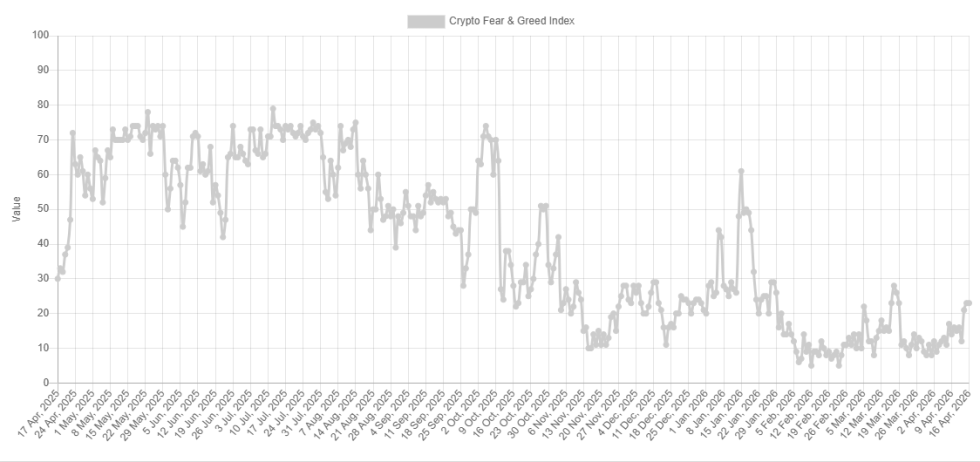
How the Fear & Greed Index has changed over the past year | Source: Alternative

The long stay in the extreme fear zone has been a consequence of the bearish action that Bitcoin and other assets have faced since Q4 2025. In mid-March, BTC’s recovery to $75,000 meant that the market saw a temporary respite from rock-bottom sentiment, with the Fear & Greed Index surging to a peak of 28. After the BTC rally fizzled out, however, the sentiment also cooled back deep into the extreme fear zone again.

From the above chart, it’s apparent that in the last few days, the metric has again made some recovery. The uplift in sentiment is due to BTC’s rally toward the $76,000 mark. Unlike the surge from mid-March, though, this one hasn’t yet been able to take the Fear & Greed Index out of the extreme fear region.

As is visible in the meter, the indicator is sitting at a value of 23 right now, which is just inside the extreme fear boundary.
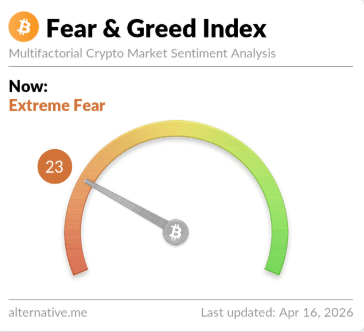
The latest value of the Fear & Greed Index | Source: Alternative

It’s possible that if bull momentum continues in the coming days, the Fear & Greed Index will escape the extreme fear zone. But for now, it seems that the market isn’t convinced about the price rally.

BTC Price

At the time of writing, Bitcoin is floating around $74,800, up nearly 5% in the last seven days.

The price of the coin seems to have been moving sideways since its upward move earlier in the week | Source: BTCUSDT on TradingView


Related Questions

QWhat is the Bitcoin Fear & Greed Index and what does it measure?

AThe Bitcoin Fear & Greed Index is an indicator created by Alternative that measures the average sentiment among traders in the Bitcoin and wider cryptocurrency markets. It uses a numerical scale from 0 to 100, taking into account five factors: trading volume, market cap dominance, volatility, social media sentiment, and Google Trends.

QWhat value on the Fear & Greed Index represents 'extreme fear' and what is its historical significance?

AValues of 25 and below on the Fear & Greed Index represent 'extreme fear.' Historically, this zone has been significant for the market as major bottoms have tended to form during periods of extreme fear.

QDespite Bitcoin's recent price recovery, what is the current reading of the Fear & Greed Index?

ADespite Bitcoin's recent rally toward $76,000, the Fear & Greed Index is currently sitting at a value of 23, which is still inside the extreme fear territory.

QWhat was the peak value the Fear & Greed Index reached during Bitcoin's mid-March recovery to $75,000?

ADuring Bitcoin's mid-March recovery to $75,000, the Fear & Greed Index surged to a peak of 28, providing a temporary respite from the rock-bottom sentiment.

QWhat is the inverse relationship between market sentiment and Bitcoin prices mentioned in the article?

AThe article states that the relationship between prices and sentiment has been inverse, with major tops in the market tending to form during periods of extreme greed, while major bottoms have typically occurred alongside extreme fear.

Related Reads

The Second Half of Macro Influencer Fu Peng's Career

Fu Peng, a prominent Chinese macroeconomist and former chief economist of Northeast Securities, has joined Hong Kong-based digital asset management firm Bitfire Group (formerly New Huo Group) as its chief economist. This move, announced in April 2026, triggered an 11% surge in Bitfire's stock price. Fu, known for his accessible macroeconomic commentary and large social media following, will focus on integrating digital assets into global asset allocation frameworks, particularly combining FICC (fixed income, currencies, and commodities) with cryptocurrencies for institutional clients. His career includes roles at Lehman Brothers and Solomon International, with significant influence gained through public communication. However, in late 2024, Fu faced temporary social media bans after a controversial private speech at HSBC on China's economic challenges, though he denied regulatory sanctions. He later left Northeast Securities citing health reasons. Bitfire, a licensed virtual asset manager serving high-net-worth clients, seeks to build trust and attract traditional capital through Fu’s expertise and credibility. The partnership represents a strategic shift for both: Fu enters the crypto sector after a traditional finance peak, while Bitfire aims to leverage his macro framework for institutional adoption. Outcomes remain uncertain regarding capital inflows and compatibility within corporate structure.

marsbit1h ago

The Second Half of Macro Influencer Fu Peng's Career

marsbit1h ago

Trading

Spot
Futures
活动图片