Bitcoin (BTC) showed weakness on Aug. 15, posting a 5% loss after testing the $25,000 resistance. The move liquidated over $150 million worth of leverage long positions and has led some traders to predict a move back toward the yearly low in the $18,000 range.
The price action coincided with worsening conditions for tech stocks, including Chinese giant Tencent, which is expected to post its first-ever quarterly revenue decline. According to analysts, the Chinese gaming and social media conglomerate is expected to post quarterly earnings around $19.5 billion, which is 4% lower than the previous year.
Moreover, on Aug. 16, Citi investment bank slashed Zoom Video Communications (ZM) recommendation to sell, adding that the stock is "high risk." Analysts explained that a challenging post-COVID dynamic, plus additional competition from Microsoft Teams, potentially caused a 20% drop in ZM shares.
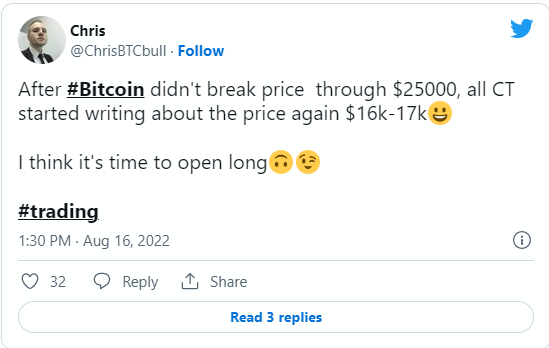
The overall bearish sentiment continues to plague crypto investors, a movement described by influencer and trader @ChrisBTCbull, who mentioned that a simple rejection at $25,000 caused traders to post sub-$17,000 targets.
Margin traders remain bullish despite the $25,000 rejection
Monitoring margin and options markets provides excellent insights into understanding how professional traders are positioned. For instance, a negative read would happen if whales and market makers reduced their exposure as BTC approached the $25,000 resistance.
Margin trading allows investors to borrow cryptocurrency to leverage their trading position, increasing returns. For example, one can increase exposure by borrowing stablecoins to buy an additional Bitcoin position.
On the other hand, Bitcoin borrowers can only short the cryptocurrency as they bet on its price declining. Unlike futures contracts, the balance between margin longs and shorts isn't always matched.

The above chart shows that traders' margin lending ratio has remained relatively stable near 14 while Bitcoin price jumped 6.3% in two days only to be rejected after hitting the $25,200 resistance.
Furthermore, the metric remains bullish by favoring stablecoin borrowing by a wide margin. As a result, pro traders have been holding their bullish positions, and no additional bearish margin trades emerged as Bitcoin retraced 5.5% on Aug. 16.
Option markets hold a neutral stance
There’s uncertainty on whether Bitcoin will make another run towards the $25,000 resistance but the 25% delta skew is a telling sign whenever arbitrage desks and market makers overcharge for upside or downside protection.
The indicator compares similar call (buy) and put (sell) options and will turn positive when fear is prevalent because the protective put options premium is higher than risk call options.
The skew indicator will move above 10% if traders fear a Bitcoin price crash. On the other hand, generalized excitement reflects a negative 10% skew.

Bitcoin 30-day options show 25% delta skew: Source: Laevitas.ch
As displayed above, the 25% delta skew has barely moved since Aug. 11, oscillating between 5% and 7% most of the time. This range is considered neutral because options traders are pricing a similar risk of unexpected pumps or dumps.
If pro traders entered a "fear" sentiment, this metric would have moved above 10%, reflecting a lack of interest in offering downside protection.
Despite the neutral Bitcoin options indicator, whales and market makers maintaining their bullish bets after a 5.5% BTC price decline on Aug. 16. For this reason, investors should expect another retest of the $25,000 resistance as soon as the global macroeconomic conditions improve.