40 Events, 700 Million Viewers: How Fight.ID is Bringing World-Class Events into Web3?

marsbitPublished on 2026-01-22Last updated on 2026-01-22

Abstract

Fight.ID, an official UFC partner, is leveraging Web3 to transform combat sports fan engagement. With UFC hosting 40+ annual events and reaching 700 million viewers, the project aims to convert this massive audience into an active on-chain community through a three-layer model: Fight.ID (on-chain identity), Fight Points (non-transferable reputation points earned via engagement), and the $FIGHT token. Notably, the project refunded its $200 million ICO entirely and airdropped 85 million $FIGHT tokens to early supporters, signaling a strong community-focused approach. The token, set to launch on Binance Alpha and Coinbase, has utilities including staking for exclusive athlete fan clubs, ecosystem access for partners, and payments for merchandise. An initial test in December 2025 saw 60,000 digital collectibles sell out in 4 hours, generating $4.5 million. The model seeks to improve upon traditional fan token approach by fostering sustained participation rather than one-time transactions. Key milestones for 2026 include full product rollout and scaling community features.

Author: Deep Tide TechFlow

Customer acquisition anxiety in Web3 projects is already a cliché.

Users leave after airdrops, KOL shillings can't sustain hype for more than three days, addresses bought for tens of dollars might just be another bot... Everyone is looking for a solution for 'sustainable customer acquisition,' but most projects' answer is still to throw more money and issue more tokens.

Actually, sports fans are a good direction for customer acquisition.

Strong emotional attachment, stable attention cycles, seasons, events, and transfer windows are natural active nodes. A few years ago, projects tried fan economy related to football, but the Fan Token path hasn't produced great case studies.

Recently, a project wanted to try the fan economy play in the fighting sports arena.

Fight.ID is an official partner of the UFC, and the UFC is the world's largest mixed martial arts league, hosting over 40 events annually, reaching 700 million viewers. The token $FIGHT completed a public sale of nearly $200 million last October, with TGE imminent.

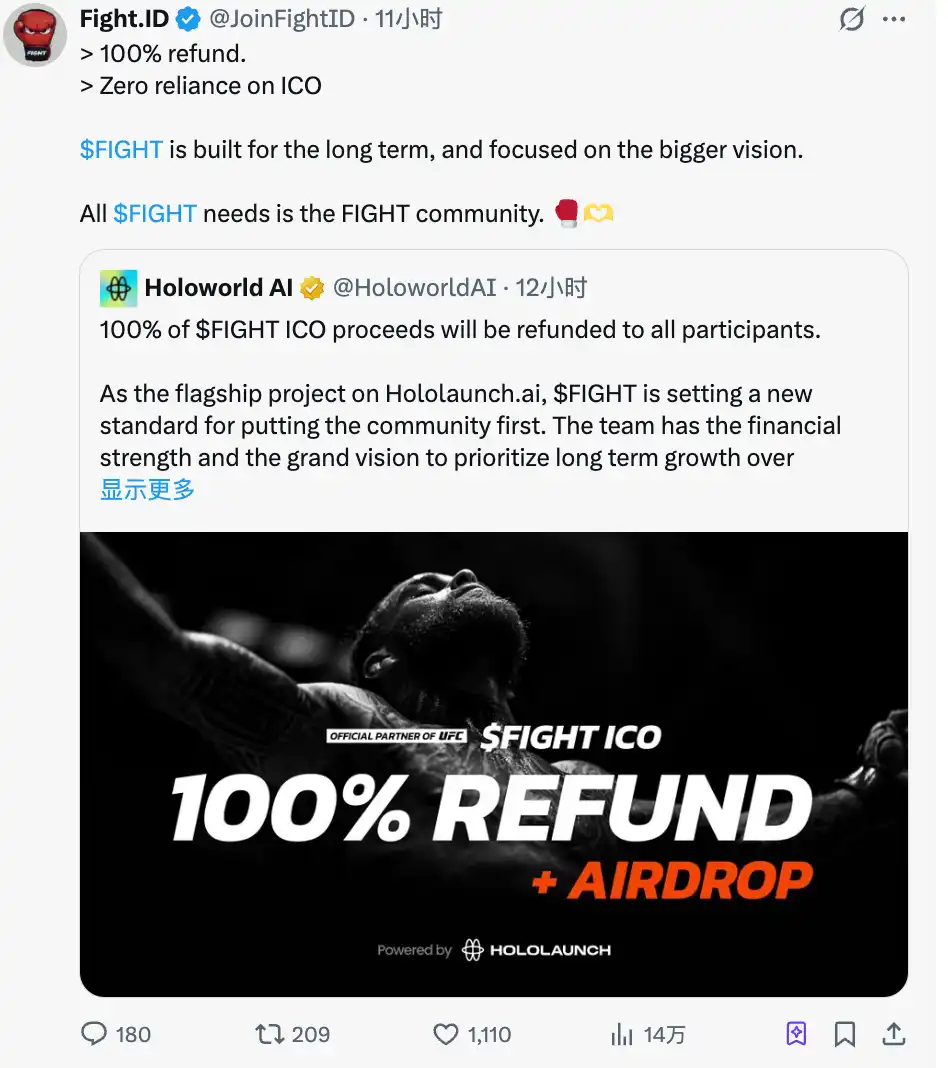
But just these past few days, the project announced a move: 100% of the funds raised in the ICO will be refunded to all participants, while an additional airdrop of 85 million tokens (0.85% of total supply) will be given to early supporters.

In other words, those who participated in the ICO not only get their principal back but also earn an airdrop for free.

This move is uncommon in the industry. Raising nearly $200 million and refunding it just like that shows the team isn't short on money, and also shows they want to leave the TGE筹码 (chips/supply) for the community rather than locked up with early investors.
On January 22nd, Binance Alpha announced the listing of $FIGHT, and Coinbase added it to its listing roadmap a few days ago.

In the current market environment, where most projects are still trying to extract money from the community's pockets, Fight.ID is instead putting money into the community's pockets.

How much recognition and participation can this kind of格局 (vision/gesture) buy? Binance Alpha confirmed the listing on January 22nd, Coinbase added it to the roadmap, the market is giving its first round of feedback.

Also, fighting sports are among the most popular sports categories in the US, with a solid audience base. Can this project's model hold up, and what value does the token have worth exploring?
Securing UFC's On-Chain IP, Aligning Fighter Interests

The value of the UFC IP license lies in its usage scenarios.

UFC hosts over 40 events a year, each event's broadcast, live audience, and social media are exposure channels. Getting the IP license means Fight.ID can run events, publish content, and onboard users following the event schedule, instead of spending money to buy traffic. It's like renting a continuously running customer acquisition machine.
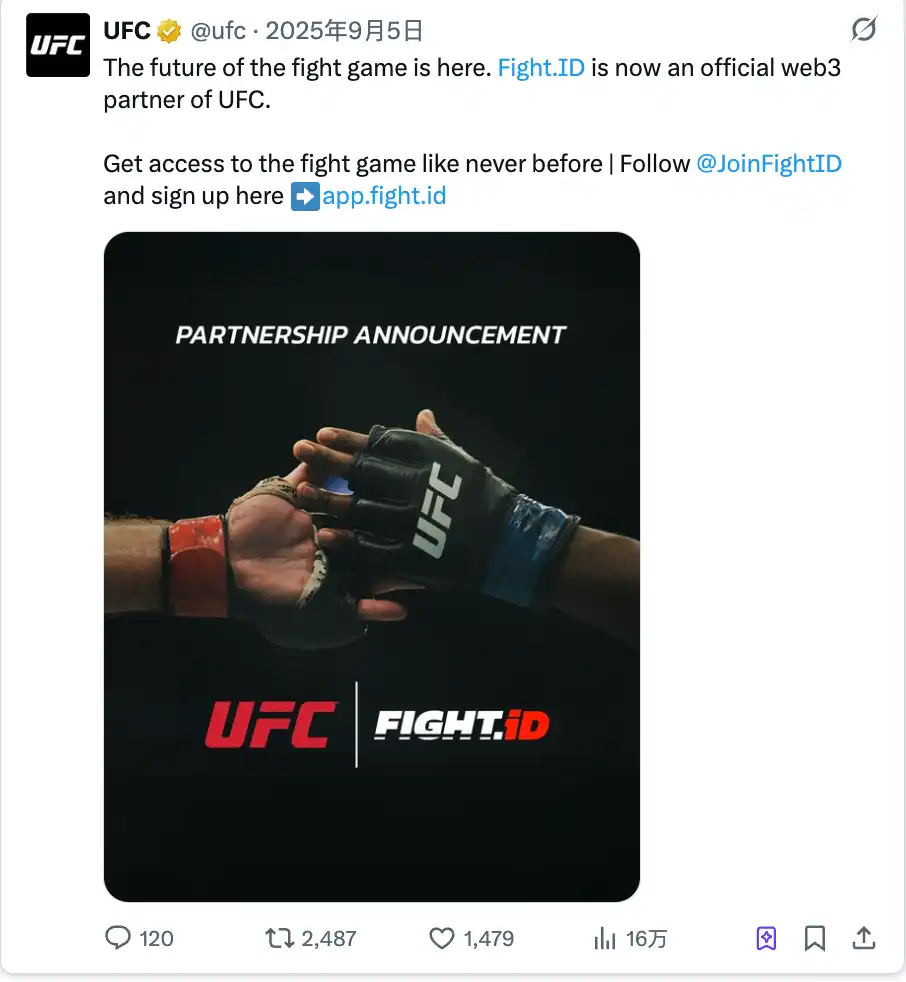
Concept Labs got this license because of prior collaboration.

In 2022, it took over the UFC Strike NFT project, focused on fighter imagery, from Dapper Labs, and has been operating it since.

The project also has an interesting design with an Athlete Committee.

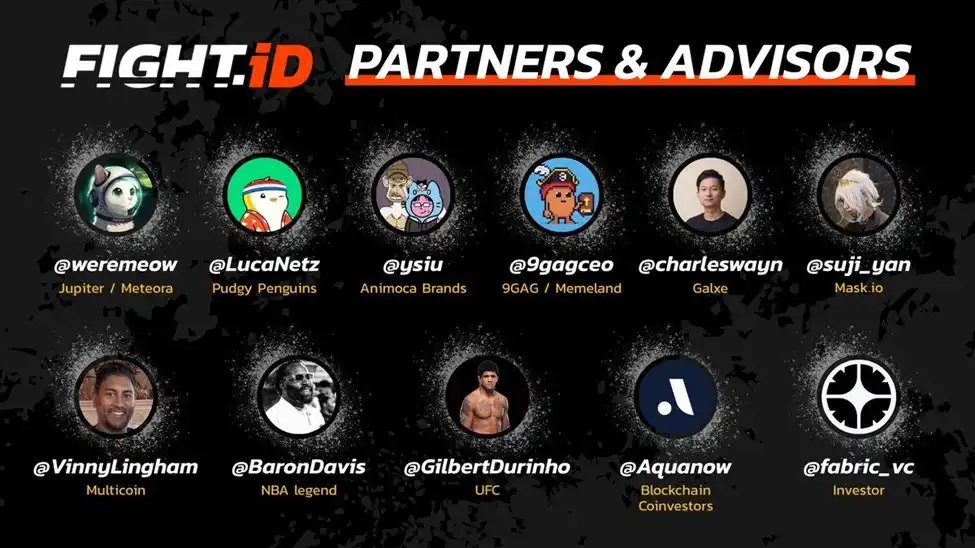
Simply put, it involves active UFC fighters in project governance, not just photo ops. Committee members include Gilbert Burns, Alexandre Pantoja, Dan Ige, etc., all ranked active fighters. Their duties include reviewing product features, deciding bonus pool distributions, etc.

The fighters are compensated in tokens, vested based on participation; they don't get the full amount if they don't participate. The intent of this design is clear:

To give athletes real skin in the game, not just a one-time endorsement fee.

Regarding funding, an institutional round was completed in September 2025, with investors including Aptos Foundation, Jupiter, Memeland, etc. The amount was not disclosed.
Every UFC Event is a User Entry Point

With the IP license and event exposure, the next question is how to turn viewers into on-chain users.

Fight.ID designed a three-tier structure to do this.

First, the base layer is Fight.ID itself, an on-chain identity. After registration, this identity can be used across platforms to participate in various activities;

The middle layer is FP, short for Fight Points, a reputation score. FP cannot be bought, sold, or transferred; it can only be earned by participating in activities. Watching fights, playing prediction games, buying digital collectibles, engaging in the community—all earn FP.

The top layer is the $FIGHT token, many of its functions are tied to FP: staking rewards are boosted based on FP level, some athlete communities require an FP threshold to join.
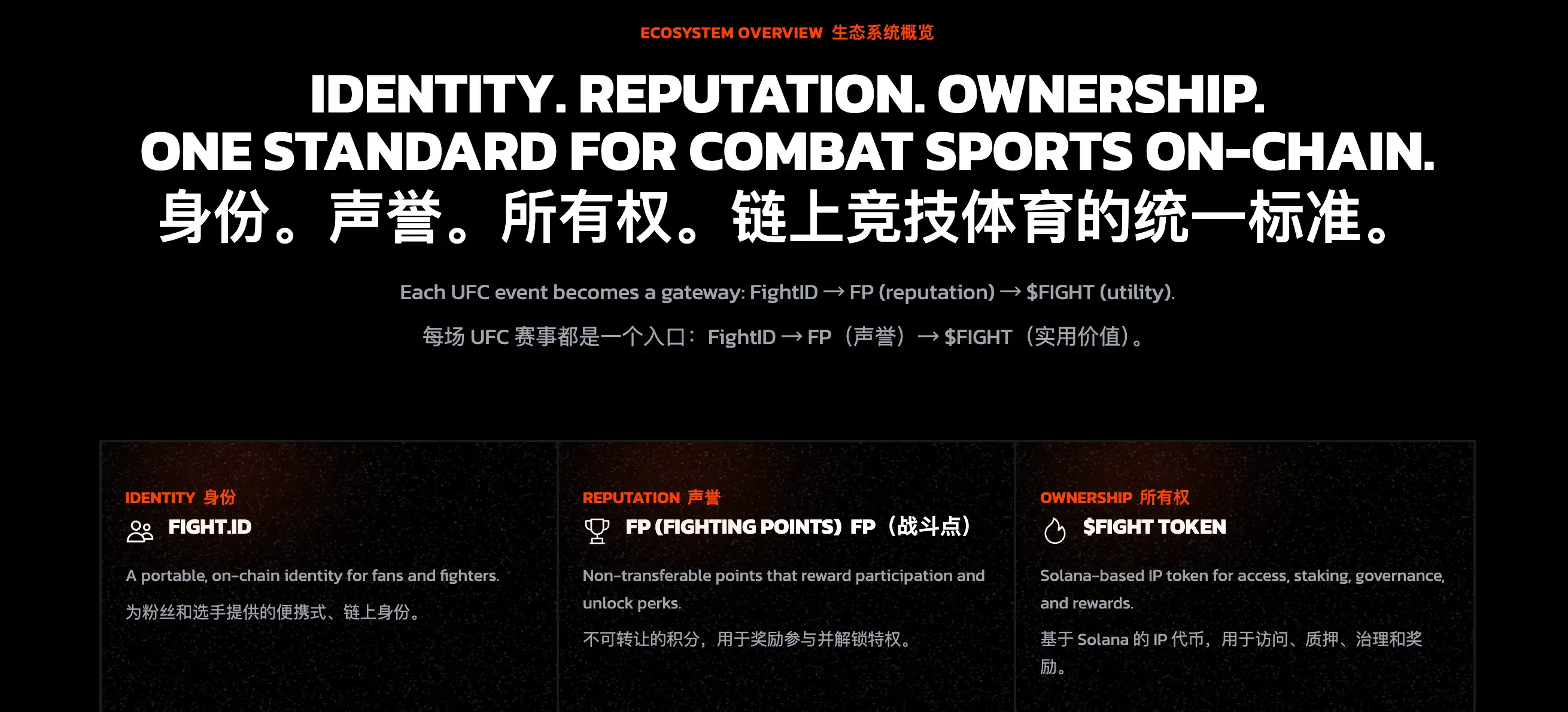
The intention behind this design is also quite clear: to figure out how to make the fan economy work through points and tokens:

First, use UFC events to pull users in; second, use FP points to keep users engaged, giving them an expectation of earning points; finally, use token functions to realize the value of FP.

Every UFC event can become an entry point for this acquisition funnel, not a one-off marketing event.

From a cost perspective, this model has another advantage:

A large part of the customer acquisition cost is borne by UFC's content production and event operations. UFC was going to host events, do broadcasts, run social media anyway; Fight.ID is essentially catching a ride. Compared to buying ads and traffic, this cost structure is healthier.

Of course, whether the model is good still depends on data validation. An event last December provided the first data sample.

60,000 Digital Collectibles, Sold Out in 4 Hours

On December 7, 2025, Fight.ID配合 (coordinated with) the UFC event that week and ran a digital collectible campaign on Telegram.

The玩法 (gameplay/mechanic) was to purchase UFC Strike digital collectible packs and earn FP points. You might think this kind of sports fan economy is niche and not very hot, but the actual results were pretty good.

Official data shows 60,000 packs sold out in 4 hours, with sales of $4.5 million, about 20,000 buyers, and over 600,000 on-chain transactions. During the event, Fight.ID rose to number 4 among social DApps on BNB Chain.

Against the backdrop of a crypto bear market, these numbers are actually quite good, also demonstrating the appeal of the UFC brand.
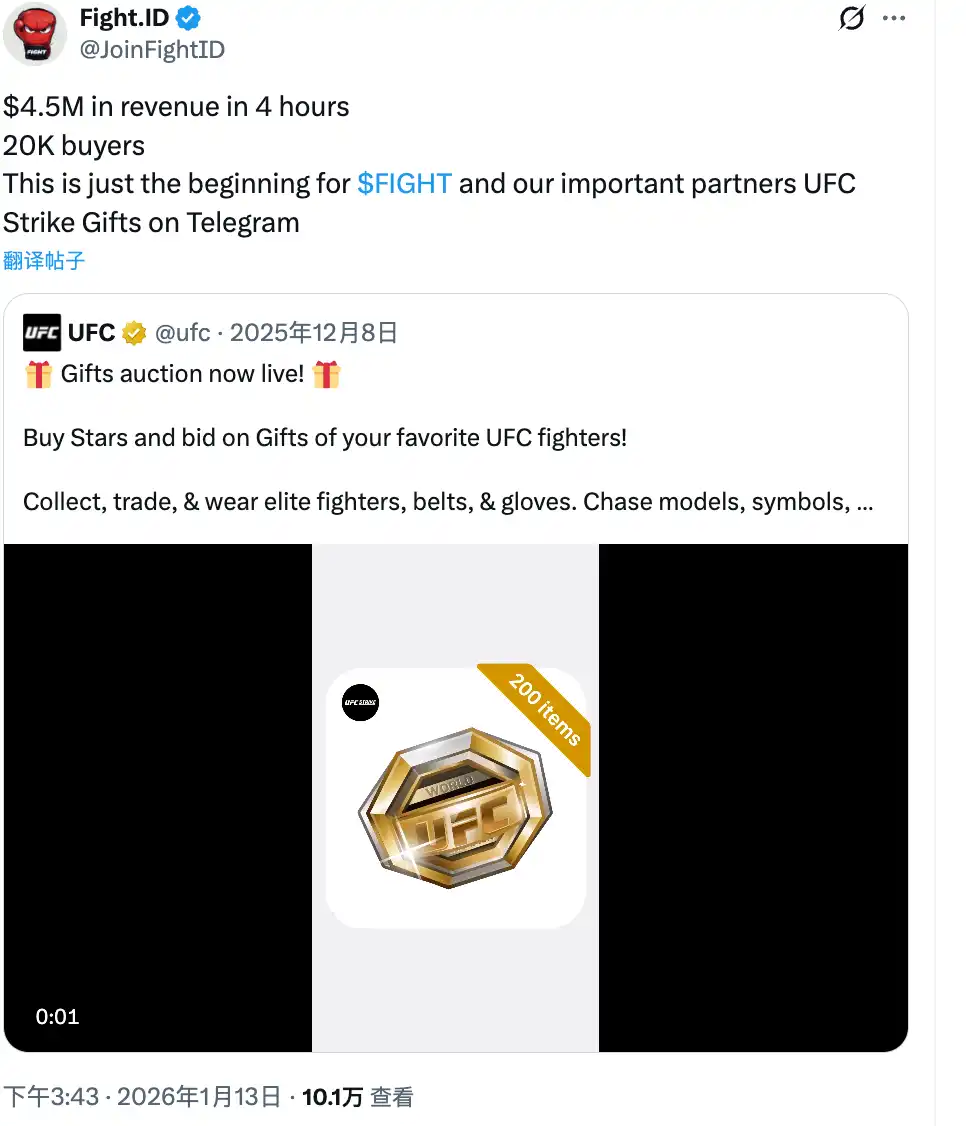
It's also necessary to clearly recognize that $FIGHT's TGE hasn't happened yet; this event was essentially pre-TGE warm-up and user accumulation.

The persuasiveness of a single event is limited; one cannot simply extrapolate linearly to subsequent events. How many of the 20,000 buyers were there for potential airdrop expectations is not publicly available data.

Additionally, this event leveraged the traffic入口 (entry point) of Telegram Gifts. Telegram has been pushing its digital collectibles feature recently, with UFC Strike being one合作案例 (case study/collaboration), and the platform itself was also driving traffic.

There is a reference point: the previous UFC Strike project operated for over two years,累计 (cumulatively) selling over $20 million in digital collectibles, accumulating 110,000 wallet addresses.

But this December event alone did $4.5 million, equivalent to over 20% of the historical total. Even with TGE hype加成 (boost), this conversion efficiency suggests the event-cycle-driven model is at least workable in the startup phase.

The next question is: users are in, how does the token capture this activity?

$FIGHT Analysis: 57% to Community, Utility Tied to Reputation Points

First, the basics.

$FIGHT is a native Solana token, total supply 10 billion. Public sale price was $0.05, putting the FDV at around $500 million at that price. The circulating supply at TGE is expected to be around 20%.

In terms of allocation, the community gets 57%, which is the largest portion. Investors 17.5%, team 15%, liquidity 6.5%, advisors 4%. The portions for team, investors, and advisors have a 12-month lock-up, followed by linear vesting over 18 to 24 months. In other words, there will be no selling pressure from this portion for a year after TGE, but it will start unlocking continuously after that.
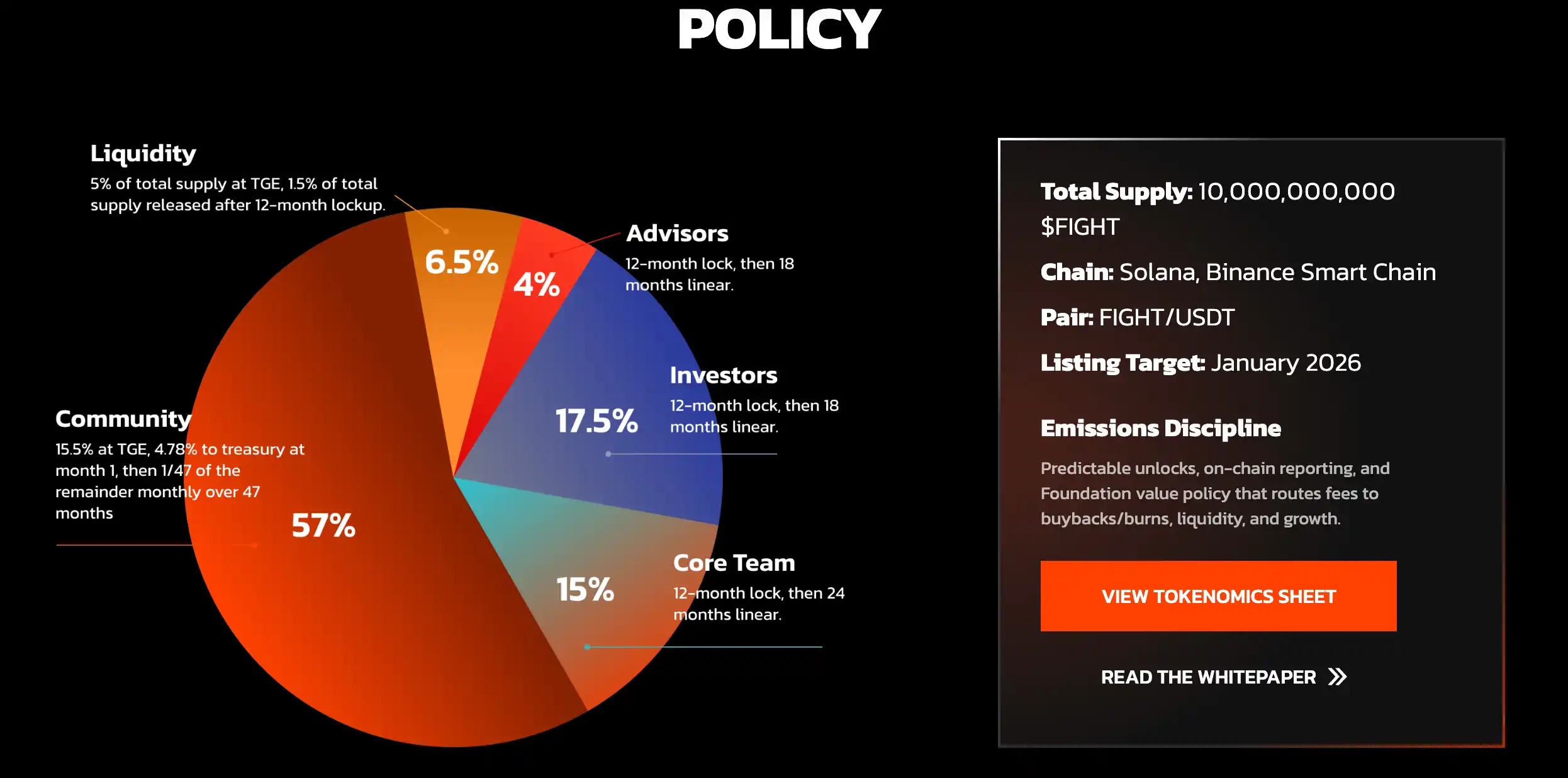
The allocation ratio is standard for Web3 projects, the community share isn't particularly high but not low either. The key is whether the utility design can create real demand for the token.

In terms of utility design, $FIGHT has several scenarios.

First is staking and Fighter Communities. Users stake $FIGHT to join specific athletes' on-chain fan clubs, gaining access to exclusive content, AMAs, priority purchase for merch, watch parties, etc.

There are a few design details: the more members a community has, the higher the staking entry threshold, giving early supporters an advantage; entry fees and community revenue are distributed proportionally to existing members and the DAO treasury; members with higher FP levels get yield boosts and priority access.

This mechanism locks tokens within communities. Each UFC fight week could bring new members, pushing up entry prices and generating more fees.

Second is Partner Ecosystem Access, officially defined as a core utility. Ecosystem partners who want to reach the Fight.ID user base need to use FIGHT to purchase FP distribution allowances, then use tasks, activities, and challenges to distribute FP to users as incentives. This is a B2B model:

Partners pay for access to the audience, users earn FP, FIGHT becomes the ecosystem access currency. As the Fight.ID user base grows, more partners are willing to pay to reach this identified, reputational user base, creating sustained token demand.

Third is peripheral scenarios. FightGear is a apparel brand, with limited edition collaborations and event-themed series; FIGHT holders have priority purchase windows and can pay with the token. PrizeFight is an on-chain prize pool, funded by sponsors, communities, DAOs, rewarding great fight performances and fan participation, with funds and fees denominated in $FIGHT. UFC Strike digital collectibles continue operating, future integration with the Fight ecosystem is planned, holding collectibles can accelerate FP accumulation.
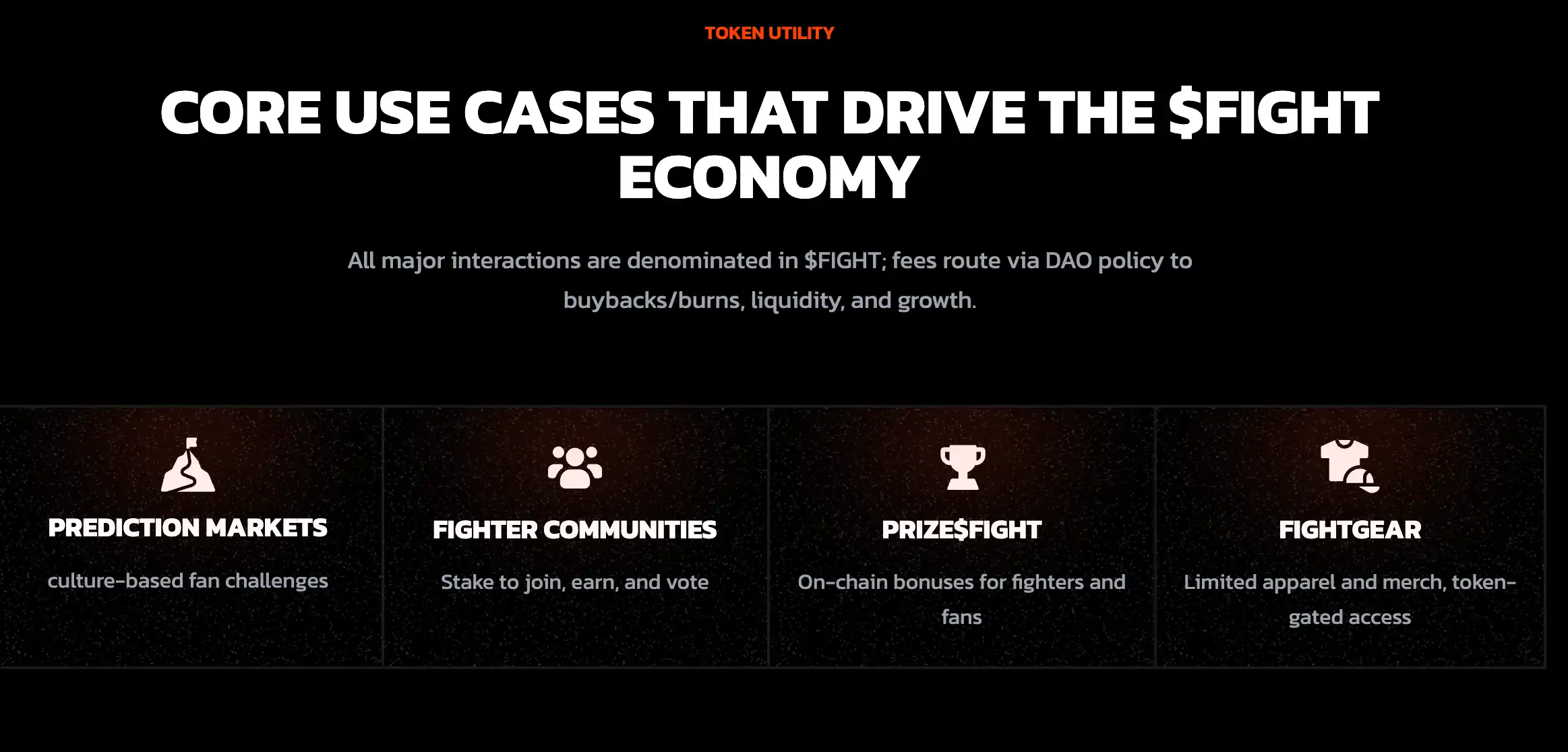
On the governance level, $FIGHT holders can vote on treasury allocation, emission schedules, ecosystem grants, etc. All revenue generated from utility scenarios flows into the DAO treasury for ecosystem support and growth.

Will it work? Honestly, it's impossible to conclude now.

Athlete community activity, real demand from ecosystem collaborators—these still need validation. But at least from a design perspective, $FIGHT isn't a 'buy and hold' token; its utility is deeply tied to the FP reputation system, forcing holders to participate in the ecosystem.

A New Approach to Fan Tokens

Looking at Fight.ID in a broader context, it's trying to answer an old question: how exactly should sports fan economy work in Web3?

Chiliz and Socios started issuing Fan Tokens for football clubs since 2019; Barcelona, Juventus, Paris Saint-Germain all have them. The model was to buy tokens for voting rights on minor things like jersey colors, walk-out music.

After a few years, the problems are obvious: voting rights are too thin, nothing to do after voting, fans buy tokens and either hold waiting for price increase or sell at a loss, no reason for持续参与 (sustained participation).

Fight.ID wants to try a different entry point. We can make a table for a clear comparison:
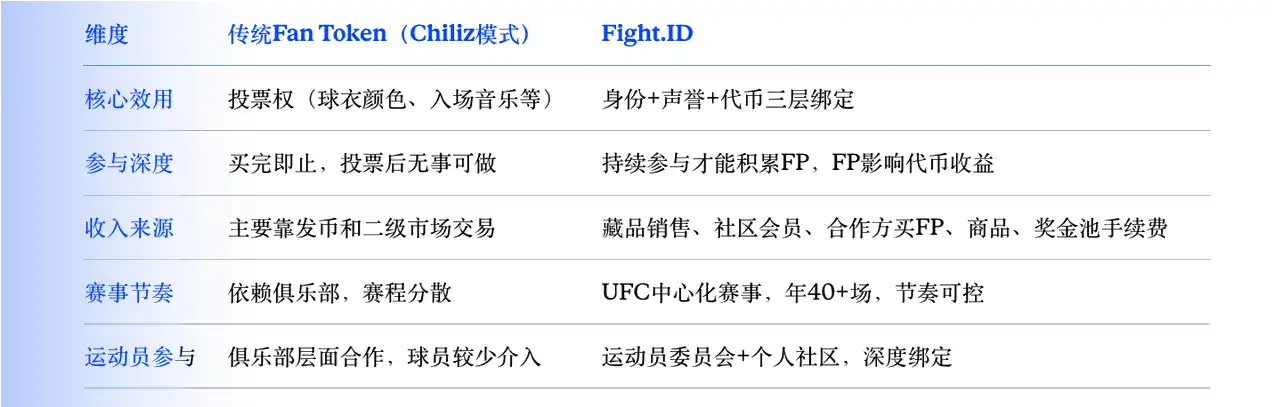
From a design perspective, Fight.ID does one more layer than traditional Fan Tokens: it's not just selling tokens, but first building identity, then nurturing reputation, and finally token monetization.

This three-tier structure of 'Identity - Reputation - Token' pulls users from 'buy and leave' into a cycle of 'sustained participation'.

This is an iterative attempt at sports fan economy in Web3. Whether the direction is right, Q1 product launches and user data will give the first round of feedback.

Back to the initial question: can the event-cycle-driven customer acquisition model work?

Fight.ID's answer is a combination: using UFC's IP license for exposure foundation, a three-tier architecture to pull users from registration to sustained participation, token utility tied to reputation forcing holders to be active.

For players interested in the project, you can watch the following validation nodes:
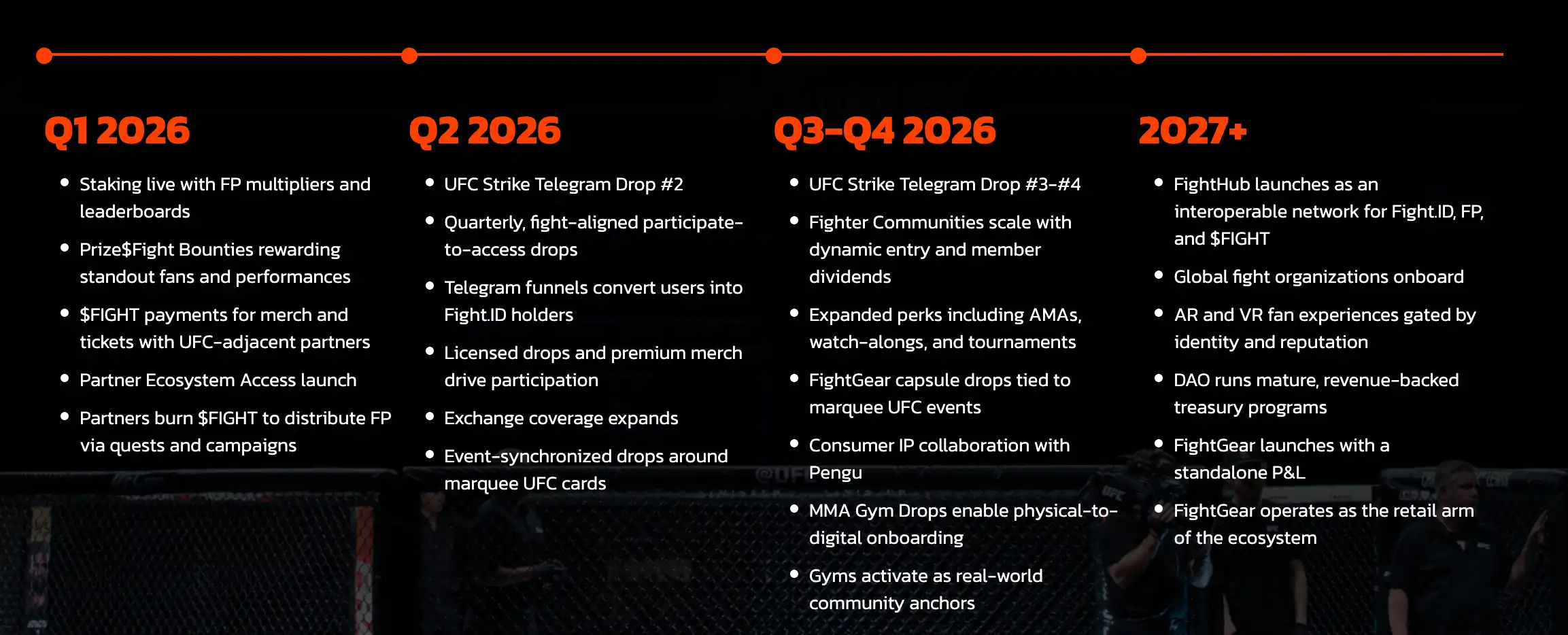
Near-term (Jan-Feb): January 22nd Binance Alpha listing, TGE execution, Coinbase listing review progress. This is the first test for liquidity and price discovery.

Q1 2026: Staking功能上线 (function goes live) (with FP multipliers and leaderboards), Partner Ecosystem Access launches (partners start burning tokens to buy FP distribution allowances), PrizeFight prize pool goes live, FightGear payment for goods and tickets goes live. This is the core validation period for token utility.

Q2 2026: Second round of UFC Strike Telegram airdrop, exchange coverage expansion, quarterly event联动活动 (tie-in activities) become regular. This is the observation window for whether the acquisition model can be sustained.

Q3-Q4 2026: Fighter Communities scale (dynamic entry price + member dividends), FightGear apparel collaborations, MMA offline gym partnerships materialize. This is the critical period for whether the ecosystem can extend from online to offline.

Fighting is one of the most popular sports categories in the US; UFC's base of over 40 events a year and 700 million viewers is there.

If Fight.ID can convert even 1% of the audience into on-chain users, that volume is enough to support a vertical ecosystem.

The path of fan economy in Web3, most previous attempts stopped at the 'issue tokens, collect money' stage. Fight.ID wants to take one more step forward, turning fans into participants, turning events into customer acquisition engines.

The direction is interesting, execution will tell.

Related Questions

QWhat is Fight.ID and what is its relationship with UFC?

AFight.ID is a Web3 project and an official partner of UFC (Ultimate Fighting Championship), the world's premier mixed martial arts organization. This partnership allows Fight.ID to leverage UFC's massive audience of 700 million viewers and over 40 annual events for user acquisition and engagement.

QWhat was the significant action taken by Fight.ID regarding its ICO funds and why?

AFight.ID announced it would refund 100% of the funds raised from its ICO, which was nearly $200 million, to all participants. Additionally, it airdropped 85 million $FIGHT tokens (0.85% of total supply) to early supporters. This move demonstrates the team's financial strength and their intention to distribute TGE筹码 (Token Generation Event tokens) more fairly to the community rather than having them locked with early investors.

QHow does Fight.ID's three-layer structure work to convert UFC viewers into on-chain users?

AFight.ID uses a three-layer structure: 1) The base layer is the Fight.ID on-chain identity, a universal profile for users across platforms. 2) The middle layer is Fight Points (FP), a non-transferable reputation score earned through activities like watching fights and predictions. 3) The top layer is the $FIGHT token, whose utility (e.g., staking rewards, community access) is often tied to a user's FP level, incentivizing continued participation.

QWhat are the key utilities and value capture mechanisms for the $FIGHT token?

AKey utilities for $FIGHT include: 1) Staking to join exclusive Fighter Communities for athlete-specific content and perks. 2) Acting as the payment currency for partners to buy FP distribution rights to access the Fight.ID user base (Partner Ecosystem Access). 3) Used for purchasing limited-edition merchandise on FightGear and participating in PrizeFight pools. Its value is tied to active participation within the ecosystem driven by UFC events.

QHow does Fight.ID's approach to fan economy differ from previous Web3 attempts like Fan Tokens?

AUnlike traditional Fan Tokens (e.g., on Chiliz) which primarily offer superficial voting rights and lack sustained engagement, Fight.ID builds a deeper 'Identity-Reputation-Token' model. It focuses on creating a persistent on-chain identity (Fight.ID), fostering ongoing engagement through non-transferable reputation (FP), and then layering token utility ($FIGHT) on top, aiming to transform fans into active participants rather than one-time token buyers.

Related Reads

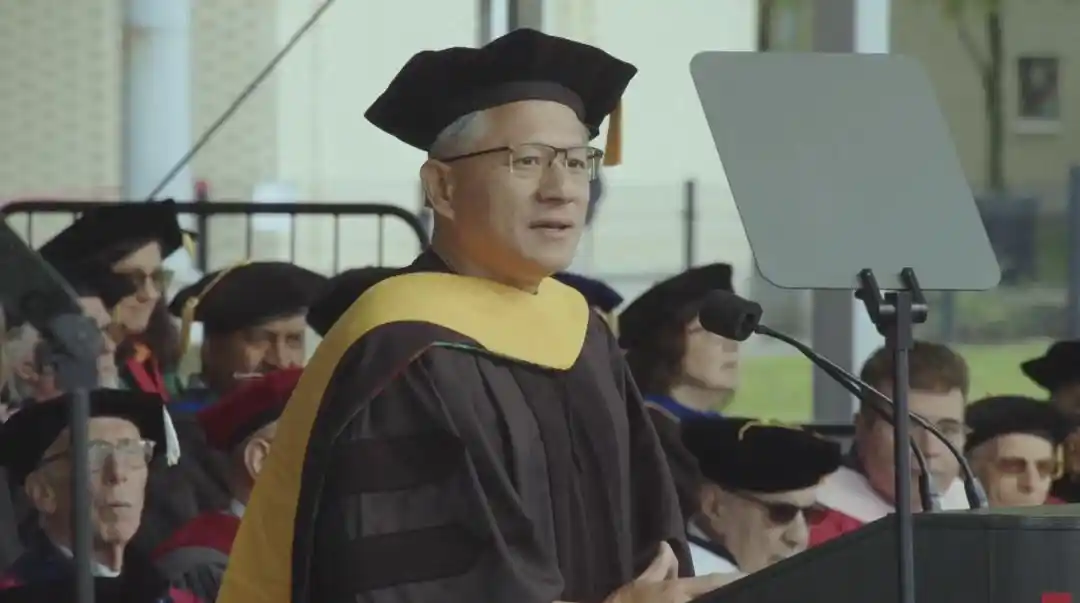
Jensen Huang's Message to Graduates: AI Won't Replace You, But Those Who Excel at Using AI Will

NVIDIA CEO Jensen Huang, addressing 2026 graduates at Carnegie Mellon University, emphasized that AI will not replace people, but those who leverage AI effectively will have an advantage. He delivered this message during a commencement speech where he also received an honorary doctorate, his seventh. Huang reflected on his personal journey as an immigrant, starting from humble beginnings as a dishwasher to co-founding NVIDIA. He shared early struggles, including a near-bankruptcy moment saved by honesty with Sega, highlighting resilience and learning from failure. He positioned the current era as the dawn of the AI revolution, a shift as significant as past computing waves. Huang explained that AI is redefining computing from human-written software to machine learning, creating a new industry focused on manufacturing intelligence. While acknowledging fears about job displacement, he argued that AI amplifies human capabilities rather than replaces human purpose. Tasks may be automated, but the core meaning of professions remains. Huang urged graduates to embrace this transformative time with responsibility and optimism. He stated that AI should democratize technology, bridging gaps and enabling broader participation in creation and problem-solving. His final advice was to actively engage with the opportunity: "So run, don’t walk," and to put their hearts into their work.

marsbit4m ago

Jensen Huang's Message to Graduates: AI Won't Replace You, But Those Who Excel at Using AI Will

marsbit4m ago

Three Scenarios for BTC's Future Direction and a Duel Between Two Strong Forces | Special Invited Analysis

**Title: Three Scenarios for BTC's Future Trajectory and a Key Duel | Invited Analysis** The market remains at a critical juncture. Over the past week, Bitcoin (BTC) consolidated broadly between $79,500 and $80,600, validating previous technical analysis. The current focus is on whether this marks the start of a new uptrend or a pause within a larger correction. **BTC Multi-Cycle Analysis & Three Possible Scenarios** BTC's daily chart structure, following its peak at $126,200 in October 2025, presents three primary technical scenarios based on Elliott Wave theory: 1. **Bullish Scenario (End of Correction):** The corrective A-B-C wave from $126,200 ended at the $60,000 low in February 2026. The current price action is the start of a major Wave I uptrend. A subsequent Wave II pullback would not break below $60,000. 2. **Bearish Scenario 1 (Complex Correction):** The correction is unfolding as an A-B-C-D-E pattern. The current move from $60,000 is a D-wave rally. After its completion, a final E-wave decline could potentially breach the $60,000 level. 3. **Bearish Scenario 2 (Larger Correction):** The entire move down from $126,200 to $60,000 was a large A-wave. The current rally is a B-wave correction within a larger A-B-C structure, to be followed by a C-wave decline below $60,000. *Analysis suggests Scenario 2 is less probable due to time disproportions between waves. The battle is effectively between the Bullish Scenario (1) and Bearish Scenario (3).* **Key BTC Levels & Weekly Strategy** On the 4-hour chart, BTC trades above a crucial consolidation zone ("Central Pivot C"). * **Key Resistance:** $83,500-$84,500; $89,000-$90,500. * **Key Support:** $78,500-$79,500 (pivot upper bound); $73,500-$75,000; $69,500-$70,500. **Weekly Outlook:** The market direction hinges on BTC's ability to hold above or break below the $78,500-$79,500 support zone. * **Mid-term Strategy:** Neutral/Wait-and-see stance due to unclear direction. * **Short-term Tactics:** Two contingency plans using 30% max capital: * **Plan A (Bullish):** Look for long entries if price holds above $78,500-$79,500 with confirming signals. Initial stop-loss below $78,500. * **Plan B (Bearish):** Consider short positions if price breaks below $73,500-$75,000 with confirming signals. Initial stop-loss above $76,500. **HYPE Analysis & Strategy** HYPE's daily chart shows a seven-segment structure from its January low of $20.46, forming a "rising pivot" zone. * **Key Level to Watch:** $45.76 (previous high). A break above would confirm the bullish structure remains intact. * **Short-term Strategy:** Focus on pivot zone boundaries ($38.41 upper, $34.44 lower). * **Long:** Consider on support near $38.41 with bullish confirmation signals. * **Short:** Consider on a break below $34.44 with bearish confirmation signals. * Position size must be below 30% with strict stop-loss discipline. **Risk Management Reminder:** Always set an initial stop-loss upon entry. Move stop-loss to breakeven at +1% profit, then trail it upwards to lock in profits dynamically. All views are based on technical analysis for informational purposes only and do not constitute investment advice. The market is inherently risky.

Odaily星球日报12m ago

Three Scenarios for BTC's Future Direction and a Duel Between Two Strong Forces | Special Invited Analysis

Odaily星球日报12m ago

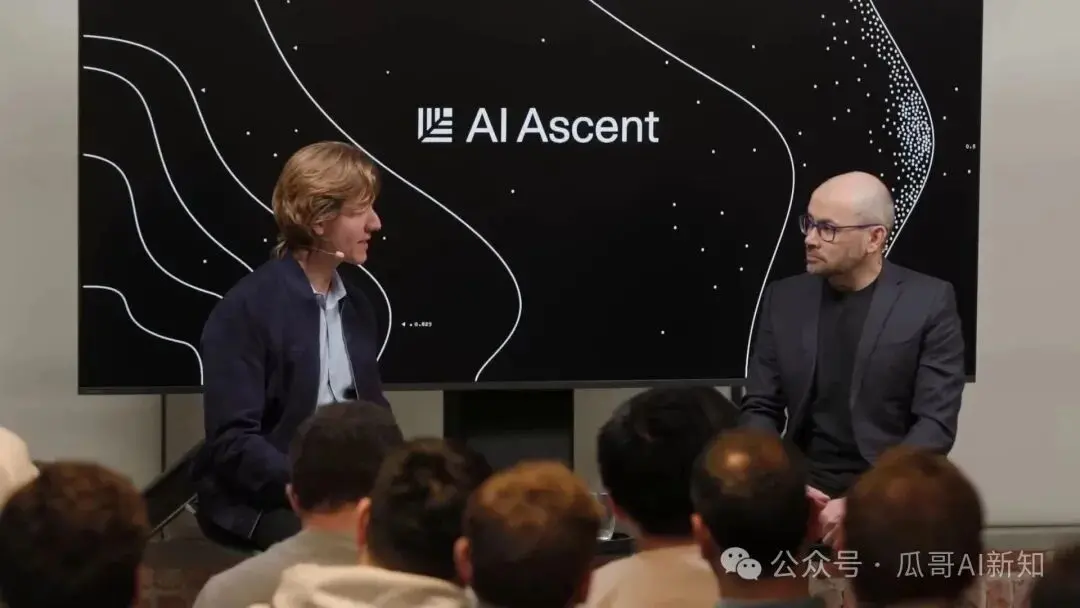
Sequoia Interview with Hassabis: Information is the Essence of the Universe, AI Will Open Up Entirely New Scientific Branches

Demis Hassabis, co-founder and CEO of Google DeepMind and Nobel laureate, discusses the path to AGI and its profound implications in a Sequoia Capital interview. He outlines his lifelong dedication to AI, tracing his journey from game development (e.g., *Theme Park*)—a perfect AI testing ground—to neuroscience and finally founding DeepMind in 2009. He emphasizes the critical lesson of being "5 years, not 50 years, ahead of time" for successful entrepreneurship. Hassabis reiterates DeepMind's two-step mission: first, solve intelligence by building AGI; second, use AGI to tackle other complex problems. He highlights the transformative potential of "AI for Science," particularly in biology where tools like AlphaFold have revolutionized protein folding. He envisions AI-powered simulations drastically shortening drug discovery from years to weeks and enabling personalized medicine. Furthermore, he predicts AI will spawn new scientific disciplines, such as an engineering science for understanding complex AI systems (mechanistic interpretability) and novel fields enabled by high-fidelity simulators for complex systems like economics. He posits a fundamental worldview where information, not just matter or energy, is the essence of the universe, making AI's information-processing core uniquely suited to understanding reality. He defends classical Turing machines as potentially sufficient for modeling complex phenomena, including quantum systems, as demonstrated by AlphaFold. On consciousness, Hassabis suggests first building AGI as a powerful tool, then using it to explore deep philosophical questions. He believes components like self-awareness and temporal continuity are necessary for consciousness but that defining it fully remains an open challenge. He predicts AGI could arrive around 2030 and, once achieved, would be used to probe the deepest questions of science and reality, much as envisioned in David Deutsch's *The Fabric of Reality*.

链捕手30m ago

Sequoia Interview with Hassabis: Information is the Essence of the Universe, AI Will Open Up Entirely New Scientific Branches

链捕手30m ago

Morgan Stanley 2026 Semiconductor Report: Buy Packaging, Buy Testing, Buy China Chips, Avoid Traditional Tracks

Morgan Stanley 2026 Semiconductor Report: Buy Packaging, Buy Testing, Buy Chinese Chips; Avoid Traditional Segments. The core theme is the shift in AI compute supply from NVIDIA dominance to a three-track system of GPU + ASIC + China-local chips. The key opportunity is capturing share in this expansion, while non-AI semiconductors face marginalization due to resource reallocation to AI. Key investment conclusions, in order of priority: 1. **Advanced Packaging (CoWoS/SoIC) - Highest Conviction**: TSMC is the primary beneficiary of explosive demand, driven by massive cloud capex. Its pricing power and AI revenue share are rising significantly. 2. **Test Equipment - Undervalued & High-Growth Certainty**: Chip complexity is causing test times to double generationally, structurally driving handler/socket/probe card demand. Companies like Hon Hai Precision (Foxconn), WinWay, and MPI offer compelling value. 3. **China AI Chips (GPU/ASIC) - Long-Term Irreversible Trend**: Export controls are accelerating domestic substitution. Companies like Cambricon, with firm customer orders and SMIC's 7nm capacity support, are positioned to benefit from lower TCO (30-60% vs NVIDIA) and growing local cloud demand. 4. **Avoid Non-AI Semiconductors (Consumer/Auto/Industrial)**: These segments face a weak, structurally hindered recovery due to AI's resource "crowding-out" effect on capacity and supply chains. 5. **Memory - Severe Internal Divergence**: Strongly favor HBM (Hynix primary beneficiary) and NOR Flash (Macronix). Be cautious on interpreting price rises in DDR4/NAND as true demand recovery. The report emphasizes a 2026-2027 time window, stating the AI capital expenditure cycle is far from over. Key macro variables include persistent export controls and AI's systemic "crowding-out" effect on traditional semiconductor supply chains.

marsbit1h ago

Morgan Stanley 2026 Semiconductor Report: Buy Packaging, Buy Testing, Buy China Chips, Avoid Traditional Tracks

marsbit1h ago

Circle:Sluggish Market? The Top Stablecoin Stock Continues to Expand

Circle, the issuer of the stablecoin USDC, reported its Q1 2026 earnings on May 11th, Eastern Time. Against a backdrop of weak crypto market sentiment, USDC's average circulation in Q1 was $752 billion, with a modest 2% sequential increase to $770 billion by quarter-end. New minting volumes declined due to the poor crypto market, but remained high, indicating demand expansion beyond crypto trading. USDC's market share remained stable at 28% of the total stablecoin market, while competition from Tether's USDT persists. A key highlight was "Other Revenue," which reached $42 million, more than doubling year-over-year, though sequential growth slowed to 13%. This revenue stream, including fees from services like Web3 software, the Cipher payment network (CPN), and the Arc blockchain, is critical for diversifying away from interest income. Circle's internally held USDC share increased to 18%, helping to improve gross margin by 130 basis points to 41.4% by reducing external sharing costs. However, profitability was pressured as total revenue growth slowed, primarily due to the significant weight of interest income, which is tied to USDC规模 and Treasury rates. Adjusted EBITDA was $133 million with a 19.2% margin. Management maintained its full-year 2026 guidance for adjusted operating expenses ($570-$585 million) and other revenue ($150-$170 million). The long-term target for USDC's CAGR remains 40%, though near-term volatility is expected. The article concludes that while Circle's current valuation of $28 billion appears reasonable after a recent recovery, further upside depends on the pace of stable币 adoption and potential positive sentiment from the advancement of regulatory clarity acts like CLARITY.

链捕手1h ago

Circle:Sluggish Market? The Top Stablecoin Stock Continues to Expand

链捕手1h ago

Trading

Spot
Futures
活动图片