Author: Wenser; Editor: Hao Fangzhou
Produced by: Odaily Planet Daily
As 2025 draws to a close, standing at the end of this "Year of Mainstream Crypto Adoption," it is time to summarize the year's four quarters with key themes, offering a glimpse into how the world has been progressively permeated and transformed by cryptocurrency.
The crypto world of 2025 witnessed a myriad of twists and turns, with dramatic rises and falls: from Donald Trump's inauguration as U.S. President in early January to the U.S. launching a tariff trade war in April; from the DAT treasury company trend led by Strategy,一度浮盈数百亿美元 (once floating profits of tens of billions of USD), to the blossoming and subsequent withering of ETH, SOL treasury listed companies and even altcoin treasury companies; from stock tokenization platforms being hailed as the "perfect fusion of DeFi and TradFi," to the Nasdaq exchange revolutionizing itself by joining the stock tokenization wave; from on-chain Perp DEXs like Hyperliquid and Aster to the prediction market duopoly Polymarket and Kalshi, each valued over ten billion; from the GENIUS stablecoin regulatory act to the ubiquitous hype around PayFi and stablecoins; from crypto IPOs to the normalization of crypto ETFs... Amidst the countless clashes, struggles, and compromises of capital, attention, and regulatory forces, amidst the countless wealth-creating projects, meme jokes, and hacking incidents, amidst the狂热 (fanatical) FOMO, new all-time highs, and frenzied buying, amidst the extreme fear, major crashes, and black swan events, the annual ring of the cryptocurrency industry's mature tree has grown another circle.
Behind the sleepless money lie the fluctuating fortunes of meme coin players, the inadequate earnings of airdrop farmers, the large-scale co-option by Wall Street, and the regulatory green light from the U.S. government. This year was somewhat complex—it was neither a full-blown bull market nor a frigid bear market; compared to the crypto markets of the past with distinct cold and hot phases and sector rotations, the crypto industry in 2025, under the influence of Trump and various authoritarian government forces,更像是一只上蹿下跳的猴子 (more resembled a monkey jumping up and down); some fell from grace, others rose with the tide. As for success and failure, gains and losses, perhaps the upcoming "2025 Crypto Investment Memoir" (https://wj.qq.com/s2/25044020/b03c/) will reveal more answers.
In this article, Odaily Planet Daily will review Crypto 2025 using 4 quarterly keywords.
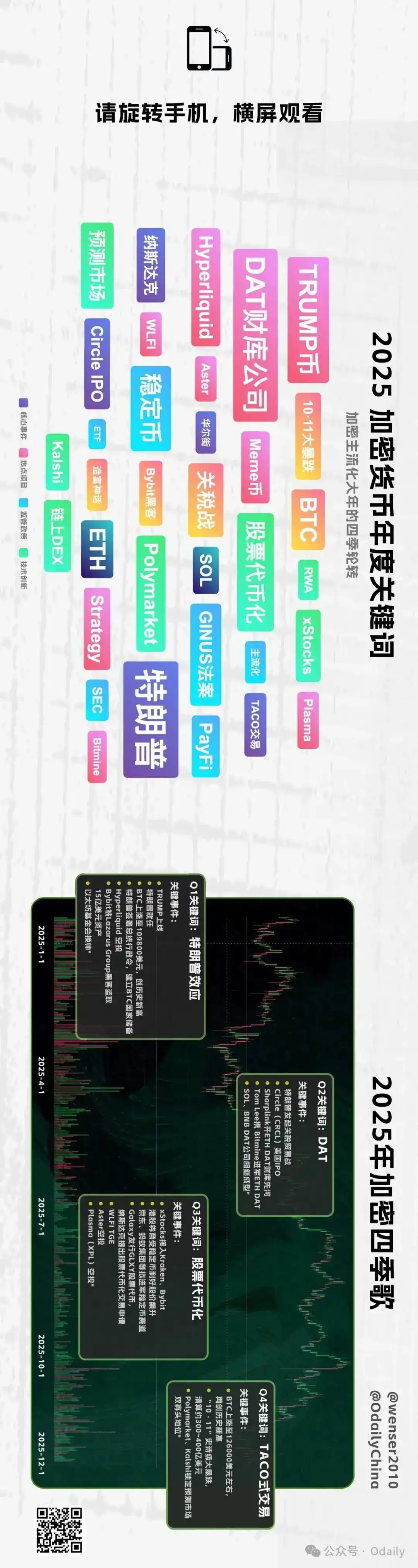

Crypto Spring: The Trump Effect Continues, TRUMP Creates Wealth, Crypto Regulatory Framework Clarifies
In January, Trump was officially inaugurated as U.S. President.
Continuing the hot momentum following Trump's election victory last year, after a brief consolidation, the crypto market saw BTC's price approach the $100,000 mark again.
And just three days before Trump's presidential inauguration, TRUMP, crowned as the "official Trump meme coin," delivered the first wave of wealth creation this year to numerous crypto participants.
I still vividly remember that morning when a colleague first shared the TRUMP token contract; its Fully Diluted Valuation (FDV) was only around $4 billion. Amidst质疑声中 (skepticism) like "Was Trump hacked?", "The U.S. President dares to issue a coin?", "Is Trump trying to make a final buck before becoming president?", TRUMP's FDV surged ahead, quickly breaking through $10 billion, $30 billion, and ultimately reaching over $80 billion.
In this astonishing wealth creation frenzy, many Chinese meme players made hefty profits, including individuals with profits reaching millions of dollars or even over $20 million. For a list of profitable TRUMP traders, recommended reading: "Who Profited Over $1 Million from TRUMP? KOLs Winning Big and Disheartened ETH Maxis" (https://www.odaily.news/zh-CN/post/5201247).
This was also a "second spring" for the crypto market's upward momentum ignited by Trump's personal influence, following his election as U.S. President in November 2024.
Soon, the crypto market offered its own "tribute" for Trump's inauguration—on January 20th, after a month, BTC broke its all-time high again (https://www.odaily.news/zh-CN/post/5201277), rising to $109,800.
At that time, everyone regarded Trump as the undisputed "Number One Crypto President." Perhaps many didn't realize then that "while water can carry a boat, it can also overturn it." What Trump brought to the crypto market was not only favorable macro policies and regulatory environment but also a series of controversies, rug pulls, and反复摇摆 (back-and-forth vacillation) associated with his family's crypto projects.
On the other hand, the key point of the "Trump Effect" was whether his administration could directly improve the U.S. crypto regulatory environment—
First, whether he could bring about legislation and executive orders with clearer boundaries and more friendly rules for crypto regulation. In this regard, Trump gradually fulfilled some of his promises, including replacing the SEC Chair with Paul Atkins, appointing David Sacks as White House AI and Crypto Czar, and promoting the passage of the GENIUS stablecoin regulatory act.
Second, was the "BTC National Strategic Reserve" that the crypto market and many crypto-friendly political figures were concerned about. In early March, Trump signed an executive order to promote the establishment of a U.S. Bitcoin Strategic Reserve using previously confiscated BTC assets. He specifically emphasized: "Will not burden taxpayers." For details, recommended reading: "Trump Establishes BTC Strategic Reserve as Promised, but Funding Relies Solely on Confiscation?" (https://www.odaily.news/zh-CN/post/5202164).
Nevertheless, the final判定结果为 (resolution) of "No" on Polymarket for the event "Trump establishes a BTC national strategic reserve within 100 days of taking office" (Odaily Planet Daily Note: The reason was that the event rules stated that U.S. government confiscated assets did not count as BTC reserves) left many frustrated, with some even exclaiming "scam site" in the event's comment section.
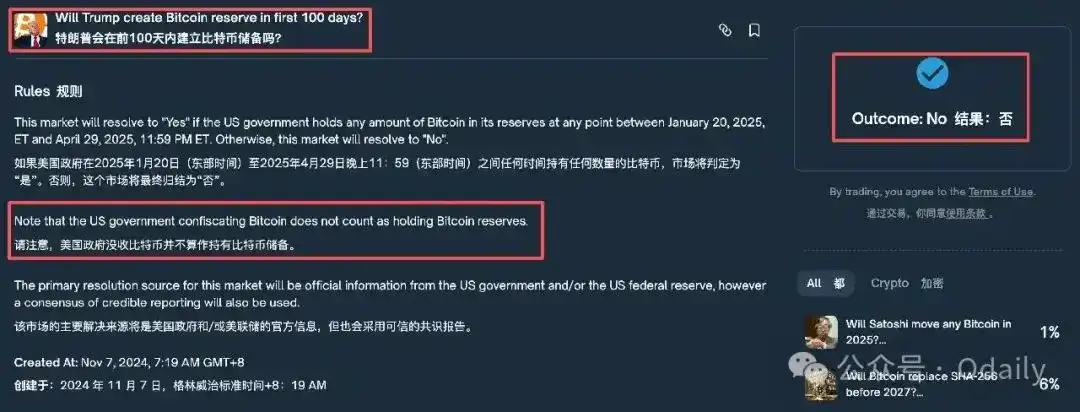
Polymarket betting event rule information
By then, the "insider whales" had already begun to show their prowess; the "50x leverage insider" on Hyperliquid profited millions of dollars based on消息 (news) like "Trump establishing a crypto reserve." For event details, refer to: "Reviewing the Hyperliquid Contract 'Insider's' Moves, Precise Long and Short Entries and Exits" (https://www.odaily.news/zh-CN/post/5202163).
During this period, numerous events also drew criticism for Trump, including the subsequent "Melania Token MELANIA incident" (https://www.odaily.news/zh-CN/post/5201261) and the political celebrity coin LIBRA incident triggered by Argentine President Milei (https://www.odaily.news/zh-CN/post/5201715), both considered the "dark work" of the Trump coin issuance group. Besides this, the crypto market in the first quarter also witnessed a series of "historic events," including:
- Hyperliquid's "most generous airdrop of the year" (https://www.odaily.news/zh-CN/post/5200155) making many on-chain players envious;
- Bybit being suddenly attacked by the North Korean hacker group Lazarus Group, with $1.5 billion in assets stolen (https://www.odaily.news/zh-CN/post/5201839);
- The much-criticized Ethereum Foundation undergoing a leadership change, with former Executive Director Aya promoted to Chair (https://www.odaily.news/zh-CN/post/5201952).
And the industry had not anticipated that Trump, this catfish, was about to let the market witness an American version of "success also due to Xiao He, failure also due to Xiao He."
Crypto Summer: DAT Treasury Companies, ETH Breaks New High, Stablecoins Take Center Stage
The second quarter began with a heavy blow to the crypto market—in early April, Trump initiated a worldwide "tariff trade war," causing global economic tensions to skyrocket, with the U.S. stock market and crypto market suffering consecutive heavy blows.
On April 7th, "Black Monday" (https://www.odaily.news/zh-CN/post/5202776), nearly $6 trillion in market capitalization was wiped off U.S. stocks in a week, including over $1.5 trillion evaporated from the "Magnificent Seven" like Apple and Google. After nearly a month of volatile行情 (market conditions), the crypto market's暴跌 (crash), though delayed, arrived—BTC一度跌破 (once fell below) the $80,000 mark, hitting a low of $77,000; ETH dropped to a low of $1,540, a new low since October 2023; the total crypto market capitalization fell to $2.6 trillion, with a single-day drop exceeding 9%. Recommended reading: "Digging into the 'Mastermind' Behind the Tariff War, Did Over $6 Trillion Vanish Overnight Because of Him?" (https://www.odaily.news/zh-CN/post/5202798)
It was also from that time, after months of market decline and organizational reforms within the foundation, that ETH finally gained some momentum and potential for a bottoming rebound. Recommended reading: "New brooms sweep clean, Ethereum Foundation's New Executive Director Reveals Where EF is Headed?" (https://www.odaily.news/zh-CN/post/5203815)
Simultaneously, riding the tailwind of Circle's U.S. stock IPO (https://www.odaily.news/zh-CN/post/5202825), stablecoins and PayFi gradually entered the mainstream view of the crypto market,被视为 (seen as) the ultimate method for "mass adoption of crypto." Recommended reading: "Stablecoins' 10-Year Journey, Finally Becoming the U.S. Government's Endorsed 'Peer-to-Peer Electronic Cash'" (https://www.odaily.news/zh-CN/post/5203857), "The Golden Age of Stablecoins Begins: USDT Goes Left, USDC Goes Right" (https://www.odaily.news/zh-CN/post/5204268)
In late May, with a command from Ethereum co-founder, Consensys, and MetaMask founder Joseph Lubin, the U.S.-listed company Sharplink (https://www.odaily.news/zh-CN/newsflash/432311) transformed from a sports marketing company into the first "ETH Treasury Listed Company." From then on, the DAT frenzy began to sweep the entire cryptocurrency market, and ETH's price finally emerged from the quagmire of continuous decline, successfully breaking through its previous all-time high of $4,800 months later and jumping to a high near $5,000.
Subsequently, "Wall Street's fortune teller" Tom Lee also joined the "DAT Treasury热潮 (trend)" with the U.S.-listed company Bitmine.自此 (From then on), ETH treasury listed companies became another "scenic spot in the crypto world" following the BTC treasury listed companies led by Strategy.
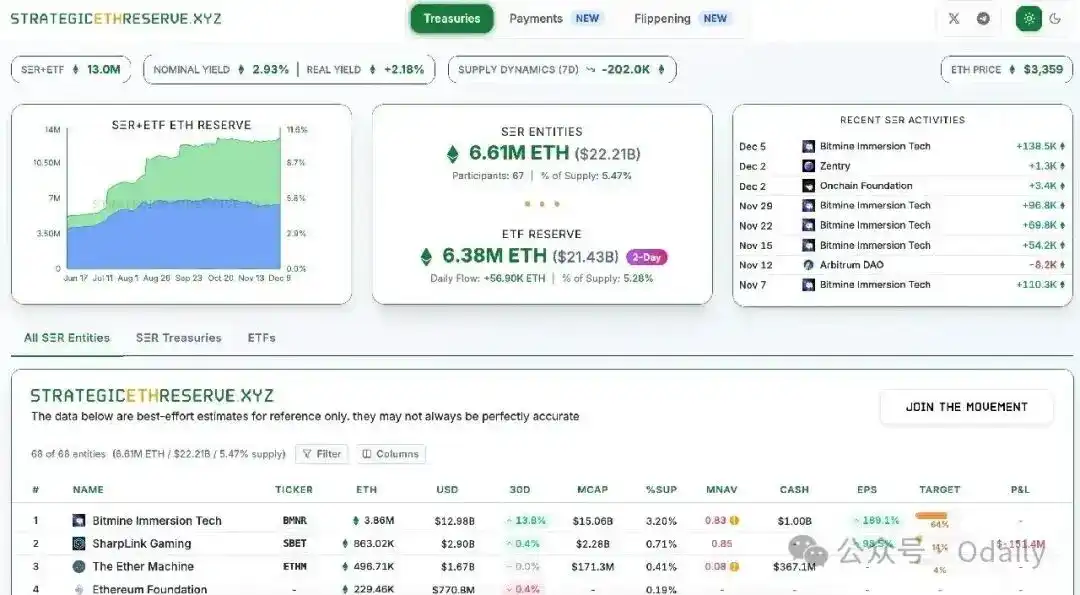
A glimpse of ETH treasury company information
As of writing, according to strategicethreserve website data, the total number of ETH treasury companies has increased to nearly 70. Among them,
- Bitmine (BMNR) ranks first with 3.86 million ETH holdings;
- Sharplink (SBET)稳居第二 (firmly holds second place) with over 860,000 ETH holdings;
- ETH Machine (ETHM)位列第三 (ranks third) with over 490,000 ETH holdings.
It is worth mentioning that the ETH holdings of the above three DAT companies significantly exceed those of the Ethereum Foundation (less than 230,000 ETH).
With ETH treasury companies leading the way, SOL DAT companies, BNB DAT companies, and a series of altcoin DAT companies also sprang up like mushrooms after rain, their stock prices rising and falling like roller coasters amidst the clamor of不甘人后 (unwillingness to lag behind).
Now, having passed the狂热 (fanatical) FOMO stage of the early转型 (transformation) period and entered a冷静期 (cooling-off period) in the crypto market, ETH DAT companies represented by Bitmine are facing billions of dollars in paper losses, while numerous DAT treasury companies, including many BTC reserve companies, without real business support, are experiencing an inversion between their market capitalization and crypto assets, with the mNAV (i.e., crypto assets / company market cap) of dozens of DAT companies falling below the baseline of 1.
The DAT companies of the crypto summer were jubilant, not yet fully understanding what Zweig meant by "All the gifts of fate were secretly priced," and that price was their languishing stock prices.
Of course, just as death often breeds new life, amidst the DAT's furious advance, the wind of stock tokenization also gradually blew into the crypto market and subsequently became an unstoppable trend, to the extent that even the U.S. stock exchange Nasdaq could not ignore it and had to join this "capital feast" in a act of self-revolution.
Crypto Autumn: Stock Tokenization, On-chain Perp DEX & Stablecoin Public Chain "Dueling Titans"
After experiencing the milestone achievement of Circle (CRCL)强势登陆 (forcefully landing on) U.S. stocks at the end of June and achieving a "10x stock price surge," the enthusiasm of the crypto market and traditional financial markets for stablecoins and crypto concept stocks heated up to an extreme level.
Influenced by related positive news, the Hong Kong stock stablecoin sector and brokerage sector rose, and numerous internet giants including JD.com and Ant Group高调宣布 (loudly announced) their impending entry into the stablecoin track, attracting much attention. Recommended reading: "Hong Kong Stock Altseason Arrives, Can Crypto Concept Stocks Support the Bull Market's Backbone?" (https://www.odaily.news/zh-CN/post/5204726)
Riding this tailwind, the RWA赛道 (track)迎来 (welcomed) a major inflection point—stock tokenization was in vogue.
In early July, exchanges Kraken and Bybit先后宣布 (announced successively) the opening of stock tokenized trading via the xStocks platform, supporting dozens of tokenized U.S. stocks including popular ones like AAPL, TSLA, and NVDA. From then on, xStocks, promoting the concept of an "on-chain U.S. stock tokenized trading platform," became the sole focus under the market spotlight. MyStonks (now renamed MSX.com) also乘势 (seized the opportunity) to attract a large number of users and investors.
If the successive launches of the BTC spot ETF in early 2024 and the ETH spot ETF in July of that year gave cryptocurrency traders the尊称 (honorary title) of "distinguished U.S. stock traders," then the emergence of stock tokenization platforms this year truly打通了 (connected) the "last mile of on-chain U.S. stock trading," also allowing包括我这个“臭炒币的” (including someone like me, a 'stinky crypto trader') to have the possibility of diversified asset allocation through on-chain tokenization platforms for the first time.
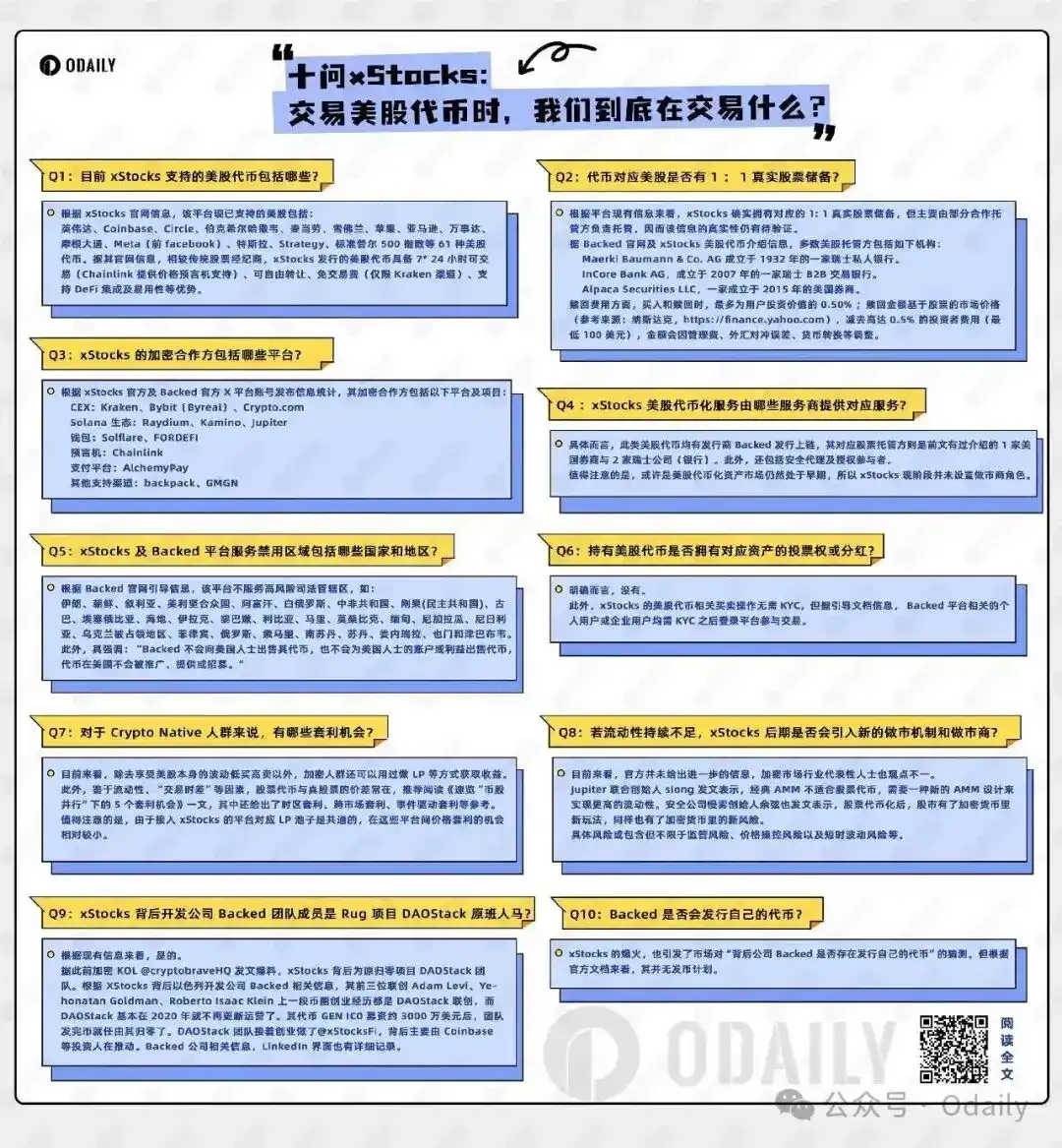
Odaily Planet Daily previously详细介绍 (detailed) the mechanisms behind xStocks and tokenized U.S. stock trading platforms in the article "10 Questions for xStocks: What Are We Actually Trading When Trading Tokenized U.S. Stocks?" (https://www.odaily.news/zh-CN/post/5204775). Looking back now, its basic principles and asset management model haven't changed much. What's different is that following the numerous U.S. stock tokenization platforms, traditional giants also began their own awakening journey.
10 Questions for xStocks overview
First, crypto asset manager Galaxy actively conducted a tokenized stock issuance (https://www.odaily.news/zh-CN/post/5205536); later, the Nasdaq exchange, with quarterly trading volumes in the tens of trillions, proactively submitted a "Tokenized Stock Trading Application" to the U.S. SEC (https://www.odaily.news/zh-CN/post/5206200). On the broad track of asset issuance and trading, the traditional giants'嗅觉 (sense of smell) is丝毫不差 (not lacking at all).
Meanwhile, the feast in the crypto-native market belonged to 2 major sectors:
First, the "on-chain Perp DEX war" following Hyperliquid—Aster from the BNB Chain ecosystem contributed another wealth creation miracle to the crypto market with an extremely暴力 (violent) "pump," with many直言 (straightforwardly saying) they "sold too early, missing millions";
Second, were the two major wealth creation spectacles in the stablecoin sector: One was the generous airdrop provided by the "理财存钱活动" (savings and deposit activity) initiated by Plasma, which touted itself as a "stablecoin public chain supported by Tether's CEO" (https://www.odaily.news/zh-CN/post/5206488). Some participants even received an XPL token airdrop worth over $9,000 for a $1 deposit, a return of over 900x. The other was the official launch of the Trump family's crypto project WLFI. Riding the momentum of its previously launched stablecoin USD1, people gained returns of up to 6x at public sale prices of $0.05 and $0.15.
Looking at the current prices of XPL and WLFI is难免让人唏嘘 (inevitably evoking sighs). According to Coingecko data, XPL is currently trading at $0.17, down nearly 90% from its high of $1.67; WLFI is trading at $0.15, down nearly 50% from its high of $0.33.
At that moment when countless people感叹 (sighed at) the无限机会 (limitless opportunities), little did they know that what awaited the crypto industry would be an "epic-level清算 (liquidation)" far exceeding any previous crash in history.
Crypto Winter: After the 10·11 Great Crash, TACO Trading Validated Again, Prediction Market Welcomes Two Ten-Billion-Dollar Valued Giants
After experiencing BTC's price hitting a new high of $126,000 in early October, people were hoping the crypto market would continue its usual "Uptober" trend. However, an "epic-level大清算 (liquidation)" on October 11th shattered those fantasies and hopes.
And once again, the trigger pointed to Trump—on the evening of October 10th, Trump announced plans to impose 100% tariffs, causing恐慌指数 (the fear index) to soar. The three major U.S. stock indices fell to varying degrees. The Nasdaq index fell nearly 3.5%, the S&P 500 dropped 2.7%, and the Dow Jones Industrial Average fell 1.9%.
The crypto market encountered exchange system issues,叠加 (coupled with) the market's fragile,惊弓之鸟般的 (startled bird-like) psychology. BTC touched a low of $101,516, a 24-hour drop of 16%; ETH touched a low of $3,400, a 24-hour drop of 22%; SOL saw a 24-hour drop of 31.83%. For a time, altcoins were a bloodbath.
The losses from this epic清算 (liquidation) far exceeded those of past major crash events like 3·12, 5·19, 9·4. The real爆仓规模 (liquidation scale) in the crypto market was at least around $30 to $40 billion.
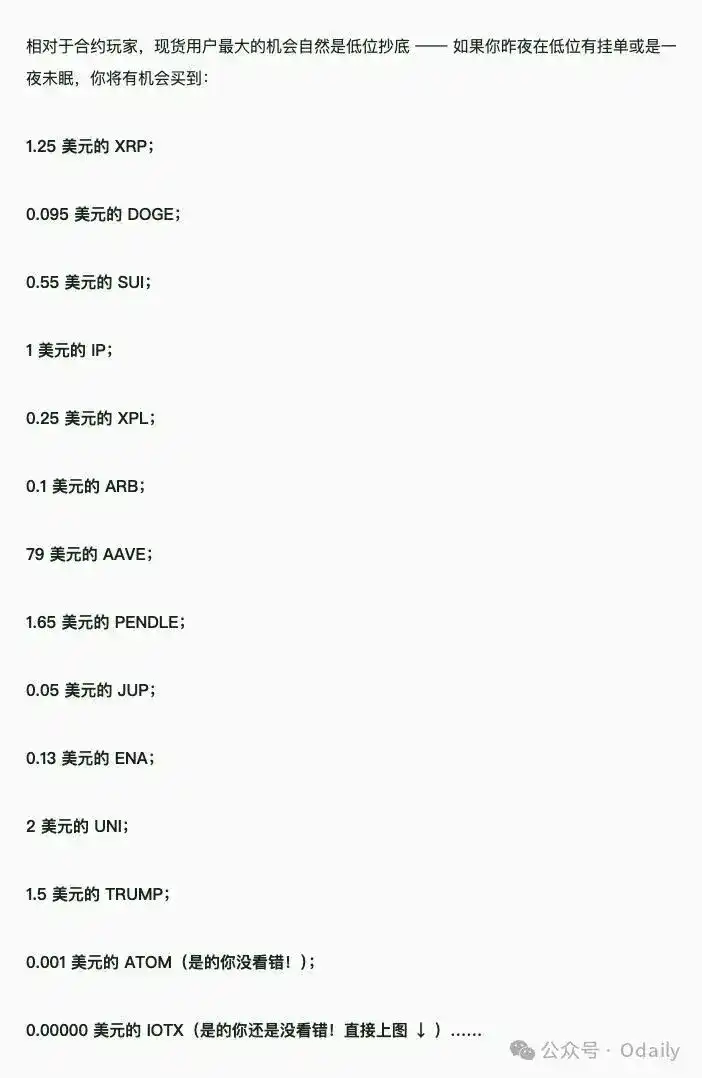
Of course, risk hides opportunity. As Odaily Planet Daily mentioned in articles like "Who 'Licked Blood from the Knife' and Made Hundreds of Millions in the Great Crash? What Wealth Opportunities Were Right Before Our Eyes?" (https://www.odaily.news/zh-CN/post/5206774) and "The Whale Dagger Fight Behind Crypto's Biggest Liquidation Day: Shorts Full, Sheathing Knives to Leave" (https://www.odaily.news/zh-CN/post/5206772)—whether it was high-leverage shorting or buying the dip, many people profited immensely from the chaos.
Risk also represents opportunity
And as the "TACO" trading style (Trump Always Chicken Out) was validated once again, the crypto market finally began a slow自我修复 (self-repair). Unlike before, many traders had lost most of their assets in that "Black Friday," becoming discouraged and leaving the scene黯然退场 (dejectedly).
It was also in this糟糕的 (poor) market environment that prediction market platforms represented by Polymarket and Kalshi gradually became one of the few hotspots and trading stages in the crypto market. Their valuations continuously rose in just a few months. After completing its latest Series E $1 billion funding round led by Paradigm, Kalshi's valuation soared to $11 billion; Polymarket, after completing a previous $2 billion funding round led by ICE Group (parent company of NYSE), is seeking a new funding round with a valuation between $12 billion and $15 billion.
Going around in circles, the crypto market returned to Polymarket, the prediction market platform that successfully predicted Trump's election in the "2024 U.S. Presidential Election" event. And after the cycle of four seasons, the mainstreaming and mass adoption process of the cryptocurrency industry continues.
Where is the future headed? U.S. regulation and traditional finance still largely determine the direction of the tide and the length of spring and winter. And we, these crypto prospectors, can only follow the currents closely and assess the situation carefully, perhaps find our own treasure trove of wealth.