First Mover Asia: Was the Metaverse All Just a Dream?

CoinDeskPublished on 2022-08-02Last updated on 2022-08-02

Abstract

Bitcoin has fallen for four straight days, but the (small-ish) scope of the price decline offers a reminder of how listless digital-asset markets have suddenly become. Sam Reynolds tots up the losses on metaverse-related tokens.

Good morning. Here’s what’s happening:

Prices: Bitcoin falls for fourth straight day as traditional markets struggle. Declining volatility in the cryptocurrency's price shows how far digital-asset markets have come since the nervy days of mid-June. (Wells Fargo's still a long-term believer, for what it's worth.)

Insights: Meta's Mark Zuckerberg acknowledges that the metaverse could be a long time in the making. Metaverse-related cryptocurrencies are undergoing their own reality check, having lost $10.9 billion of their market capitalization in the second quarter.

Prices

●Bitcoin (BTC): $23,179 −0.8% ●Ether (ETH): $1,630 −2.8% ●S&P 500 daily close: 4,118.63 −0.3% ●Gold: $1,770 per troy ounce +0.4% ●Ten-year Treasury yield daily close: 2.61% −0.04

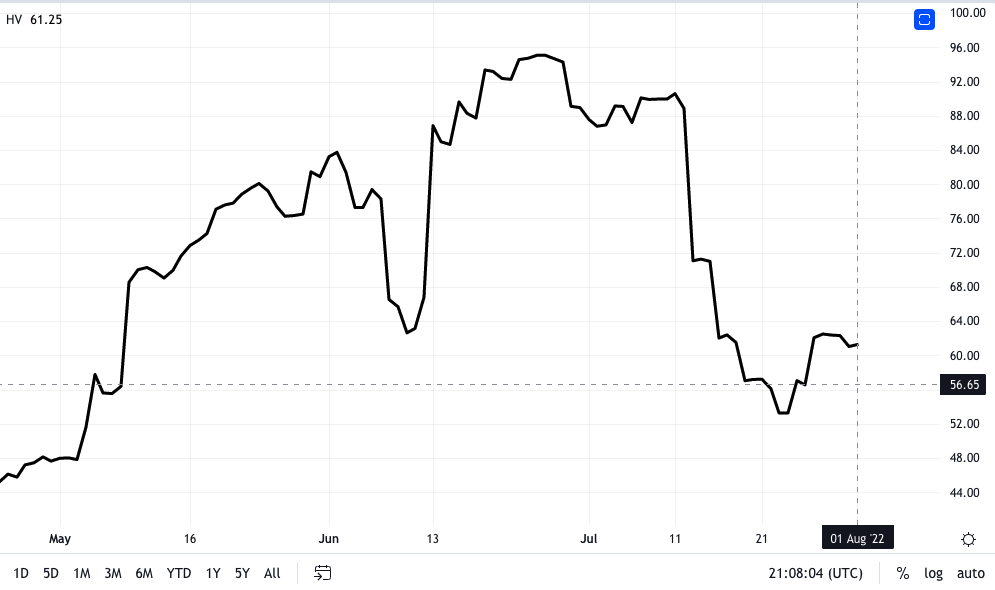
Bitcoin has fallen for four straight days. But as market volatility ebbs, the price slide doesn't look like much to worry about.

By Bradley Keoun

Bitcoin (BTC) was lower for a fourth straight day, but there wasn't much to panic about because the price drops have been pretty modest by the standards of usually-volatile cryptocurrency markets: Over the four-day slide, the cumulative price drop is less than 4%.

That's pretty harmless for an asset whose price has been known to fall 16% in a single day.

The listlessness might be a sign that the Northern Hemisphere is entering the dog days of summer, during a (largely) post-pandemic stretch when many people really are taking vacations for the first time in years.

Or it might be a sign of just how little there is in the way of any firm direction in markets, torn between the angst of wondering if the U.S. economy meets the definition of a recession and if the Federal Reserve must still keep ratcheting monetary policy tighter to wring out inflation trending at its fastest in four decades.

Trading volume is light.
One sign of hope for the bulls: Despite this year's crash in crypto markets, traditional financial firms are still keenly interested in the long-term prospects: "We believe digital assets are a transformative innovation on par with the internet, cars and electricity," analysts for the U.S. bank Wells Fargo wrote on Monday. They were quick to add: "At such an early stage of investment development, many investment risks remain."

There's less carnage in the news these days and what appears to be a return to development: The crypto exchange Huobi says it's now able to operate in Australia, and July marked the strongest month of digital-asset fund inflows this year. Coinbase Prime added Ethereum staking for U.S. institutional clients.
Insights

Tens of Billions of Investor Dollars Are Flowing Away From the Metaverse

By Sam Reynolds

Investors are souring on the dream of the metaverse, regardless whether its Meta's superset of virtual reality, augmented reality and the internet – or crypto's cocktail of virtual reality, augmented reality and blockchain.

“We hope to basically get to around a billion people in the metaverse, each doing hundreds of dollars of commerce buying digital goods, digital content, different things to express themselves, so whether that’s clothing for their avatar or different digital goods for their virtual home or things to decorate their virtual conference room, utilities to be able to be more productive in virtual and augmented reality and across the metaverse overall,” is how Mark Zuckerberg described the dream on CNBC’s Mad Money with Jim Cramer.
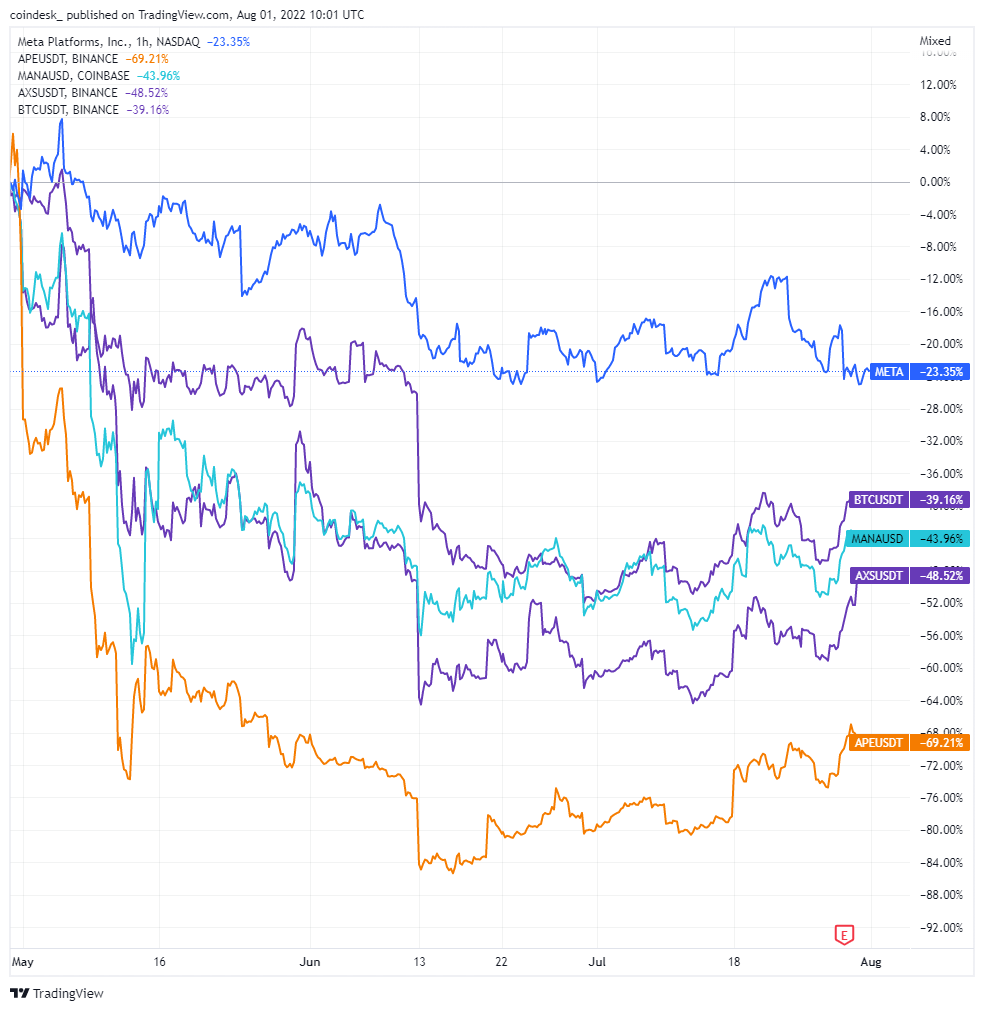
But this vision isn’t at odds with reality. In recent earnings, Meta reported a $2.8 billion loss on its Facebook Reality Labs (FRL) division, home to the augmented and virtual reality operations.

According to 13F filings (a form institutional investors must file quarterly with the Securities and Exchange Commission) aggregated by Whale Wisdom, $21.5 billion in institutional capital flowed out of Meta during the last quarter.

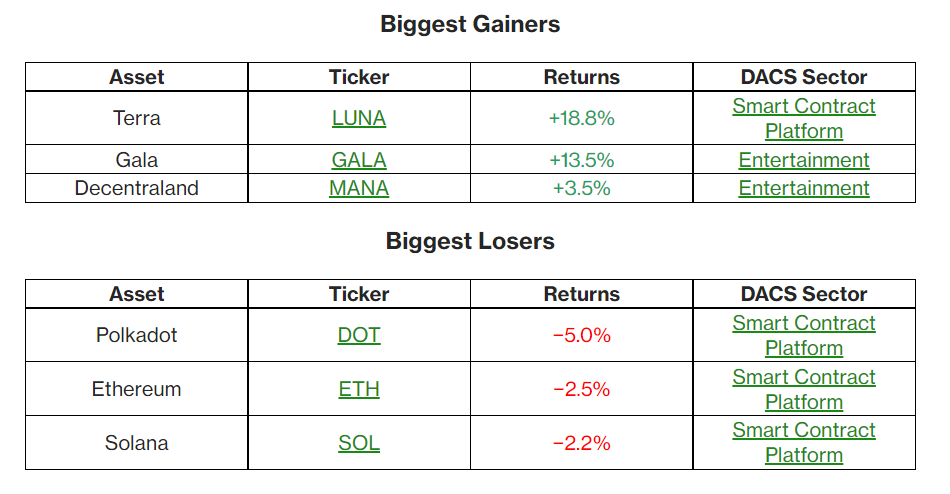
The crypto metaverse isn’t doing much better. Facing a user base that seems to refuse to materialize, and intense market headwinds because of the broader crypto decline, most of the major metaverse tokens saw their market caps dip by over a third as valuations of cryptocurrencies dropped.
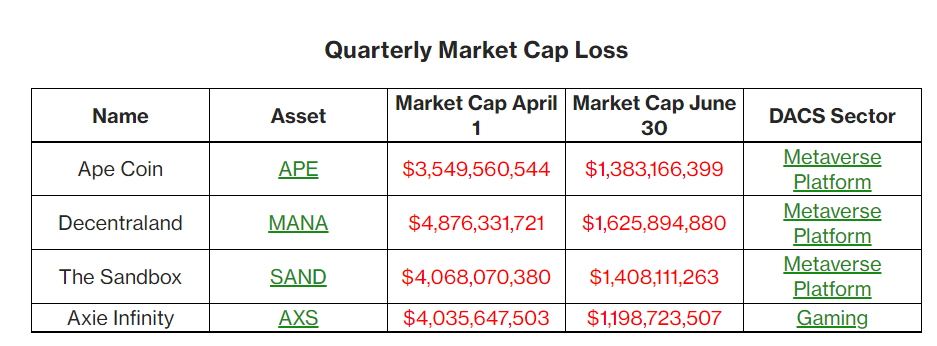
All in all, $10.9 billion departed from the metaverse majors as their market cap deflated. As of late afternoon Asia time on Aug. 1, Decentraland had 803 total online users whereas Steam, an online gaming community, had just under 20 million.

Mark Zuckerberg, Meta’s founder, admits that the current engagement ratio to profitability is a problem. Meta’s virtual world, Horizon Worlds, is said to have 300,000 sign-ups but there’s no publicly available count on active players.

“This is obviously a very expensive undertaking over the next several years,” Zuckerberg said during a recent analysts call. “But as the metaverse becomes more important in every part of how we live, I’m confident that we’re going to be glad we played an important role in building this.”

For a point of comparison, Facebook gained its first million users in less than a year at a per-user acquisition cost that’s infinitely smaller than the company’s pivot to the metaverse. Eight years later, it hit its billionth user.

Zuckerberg’s Meta, and the crypto metaverse majors are nowhere near to following this trajectory. Is this really the future of virtual interaction?


Related Reads

The First Encyclical of the New Pope in Rome, to Save the Common People in the AI Era

New Pope's First Encyclical Aims to Safeguard Humanity in the AI Era On May 25th, Pope Leo XIV issued his first encyclical, "Magnifica humanitas," a 40,000-word document addressing the profound challenges posed by Artificial Intelligence. Released on the 135th anniversary of Pope Leo XIII's "Rerum novarum," it positions itself as a guide for the Church's social doctrine in the AI age. The encyclical's central concern is preserving deep humanity amid rapid technological advancement. It argues technology is never neutral, carrying the values of its creators and users, and warns against building a "Tower of Babel" of technological tyranny versus a human-centric community. Pope Leo XIV criticizes the concentrated, opaque power of tech giants and the "new forms of slavery" emerging in the digital economy, where humans risk being reduced to mere instruments. A significant focus is the military use of AI. The Pope declares traditional "just war" theory obsolete, arguing that delegating lethal decisions to opaque algorithms severs moral accountability. He calls for "disarming AI" from military and economic arms races. The document also warns that deepfakes and information manipulation erode societal trust and rational discourse. Anthropic co-founder Chris Olah, present at the Vatican, responded by acknowledging the AI industry's limitations due to commercial and competitive pressures, necessitating external ethical oversight. He emphasized that AI's nature and its interaction with the world are ultimately philosophical and religious questions, not solvable by computer science alone. Olah revealed unsettling findings from his team's research into AI internals, including structures mirroring human neuroscience and evidence of internal states resembling emotions and introspection. The dialogue highlights a pivotal shift: AI is not a passive tool but an entity with emerging "quasi-agency." As creators themselves express unease, science is turning to realms like religion to grapple with fundamental questions about human identity and dignity. The core imperative becomes safeguarding irreducible human qualities—compassion, conscience, free will, and the pursuit of truth—in the face of a potentially more efficient intelligence.

Odaily星球日报12m ago

The First Encyclical of the New Pope in Rome, to Save the Common People in the AI Era

Odaily星球日报12m ago

On-chain Analyst: Why Are Most Zcash Transactions Still Traceable?

Title: Why Most Zcash Transactions Remain Traceable Zcash, a privacy-focused cryptocurrency launched in 2016, was designed to offer anonymity by hiding transaction details like sender, receiver, and amount using zero-knowledge proof technology (zk-SNARKs). However, in practice, a significant portion of ZEC transactions are still traceable on-chain. The key reason is Zcash's dual-address system. It features transparent addresses (t-addresses), which work like standard Bitcoin addresses with all data public, and shielded addresses (z-addresses) that encrypt transaction details. There are four transaction types with varying privacy levels: fully transparent (t→t), partially shielded (t→z and z→t), and fully private (z→z). Despite its privacy capabilities, most real-world Zcash activity involves transparent addresses, primarily because major exchanges and institutions use them for regulatory compliance. As a result, blockchain analytics platforms like Arkham can track and attribute a substantial volume of Zcash transactions. Arkham reports it has identified entities behind over $420 billion in ZEC transaction volume. Case studies highlight this traceability: the U.S. government holds seized Zcash from a dark web case, visible via its transparent wallet, and individual traders' profitable moves are trackable from purchase to exchange deposit. In conclusion, Zcash's privacy is not inherent but user-dependent. While purely shielded (z→z) transactions remain cryptographically private, the prevalence of transparent address usage makes much of the network's activity traceable. The actual privacy protection offered depends entirely on how users choose to transact.

marsbit58m ago

On-chain Analyst: Why Are Most Zcash Transactions Still Traceable?

marsbit58m ago

From Power Infrastructure to Token Economy: The 'Seven-Layer Cake' of the AI Industry Chain

From Power Grid to Token Economy: The AI Industry's "Seven-Layer Cake" The AI industry is shifting from a "model-centric" paradigm focused on massive training to a "token-centric" industrial era driven by inference demand. This new phase revolves around the production, distribution, scheduling, and consumption of tokens—the units of computation used by AI agents for every interaction and task. The article proposes a "seven-layer cake" framework for the AI economy: 1. **Power**: The foundational energy source, with competition shifting to securing stable, low-cost electricity. 2. **AIDC (AI Data Centers)**: Large-scale "Token factories." A trend toward smaller, modular, and regionally deployed AI Factories is emerging for efficiency and proximity to users. 3. **GPU**: The core production hardware for tokens. While NVIDIA dominates, competition exists from AMD, ASIC makers, and Chinese chipmakers, with a growing focus on inference efficiency. 4. **LLMs**: The "engines" that generate tokens. The competition is evolving beyond model size to prioritize factors like token cost, inference efficiency, and operational synergy with infrastructure. 5. **Token Distribution**: The "grid" that allocates and rents out compute resources, led by cloud giants and specialized AI-native platforms. 6. **Token Optimization & Intelligent Scheduling**: The critical "brain" layer that intelligently routes tasks (e.g., to local, cloud, or edge models) for optimal cost, latency, and privacy—maximizing the value of each token. 7. **AI Agents & Models**: The end consumers of tokens. The vision involves billions of AI agents working and interacting concurrently, consuming vast amounts of tokens. Currently, the industry faces fragmentation and inefficiencies between these layers. The true "mass adoption era" of AI will begin only when this seven-layer infrastructure is fully integrated and operates as a cohesive, intelligent network—transforming AI from a software tool into a global industrial system spanning energy, hardware, and compute logistics.

marsbit1h ago

From Power Infrastructure to Token Economy: The 'Seven-Layer Cake' of the AI Industry Chain

marsbit1h ago

Trading

Spot
Futures
活动图片