Ethereum New Addresses Hit Record Levels: What’s Driving The Growth?

bitcoinistPublished on 2026-01-15Last updated on 2026-01-15

Abstract

On-chain data reveals that Ethereum's Network Growth, which tracks the number of new addresses conducting their first transaction, has surged to a record high. An average of 327,100 new addresses were created daily over the past week, with a single-day peak of 393,600 on Sunday. This spike in adoption has also pushed the total number of non-empty addresses to an all-time high of 172.97 million. Key drivers include the Fusaka upgrade in December, which improved data handling and reduced layer-2 fees, record stablecoin transaction volume of $8 trillion in Q4 2025, and improved trader sentiment at the start of the year. Concurrently, Ethereum's price rose over 5% to around $3,340.

On-chain data shows the Ethereum Network Growth has surged to a new all-time high (ATH), suggesting ETH’s adoption has been accelerating.

Ethereum Network Growth Has Shot Up Recently

In a new post on X, on-chain analytics firm Santiment has discussed about the recent increase in the Ethereum Network Growth. This metric measures the total number of addresses that are coming online on the network for the first time.

A wallet is said to come “online” when it participates in some kind of transaction activity on the blockchain. Thus, the addresses that the Network Growth tracks are the ones that are participating in their first transfer.

When the value of the metric is high, it means that the users are creating a high amount of new addresses on the network. Such a trend can be a sign that adoption of the asset is occurring.

On the other hand, the indicator having a low value can imply that the cryptocurrency isn’t attracting new users as not much wallet generation is taking place on the network.

Now, here is the chart shared by Santiment that shows the trend in the Ethereum Network Growth over the past year:
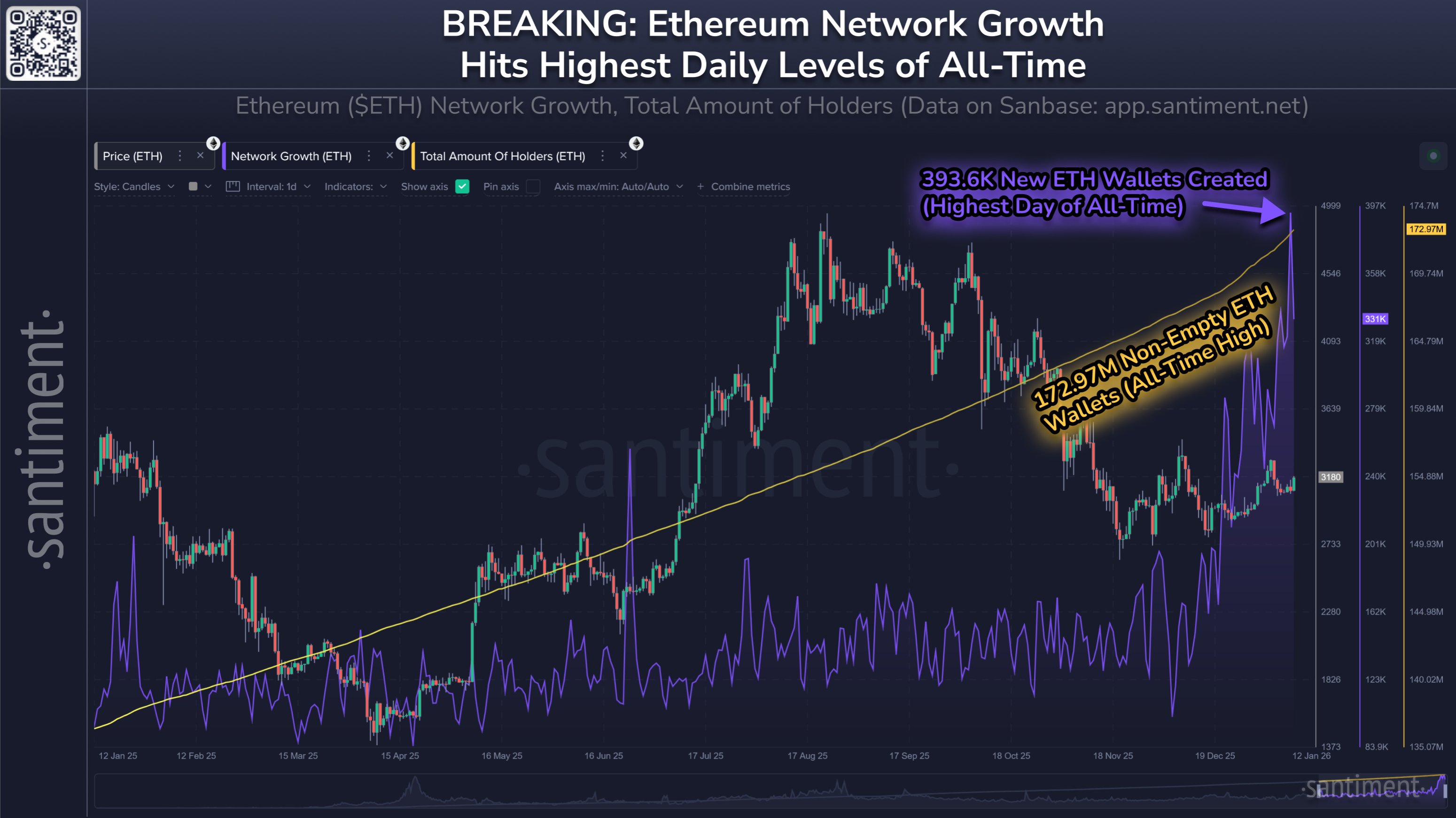
The value of the metric seems to have shot up in recent days | Source: Santiment on X

As displayed in the above graph, the Ethereum Network Growth has witnessed a spike recently. Over the past week, address generation has averaged around 327,100 per day, with a particularly large level being observed on Sunday, when 393,600 new addresses popped up.

The Sunday high was a new record for the indicator, meaning that ETH saw an unprecedented amount of single-day address creation. As a result of the surge in the Network Growth, the Total Amount of Holders, an indicator tracking the number of non-empty addresses that exist on the blockchain, has also shot up to a new ATH of 172.97 million.

What’s driving all this adoption? According to the analytics firm, there can be several factors contributing to the trend. First is the Fusaka upgrade that occurred in December, and improved data handling and cut layer-2 fees.

The second is the record stablecoin activity that the Ethereum blockchain saw in late 2025, with the transaction volume reaching $8 trillion in the fourth quarter. “This kind of real financial activity tends to bring in new participants who create wallets to send, receive, or hold stablecoins and other tokens,” explained Santiment.

Lastly, the turn of the year saw growing interest and improvement in sentiment among traders, which would have led to fresh retail traders signing up new wallets.

ETH Price

The past day has been bullish for Ethereum as its price has jumped by more than 5%, recovering back to the $3,340 level.

Looks like the price of the coin has shot up recently | Source: ETHUSDT on TradingView


Related Reads

Research Status Report on AI Payment Protocols: The New Paradigm of Payment in the Agent Economy

AI Payment Protocol Research Status Report: A New Paradigm for Agent Economy Payments This report analyzes the rapid evolution of payment infrastructure designed for AI agents, driven by major industry moves from OpenAI, Google, Visa, Mastercard, Coinbase, and Stripe between late 2025 and early 2026. The core challenge is that traditional payment systems, built for human interaction, are incompatible with AI agents that require machine-readable interfaces, millisecond authorizations, and support for high-frequency micro-transactions. The emerging infrastructure is forming a two-layer architecture: 1. **Intent Orchestration Layer:** Translates agent intent into executable transactions. Two key segments exist: * **Agent Shopping for Humans:** Focuses on enabling agents to shop on human-centric e-commerce platforms. Protocols include OpenAI & Stripe's closed **Agentic Commerce Protocol (ACP)** and Google's open **Universal Commerce Protocol (UCP)** for standardized merchant interfaces. * **Agent-to-Agent (A2A) Transactions:** Solves trust issues in environments without human merchants, using blockchain-based smart contracts like **ERC-8183** for task execution and payment escrow. 2. **Settlement Layer:** Handles the actual movement of funds. Key competing protocols include: * **Stripe's SPT & Card Network Upgrades (Visa/Mastercard):** Extend existing card payments with delegated authorization tokens, ideal for standard retail but unsuitable for micro-payments. * **Coinbase's x402:** Uses the HTTP 402 status code for on-chain atomic swaps with stablecoins (e.g., USDC), enabling low-fee, account-less payments. * **Circle's Nanopayments:** An x402 enhancement for extreme micro-payments using off-chain batch processing. * **MPP (Stripe & Tempo):** A unified, pluggable framework supporting multiple payment rails (stablecoins, fiat, card tokens, Lightning Network) within a single "payment session." **Current State & Opportunities:** While core protocols are live, commercial adoption lags due to fragmentation in the intent layer. The key opportunities are: * **Settlement Layer:** Building multi-rail Agent wallets that abstract complexity and can route transactions across different payment protocols is a definitive, high-value opportunity. * **A2A Economy:** A significant blue-ocean opportunity exists in creating API services for agents to consume (e.g., data analysis, content creation) on a pay-per-use model (e.g., via HTTP 402), moving beyond subscription models. The future will see a dual-track evolution: consumer-facing agent commerce relying on card rails, and A2A transactions thriving on stablecoin rails. The inflection point will be when enterprises delegate spending authority to agents, making multi-rail wallets and service directories critical, unclaimed infrastructure.

marsbit23m ago

Research Status Report on AI Payment Protocols: The New Paradigm of Payment in the Agent Economy

marsbit23m ago

Trading

Spot
Futures

Hot Articles

Discussions

Welcome to the HTX Community. Here, you can stay informed about the latest platform developments and gain access to professional market insights. Users' opinions on the price of ETH (ETH) are presented below.

活动图片