Bitcoin [BTC] manages to float above $20K despite recent liquidations and heavy outflows

AmbcryptoPublished on 2022-07-24Last updated on 2022-07-24

Abstract

If you have been closely watching the crypto, or even invested in it, chances are that you are wondering whether the latest bear cycle is over. The truth is that the market remains unpredictable especially in the long-term.

If you have been closely watching the crypto, or even invested in it, chances are that you are wondering whether the latest bear cycle is over. The truth is that the market remains unpredictable especially in the long-term. Despite this, here are some opinions and observations will help you to better understand the current market state.

We recently witnessed heavy liquidations in the Bitcoin [BTC] space. Some investment companies that dabbled in Bitcoin, such as Celsius went bankrupt during the latest crash. The bear market liquidated many highly leveraged positions. Companies such as Tesla that had recently invested in BTC dumped their holdings.

Assessing the market outlook

Despite the heavy outflows, Bitcoin still managed to promptly recover above $20,000. The recovery demonstrated Bitcoin’s strength despite being stress tested against highly volatile and unfavorable market conditions. Could this outcome be a sign that the market is ready for a bigger recovery?

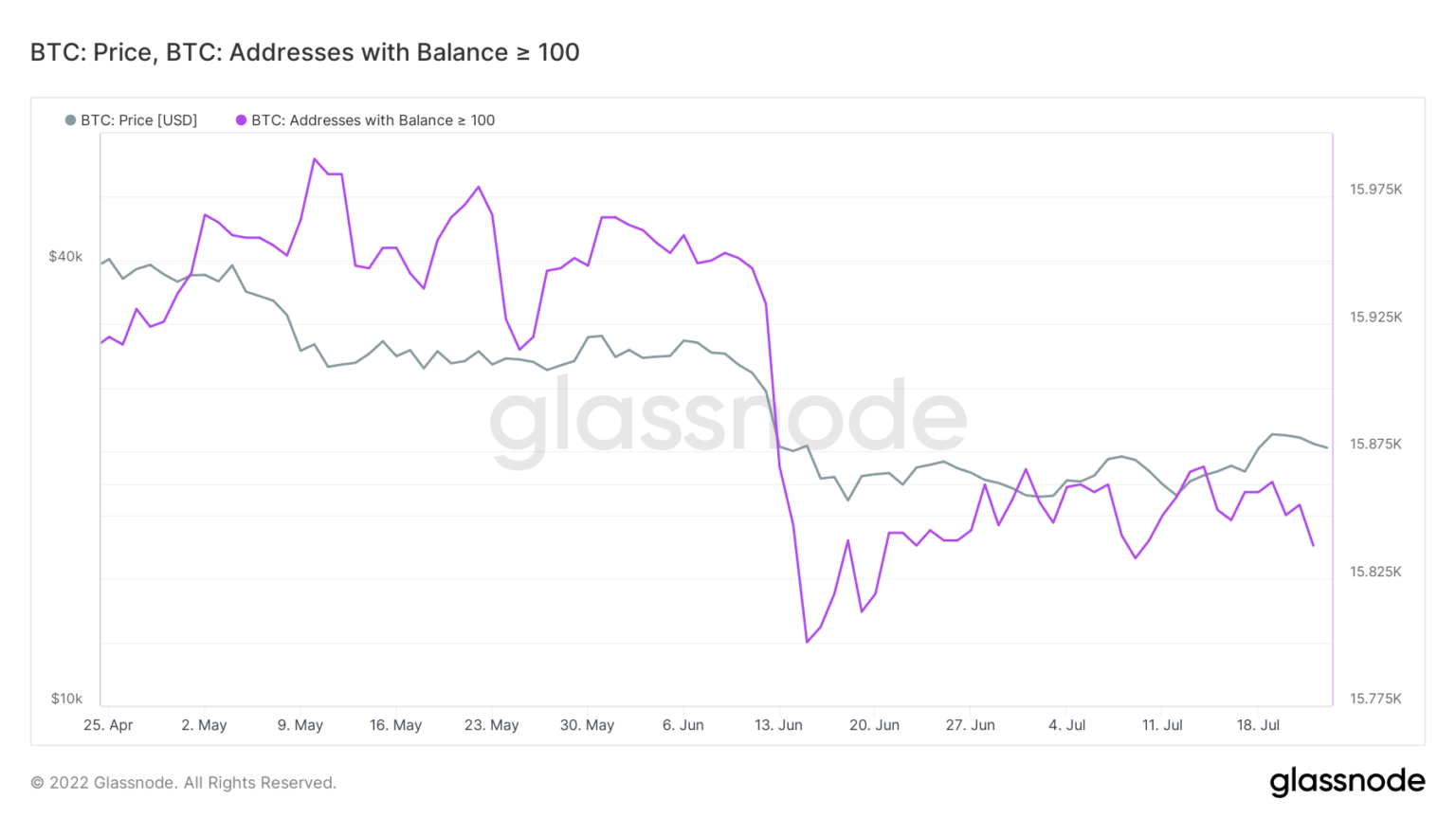
A look at some metrics may help provide a clearer picture of BTC’s current position. For example, addresses holding more than 100 BTC have drastically reduced their selloff. The number of such addresses increased substantially since mid-June, thus supporting Bitcoin’s bullish performance.
Source: Glassnode

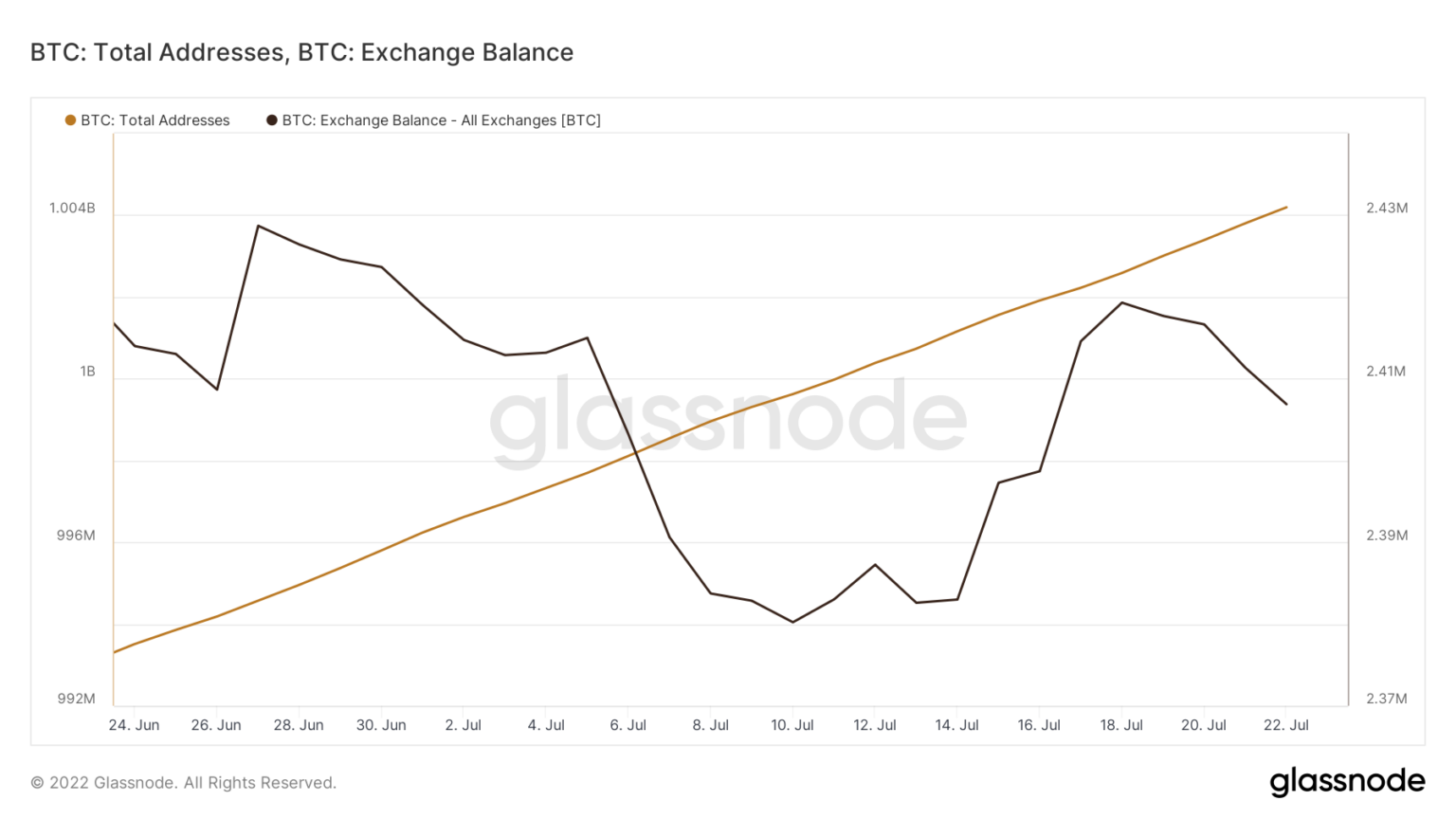
A slight drop in the same metric in the last few days suggests the likelihood that increased selling pressure may prevent more upside in the short-term. BTC balances on exchanges have been all over the place during the month but outflows and inflows have relatively balanced out. However, the total addresses metric indicates that the number of addresses has grown steadily during the last 30 days.
Source: Glassnode

However, the balance on exchanges has notably reduced in the last few months. This is a healthy sign as far as Bitcoin’s long-term performance is concerned. It highlights strong demand at lower price levels. Investors have thus been taking advantage of the lower prices. However, some exchanges might experience higher balances because of long-term increases in trading volumes.

Bitcoin’s risk-on nature and the FED

It is no secret that most of the top investors in Bitcoin have been holding it as a risk-on asset. This means they have been selling or avoiding BTC when the U.S Federal Reserve started raising rates. If this trend continues, then we will likely continue to see more selling pressure in on Bitcoin. A softer approach on interest rates may support more upside.

While the FED holds a chip over BTC’s shoulder, other factors will influence its short-term and long-term performance. Regulations and investor sentiment still have a substantial impact on BTC’s performance. For instance, favorable crypto laws from the SEC might favor crypto bulls. The fact that the market recently bottomed out is also a healthy sign and improved investor sentiment since June may encourage more buyers.


Related Reads

Anthropic CEO's Latest Interview: On Technological Explosion, Safety Red Lines, and the Civilization Contract

Interview with Anthropic CEO Dario Amodei covers the intense pressures and ethical dilemmas of leading AI development. He describes the experience as "exponential growth," feeling constant acceleration akin to relativistic time dilation. The discussion delves into his departure from OpenAI, rooted in a fundamental loss of trust and divergent values rather than mere technical disagreements. Amodei emphasizes Anthropic's enterprise-focused business model, arguing it aligns better with safety and responsible deployment than consumer-facing, ad-driven models. He addresses critical issues like AI's impact on employment, advocating for proactive macroeconomic policies and a shift towards "doing more with the same resources" to avoid widespread job displacement. On safety and governance, he details Anthropic's cautious approach, including delaying the release of the powerful "Mythos" model due to its advanced cyber capabilities. He stresses the need for "human-in-the-loop" principles in military applications, setting red lines against autonomous weapons and mass surveillance. Amodei calls for industry collaboration among trustworthy actors to establish standards and advocates for a balanced regulatory framework with checks and balances, such as Anthropic's Long-term Benefit Trust, rather than corporate or government monopoly over the technology. He expresses geopolitical concerns, particularly regarding China, and a belief that AI should bolster liberal democracies. While acknowledging a non-zero risk of civilizational catastrophe from advanced AI, he asserts Anthropic's actions are aimed at significantly reducing that probability. The interview concludes with Amodei arguing that trust must be earned through concrete actions, like sacrificing commercial gain for safety, to distinguish Anthropic in a Silicon Valley landscape he criticizes for eroded public trust.

marsbit5m ago

Anthropic CEO's Latest Interview: On Technological Explosion, Safety Red Lines, and the Civilization Contract

marsbit5m ago

The Brutal Truth Behind CARDS' $535M FDV: Only $43M in Net Revenue and Halved Profit Margins

The article titled "The Brutal Truth Behind CARDS' $535 Million FDV: Only $43 Million Net Revenue, Profit Margins Halved" provides a critical analysis of Collector Crypt (CC), a platform combining physical collectible cards with NFTs in a gacha-style system. Key findings include: * CC has generated $635 million in total user deposits. However, 90.6% ($576 million) is instantly returned to users via automatic card buybacks, resulting in only $43 million in net platform revenue (6.7% retention). * Activity is highly concentrated among dozens of high-frequency wallets, with an average of only ~420 daily active players. * There is minimal secondary market activity for the cards (under $5 million total), indicating the platform functions more as a gambling casino than a collector's marketplace. eBay sales as a percentage of gacha volume have declined for six consecutive quarters. * Despite a tripling in transaction volume, net profit margins have been halved from 11.2% to 5.8% as activity shifts to higher-priced card packs with lower margins. * Value captured by the CARDS token is minimal: only $140,000 (from burns and recent buybacks), representing just 3.4% of CC's cumulative net revenue. In contrast, wallets linked to operational infrastructure have off-ramped $45.7 million in USDC. * The token's ~$535 million Fully Diluted Valuation (FDV) represents a 7.3x multiple of annualized net revenue. Only 20.5% of the token supply is floating, with 72% allocated to insiders and locked until November 2027. The conclusion is that CC has found product-market fit as a high-speed gambling platform for a niche user base, not as a growing collector economy. The token currently captures a negligible share of the platform's revenue.

Foresight News30m ago

The Brutal Truth Behind CARDS' $535M FDV: Only $43M in Net Revenue and Halved Profit Margins

Foresight News30m ago

BitTorrent Launches BTTInferGrid: The Decentralized Infrastructure Layer for Scalable AI Inference

BitTorrent has launched BTTInferGrid, a decentralized GPU computing network designed to meet the surging demand for AI inference workloads. The platform aggregates global idle GPU resources into an open-access, verifiable, and pay-as-you-go infrastructure, aiming to solve the cost, scalability, and supply bottlenecks of traditional centralized cloud providers. BTTInferGrid addresses a key market shift, as industry forecasts indicate over 70% of future AI compute will be for inference—a continuous operational cost. It tackles centralization issues like inflexible resource allocation during volatile demand, prohibitive GPU pricing, and the underutilization of fragmented global compute capacity. The platform establishes a direct corridor between AI developers and idle hardware. On the supply side, it allows providers to monetize underutilized GPUs through tokenized incentives. On the demand side, it offers developers cost-efficient, on-demand inference with on-chain verification. Key differentiators include permissionless access for providers, verifiable service quality through blockchain validation, and a sustainable, demand-driven economic model. Built on BitTorrent's proven DePIN expertise from the BitTorrent File System (BTFS), BTTInferGrid follows a phased roadmap. It begins with network bootstrapping in 2026, focusing on scaling GPU nodes, and aims to evolve into a foundational Web3 AI infrastructure layer by 2028, supporting diverse model architectures and decentralized fine-tuning.

TheNewsCrypto1h ago

BitTorrent Launches BTTInferGrid: The Decentralized Infrastructure Layer for Scalable AI Inference

TheNewsCrypto1h ago

Trading

Spot
Futures
活动图片