Bitcoin and Ethereum look bullish: But they face the same pre-breakout risk

AmbcryptoPublished on 2026-01-05Last updated on 2026-04-03

Abstract

Bitcoin broke above the $90k resistance after weeks of consolidation, though declining whale balances signaled potential setbacks. Analyst CrypNuevo warned of a possible "liquidity run"—a false breakout above $94.5k that could trap bulls, followed by a sweep of lows near $84k before a true rally toward $100k. Alternatively, rejection at the $92k resistance could lead to a drop toward $80.6k. Ethereum shows a comparable pattern, with key liquidity levels at $3,500 and $2,700–$2,800. Traders are advised to wait for clearer momentum shifts and avoid premature long entries, as both assets face pre-breakout volatility risks.

Bitcoin [BTC] has managed to break the $90k round-number resistance after three weeks of sideways price action between the $85k – $90k region.

Declining whale balances was a warning sign that the rally might face setbacks and delays.

In a post on X, crypto analyst CrypNuevo highlighted another reason why Bitcoin’s expected price bounce might see a liquidity run before the true impulse move.

Analyzing the expected Bitcoin liquidity run
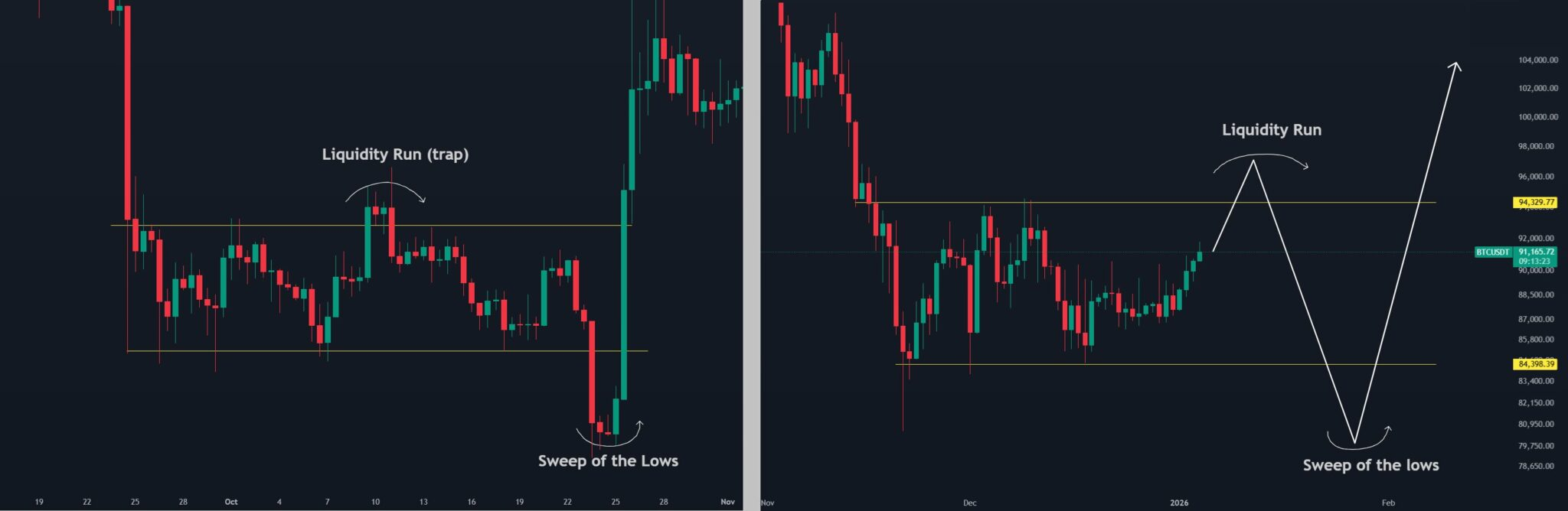
A liquidity run is an initial false price move that is designed to trap breakout traders, explained the analyst. In this scenario, a breakout past the $94.5k local resistance would persuade bulls that the breakout was underway.

The new long positions’ liquidation levels can then be hunted with a sweep of the lows below $84k. Thereafter, the true impulse move to $100k and beyond can commence.

At the same time, the analyst warned that it is possible that the resistance at the $92k from the 50-day EMA could reject Bitcoin.

In this scenario, the liquidity run to $96k might not happen, and instead BTC might directly head toward $80.6k in the coming days.

AMBCrypto had noted recently that a move toward $94k-$96k was likely this month but also warned of bearish ETF flows in the second half of December that gave traders a dilemma.

The similarities with Ethereum

Interestingly, Ethereum [ETH] could also see a similar outcome on the price charts. While the leading altcoin tends to follow Bitcoin, the liquidation heatmap outlined what swing traders can expect in January.
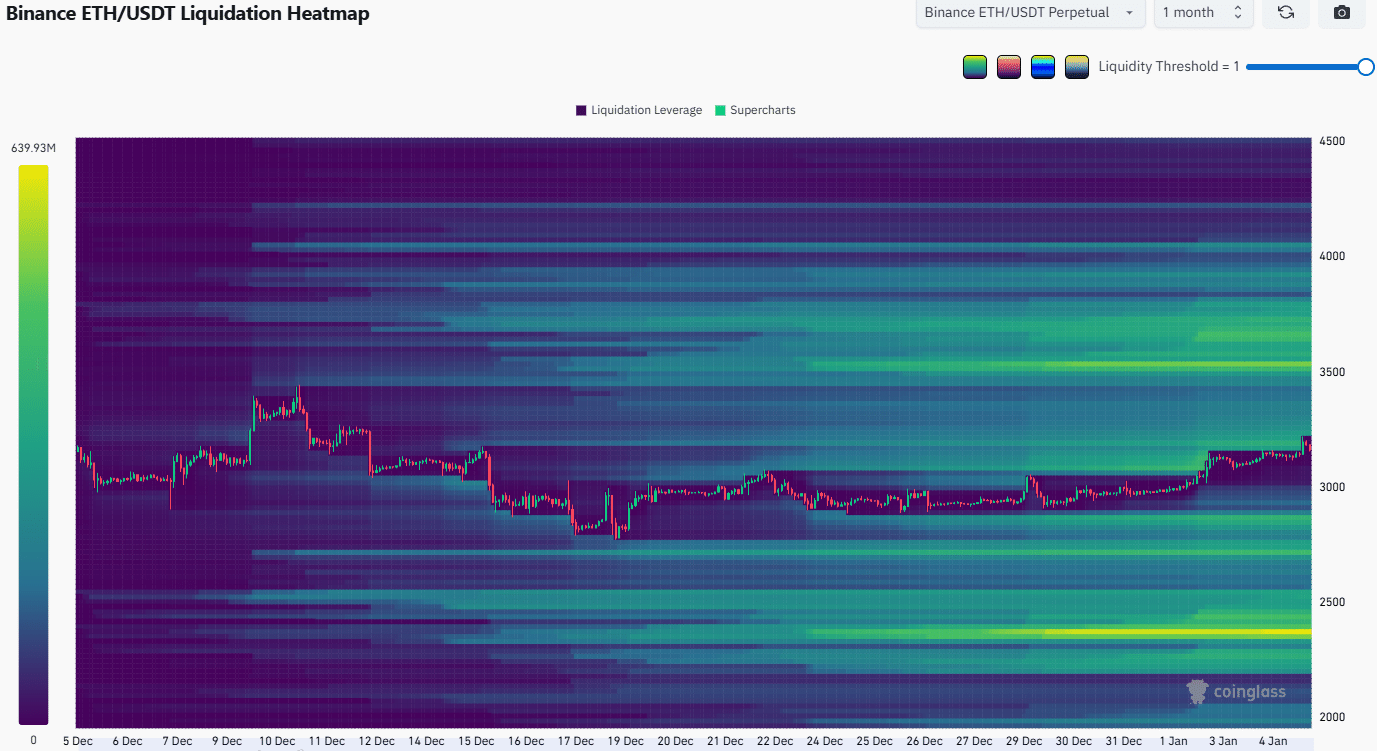
Ethereum has also collected the liquidity at $3,200 and has another strong magnetic zone at $3,500. It also has an attractive liquidity cluster at $2,700-$2,800.

A sweep of these lows could serve as a launchpad for the next ETH rally.

This meant that Bitcoin and Ethereum traders not already in long positions should be patient. Those in short-term profits could use a lower timeframe momentum shift to take profits.

A BTC breakout past the $94.5k is not an automatic signal to go long, and traders should beware of the possibility of a liquidity run.

Final Thoughts

  • A sweep of the $96k level and a subsequent reversal below $94k could be a warning sign that Bitcoin could drop to $84k and $80.6k.
  • Ethereum liquidation levels also showed similarities to Bitcoin’s, and a price drop to $2,800 was a possibility.

Related Questions

QWhat is a liquidity run in the context, as explained by the analyst CrypNuevo?

AA liquidity run is an initial false price move designed to trap breakout traders. It involves a breakout past a key resistance level to persuade bulls that a rally is starting, only for the price to reverse and hunt the liquidation levels of the new long positions before the true upward move begins.

QWhat are the two possible price scenarios for Bitcoin if it faces rejection at the $92k resistance from the 50-day EMA?

AIf rejected at the $92k resistance, Bitcoin might not experience the liquidity run to $96k and could instead head directly toward the $80.6k support level in the coming days.

QAccording to the article, what similar price behavior does Ethereum exhibit compared to Bitcoin?

AEthereum exhibits a similar potential for a liquidity run, with a strong magnetic zone at $3,500 and an attractive liquidity cluster at $2,700-$2,800. A sweep of these lower levels could serve as a launchpad for its next rally, mirroring the potential behavior seen in Bitcoin.

QWhat warning sign does the article mention for traders considering going long if Bitcoin breaks past $94.5k?

AThe article warns that a breakout past $94.5k is not an automatic signal to go long. Traders should beware of the possibility of a liquidity run, where the price could reverse and sweep lower liquidation levels, causing significant losses for those who entered long positions.

QWhat are the key liquidity levels identified for Ethereum on the price charts?

AThe key liquidity levels identified for Ethereum are the already collected liquidity at $3,200, a strong magnetic zone at $3,500, and an attractive liquidity cluster in the $2,700-$2,800 range.

Related Reads

Native Account Abstraction + Quantum Resistance: Why Hasn't EIP-8141 Become the Headliner of Ethereum's Hegotá?

Brief: EIP-8141, a proposal for native account abstraction on Ethereum, was recently discussed by core developers but only received a "Considered for Inclusion" (CFI) status for the upcoming Hegotá upgrade, rather than being a headline feature. Despite having support from Vitalik Buterin, the proposal is considered too heavy for immediate implementation due to unresolved complexities in client implementation, transaction pool security, and validation. The proposal, named "Frame Transactions," introduces a new transaction type (0x06) that decouples the validation, payment, and execution of transactions into sequential "frames." This allows accounts to have programmable verification logic, enabling features like gas abstraction (e.g., paying fees with stablecoins), multi-operation batching, social recovery, and future-proofing against quantum threats by supporting alternative signature schemes beyond ECDSA. While EIP-8141 is backward compatible and wouldn’t require users to migrate existing wallets, its protocol-level changes are significant. The delay in full adoption reflects Ethereum’s cautious, incremental approach to upgrading its account model. The proposal highlights growing urgency around improving user experience and preparing for long-term security challenges, such as quantum computing, though it is not a finalized solution. The CFI status means it remains under active evaluation for future upgrades.

marsbit44m ago

Native Account Abstraction + Quantum Resistance: Why Hasn't EIP-8141 Become the Headliner of Ethereum's Hegotá?

marsbit44m ago

If We Gathered the Most Accurate Gold Forecasters in History, Could We Crack the Future Price of Gold?

The article investigates whether assembling the most historically accurate gold price forecasters could unlock future price movements. The author analyzes three groups: top Wall Street institutions (e.g., LBMA, Goldman Sachs, JPMorgan), prominent gold bulls (e.g., Peter Schiff, Jim Rickards), and analysts famed for precise calls (e.g., Nouriel Roubini, Ben McMillan). The findings reveal significant flaws. Institutions consistently exhibit "lagging predictions," adjusting forecasts too slowly and underestimating bull market magnitudes. Pundits perpetually predict extreme price targets (e.g., $35,000) without precise timing, often being early or wrong. Even "prophetic" forecasters have mixed records; Roubini missed the entire 2009-2012 bull market, and Ray Dalio has a history of erroneous crisis predictions. The analysis notes that the current environment mirrors 2011, where extreme predictions clustered near the market top. Today, forecasts from the same experts range wildly from $5,400 to $35,000. The conclusion is that no consistently accurate forecaster exists. Predictions are often right by chance, not skill. The author ultimately rejects seeking a "wealth password" and instead advocates for a Dalio-inspired approach: avoiding precise price predictions, acknowledging uncertainty, and using portfolio allocation (e.g., 5-15% in gold) for long-term risk management.

marsbit53m ago

If We Gathered the Most Accurate Gold Forecasters in History, Could We Crack the Future Price of Gold?

marsbit53m ago

Trading

Spot
Futures

Hot Articles

What is $BITCOIN

DIGITAL GOLD ($BITCOIN): A Comprehensive Analysis Introduction to DIGITAL GOLD ($BITCOIN) DIGITAL GOLD ($BITCOIN) is a blockchain-based project operating on the Solana network, which aims to combine the characteristics of traditional precious metals with the innovation of decentralized technologies. While it shares a name with Bitcoin, often referred to as “digital gold” due to its perception as a store of value, DIGITAL GOLD is a separate token designed to create a unique ecosystem within the Web3 landscape. Its goal is to position itself as a viable alternative digital asset, although specifics regarding its applications and functionalities are still developing. What is DIGITAL GOLD ($BITCOIN)? DIGITAL GOLD ($BITCOIN) is a cryptocurrency token explicitly designed for use on the Solana blockchain. In contrast to Bitcoin, which provides a widely recognized value storage role, this token appears to focus on broader applications and characteristics. Notable aspects include: Blockchain Infrastructure: The token is built on the Solana blockchain, known for its capacity to handle high-speed and low-cost transactions. Supply Dynamics: DIGITAL GOLD has a maximum supply capped at 100 quadrillion tokens (100P $BITCOIN), although details regarding its circulating supply are currently undisclosed. Utility: While precise functionalities are not explicitly outlined, there are indications that the token could be utilized for various applications, potentially involving decentralized applications (dApps) or asset tokenization strategies. Who is the Creator of DIGITAL GOLD ($BITCOIN)? At present, the identity of the creators and development team behind DIGITAL GOLD ($BITCOIN) remains unknown. This situation is typical among many innovative projects within the blockchain space, particularly those aligning with decentralized finance and meme coin phenomena. While such anonymity may foster a community-driven culture, it intensifies concerns about governance and accountability. Who are the Investors of DIGITAL GOLD ($BITCOIN)? The available information indicates that DIGITAL GOLD ($BITCOIN) does not have any known institutional backers or prominent venture capital investments. The project seems to operate on a peer-to-peer model focused on community support and adoption rather than traditional funding routes. Its activity and liquidity are primarily situated on decentralized exchanges (DEXs), such as PumpSwap, rather than established centralized trading platforms, further highlighting its grassroots approach. How DIGITAL GOLD ($BITCOIN) Works The operational mechanics of DIGITAL GOLD ($BITCOIN) can be elaborated on based on its blockchain design and network attributes: Consensus Mechanism: By leveraging Solana’s unique proof-of-history (PoH) combined with a proof-of-stake (PoS) model, the project ensures efficient transaction validation contributing to the network's high performance. Tokenomics: While specific deflationary mechanisms have not been extensively detailed, the vast maximum token supply implies that it may cater to microtransactions or niche use cases that are still to be defined. Interoperability: There exists the potential for integration with Solana’s broader ecosystem, including various decentralized finance (DeFi) platforms. However, the details regarding specific integrations remain unspecified. Timeline of Key Events Here is a timeline that highlights significant milestones concerning DIGITAL GOLD ($BITCOIN): 2023: The initial deployment of the token occurs on the Solana blockchain, marked by its contract address. 2024: DIGITAL GOLD gains visibility as it becomes available for trading on decentralized exchanges like PumpSwap, allowing users to trade it against SOL. 2025: The project witnesses sporadic trading activity and potential interest in community-led engagements, although no noteworthy partnerships or technical advancements have been documented as of yet. Critical Analysis Strengths Scalability: The underlying Solana infrastructure supports high transaction volumes, which could enhance the utility of $BITCOIN in various transaction scenarios. Accessibility: The potential low trading price per token could attract retail investors, facilitating wider participation due to fractional ownership opportunities. Risks Lack of Transparency: The absence of publicly known backers, developers, or an audit process may yield skepticism regarding the project's sustainability and trustworthiness. Market Volatility: The trading activity is heavily reliant on speculative behavior, which can result in significant price volatility and uncertainty for investors. Conclusion DIGITAL GOLD ($BITCOIN) emerges as an intriguing yet ambiguous project within the rapidly evolving Solana ecosystem. While it attempts to leverage the “digital gold” narrative, its departure from Bitcoin's established role as a store of value underscores the need for a clearer differentiation of its intended utility and governance structure. Future acceptance and adoption will likely depend on addressing the current opacity and defining its operational and economic strategies more explicitly. Note: This report encompasses synthesised information available as of October 2023, and developments may have transpired beyond the research period.

363 Total ViewsPublished 2025.05.13Updated 2025.05.13

What is $BITCOIN

Discussions

Welcome to the HTX Community. Here, you can stay informed about the latest platform developments and gain access to professional market insights. Users' opinions on the price of BTC (BTC) are presented below.

活动图片