JPMorgan Says Bitcoin Production Cost Drops 50% to $13,000, Why This Is Negative for BTC?

CoingapePublished on 2022-07-14Last updated on 2022-07-14

Abstract

Wall Street banking JPMorgan has recently published a report that suggests that the Bitcoin production cost has dropped 50% over the last month.

Wall Street banking JPMorgan has recently published a report that suggests that the Bitcoin production cost has dropped 50% over the last month. Currently, the BTC production cost stands at $13,000 down from the $24,000 cost at the start of June 2022.

JPMorgan strategists led by Nikolaos Panigirtzoglou wrote that this drop comes amid the fall in electricity use as per data from Cambridge Bitcoin Electricity Consumption Index.
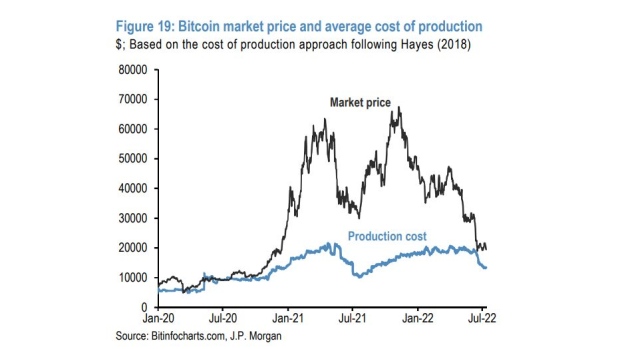
The banking giant notes that this is an effort y the miners to protect profitability and deploy efficient rigs. However, it could also serve as a major obstacle to any gains in the Bitcoin price. The JPMorgan strategists wrote:

“While clearly helping miners’ profitability and potentially reducing pressures on miners to sell Bitcoin holdings to raise liquidity or for deleveraging, the decline in the production cost might be perceived as negative for the Bitcoin price outlook going forward. The production cost is perceived by some market participants as the lower bound of the Bitcoin’s price range in a bear market.”

Bitcoin Miner Capitulation

During the second quarter of 2022, Bitcoin miners were on a selling spree. As the Bitcoin price corrected a staggering 70% from its all-time highs in November 2021, miners had to offload more quantity in order to cover their operational costs.

Last month, JPMorgan strategists said that Bitcoin could further witness selling pressure during the third quarter as well. Miners are further likely to liquidate their holdings going ahead. Also, if the BTC production has actually gone to $13,000 as per JPMorgan, miners might have a good profit to make on its new production.

On-chain data provider Glassnode recently shared its insights wherein it notes that long-term holder (LTH) capitulation. The report adds:

“There is an increased probability that a long-term holder (LTH) capitulation is underway. Bitcoin investors are not out of the woods yet”.

On the upside, Bitcoin (BTC) still has to cross its 200-day EMA at around $22,500 and hold above that level to resume the uptrend.


Related Reads

Bitcoin Trading Strategy Breakdown: Celebrity Predictions and Classic Models All Fail, Only These Four Indicators Remain

Analysis of Bitcoin Trading Strategies: Why Celebrity Forecasts and Classic Models Fail, Leaving Only These Four Reliable Indicators This analysis examines the failure of common Bitcoin prediction methods and identifies four reliable indicators for constructing a trading strategy. The author reviewed all major BTC prediction approaches from 2017-2025, categorizing them into three groups: celebrity price targets (consistently over-optimistic), analytical models like Stock-to-Flow (broken post-2022), and on-chain signals. The key finding is that more data often creates confusion, not clarity. The strategy discards unreliable elements: celebrity predictions (incentivized to be extreme), pure models (invalidated by post-ETF market changes), and the Fear & Greed Index used alone (too many false signals). Four reliable indicators were selected: 1. **MVRV Z-Score:** Accurately identifies cycle bottoms when entering its green zone (e.g., 2018, 2020, 2022). Note: Its ability to call tops is now ineffective post-2024. 2. **SOPR (28-day MA):** Consistently signals bottoms when below 1.0, indicating holders are selling at a loss. 3. **ETF Net Flow:** A crucial post-2024 metric showing institutional momentum (e.g., sustained inflows = buying). 4. **Macro Liquidity (Fed policy & M2):** Sets the overall directional bias (e.g., bullish during easing cycles). The core strategy involves waiting for a multi-signal共振 (resonance). For example, a bottom signal requires MVRV in the green zone + SOPR < 1.0. A top signal requires overheated on-chain data + sustained ETF outflows. Macro policy sets the overall direction. The Fear & Greed Index is only used as a weighted confirmatory signal, never alone. Action is only taken when three or more indicators align. The author automated this into a monitoring system that sends Telegram alerts only when signals trigger. As of the article's date (April 15, 2026), the system showed a strong bottom signal: extreme fear (F&G=12), MVRV in the buy zone, and SOPR < 1.0. The only contrary signal was weak ETF flows. Historically, such triple on-chain共振 has preceded 100%+ returns. The conclusion emphasizes building a personal framework over relying on external predictions, allowing for iterative improvement and customization based on individual risk tolerance.

marsbit1h ago

Bitcoin Trading Strategy Breakdown: Celebrity Predictions and Classic Models All Fail, Only These Four Indicators Remain

marsbit1h ago

Trading

Spot
Futures
活动图片