Circle acquiert l'équipe et la propriété intellectuelle d'Interop Labs tandis qu'Axelar reste indépendant

cointelegraphPublished on 2025-12-15Last updated on 2025-12-15

Abstract

Circle, émetteur du stablecoin USDC, a conclu un accord pour acquérir l'équipe et la technologie propriétaire d'Interop Labs, un contributeur clé du réseau décentralisé Axelar. L'opération, qui devrait être finalisée début 2026, n'inclut pas le réseau Axelar, sa fondation ou le jeton AXL, qui resteront indépendants. Les technologies d'Interop Labs seront intégrées à la blockchain Arc et au protocole de transfert inter-chaînes (CCTP) de Circle. Cette acquisition vise à accélérer l'interopérabilité des actifs sur Arc et à renforcer les outils pour les applications multichaînes. Circle, qui détient environ 25% du marché des stablecoins, poursuit ainsi sa stratégie de croissance après le rachat de Hashnote en janvier. Parallèlement, d'autres émetteurs comme Paxos et Tether ont également réalisé des acquisitions significatives en 2025.

L'émetteur de stablecoin Circle a signé un accord pour acquérir l'équipe d'Interop Labs et sa technologie propriétaire, intégrant ainsi un contributeur clé du réseau Axelar à son activité d'infrastructure.

Cette transaction, qui devrait être finalisée début 2026, porte sur le personnel et la propriété intellectuelle propriétaire d'Interop Labs, tandis que le réseau Axelar, sa fondation et le jeton AXL resteront indépendants et gouvernés par la communauté.

Interop Labs est le développeur initial du réseau Axelar, un réseau d'interopérabilité décentralisé qui prend en charge la messagerie inter-chaînes et les transferts d'actifs entre les blockchains. Circle a déclaré que la technologie de l'équipe sera intégrée à la blockchain Arc de Circle et à son protocole de transfert inter-chaînes (CCTP).

Un autre contributeur d'Axelar, Common Prefix, reprendra les précédentes responsabilités de développement d'Interop Labs pour assurer la continuité du réseau open source.

Selon Circle, cette acquisition devrait accélérer l'interopérabilité pour les actifs émis sur Arc, améliorer les outils de développement pour les applications multichaînes et soutenir le développement des produits construits par Circle. Les termes de l'accord n'ont pas été divulgués.

Circle émet l'USDC (USDC), le deuxième stablecoin par capitalisation boursière, représentant environ 25 % du marché mondial des stablecoins de 310 milliards de dollars, selon les données de DefiLlama.
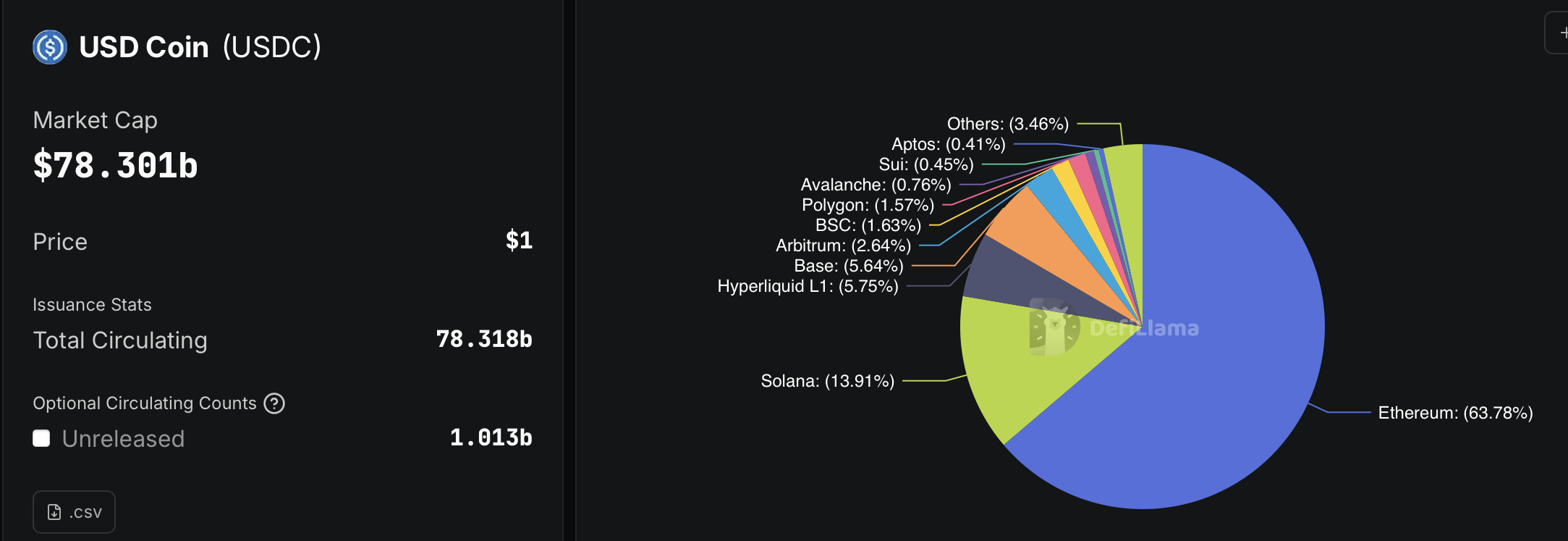
Capitalisation boursière de l'USDC et blockchains. Source : DefiLlama

En janvier, Circle a acquis Hashnote, l'émetteur du fonds monétaire tokenisé US Yield Coin, intégrant ainsi l'un des plus grands produits d'actifs réels générateurs de rendement à son activité de stablecoin et d'infrastructure.

En relation : Paxos, Ripple, Circle et d'autres obtiennent des agréments de banques fiduciaires américaines

Les émetteurs de stablecoins réalisent des acquisitions en 2025

Les émetteurs de stablecoins ont de plus en plus recours aux acquisitions en 2025 pour développer leurs activités.

En novembre, Paxos a acquis le fournisseur de portefeuilles crypto institutionnels Fordefi dans le cadre d'une transaction évaluée à plus de 100 millions de dollars, selon Fortune. Paxos, l'émetteur du Pax Dollar (USDP) et du stablecoin USD (PYUSD) de PayPal, a déclaré que cette acquisition renforce son infrastructure de garde et de transaction pour l'émission de stablecoins, la tokenisation d'actifs et les paiements onchain.
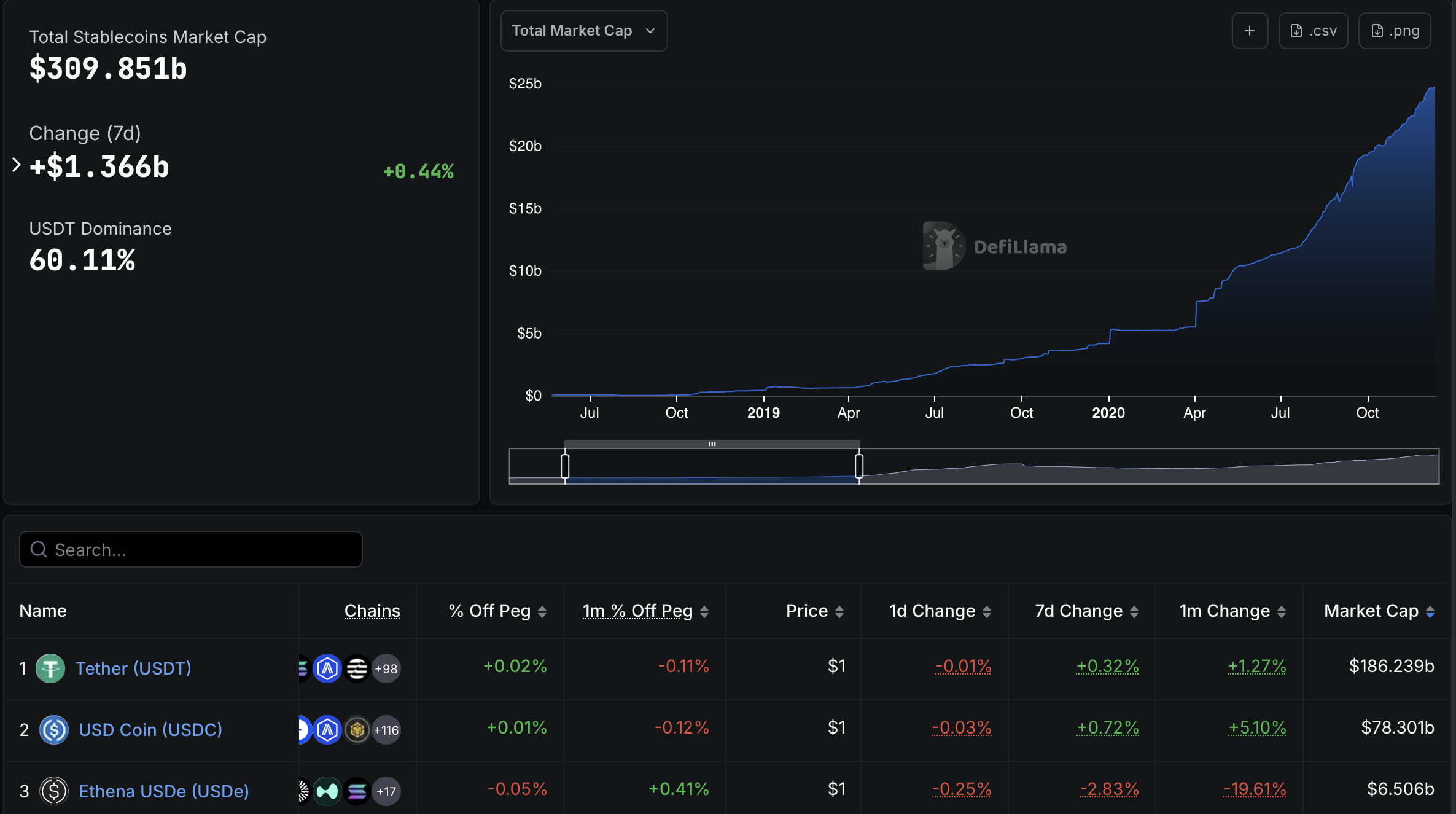
Capitalisation boursière des stablecoins. Source : DefiLlama

Tether, le principal émetteur de stablecoins derrière le jeton USDt (USDT), a utilisé son bilan pour acquérir des participations minoritaires et des positions stratégiques dans des entreprises d'actifs traditionnels.

En juin, il a acquis environ 32 % du capital de la société de redevances aurifères canadienne Elemental Altus Royalties pour environ 89 millions de dollars. En novembre, Tether Investments a acquis une participation minoritaire dans la société de métaux précieux Versamet Royalties, achetant environ 11,8 millions d'actions ordinaires via un accord privé avec un actionnaire existant.

Tether a tenté de s'étendre au-delà de la finance vers le sport, en soumettant le 12 décembre une offre ferme entièrement en numéraire pour acquérir la participation majoritaire de 65,4 % d'Exor dans la Juventus Football Club d'Italie, une offre que la société holding de la famille Agnelli a ensuite déclaré que son conseil d'administration avait rejetée à l'unanimité.

Magazine : Rencontrez les détectives crypto onchain qui luttent contre le crime mieux que la police

Trending Cryptos

Related Questions

QQu'est-ce que Circle acquiert dans cet accord avec Interop Labs ?

ACircle acquiert l'équipe d'Interop Labs et sa technologie propriétaire, qui est un contributeur clé du réseau Axelar.

QQu'adviendra-t-il du réseau Axelar et du jeton AXL après cette acquisition ?

ALe réseau Axelar, sa fondation et le jeton AXL resteront indépendants et seront gouvernés par la communauté.

QComment cette acquisition bénéficiera-t-elle à Circle selon l'article ?

AElle accélérera l'interopérabilité pour les actifs émis sur Arc, améliorera les outils pour les applications multichaînes et soutiendra le développement des produits de Circle.

QQuelle est la part de marché de l'USDC, le stablecoin émis par Circle ?

AL'USDC représente environ 25 % du marché des stablecoins, qui s'élève à 310 milliards de dollars, ce qui en fait le deuxième stablecoin en termes de capitalisation boursière.

QQuels autres exemples d'acquisitions par des émetteurs de stablecoins sont mentionnés dans l'article ?

APaxos a acquis Fordefi pour plus de 100 millions de dollars, et Tether a acquis des participations minoritaires dans des entreprises traditionnelles comme Elemental Altus Royalties et Versamet Royalties.

Related Reads

Oil Prices Fall Below $80, Bitcoin Yet to Rise: Liquidity Becomes Key Market Driver

Oil prices fell below $80 as a US-Iran peace framework eased tensions, but Bitcoin failed to rally, remaining around $64,900. The article argues that while lower oil removes a key bearish factor for BTC, the primary market drivers have shifted to liquidity conditions, Federal Reserve policy, ETF fund flows, and overall risk appetite. Historically, high oil prices threatened inflation, delaying Fed rate cuts and hurting risk assets like Bitcoin. Now, with oil prices down, Bitcoin's path hinges on whether this translates into lower inflation expectations, softer Treasury yields, and a more dovish Fed stance. Recent FOMC minutes still show concern over energy-driven inflation, keeping financial conditions restrictive. Bitcoin ETF flows showed a slight positive inflow recently, but sustained demand is needed for a meaningful shift. The market requires consistent signals: stable ETF inflows, declining yields, and improving risk sentiment alongside lower oil prices. Without this combination, lower oil alone may not boost BTC. The outlook presents two paths: a recovery if lower oil eases inflation, the Fed turns less hawkish, and ETF demand stabilizes, allowing BTC to reclaim the $66,900-$70,000 range. Conversely, Bitcoin could remain pressured if the peace deal stalls, the Fed remains restrictive, yields stay high, or ETF flows reverse. In summary, for the remainder of 2026, liquidity factors—Fed policy, ETF activity, and investor risk appetite—have surpassed oil prices as the critical determinants of Bitcoin's price trajectory.

marsbit18m ago

Oil Prices Fall Below $80, Bitcoin Yet to Rise: Liquidity Becomes Key Market Driver

marsbit18m ago

Full Debut Q&A! Fed Chair Wash: Firmly Adhering to 2% Inflation Target, Establishing Five Special Task Forces, Personally Did Not Submit Dot Plot

Federal Reserve Chair Kevin Warsh delivered his first FOMC press conference, maintaining the federal funds rate at 3.5%-3.75% and emphasizing the Committee's unanimous and explicit commitment to achieving its 2% inflation target. Key announcements included significant changes to Fed communication and operations. The policy statement was significantly shortened and, notably, forward guidance was removed. Chair Warsh broke from precedent by declining to submit his own economic forecasts and "dot plot." He announced the immediate formation of five special working groups focusing on: Fed communication, the balance sheet, data sources, productivity and employment (including AI's impact), and the inflation framework. These groups, which will include external experts, are tasked with recommending improvements by year-end. One key group will review the Fed's $6.7 trillion balance sheet to assess the roles of interest rates versus balance sheet tools in monetary policy. Warsh characterized the current restrictive stance of policy as "uneven," noting its effect on housing but questioning its impact on financial markets where conditions appear less restrictive. He expressed a desire to move away from a "Fed-speak" driven market, arguing that markets should react to economic data rather than Fed commentary to provide better informational signals. On inflation, he stated there is no need to reconsider the 2% target until the Fed re-establishes its commitment and capability to achieve it. Economic projections (SEP) from other officials showed a split on the rate outlook for 2024, with half expecting at least one hike and half forecasting unchanged or lower rates. The median projection saw the federal funds rate at 3.8% by year-end 2024. Following the announcements, risk assets sold off sharply, Treasury yields rose, and the dollar strengthened.

marsbit48m ago

Full Debut Q&A! Fed Chair Wash: Firmly Adhering to 2% Inflation Target, Establishing Five Special Task Forces, Personally Did Not Submit Dot Plot

marsbit48m ago

Trading

Spot
Futures

Hot Articles

What is STORY

Understanding Story Protocol: Pioneering a New Era in Intellectual Property Management Introduction to Story Protocol In the rapidly evolving world of blockchain technology, Story Protocol emerges as an innovative solution aimed at transforming the landscape of intellectual property (IP) management. Designed to empower creators, Story Protocol is paving the way for a digital ecosystem that promotes transparency, creativity, and legal empowerment. The protocol operates on the principles of web3, introducing a decentralized framework that allows creators to not only protect but also monetize their works efficiently. In an age where content can easily be reproduced and shared, Story Protocol aims to establish a mechanism that respects creators’ rights and fosters a culture of collaboration. What is Story Protocol? At its core, Story Protocol is an advanced blockchain-based IP management tool that strives to revolutionize how intellectual property is created, managed, and licensed. The aim of the project is to disrupt traditional methods by leveraging the decentralized nature of blockchain technology. This offers a global and scalable library of intellectual property assets, allowing creators to engage with their audience in a more direct manner. Creators can easily register their works using the platform, setting customizable guidelines for how their content may be used. This process not only protects their legal rights but also facilitates the monetization of their creations in a manner that is both transparent and efficient. As a result, Story Protocol caters to a diverse range of creators—from writers and artists to musicians and programmers—by fostering an inclusive and accessible environment. Who is the Creator of Story Protocol? The vision for Story Protocol is brought to life by Seung Yoon Lee, known as SY Lee, and Jason Zhao. SY Lee serves as the CEO and co-founder, bringing with him a wealth of experience from his background in journalism and entrepreneurship. His previous ventures, including Byline and Radish Fiction—subsequently sold to Kakao—have positioned him as a pioneering figure in digital content platforms. Co-founder Jason Zhao complements SY Lee's vision with his robust technical expertise. A graduate in Computer Science from Stanford University and a former employee of DeepMind, Jason's experience in advanced technologies empowers Story Protocol's capabilities in the digital ecosystem. Who are the Investors of Story Protocol? Story Protocol has garnered substantial financial backing from a range of reputable investors known for their keen eye for transformative technologies. This vital support reflects confidence in the project’s potential to reshape the IP market. Among the notable investors is A16z Crypto, which led both the seed round and Series B financing, further demonstrating its commitment to the future of digital economies. Other significant investors contributing to the project include: Polychain Capital: A recognized leader in blockchain investment that participated in the Series B round. Hashed Endeavor Samsung Next Foresight Ventures Dao5 Insignia Venture Partners Alliance DAO Mirana Ventures The breadth of this investment network not only provides funding but also adds credibility and strategic insight to the platform, positioning Story Protocol as a leader in its field. How Does Story Protocol Work? Story Protocol offers a comprehensive framework that allows creators to manage their intellectual property seamlessly. The platform is underpinned by several unique and innovative features that distinguish it from traditional IP management systems. Key Features: Programmable IP: This feature allows creators to define the terms of how their IP can be utilized, including guidelines for remixing and collaboration. By establishing clear and programmable parameters, creators can ensure their works are used in ways that align with their vision. Decentralized Ecosystem: The protocol enables creators to operate independently, without the need for intermediaries often found in traditional licensing arrangements. This decentralized approach not only empowers creators but also reduces the friction typically associated with IP management. Transparent Licensing: By simplifying the licensing process, Story Protocol makes it easier for creators to track how their works are being used. This manual transparency is essential for establishing trust and fostering collaboration in a digital landscape where IP rights are often contested. Together, these features create a robust environment that encourages innovation, cooperation, and respect for creators’ rights while simplifying the complexities of intellectual property law in the digital age. Timeline of Story Protocol Understanding the developmental milestones of Story Protocol can provide insights into its strategic growth and vision for the future. Below is a timeline highlighting significant events in the project's history: 2021: Foundation laid for the concept of Story Protocol while formulating its objectives. 2023: The project successfully raised $29.3 million in a seed funding round led by A16z Crypto, marking its official entry into the competitive landscape of blockchain innovations. 2024: Following the success of its initial funding, Story Protocol announced an $80 million Series B financing round at a substantial $2.25 billion valuation, further solidifying its position in the market. This timeline illustrates not only the rapid growth of Story Protocol but also the increasing interest and investment it has attracted from prominent players in the industry. The Future of Story Protocol As the digital content landscape continues to evolve, Story Protocol stands at the forefront of a revolution in IP management. By leveraging blockchain technology for creator empowerment and transparency, the protocol offers a compelling vision for a sustainable intellectual property ecosystem. In a world that demands creativity and innovation, Story Protocol enables creators to maintain ownership and control over their assets, ultimately fostering an environment where creativity can flourish. The extensive backing from seasoned investors further underscores the potential for this platform to redefine how intellectual property operates in the rapidly changing digital economy. In conclusion, Story Protocol is not just a project; it is a movement towards a more equitable and accessible IP landscape. As the digital world expands, Story Protocol promises to lead the charge, ensuring that creators are acknowledged and compensated fairly for their contributions to culture and society. The journey has just begun, and the implications of such an initiative are profound—not only for creators but for the future of digital content itself.

466 Total ViewsPublished 2024.04.04Updated 2024.12.03

What is STORY

Discussions

Welcome to the HTX Community. Here, you can stay informed about the latest platform developments and gain access to professional market insights. Users' opinions on the price of IP (IP) are presented below.

活动图片