Analyzing DOGE’s performance amid Musk backing out of the Twitter acquisition

AmbcryptoPublished on 2022-07-10Last updated on 2022-07-10

Abstract

Dogecoin’s fate is once again covered by a cloud of uncertainty now that Musk has withdrawn his Twitter acquisition plans. DOGE’s price action had not responded negatively at press time, hours after Musk’s exit from the deal was announced. In fact, Dogecoin experienced a slight upside in the last 24 hours.

The meme coin status was one of the key driving factors behind Dogecoin’s [DOGE] success in 2021. Fast forward a year later and it is no longer as hyped. However, the coin has received a lot of support from Tesla CEO Elon Musk but the latest events might cast a dark cloud over DOGE.

Elon Musk has reportedly opted out of the plan to acquire the Twitter microblogging platform. How does this affect Dogecoin? Well, the Tesla techno king previously expressed his support for the meme coin. As soon as Musk submitted his bid to acquire Twitter, there was speculation that he would turn Dogecoin into the microblogging platform’s official currency.

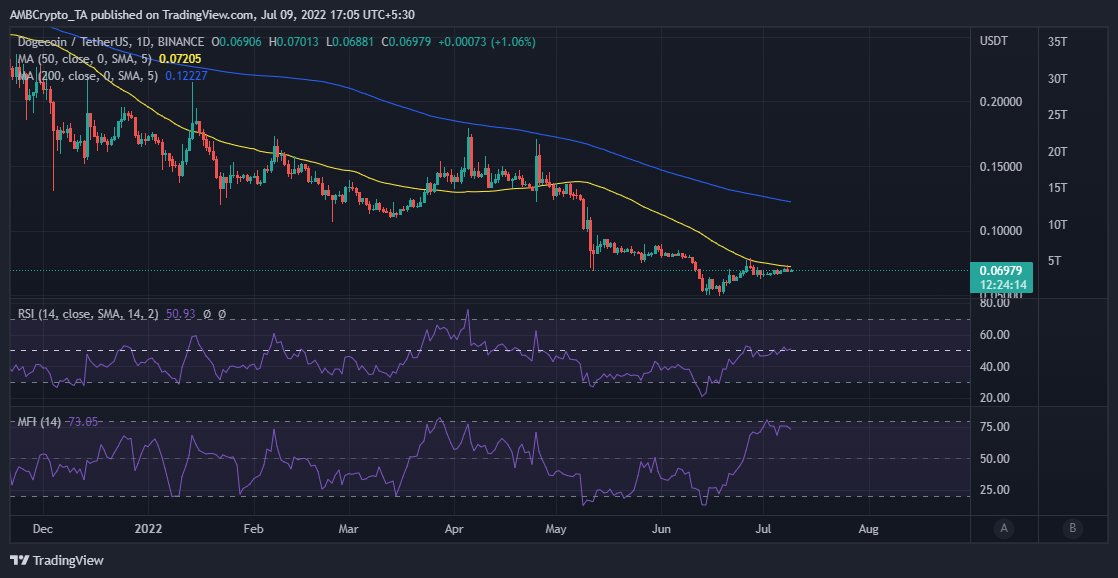
Dogecoin’s fate is once again covered by a cloud of uncertainty now that Musk has withdrawn his Twitter acquisition plans. DOGE’s price action had not responded negatively at press time, hours after Musk’s exit from the deal was announced. In fact, Dogecoin experienced a slight upside in the last 24 hours. It traded at $0.069 at press time after a 0.73% upside in the last 24 hours.
Source: TradingView

DOGE’s price action delivered a ranging performance in the first week of July after a solid uptick since mid-July. Its Relative Strength Index (RSI) has been hovering within the 50% range while the Money Flow Index (MFI) registered some outflows. This was expected especially after the price briefly pushed into the MFI’s distribution zone above 80.

Behind the scenes

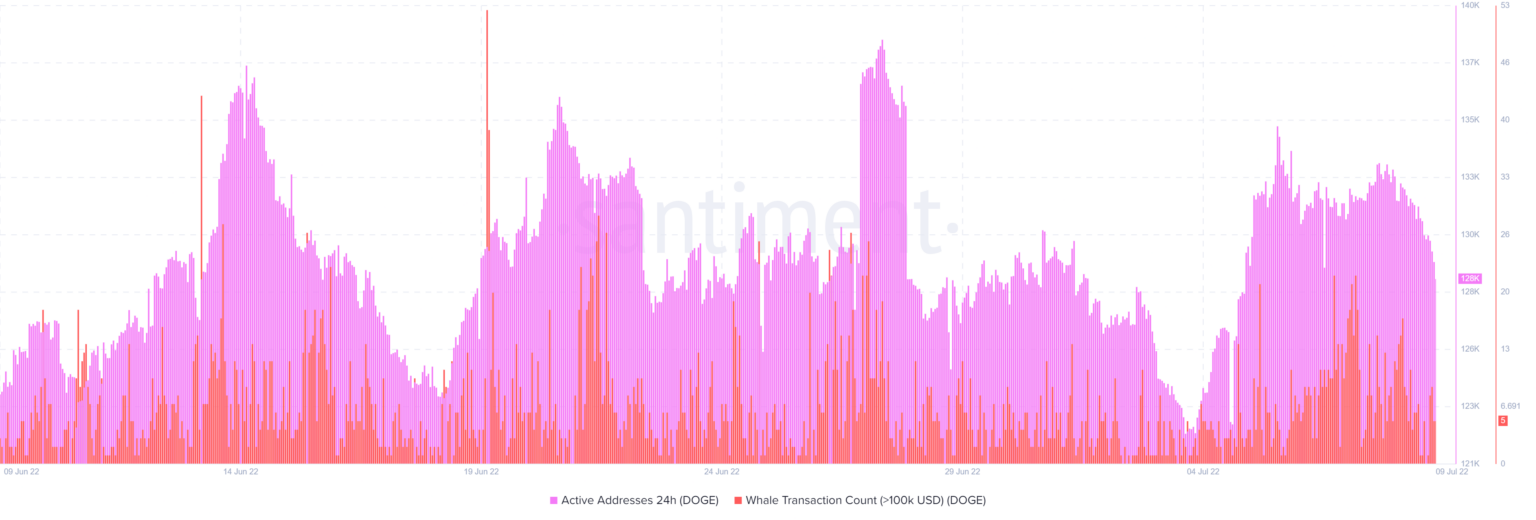
Despite the slight upside, many investors remain cautious about DOGE’s performance. There was a notable drop in 24-hour active addresses from 133,670 to 128,960 addresses between 8 and 9 July. Whale transactions also saw fewer actions, tapering out from as high as 21 whales on 7 July to 5 whale transactions by 8 July.
Source: Santiment

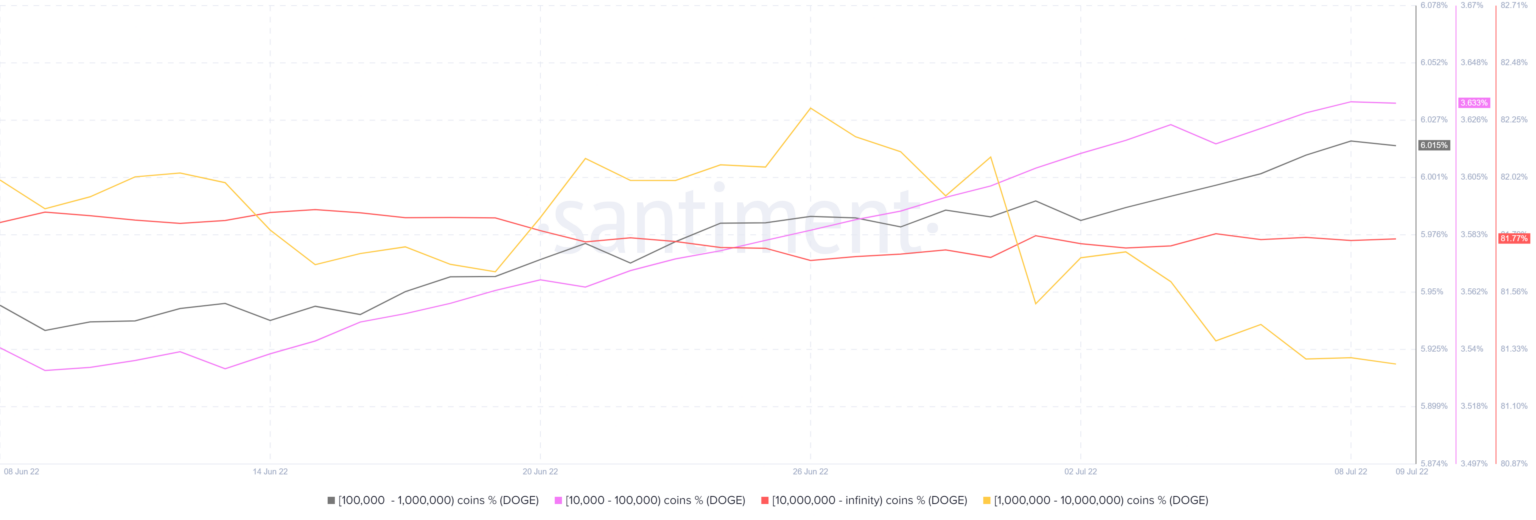
DOGE’s supply distribution reveals a tug of war between different whale categories. For example, addresses holding between one million and 10 million DOGE have been selling since 26 June, while addresses holding between 10,000 and one million Dogecoin have been accumulating during the same period.
Source: Santiment

Addresses holding more than 10 million coins had the least activity during the last two weeks. Their balances increased slightly and this is important because it means they have not been heavily selling off their holdings. This is good for DOGE’s upside and may explain why its price experienced a slight upside.
Related Reads

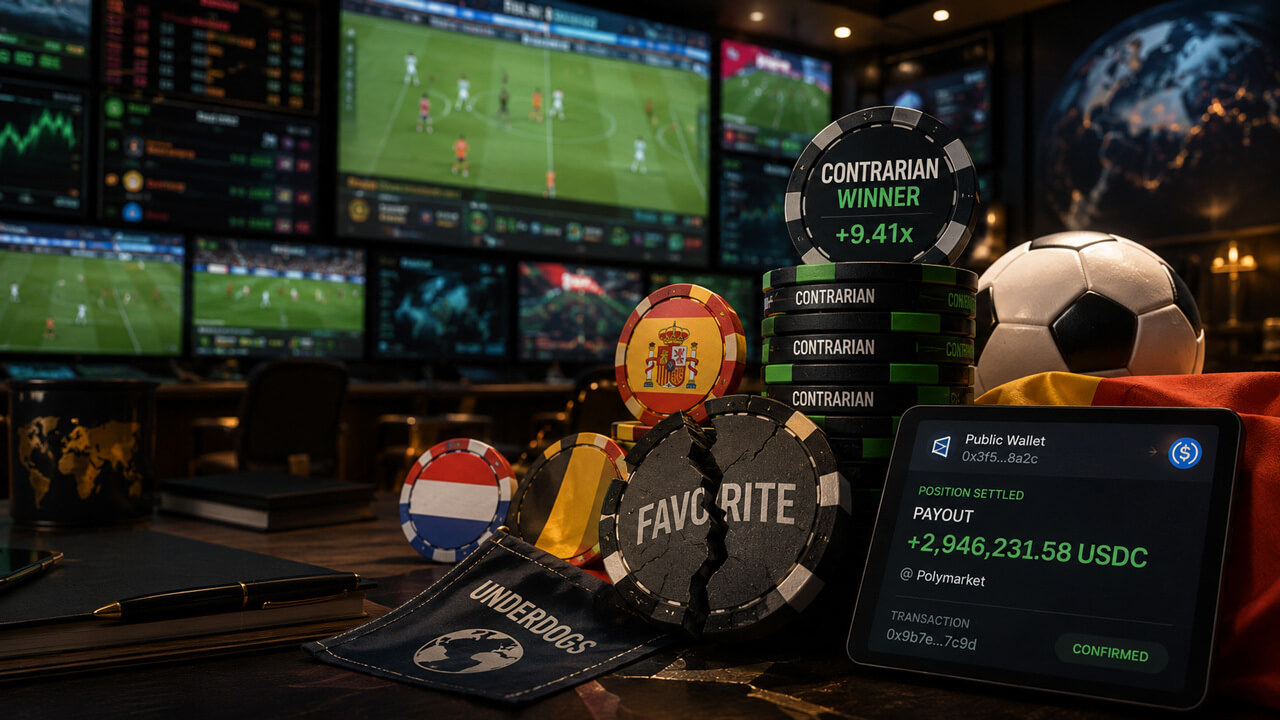
Football Draw Harvests Whales: Extreme Profit-Loss Divergence on Polymarket's World Cup

A bettor known as "fishalive" made a stunning profit of nearly $9 million on the Polymarket prediction platform by correctly wagering against favorites during the 2026 FIFA World Cup group stage. The account, registered just before the tournament, risked roughly $400,000 on two contracts for a Spain vs. Cape Verde match: one that Spain would *not* win, and another on a Cape Verde +2.5 goal handicap. The resulting 0-0 draw triggered both payouts. This single event, with a total market volume of $64 million, highlighted extreme profit-and-loss divergence. Other traders, like "betoor619" and "leeeeroyjenkins," lost millions by betting heavily on favorites Spain and Belgium to win outright—contracts that become worthless in a draw. The article explains that while markets heavily favored strong teams, the "team to win" contracts are binary and do not account for the common outcome of a draw. This creates high-risk, low-reward scenarios for favorite backers, while asymmetric profits flow to those betting on underdogs or against outright wins. The transparency of Polymarket's on-chain ledger publicly documents these massive wins and losses, driving mainstream media coverage. As the tournament progresses, the author suggests traders may shift towards hedging strategies that account for draws. The piece also notes growing regulatory scrutiny in the US and Europe, questioning whether such large-scale, anonymous sports prediction markets should be regulated as gambling or financial derivatives.

Foresight News20m ago

Football Draw Harvests Whales: Extreme Profit-Loss Divergence on Polymarket's World Cup

Foresight News20m ago

ChatGPT Loses Half Its Market: From Monopoly to Shared Market in Three and a Half Years

In a landmark shift three and a half years after its debut, ChatGPT's global market share in the AI assistant market has fallen below 50% for the first time, dropping to 46.4% as of May 2026. This signals the end of its initial dominance, with the market now diversifying among competitors like Gemini (27.7%) and Claude (10.3%). The report from Sensor Tower indicates the AI assistant landscape has matured from a phase of awe and experimentation into one of product comparison, ecosystem integration, and monetization. Users are increasingly pragmatic, readily switching between assistants based on specific use cases, brand trust, and value propositions. The industry is moving past the "free lunch" era, with users demonstrating a willingness to pay for premium features, driving significant in-app expenditure. Major players are adopting varied monetization strategies: Claude boasts a high subscription conversion rate, while ChatGPT is increasingly testing ads and shopping integrations to complement its subscription revenue. However, this growth comes with immense costs, as exemplified by OpenAI's soaring cash burn for model training and infrastructure. While ChatGPT remains the largest single player, its declining share symbolizes a broader normalization of AI. The technology is no longer a novelty but an integral, scrutinized part of daily digital life, judged on practical utility, price, and seamless integration. The battle has shifted from proving AI's potential to competing in a crowded field where no single product holds a permanent monopoly.

marsbit31m ago

ChatGPT Loses Half Its Market: From Monopoly to Shared Market in Three and a Half Years

marsbit31m ago

Trading

Spot
Futures
活动图片