美联储新主席带来狂暴大牛的可能性

深潮Published on 2025-12-03Last updated on 2025-12-04

不出意外的话,凯文·哈塞特会是下一届美联储主席,特朗普的最爱。

撰文:Cookie,律动

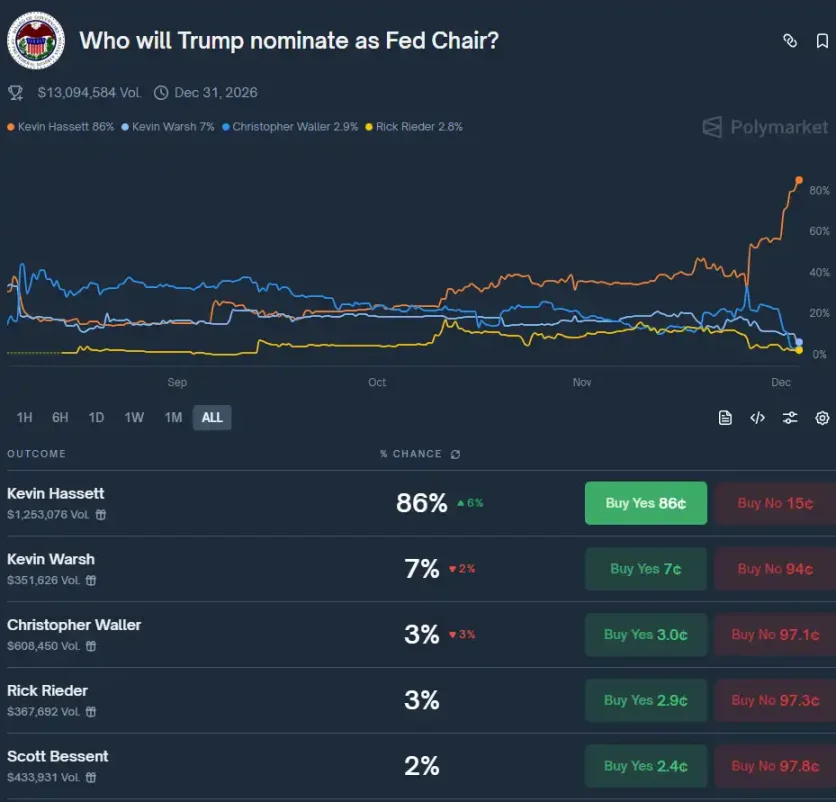
在预测市场 Polymarket 上,哈塞特当选新一任美联储主席的概率已经上升至了 86%,远远领先其他可能的美联储新任主席人选。

不出意外的话,凯文·哈塞特(Kevin Hassett)会是下一届美联储主席,特朗普的最爱。
美联储的动作一直是影响加密货币市场的重要因素。那么,如果哈塞特最终如市场预期那般成为新一任美联储主席,预计会对市场造成哪些影响呢?

加速降息

哈塞特 11 月底的时候曾表示,此时暂停降息将是「非常糟糕的时机」,因为政府停摆已经拖累了第四季度的经济增长。他预计政府停摆将导致第四季度国内生产总值(GDP)下降 1.5 个百分点。与此同时,他指出 9 月份消费者价格指数(CPI)显示,通胀表现好于预期。

更早一些的时候,11 月 13 日,哈塞特表示,预计第四季度 GDP 将因政府停摆而下降 1.5%。看不到不降息的太多理由。

因此,若哈塞特成为新一任美联储主席,预计他将推动更快的利率下调,可能将联邦基金利率降至 3% 以下,甚至接近 1%,以刺激经济增长和就业。

这也是特朗普想看到的。

恢复 QE

12 月 1 日,美联储正式结束了量化紧缩(QT)政策,这标志着从 2022 年开始的资产负债表缩减过程的结束。尽管有观点认为,相关效果或将于明年年初才能显现,但流动性宽松预期已获得逐步实现。

哈塞特可能对通胀更宽容,将 2% 通胀目标视为灵活上限,而非严格锚定。重点放在就业和 GDP 增长上,减少对数据依赖的「渐进式」决策,转向更主动的亲增长干预。

今年 9 月,哈塞特在接受 Fox Business 采访时表示,美国正处于供给侧繁荣的时期,在没有真正通胀的经济体中,当前利率正阻碍经济增长和就业创造。同时他还表示,美国有望实现 4% 的 GDP 增长。

优先发展经济而非通膨控制的观点,让哈塞特执掌后的美联储重启 QE 是可以被期待的。

对比特币的影响

每一位美联储主席候选人,不论其是否直接谈论加密话题,都将对加密货币行业产生结构性影响,而哈塞特更与加密货币行业有着不容忽视的关联,他不仅曾公开持有价值百万美元的 Coinbase 股票,还担任过 Coinbase 的顾问委员会成员。

此外,他曾参与白宫内部关于数字资产政策的工作小组,推动在监管框架中为创新保留空间,并认为加密技术是影响未来经济结构的重要变量。他曾表示比特币将「改写金融规则」。

哈塞特的加密背景可能会减少监管不确定性,推动机构推动和美联储探索加密货币整合。这可以提升比特币的合法性和流动性,潜在推动价格至新高。

有不少交易员看好哈塞特上任后的行情,认为上任后才是牛市的开始,预计时间是明年年中,所以 26 年下半年是加密货币行业的重中之重。

Related Reads

From Theft to Re-entry: How Was $292 Million "Laundered"?

A sophisticated crypto laundering operation was executed following the $292 million hack of Kelp DAO on April 18. The attack, attributed to the North Korean Lazarus group, began with anonymous infrastructure preparation using Tornado Cash to fund wallets untraceably. The hacker exploited a vulnerability in Kelp’s cross-chain bridge, stealing 116,500 rsETH. To avoid crashing the market, the attacker used Aave and Compound as laundering tools—depositing the stolen rsETH as collateral to borrow $190 million in clean, liquid ETH. This move triggered a bank run on Aave, causing an $8 billion drop in TVL. After consolidating funds, the attacker fragmented them across hundreds of wallets to evade detection. A major breakpoint was THORChain, where over $460 million in volume—30 times its usual activity—was processed in 24 hours, converting ETH into Bitcoin. This shift to Bitcoin’s UTXO model exponentially increased tracing complexity by shattering funds into countless untraceable fragments. The final destination was Tron-based USDT, the primary channel for illicit crypto flows. From there, funds were cashed out via OTC brokers in China and Southeast Asia, using unlicensed underground banks and UnionPay networks outside Western sanctions scope. Ultimately, the laundered money supports North Korea’s weapons programs, which rely heavily on crypto hacking for foreign currency. The incident underscores structural challenges in DeFi: its openness, composability, and lack of central control make such laundering not just possible, but inherently difficult to prevent.

marsbit36m ago

From Theft to Re-entry: How Was $292 Million "Laundered"?

marsbit36m ago

Google and Amazon Simultaneously Invest Heavily in a Competitor: The Most Absurd Business Logic of the AI Era Is Becoming Reality

In a span of four days, Amazon announced an additional $25 billion investment, and Google pledged up to $40 billion—both direct competitors pouring over $65 billion into the same AI startup, Anthropic. Rather than a typical venture capital move, this signals the latest escalation in the cloud wars. The core of the deal is not equity but compute pre-orders: Anthropic must spend the majority of these funds on AWS and Google Cloud services and chips, effectively locking in massive future compute consumption. This reflects a shift in cloud market dynamics—enterprises now choose cloud providers based on which hosts the best AI models, not just price or stability. With OpenAI deeply tied to Microsoft, Anthropic’s Claude has become the only viable strategic asset for Google and Amazon to remain competitive. Anthropic’s annualized revenue has surged to $30 billion, and it is expanding into verticals like biotech, positioning itself as a cross-industry AI infrastructure layer. However, this funding comes with constraints: Anthropic’s independence is challenged as it balances two rival investors, its safety-first narrative faces pressure from regulatory scrutiny, and its path to IPO introduces new financial pressures. Globally, this accelerates a "tri-polar" closed-loop structure in AI infrastructure, with Microsoft-OpenAI, Google-Anthropic, and Amazon-Anthropic forming exclusive model-cloud alliances. In contrast, China’s landscape differs—investments like Alibaba and Tencent backing open-source model firm DeepSeek reflect a more decoupled approach, though closed-source models from major cloud providers still dominate. The $65 billion bet is ultimately about securing a seat at the table in an AI-defined future—where missing the model layer means losing the cloud war.

marsbit6h ago

Google and Amazon Simultaneously Invest Heavily in a Competitor: The Most Absurd Business Logic of the AI Era Is Becoming Reality

marsbit6h ago

Trading

Spot
Futures
活动图片