В поисках альтсезона: почему альты буксуют

cryptonews.ruPublished on 2025-12-21Last updated on 2025-12-21

Многие участники криптосообщества продолжают ждать наступления альтсезона, однако рынок по-прежнему не демонстрирует признаков перехода к фазе активного роста. Инвесторы следят за макроэкономикой, динамикой биткоина и состоянием ликвидности, но заметных изменений нет.

Редакция BeInCrypto выяснила, что происходит с альткоинами и есть ли основания ожидать альтсезон.

Что такое альтсезон и как к нему подготовиться

Что не так с альткоинами

ISM против альтов

Индекс ISM Manufacturing PMI отражает состояние промышленности США. Он формируется на основе опроса более 400 компаний, которые оценивают заказы, производство, занятость, поставки и складские запасы. Показатели выше 50 указывают на рост, ниже — на спад.

Последний показатель составил 48,2, что означает продолжающееся снижение промышленной активности.
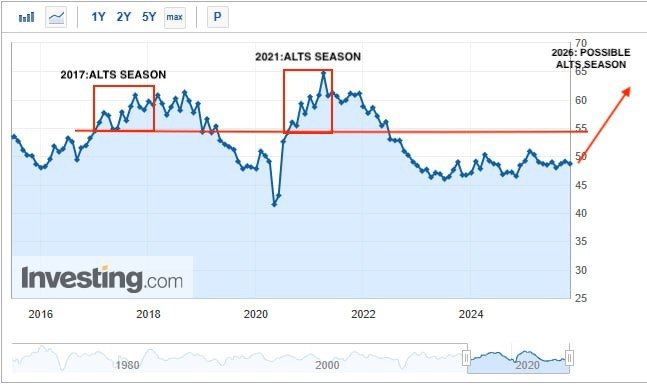
Корреляция ISM Manufacturing PMI с альтсезонами
Корреляция ISM Manufacturing PMI с альтсезонами. Источник: Investing

Исторически альтсезоны возникали только тогда, когда экономика находилась в фазе расширения, а ISM поднимался выше 55. Так происходило в 2017 и 2021 годах. Сейчас экономика далека от таких уровней, и это удерживает спрос на рисковые активы, включая альткоины.

Ликвидность сжимается

Сегмент альткоинов испытывает давление из-за снижающейся ликвидности. Ликвидность — это объем капитала, который может входить в активы или выходить из них без резких ценовых колебаний. Когда ликвидность уменьшается, рост становится сложнее, а импульсы быстро затухают.

CEO CryptoQuant Ки Ён Чжу отмечает, что ликвидность альткоинов падает. По его словам, проекты, которые развивают каналы притока капитала — например, через инфраструктуры уровня DAT или участие в продуктах, связанных с ETF, — повышают свои шансы на долгосрочное выживание. Проекты, которые этим не занимаются, сталкиваются с повышенными рисками.
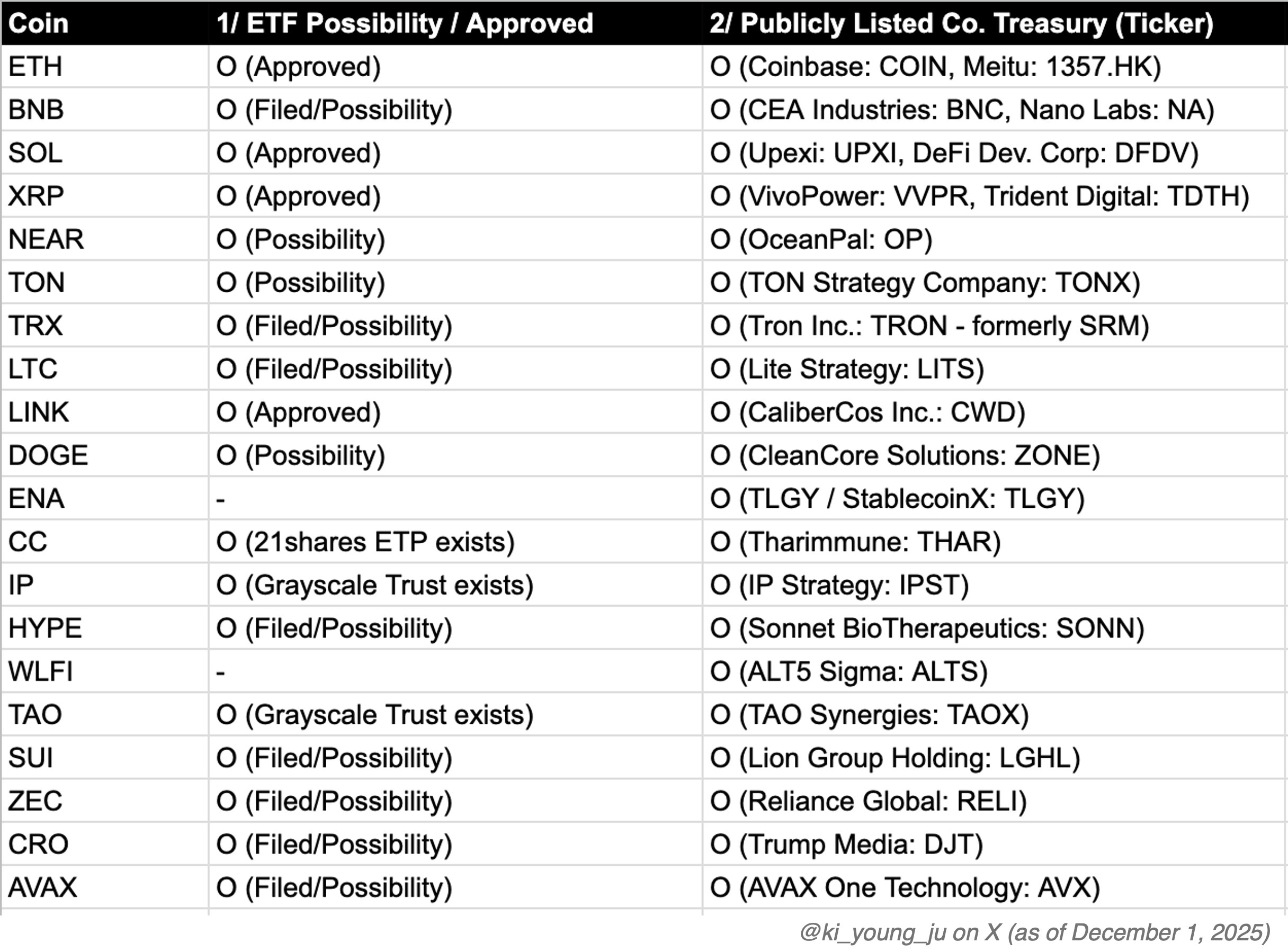
На скрине представлена таблица Ки Ён Чжу с перечнем альткоинов, для которых указаны текущие или потенциальные ETF-статусы и компании, держащие эти активы в своих публичных казначействах.
На скрине таблица Ки Ён Чжу, где перечислены крупные альткоины с указанием статуса возможных или уже поданных заявок на ETF и компаний, публично хранящих эти активы на балансе.

Цикл биткоина не определен

Ожидания по альткоинам напрямую связаны с тем, на какой стадии находится биткоин. Типичный альтсезон начинается после того, как биткоин завершает пик цикла и переходит в более спокойную фазу.

Аналитик CryptoCon придерживается четырехлетней модели. По его мнению, пик цикла пришелся на 6 октября 2025 года. Он считает, что год, соответствующий бычьей фазе, завершился 28 ноября 2025 года, а далее начинается период медвежьей динамики, который может продлиться до 28 ноября 2026 года. Он сообщил, что вышел из всех криптовалютных позиций.
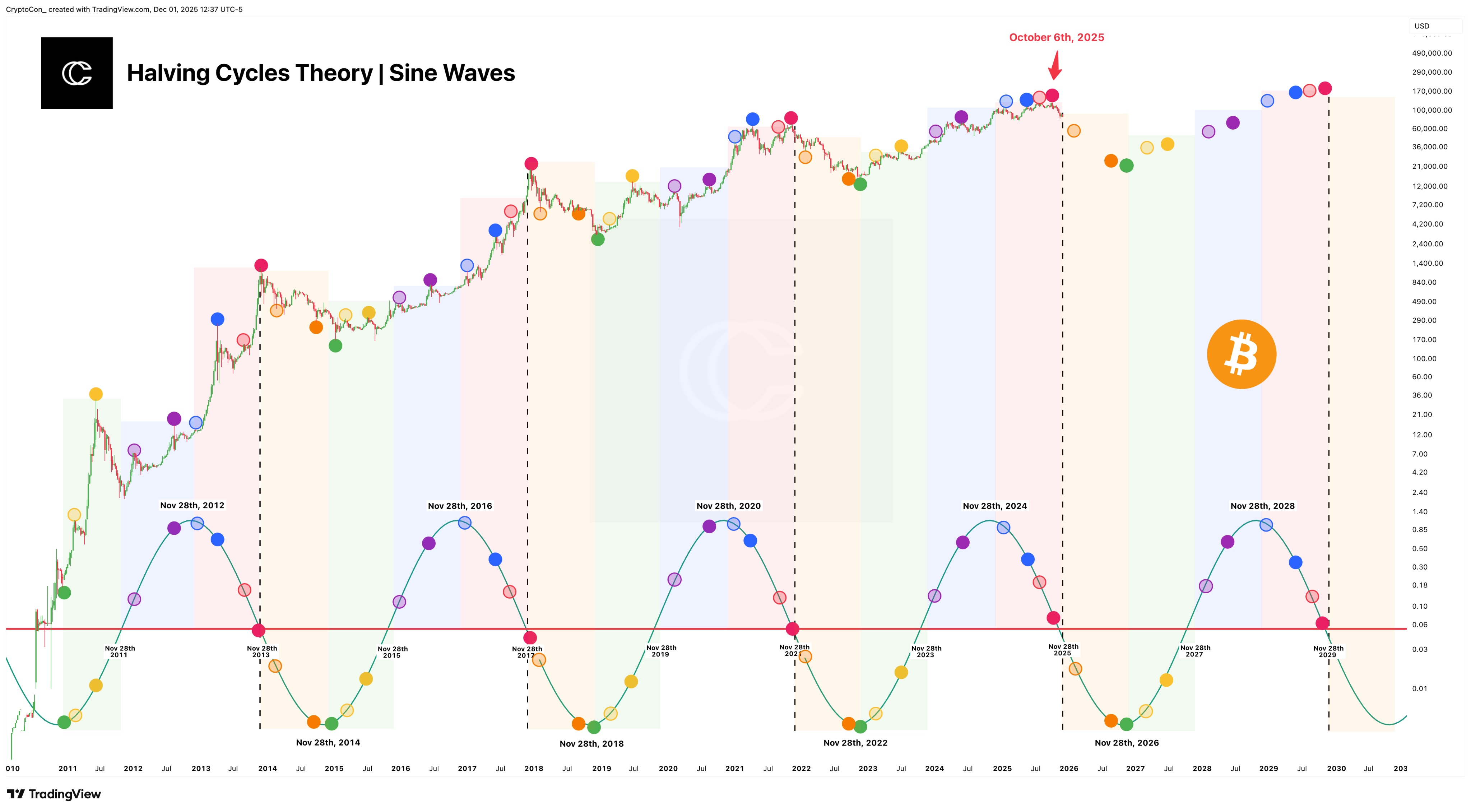
Цикличность движения биткоина.
Цикличность движения биткоина. Источник: X CryptoCon

Аналитическое подразделение Grayscale предлагает иную трактовку. По их наблюдениям, текущий цикл развивался без характерного розничного всплеска и формировался за счет институциональных потоков. Они допускают, что возможное снижение процентных ставок в 2026 году и прогресс в регулировании крипторынка могут привести к новым историческим максимумам биткоина именно в 2026 году, даже если это не совпадает с традиционной четырехлетней моделью.

К неопределенности добавляется и то, что траектория M2 окончательно разошлась с движением биткоина. Ранее многие ожидали, что биткоин будет следовать за M2. Сейчас M2 растет, а биткоин — нет. Это ставит под вопрос прежние подходы к анализу циклов.
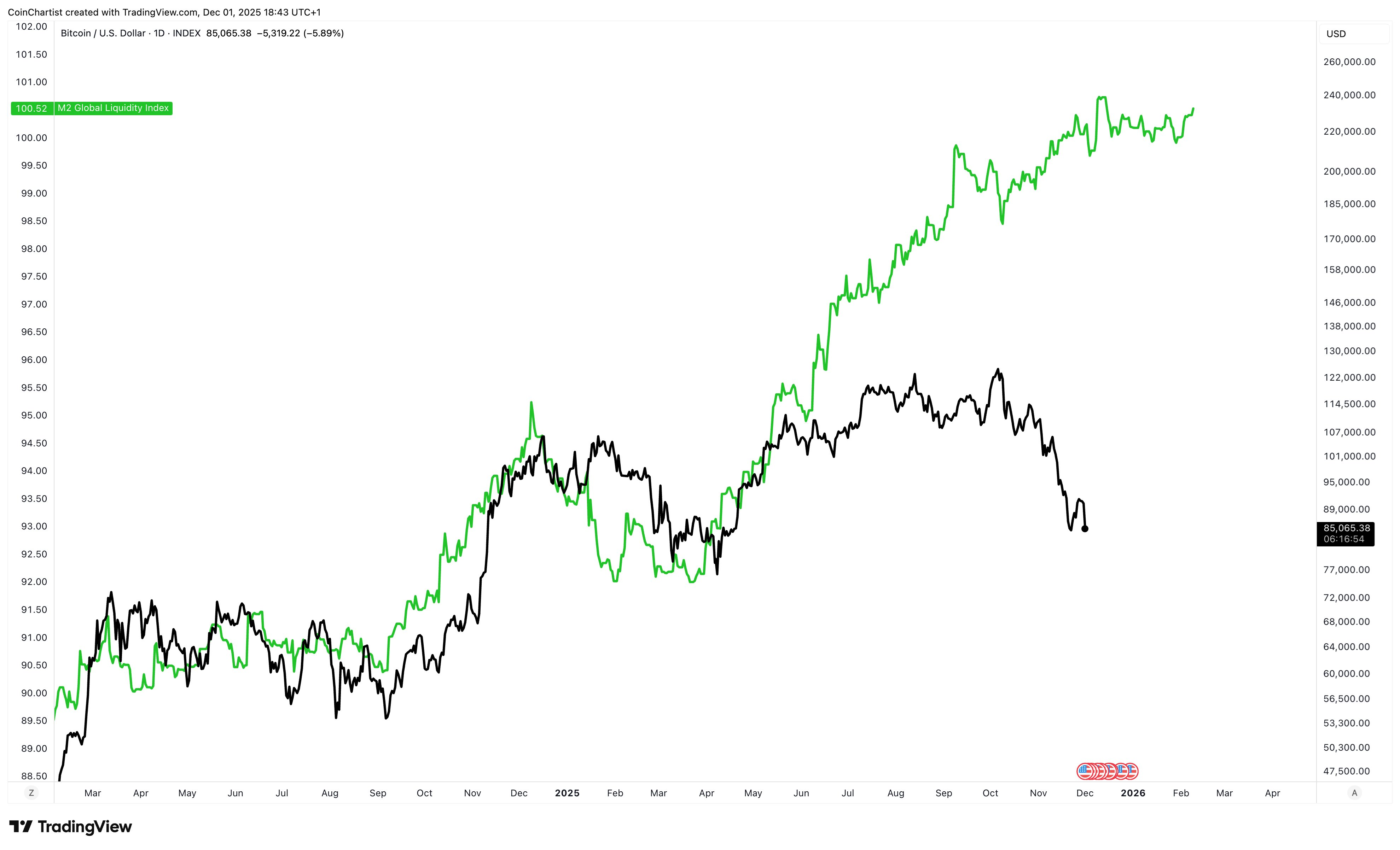
Корреляция M2 и биткоина
Корреляция M2 и биткоина. Источник: TradingView

Потенциал для будущего альтсезона

Несмотря на слабые текущие сигналы, предпосылки для будущего восстановления существуют. В 2026 году могут появиться факторы поддержки — снижение процентных ставок, улучшение финансовых условий и рост институционального интереса. Некоторые проекты уже укрепляют ликвидность и развивают инфраструктуру, подготавливаясь к возможному новому циклу.

В прошлых циклах альтсезон возникал при сочетании трех условий: роста экономики, достаточной ликвидности и улучшения ожиданий инвесторов. Сейчас эти условия отсутствуют, однако отдельные элементы могут начать формироваться в ближайшие кварталы.

Что в сухом остатке

Рынок находится в переходной фазе. Промышленность США не демонстрирует признаков устойчивого роста, ликвидность альткоинов снижается, аналитики расходятся во мнениях о текущем цикле биткоина, а прежние макрокорреляции перестали работать.

Альтсезон остается возможным сценарием, но условия для его появления пока не сформировались. Рынок продолжает ждать улучшения макроэкономических показателей и восстановления ликвидности. Без этого мощное движение в альткоинах маловероятно.

Related Reads

Options Don't Work in DeFi? Vitalik Might Not Agree

For years, the prevailing view has been that options struggle to gain traction in DeFi due to complexity, fragmented liquidity, and lack of natural demand compared to products like perpetual futures. However, a recent algorithmic stablecoin design proposed by Vitalik Buterin presents a different perspective, using options not as a standalone trading product, but as foundational infrastructure for other financial instruments. In this design, one unit of ETH is split into two components: a "stable" side (P) that retains value up to a specified strike price, and an "upside" side (N) that captures all appreciation above that strike. Combined, they always equal one ETH, eliminating debt, margin, and liquidation risks inherent in typical collateralized debt position (CDP) stablecoins. The stable component essentially mimics the payoff of a covered call option. To function as a stablecoin, this structure requires continuously rolling deep in-the-money calls, which introduces challenges like rollover slippage, predictable transaction flow vulnerable to front-running, and persistent liquidity needs. A core hurdle is finding consistent buyers for the leveraged ETH upside exposure (N). While it offers leverage without funding rates or liquidation, it must compete with simpler alternatives like direct call options or perpetuals. The system's scalability depends on a sustained demand for this specific form of leverage. The author draws parallels to their experience with Rysk, where earlier versions of DeFi options protocols struggled. The breakthrough came with Rysk V12, which aligns incentives: asset holders generate yield by selling covered calls against their holdings, while market makers efficiently acquire the desired option exposure. This demonstrates that options can find product-market fit when embedded as a risk distribution and pricing engine within structured products, stablecoins, or yield-generating assets, rather than marketed as a complex direct trading instrument. Vitalik's proposal reinforces this architectural approach—using fully collateralized, non-custodial, and physically settled options as a fundamental building block. The real opportunity for options in DeFi may lie not in becoming the next perpetual swap, but in powering the next generation of on-chain financial products.

marsbit8m ago

Options Don't Work in DeFi? Vitalik Might Not Agree

marsbit8m ago

Conversation with Investor Zheng Di: MicroStrategy's Coin Sale Experiment, AI Economy, and Opportunities in US Stocks

Frontier tech investor Zheng "Didier" Di discusses the recent Bitcoin price drop, the financial strategy shift at MicroStrategy, the AI-driven surge in U.S. stocks, and the evolving role of crypto exchanges. Didier posits that the recent BTC decline stems less from macro factors or ETF outflows, and more from market repricing due to MicroStrategy's new financial structure. Following a wave of preferred stock and debt issuance (STRC, STRZ, etc.), MicroStrategy must now manage cash flow to pay dividends, potentially leading to a market expectation of sustained, small-scale BTC sales to maintain its "per-share bitcoin neutral" principle. Didier views this as a financial "experiment" testing market capacity for such recurring sell pressure, which, while creating near-term structural headwinds, likely avoids a true "death spiral" absent major new external shocks. Shifting to AI, Didier argues that tokens are becoming the new form of labor, with AI models and compute (tokenized inputs) increasingly replacing human roles in execution and middle-management. This drives enterprise efficiency and higher margins, fueling the sustained rally in U.S. semiconductor, data center, and infrastructure stocks. He foresees an emerging "machine economy" where automated agents transact and collaborate on-chain. Regarding crypto exchanges offering U.S. equities, Didier sees this as a natural evolution. With few crypto-native assets generating lasting value, exchanges are pivoting towards real-world assets (RWAs) like stocks and bonds. This doesn't necessarily cannibalize crypto but reflects a maturing industry focusing on blockchain's core utilities: decentralized choice and efficient settlement. He notes that trading logic for crypto natives doesn't need to drastically change, as meme-driven and fundamentalist strategies find analogs in U.S. markets. The "1011 event" (likely referring to a major market crash) severely damaged crypto market liquidity, marking a probable end to the altcoin speculative cycle, with capital flowing towards the deeper liquidity of U.S. markets. For the macro outlook, Didier is cautious about near-term market pressure from potential mega-IPOs (e.g., SpaceX) and the U.S. midterm elections, which could bring more regulatory scrutiny. Long-term, he remains bullish on AI's productivity gains and its convergence with blockchain/Web3, predicting a shift from speculative frenzy to a more institutionalized, industrial phase for the crypto sector.

marsbit45m ago

Conversation with Investor Zheng Di: MicroStrategy's Coin Sale Experiment, AI Economy, and Opportunities in US Stocks

marsbit45m ago

Playnance’s $GCOIN Lists on KoinBX Amid Rapid Growth in India

Playnance's native token, $GCOIN, has been listed on the cryptocurrency exchange KoinBX as of June 18. This move aims to enhance accessibility for its rapidly growing community, particularly in India, where the blockchain-powered Web3 iGaming ecosystem has gained significant traction. Over 130 partners in Playnance's "Be the Boss" program have built communities engaging thousands of active players in the region. The "Be the Boss" model allows participants to create and manage their own gaming communities, earning rewards tied to community activity. CEO Pini Peter noted India's high engagement, with community leaders successfully building player networks. One partner, Dr. Nicolas, reported earning over $57,000 through the program in recent months, highlighting both the financial rewards and the opportunity to grow an engaged community. $GCOIN serves as the ecosystem's core utility token, incentivizing participation and aligning the interests of players and community leaders ("Bosses"). The listing on KoinBX is part of Playnance's strategy to expand globally, increasing the token's utility and accessibility by combining community ownership, gamified engagement, and blockchain-based incentives. Founded in 2020, Playnance is a Web3 iGaming infrastructure company focused on creating live, non-custodial, on-chain products to onboard mainstream users. It currently processes approximately one million transactions daily, aiming to simplify the user experience while maintaining full on-chain transparency.

TheNewsCrypto1h ago

Playnance’s $GCOIN Lists on KoinBX Amid Rapid Growth in India

TheNewsCrypto1h ago

STRC Hits Historic Low, Saylor's Perpetual Motion Machine Grinds to a Halt

STRC, the perpetual preferred stock issued by MicroStrategy to fund its Bitcoin purchases, hit a historic low of $85.32, a 17% discount to its $100 par value. Designed as a "digital credit engine" to trade stably near par and enable continuous share issuance for buying Bitcoin, its plunge signals a breakdown in this model. Three key factors drove the decline: 1. Bitcoin's price fell over 50% from its peak, trading around $63,000 amid hawkish Fed signals. 2. MicroStrategy's cash reserves were depleted after a $1.5 billion convertible note repayment, slashing the dividend coverage for STRC's 11.5% yield to ~7 months. The company then sold 32 BTC to cover dividends—Michael Saylor's first Bitcoin sale since 2022—damaging the "never sell" narrative. 3. A competing Bitcoin-backed preferred stock, Strive's SATA, offers a higher yield (~13%) and daily dividends, drawing investors away from STRC. The drop triggers a negative cycle: STRC below par halts ATM share issuances, cutting off a key funding source for Bitcoin buys and potentially forcing more BTC sales for dividends, further eroding confidence. While Saylor argues the model is mathematically sound—needing only 2.3% annual Bitcoin growth to sustain itself—the market is testing the resilience of the leveraged Bitcoin treasury strategy in a bear market. The STRC price now reflects rising skepticism about this financial machinery's durability during downturns.

marsbit1h ago

STRC Hits Historic Low, Saylor's Perpetual Motion Machine Grinds to a Halt

marsbit1h ago

Trading

Spot
Futures
活动图片