Спотовый биткоин-ETF стал главным источником дохода для BlackRock

cryptonews.ruPublished on 2025-11-16Last updated on 2025-11-30

Биткоин-ETF от BlackRock стал самым прибыльным направлением бизнеса компании. Об этом заявил директор по развитию бизнеса фирмы Кристиано Кастро на Blockchain Conference в Сан-Паулу.

Рекордные показатели IBIT

Американский спотовый ETF на базе биткоина (BTC) под тикером IBIT запустили в январе 2024 года. В ноябре он установил исторический рекорд: за 341 день в него вложили $70 млрд. По данным SoSoValue, текущий объем чистых активов фонда составляет $70,7 млрд.

По теме: на этой неделе в спотовые биткоин-ETF вложили $70 млн — череда оттоков прервалась

«При запуске мы были оптимистичны, но не ожидали такого масштаба», — признался Кастро.

При этом совокупные активы под управлением в BTC-ETF BlackRock, включая американский IBIT и бразильский IBIT39, приблизились к $100 млрд.

Финансовое влияние и институциональный интерес

За первый год работы чистый приток средств в IBIT превысил $52 млрд. Этот результат превзошел показатели всех остальных ETF, запущенных за последнее десятилетие. К октябрю 2025 года фонд сгенерировал приблизительно $245 млн годовых комиссий.
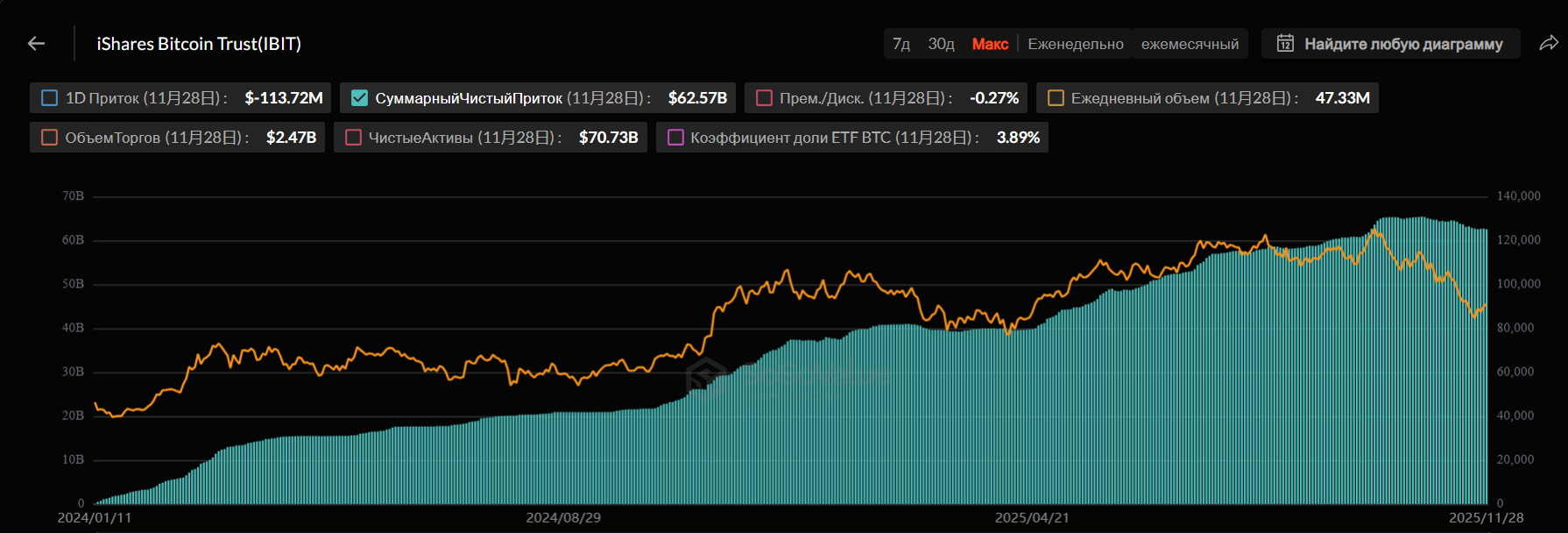
Суммарный чистый приток капитала в IBIT. Источник: SoSoValue.

По теме: биткоин остается «цифровым золотом», а не платежной сетью — BlackRock

Кастро отметил, что стремительный рост обусловлен глобальной дистрибьюторской сетью BlackRock и волной институционального интереса. На данный момент IBIT хранит свыше 3% от общего предложения биткоина.

Реакция на недавние оттоки

Директор прокомментировал недавние оттоки из криптофондов, назвав их ожидаемыми:

«ETF — это очень ликвидный и мощный инструмент. Они предназначены для управления потоками капитала».

Статус инструмента как главного генератора дохода особенно значим на фоне общего масштаба операций BlackRock. Компания управляет более 1 400 ETF по всему миру и активами объемом свыше $13,4 трлн.

По теме: Nasdaq хочет увеличить лимит опционов на биткоин-ETF от BlackRock в четыре раза

Related Reads

Refunds! Claude 4.8 Sees Overnight Major 'Dumb-Down', GPT-5.6's Computational Power Reportedly 'Halved'

The AI community is currently alarmed by widespread reports of significant performance degradation in two leading models. This article details a "mass self-testing frenzy" triggered by a mysterious prompt designed to detect a hidden "Juice" value, representing a model's reasoning compute budget. On OpenAI's side, users suspect a covert, limited test of a "GPT-5.6-sol" model is underway. When using a specific XML prompt on the Codex platform, a normal "gpt-5.5 xhigh" model reportedly returns a Juice value of 768. However, some users routed to the suspected GPT-5.6 test receive a drastically reduced value of 128—a six-fold decrease. This has sparked debate on whether it signifies a major efficiency leap or a "watered-down, low-cost version" achieved by slashing reasoning depth to save computational expenses. Simultaneously, Anthropic's Claude models, particularly the flagship Opus 4.8 Max, are facing intense user backlash for a perceived "physical brain cut." Users on platforms like Reddit report a dramatic decline in the model's once-impressive reasoning, with complaints of it becoming "absurdly" weakened, performing worse than older, lighter models like Haiku. Specific criticisms include: losing long-context memory, refusing to think deeply even in high-reasoning modes, providing instant incorrect answers, and engaging in unhelpful, argumentative, or "gaslighting" behavior where it contradicts users unnecessarily. The article speculates these "stealth downgrades" might be a calculated corporate strategy. Companies could initially release models with temporarily boosted compute to create an illusion of a major breakthrough, then silently scale back parameters later to manage unsustainable inference costs. A proposed underlying cause is a tightened funding environment, potentially exacerbated by SpaceX's massive IPO soaking up market liquidity, which could delay AI company IPOs and force cost-cutting measures like model "nerfing." The core issue highlighted is the asymmetry of information: subscribers pay for a service that can be silently and fundamentally altered without notification or explanation. The viral "Juice test" resonates because it represents users' desire for transparency about what they are actually paying for.

marsbit16m ago

Refunds! Claude 4.8 Sees Overnight Major 'Dumb-Down', GPT-5.6's Computational Power Reportedly 'Halved'

marsbit16m ago

Earning Six Figures and Still Struggling to Rent in San Francisco

A couple in San Francisco with a combined tech income over $360,000 struggled for months to find a one-bedroom apartment under $5,000 per month. Their story highlights how the AI wealth boom, driven by upcoming IPOs from companies like OpenAI and Anthropic, is dramatically escalating the city's cost of living. Even six-figure salaries are becoming insufficient for a comfortable lifestyle. The article details the financial reality for tech workers earning around $180,000 annually. After taxes, retirement contributions, and healthcare, take-home pay is roughly $7,000 per month. With average rents exceeding $3,800 and one-bedrooms often costing $4,500-$5,200, discretionary income shrinks to $1,500-$2,500. This contrasts sharply with reported median total compensations of $640,000 at OpenAI and $420,000 at Anthropic. The AI gold rush is identified as the primary driver. The scale of potential wealth from these IPOs, far surpassing previous tech booms, is flooding the housing market. Data shows San Francisco's average rent is now the highest in the U.S., with vacancy rates in desirable neighborhoods plummeting to around 3%. The overall cost of living is 65.6% above the national average. The piece features multiple professionals, including a 25-year-old with a $250,000 salary, facing housing instability, fierce competition for rentals, and a persistent, low-grade financial anxiety despite high earnings. It concludes that the rapid concentration of AI wealth is redefining what constitutes a "high salary" in San Francisco, pushing out mid-tier tech talent and creating a stark divide between those in the AI sector and everyone else.

marsbit2h ago

Earning Six Figures and Still Struggling to Rent in San Francisco

marsbit2h ago

Trading

Spot
活动图片