South Korea Risks Stablecoin Legislation Delay As Financial Authorities Clash With BOK

bitcoinistPublished on 2025-11-26Last updated on 2025-11-26

Abstract

South Korea’s long-awaited stablecoin legislation risks being delayed until next year, as financial authorities brawl with the Bank of Korea...

Trusted Editorial content, reviewed by leading industry experts and seasoned editors. Ad Disclosure

South Korea’s long-awaited stablecoin legislation risks being delayed until next year, as financial authorities brawl with the Bank of Korea (BOK) over the role of banks in the sector.

BOK, Financial Regulators In Disagreement

On Tuesday, Korea JoongAng Daily reported that the highly anticipated stablecoin framework, which is expected to come by the end of 2025, seems unlikely to pass this year, arguing that while regulators aim to open the market to tech companies, the central bank insists that the financial institutions should hold a majority stake in the issuance of any won-pegged token.

According to the local news media outlet, the BOK and regulators agree that banks must be involved in the issuance of won-pegged tokens, but differ on the extent of the financial institutions’ role.

The central bank is pushing for a consortium of banks owning at least 51% of any stablecoin issuer seeking regulatory approval. Meanwhile, regulators are reportedly willing to take a chance at innovating Korea’s financial structure, involving diverse players in the process.

Korea JoongAng Daily affirmed that, “even if the two sides agree on the ownership issue, other issues remain unresolved, including limits on the total issuance amount and the regulatory framework.”

Moreover, the BOK is allegedly calling for a legally mandated interagency council to make stablecoin policy decisions by a unanimous vote. Nonetheless, financial regulators are seemingly pushing back, citing a lack of legal basis for this requirement.

In July, BOK Governor Lee Chang-yong expressed concerns about the issuance of stablecoins by non-bank entities, claiming that the digital assets could confuse monetary policies and foreign exchange regulations.

Lee asserted that “if multiple non-bank institutions issue won-pegged stablecoins, it could lead to confusion similar to that caused by private currency issuance in the 19th century,” adding that if won-pegged tokens are allowed to be issued “indiscriminately,” it may conflict with foreign exchange liberalization policies.

Last month, the central bank released a report warning that these digital assets could unlock new possibilities for the Korean economy but could also “sow the seeds of new instability.” In the report, the BOK affirmed that the promise behind stablecoin raises unrealistic expectations in the market.

“Allowing non-bank companies to issue stablecoins is essentially equivalent to permitting them to engage in narrow banking — simultaneously issuing currency and offering payment services,” the central bank claimed.

In addition, it warned that online platform companies issuing their own stablecoins could integrate payment and settlement services into their ecosystems, further consolidating “monopolistic power” and potentially altering banks’ profit structure.

Korea’s Stablecoin Sector Faces Regulatory Challenges

A BOK official, on condition of anonymity, told Korea JoongAng Daily that “banks, which are already under regulatory oversight and have extensive experience handling anti-money laundering protocols, are best positioned to serve as majority shareholders in stablecoin issuers.”

However, the report noted that financial authorities are concerned that giving a majority stake to banks could reduce participation from tech companies and constrain the Korean market’s innovation.

As reported by Bitcoinist, financial institutions in Korea have been preparing for two potential scenarios. Notably, the sector has allegedly explored a business model in which banks establish a joint venture to collectively issue stablecoins, while also contacting various non-bank companies to prepare for the upcoming framework.

The regulatory standoff has seemingly left the market in limbo, with some tech companies actively preparing to secure approval while others remain cautious due to the unclear regulatory direction.

An official at a fintech company revealed that “there’s doubt about whether a won-based stablecoin will catch on, and with no clarity on approval rules, most firms are taking a wait-and-see approach.”

Korea JoongAng Daily cited a recent report by Hashed Open Research, which argued that “to maintain competitiveness in the digital economy, Korea should adopt a capital market-led structure instead of a bank-centered one,” similar to major issuers such as Tether and Circle.

Kim Sang-bong, an economics professor at Hansung University, considers that “to earn public trust, stablecoins can’t be left entirely in the hands of tech firms, and financial institutions must be involved.”

“But if banks dominate, innovation could be stifled. A more realistic solution may be to start by granting licenses to card companies and other firms focused on payments,” Kim concluded.
stablecoin, btc, btcusdt, bitcoin

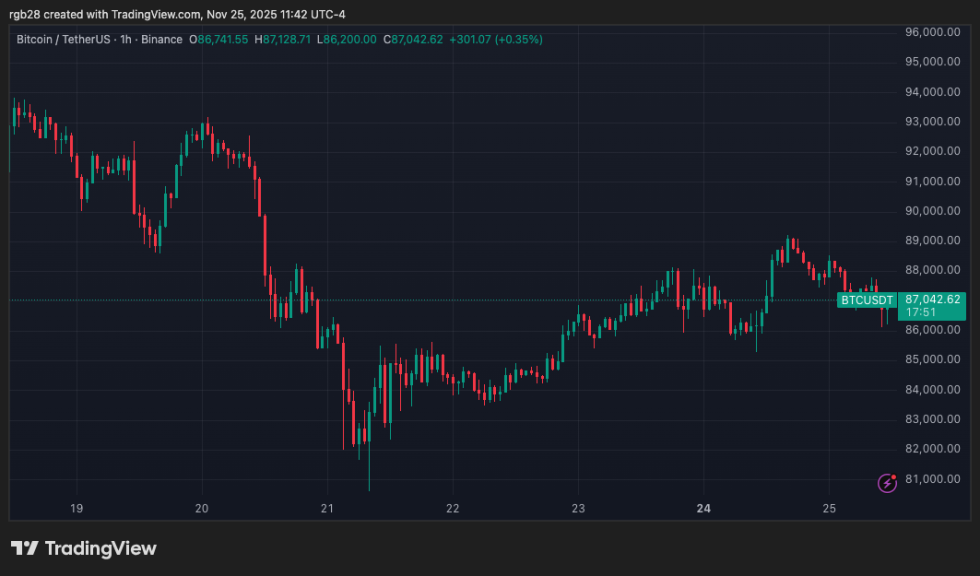
Bitcoin (BTC) trades at $87,042 in the one-week chart. Source: BTCUSDT on TradingView
Featured Image from Unsplash.com, Chart from TradingView.com
Editorial Process for bitcoinist is centered on delivering thoroughly researched, accurate, and unbiased content. We uphold strict sourcing standards, and each page undergoes diligent review by our team of top technology experts and seasoned editors. This process ensures the integrity, relevance, and value of our content for our readers.

Rubmar is a crypto enthusiast who likes learning and improving constantly. She enjoys reporting on the latest news and developments in the crypto industry. Rubmar also enjoys scrapbooking, crafting, simulation games, and watching football.

Related Reads

Pax Silica vs. WAICO: The US Wants to Prohibit Europe from Using Chinese Artificial Intelligence

The United States is preparing to demand that European and other partners abandon Chinese artificial intelligence initiatives, threatening exclusion from the American-led "Pax Silica" coalition, according to a leaked U.S. State Department document. This ultimatum forces signatories of the "AI Opportunity Statement" to choose between the Western technological ecosystem and alternative frameworks, with China not explicitly named but clearly targeted. Pax Silica is a U.S. strategy for AI and semiconductor hegemony, launched in late 2025. Its European presence expanded significantly in mid-2026. Concurrently, China, Russia, and 27 other nations established the World AI Cooperation Organization (WAICO) in July 2026 as an independent intergovernmental platform promoting AI governance based on UN principles. This situation creates a difficult choice, especially for European nations balancing strategic autonomy with dependence on U.S. tech and security. It also pressures Global South countries with pragmatic ties to both Washington and Beijing. The formation of competing blocks risks fragmenting the global tech landscape, forcing companies to split supply chains, increasing costs, and potentially leading to incompatible standards and protocols. The era of open globalization in AI may be ending, replaced by geopolitical confrontation where technological sovereignty trumps economic efficiency. The decisions made will shape the global digital economy for decades.

cryptonews.ru1h ago

Pax Silica vs. WAICO: The US Wants to Prohibit Europe from Using Chinese Artificial Intelligence

cryptonews.ru1h ago

Robert Kiyosaki Shares His Mentor's Predictions About the Emergence of Bitcoin and AI

American entrepreneur and author of "Rich Dad Poor Dad," Robert Kiyosaki, discussed the influence of futurist R. Buckminster Fuller on his worldview, linking Fuller's past technological predictions to the emergence of Bitcoin and the development of artificial intelligence. In an X post, Kiyosaki also reflected on personal purpose, sharing his journey from the music business—where he worked with bands like The Police and Iron Maiden—to creating the "Cashflow" board game and writing his famous book. He described feeling an inner emptiness despite his success, a turning point that came after meeting Fuller, whom he studied with for three summers. Kiyosaki described Fuller as a "friendly genius" who foresaw world-changing developments like Bitcoin and AI. However, the core of his post focused on Fuller's philosophical impact, particularly a quote about belonging to the universe and finding purpose by dedicating one's life to the maximum benefit of others. The entrepreneur remains a vocal advocate for cryptocurrencies. He regularly advises buying Bitcoin during market panics, viewing it and assets like Ethereum, gold, and silver as hedges against traditional financial system failures. Kiyosaki has predicted a major market crash by 2026, seeing it as an opportunity for prepared investors, with long-term price targets including $750,000 for Bitcoin and $95,000 for Ethereum.

cryptonews.ru3h ago

Robert Kiyosaki Shares His Mentor's Predictions About the Emergence of Bitcoin and AI

cryptonews.ru3h ago

Etherealize CEO Calls Wall Street's Private Blockchains a 'Race to the Bottom'

Etherealize co-founder and CEO Vivek Raman criticized Wall Street's growing interest in private, permissioned blockchains, calling them a "race to the bottom." In an interview with CoinDesk, Raman argued that consortium networks fragment liquidity and return the industry to the siloed systems that blockchain technology was meant to overcome. He stated that closed networks do not interoperate, undermining two key advantages of the technology: system compatibility and liquidity concentration. Etherealize promotes Ethereum as an open, foundational layer for institutional players. Raman insists that privacy and access restrictions should be built on top of public infrastructure—at the application or L2 level—rather than creating separate, closed networks. He compared Ethereum to HTTP as a base layer, with additional permissioned and private layers akin to HTTPS. Examples of this new wave of "closed" solutions mentioned include Canton Network from Digital Asset, Circle's Arc project, and Stripe's Tempo. Raman termed this trend "consortium chains 2.0," recalling earlier initiatives like the R3 interbank consortium and the Hyperledger corporate ecosystem from 2016 that failed to gain significant traction. He reiterated his firm belief that a global, open, permissionless infrastructure is necessary as a foundational base layer. Raman previously noted in June that traditional financial institutions had begun implementing Ethereum-based solutions into real business processes.

cryptonews.ru3h ago

Etherealize CEO Calls Wall Street's Private Blockchains a 'Race to the Bottom'

cryptonews.ru3h ago

Trading

Spot
活动图片