На графике PI формируется редкий бычий паттерн «Адам и Ева»

cryptonews.ruPublished on 2025-11-26Last updated on 2025-11-26

Токен PI начинает демонстрировать признаки потенциального дна, поскольку на его графике формируется редкая бычья фигура «Адам и Ева». Она представляет собой сочетание резкого падения с последующим округлым дном, что способствует растущему спросу вблизи точки контроля.
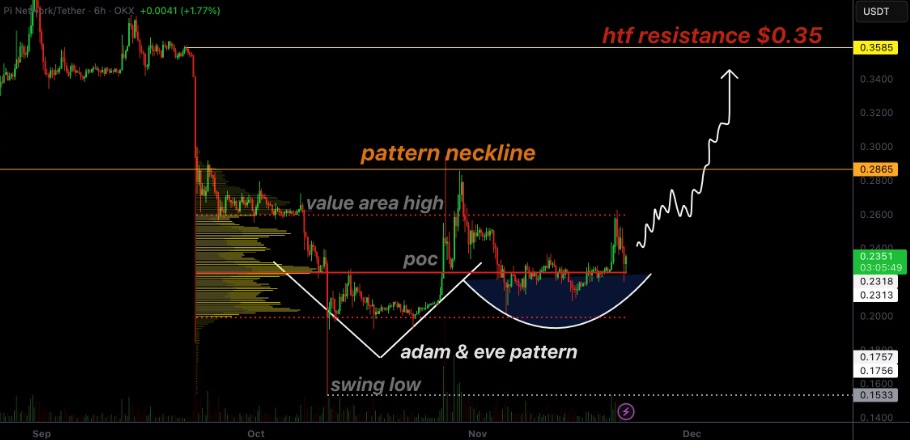
рис 1

Паттерн «Адам и Ева» состоит из двух отдельных фаз. Первая — это резкое, агрессивное падение, формирующее «Адама» в структуре. За этим движением последовала сильная бычья реакция, создавшая первую фазу разворота. Вторая фаза, формация «Евы», обычно выглядит как округлое дно, поддерживаемое возобновляющимся спросом. Он сейчас заметен на графике, поскольку PI стабилизируется и движется вверх.

Чтобы паттерн «Адам и Ева» сформировался, цена должна преодолеть сопротивление на линии шеи. В случае с Pi эта зона находится в диапазоне от $0,21 до $0,28, где предыдущие ралли не смогли набрать обороты. Прорыв этой области, особенно при увеличении объёма торгов, подтвердит паттерн и повысит вероятность роста до уровня $0,35. Это станет следующей важной технической целью в рамках более масштабного восстановления.

В настоящее время токен приближается к линии шеи и демонстрирует признаки устойчивости. Округлое дно продолжает формироваться, а значит, рынок постепенно переходит от распределения к накоплению. Получается, что прорыв выше линии шеи $0,21–$0,28 подтвердит разворот и откроет цели для роста до $0,35.


Related Reads

NVIDIA CPU Advances, China's RISC-V Responds: Semiconductor Deep Dive - Part Four

NVIDIA is set to launch its new Vera AI data center CPU in China as early as August, with high pricing. While this move offers a new option, it highlights China's continued dependence on foreign-controlled Arm architecture. In response, the Chinese semiconductor industry is increasingly turning to RISC-V as a strategic alternative for achieving high-performance computing autonomy. The article explores the concept of the "impossible triangle" in CPU development—balancing prosperity, control, and autonomy—and posits that RISC-V's open-source, modular nature offers a unique path to achieving all three. While RISC-V is already dominant in embedded systems, the focus is now shifting to data centers and AI workloads. China has become a global hotspot for RISC-V development, driven by AI-driven compute demand, supply chain concerns from export controls, cost benefits of open-source, and strong policy support. Multiple Chinese companies have reportedly crossed the key performance threshold of 15 SPECint per GHz, a benchmark for entering the high-performance CPU club. Progress extends beyond single-core benchmarks. Companies are developing complete computing subsystems, including commercial-grade coherent network-on-chip (NoC) technology and server processors with up to 40 cores that strictly adhere to the RVA23 standard to ensure software compatibility. Real-world applications are emerging in areas like video transcoding and edge AI. However, significant challenges remain. The RISC-V ecosystem faces fragmentation, immature toolchains and verification processes, and gaps in single-core performance and energy efficiency compared to mature x86 and Arm architectures. The formidable software moat, epitomized by NVIDIA's CUDA, is a long-term hurdle. In conclusion, while RISC-V cannot immediately replace offerings like NVIDIA's Vera, it represents a viable long-term path for China to develop a self-sufficient, high-performance CPU ecosystem. The journey is acknowledged to be long and arduous, requiring sustained effort to overcome technical and ecosystem challenges.

marsbit6h ago

NVIDIA CPU Advances, China's RISC-V Responds: Semiconductor Deep Dive - Part Four

marsbit6h ago

My Coding Betting Dashboard is Profiting, but Polymarket is Truly Not a Good Place for 'Arbitrage'

The author built a custom monitoring dashboard for Polymarket, a prediction market platform, and tested it with $1,600, achieving over 30% returns. However, the core argument is that Polymarket is not a good venue for traditional arbitrage. The dashboard has two main sections: a "Portfolio Dashboard" for tracking active positions with key metrics like total capital, P&L, and a risk-control module using a tier system (T1, T2, T3), and an "Opportunity Watchlist" for monitoring markets. The article details a critical structural trap in binary markets: a bet with a high perceived probability of success still carries a 100% loss risk if wrong. The author's T1/T2/T3 system is designed to manage this by limiting position sizes based on conviction and time horizon, emphasizing that high confidence should not equal high concentration. A key insight is the danger of "pseudo-diversification"—betting on different markets driven by the same underlying variable. The author concludes that Polymarket offers few true low-risk, arbitrage opportunities. It is instead a high-risk environment where wins can create a false sense of mastery, leading to large losses. The platform is better viewed as a training ground for honing judgment through disciplined, framework-driven betting rather than a reliable income source. The tools help transform intuition into structured, rule-based decisions to mitigate the risk of catastrophic errors.

marsbit9h ago

My Coding Betting Dashboard is Profiting, but Polymarket is Truly Not a Good Place for 'Arbitrage'

marsbit9h ago

Trading

Spot
Futures
活动图片