Биткоин закрепился ниже $102 000: аналитики спорят о смене тренда

cryptonews.ruPublished on 2025-01-19Last updated on 2025-11-20

Курс первой криптовалюты с прошлой пятницы торгуется ниже 365-дневной скользящей средней. Данный индикатор проходит на отметке $102 000. Это событие спровоцировало дискуссию в профессиональном сообществе относительно вероятности начала затяжной коррекции.

Индекс страха и жадности упал до 10 пунктов. Подобные показатели паники фиксировались инвесторами лишь в начале и середине 2022 года. К четвергу капитализация рынка сократилась более чем на $700 млрд за месяц. Несмотря на тревожные технические сигналы, макроэкономические факторы и активность крупных игроков удерживают экспертов от однозначно негативных прогнозов.

Технический анализ и риски рецессии

Повторное снижение биткоина ниже уровня $100 000 в течение одной недели стало критическим сигналом. В настоящий момент актив находится под 365-дневной скользящей средней. Ранее этот уровень служил индикатором смены режимов в ходе медвежьих циклов 2018 и 2021 годов. Детальный анализ подтверждает валидность данного инструмента для разграничения фаз роста и падения.

Отрицательную динамику подтверждают и ончейн-данные. Цена биткоина опустилась ниже уровня реализации для монет, удерживаемых от 6 до 12 месяцев ($94 600). Это базовая стоимость входа для инвесторов, ориентированных на текущий цикл. Удержание котировок ниже этой отметки грозит убытками для многих участников. Следовательно, давление со стороны продавцов может существенно возрасти.

Рынок бессрочных фьючерсов также отреагировал на волатильность. Открытый интерес продемонстрировал максимальный недельный рост с апреля, превысив $3,3 млрд. Значительная часть трейдеров разместила лимитные ордера на покупку в зоне ниже $98 000. Однако котировки продолжили падение. Исполнение этих ордеров привело к формированию крупного объема позиций с кредитным плечом на падающем рынке.

Трейдер Питер Брандт выразил обеспокоенность сложившейся технической картиной. Он отметил разворот тренда 11 ноября, за которым последовало восемь дней снижения максимумов и формирование паттерна «расширяющаяся вершина». Его расчеты допускают возможность снижения до $81 000 и $58 000.

Does a sweeping reversal ((Nov 11) followed by 8 days of lower highs and the completion of a massive broadening top qualify as a bear market?
Targets implied are 81k and 58k
Those who now claim they will be big buyers at $58K will be pukers by the time BTC reaches $60k pic.twitter.com/Z01KKDSGmV

— Peter Brandt (@PeterLBrandt) November 19, 2025

Впрочем, ряд аналитиков не считает текущие условия подтверждением полноценного медвежьего рынка. Они характеризуют эту фазу как «срыв в середине цикла». Это период повышенного риска, требующий дополнительных подтверждений.

Для фиксации смены глобального тренда необходимы три условия:

  1. Удержание цены ниже 365-дневной скользящей средней в течение 4–6 недель.
  2. Реализация долгосрочными держателями более 1 млн монет за 60 дней.
  3. Переход индикатора MACD в отрицательную зону на широком рынке.

Активность институциональных инвесторов

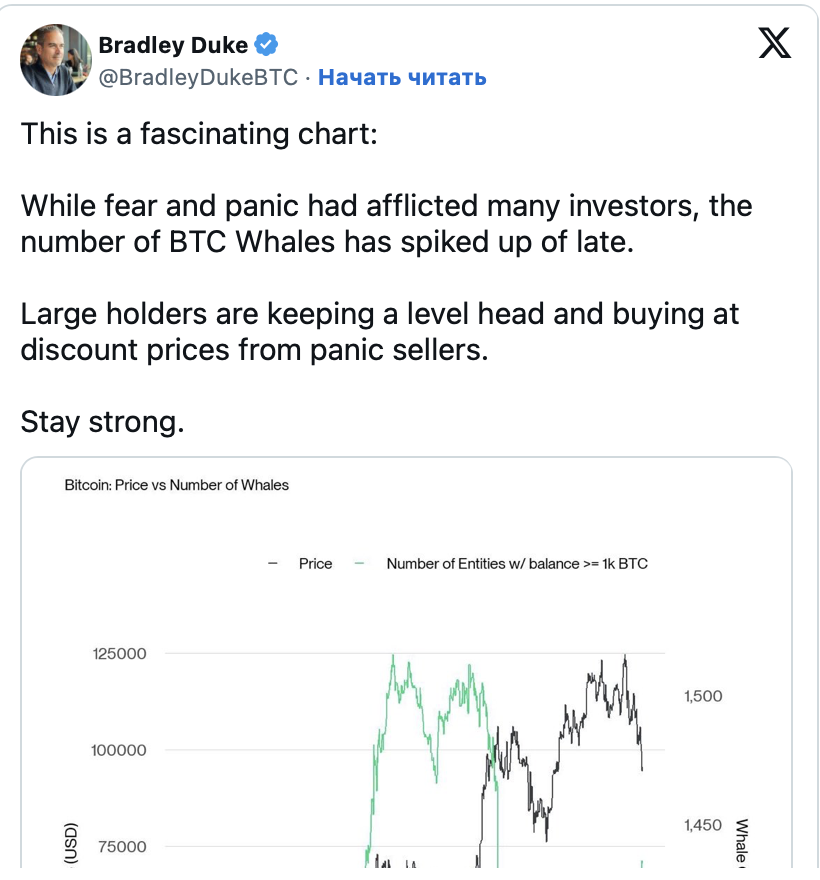
Показатели рыночных настроений сигнализируют о капитуляции розничных участников. Однако данные блокчейна фиксируют рост накоплений среди крупных держателей. Адреса с балансом от 1000 биткоинов увеличивают позиции даже на фоне снижения котировок. Это свидетельствует о том, что институциональные инвесторы рассматривают коррекцию как возможность для входа, а не как начало длительной стагнации.
Ключевым аргументом против негативного сценария остаются макроэкономические показатели. Глобальная ликвидность достигла исторического максимума. Более 80% центральных банков мира перешли к смягчению монетарной политики. Масштабные денежные вливания исторически оказывают поддержку рисковым активам. Криптовалюты, в свою очередь, обладают высокой чувствительностью к потокам ликвидности.

Макроаналитики акцентируют внимание на снижении ставок регуляторами. Данные Банка международных расчетов подтверждают этот тренд. Кредитование в долларах США выросло на 6%, а в евро — на 13% в годовом выражении по итогам второго квартала 2025 года. Расширение кредитного импульса часто выступает драйвером роста стоимости активов.
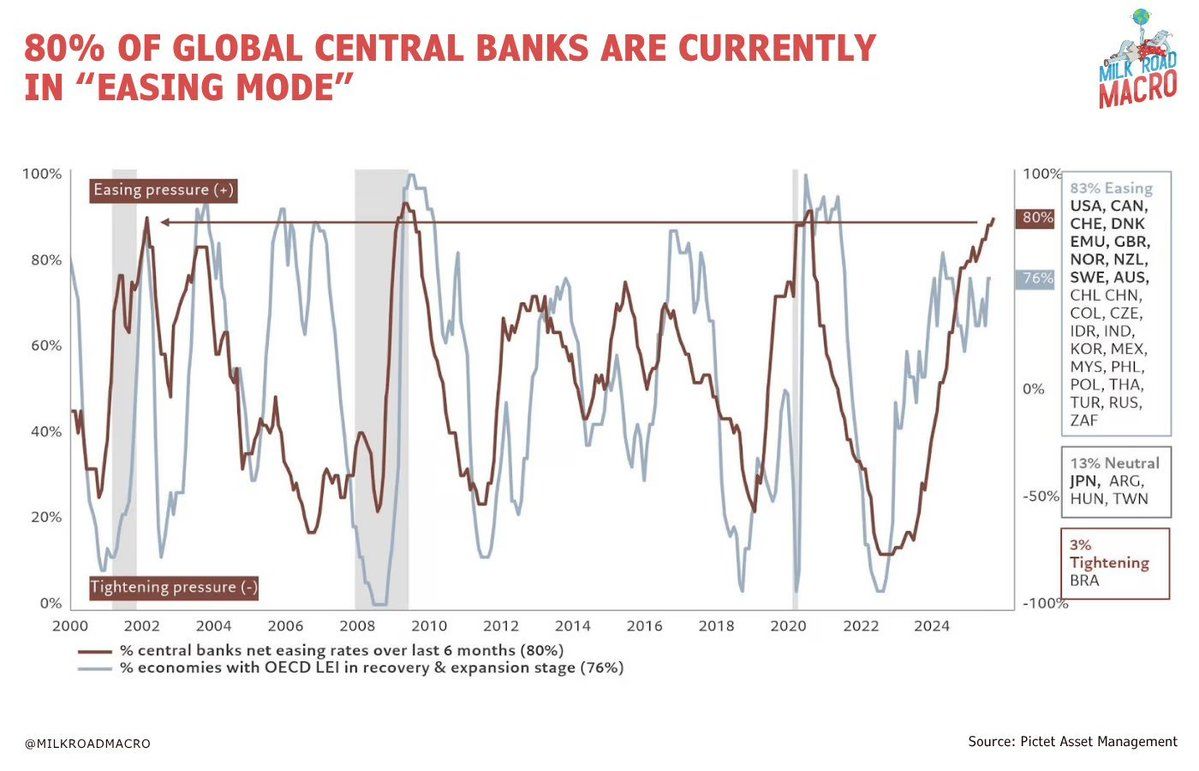
График смягчения политики центральных банков мира
Более 80 % мировых центральных банков находятся в режиме смягчения до 2024 года, что создает благоприятные условия ликвидности для рисковых активов. Источник: MilkRoadMacro .

Историческая ретроспектива поддерживает данный тезис. Рост денежной массы часто приводит к ралли на рынках капитала. Текущая ситуация напоминает периоды, предшествующие фазам роста, когда краткосрочные коррекции происходили на фоне расширения ликвидности. Пока монетарный тренд сохраняется, рынок цифровых активов имеет фундаментальную поддержку.

Тем не менее существуют сдерживающие факторы. В отчете МВФ о глобальной финансовой стабильности отмечена переоценка технологического сектора. Кроме того, ОЭСР прогнозирует замедление роста мирового ВВП до 2,9% в следующем году. Эти экономические реалии могут ограничить влияние ликвидности на ценообразование. Таким образом, аналитикам приходится сопоставлять позитивный эффект от денежных вливаний с рисками замедления экономики.


Related Reads

Karpathy's Genius Strikes Again, Challenging RAG, Turning Your Notes into a Second Brain

Andrej Karpathy has proposed a revolutionary concept for managing personal knowledge: treating notes as immutable "source code" and using LLMs as "compilers" to build a structured, interlinked wiki. This approach fundamentally shifts the cognitive workflow away from the limitations of RAG (Retrieval-Augmented Generation), which merely retrieves and pieces together fragments, leading to contradictions and "digital mummies"—unused, decaying notes. The LLM-Wiki framework introduces a three-layer architecture: the **Raw Layer** for original, immutable notes; the **Schema Layer** defining rules for structuring knowledge; and the **Wiki Layer**, where the LLM continuously compiles and maintains a coherent, cross-referenced knowledge base. Key operations are **Ingest** (adding new material, which triggers updates across related pages), **Query** (asking the compiled wiki, with answers that can become new pages), and **Lint** (periodic AI audits to find contradictions, outdated claims, or gaps). This system automates the tedious maintenance—updating links, resolving conflicts, keeping summaries fresh—that has historically made large-scale personal knowledge management unsustainable. It realizes Vannevar Bush's 1945 "Memex" vision by finally solving the maintenance problem. Karpathy's proposal represents a third piece in human-AI collaboration, following "Vibe Coding" and "Agentic Engineering." It liberates human attention from organizational drudgery, refocusing it on what matters: deciding what to read and deriving meaning.

marsbit3m ago

Karpathy's Genius Strikes Again, Challenging RAG, Turning Your Notes into a Second Brain

marsbit3m ago

Claude Science Completes Two Years' Work in a Few Weeks, Is 10x Research Acceleration Really Here?

Claude Science, a new AI workbench from Anthropic, is being tested by scientists, reportedly accelerating specific research workflows by up to 10x. A neuro-scientist at the Allen Institute completed a lengthy literature review in weeks instead of nearly two years using the tool, which automates tasks like citation verification. The platform is an integrated environment for macOS and Linux, connecting to local or remote computing resources. It streamlines the fragmented research process—literature analysis, computation, visualization, and drafting—into a single, auditable workflow. A key feature is its emphasis on reproducibility: every chart generated includes the exact code, environment, and history used to create it. Claude Science uses a multi-agent system. A coordinator manages over 60 pre-configured skills for life sciences (genomics, proteomics, etc.) and can spawn specialized agents. A dedicated reviewer agent checks citations and calculations for accuracy, creating a form of internal AI peer review. The system operates with a human-in-the-loop, requiring user approval for major steps. Initial applications are in life sciences. Examples include target identification for biotech company Manifold Bio and germline variant analysis for glioma research at UCSF, completing analyses in roughly one-tenth the previous time. The approach contrasts with competitors: Google focuses on proprietary models like AlphaFold, while OpenAI is advancing models' scientific reasoning with benchmarks like GeneBench-Pro. Claude Science differentiates by automating and integrating the practical research pipeline, not just the model's intelligence, aiming to make AI-aided science more reproducible and integrated into daily lab work.

marsbit7m ago

Claude Science Completes Two Years' Work in a Few Weeks, Is 10x Research Acceleration Really Here?

marsbit7m ago

The Invisible Force in Bitcoin's Bear Market: Accelerating On-Chain Payments and Institutional Adoption

Amidst ongoing Bitcoin price volatility, the quiet acceleration of on-chain payments and tokenized trading holds significant importance for investors and policymakers, especially with legislation like the CLARITY Act on the horizon. Major traditional financial institutions adopting these technologies are driving crucial discussions on compliance, security, and transparency, which are vital for broader market adoption. Key developments are shaping this evolution. First, blockchain traceability is moving beyond a simple "public vs. private" debate. New frameworks aim to standardize how financial data from immutable ledgers is analyzed and interpreted, making it as crucial as standardized financial reporting for building institutional trust. Second, while traditional finance supports clear digital asset regulation, they emphasize that an asset's economic function should dictate its regulatory treatment, advocating for robust consumer protections over broad exemptions. Furthermore, the growth of on-chain deposits at regulated institutions signals a shift. Major banks are leveraging blockchain not to replace but to upgrade existing services—like deposits and cross-border settlements—with benefits like 24/7 operations and programmable treasury management. This trend focuses more on modernizing financial infrastructure than creating speculative assets. Despite market turbulence, these underlying advancements in on-chain infrastructure point toward a more robust foundation for the industry's future.

Foresight News54m ago

The Invisible Force in Bitcoin's Bear Market: Accelerating On-Chain Payments and Institutional Adoption

Foresight News54m ago

Trading

Spot
活动图片