Propanc Biopharma привлекла $100 млн для создания криптофонда и лечения рака

cryptonews.ruPublished on 2025-07-10Last updated on 2025-11-11

Австралийская биофармацевтическая компания Propanc Biopharma привлекла до $100 млн от криптофонда Hexstone Capital для создания криптовалютного фонда, который поможет финансировать разработку противораковой терапии.

Частное размещение структурировано в виде конвертируемых привилегированных акций и предоставляет Propanc первоначальные инвестиции в размере $1 млн с возможностью получения дополнительных $99 млн в течение следующих 12 месяцев. Hexstone Capital — это семейный офис, который инвестирует в несколько компаний с криптовалютными резервами.

Средства направят на противораковую терапию

Полученные средства компания использует для создания резервов цифровых активов и ускорения разработки основного препарата PRP — противораковой терапии, которая должна войти в фазу первых испытаний на людях во второй половине 2026 года.

Генеральный директор Propanc Джеймс Натаниельз (James Nathanielsz) назвал создание криптовалютного фонда «трансформационным» шагом для компании, который укрепит ее баланс и продвинет платформу онкологических препаратов на основе проферментов.

«Мы можем ориентироваться не только на пациентов с метастатическим раком от солидных опухолей, но и на несколько хронических заболеваний, основываясь на механизме действия проферментной терапии», — заявил он.

Propanc не уточнила, какие именно цифровые активы планирует приобрести для фонда. Однако клиенты Hexstone инвестируют в биткоин, Ethereum, Solana, Injective и другие менее известные криптовалюты.

Биотех-компании все чаще выбирают криптовалютную стратегию

Propanc присоединяется к Sonnet BioTherapeutics, Sharps Technology и другим биотехнологическим компаниям, которые обратились к криптовалютам для привлечения интереса инвесторов.

Однако решение Propanc не понравилось инвесторам — акции PPCB упали на 10,5% на бирже Nasdaq. За последний месяц бумаги компании потеряли 46,7% стоимости.

Криптовалютные стратегии показывают слабые результаты

Компании с биткоин-резервами потеряли часть привлекательности за последние месяцы, поскольку в этом сегменте появляется все больше участников.
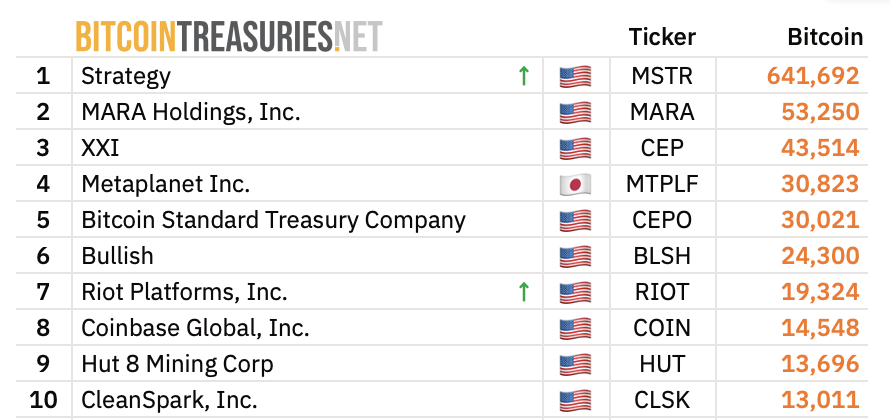
Топ-10 корпоративных держателей биткоина. Источник: Bitcoin Treasuries

MicroStrategy, крупнейший корпоративный держатель биткоина, показала снижение рыночной капитализации на 43% — с $122,1 млрд в июле до $69,1 млрд сегодня. Metaplanet, одна из лучших акций Токийской фондовой биржи в начале года, пострадала еще сильнее, упав примерно на 55% с конца июня.

Некоторые компании с криптовалютными резервами даже вынуждены были продавать часть биткоинов для погашения долгов. Это показывает, что стратегия криптовалютного фонда не гарантирует успеха и может создавать дополнительные риски для биотехнологических компаний, полагающихся на стабильное финансирование исследований.

Related Reads

Analysis of 13F Holdings of Seven Major Funds: What Are Buffett, Duan Yongping, Li Lu, and Dan Bin Thinking?

A summary of Q2 2026 13F filings from seven major funds (Berkshire Hathaway, Duquesne Family Office, H&H International Investment, Himalaya Capital, ARK Investment, Oriental Harbor Investment Master Fund, Situational Awareness LP) reveals AI remains the central investment theme, with significant capital reallocation within the sector. Berkshire Hathaway, under Greg Abel, made its largest net stock purchases in years, heavily increasing its stake in Alphabet, signaling a strategic tilt towards tech while maintaining core holdings in consumer and financial stocks. Duquesne Family Office (Stanley Druckenmiller) rotated within semiconductors, selling Micron, Broadcom, and Intel but adding to positions in TSMC, STMicroelectronics, and AMD, while also reinvesting in cloud giants Alphabet and Amazon and cautiously re-entering Chinese tech via Baidu. H&H International Investment (Duan Yongping) and Himalaya Capital (Li Lu) both significantly increased their stakes in PDD, with Li Lu also concentrating his portfolio by selling out of several financial and energy holdings to focus on core positions like Alphabet and Berkshire. H&H also took profits from high-flying AI/tech names like Nvidia and Google, viewing the moves as valuation adjustments rather than a loss of conviction. ARK Investment (Cathie Wood) aggressively bought SpaceX upon its IPO and continued hunting for disruptive innovation across AI, energy, and biotech, while reducing its Tesla holding. Oriental Harbor Investment Master Fund (Dan Bin) executed a dramatic shift towards AI hardware, launching major new positions in Intel, SanDisk, AMD, and others while selling down software/platform holdings like Google and clearing out consumer names Apple and Tesla. Situational Awareness LP's filing, reflecting pre-liquidation positions, showed a story of missed hedging opportunities leading to significant losses. The consensus is that AI growth is continuing, but capital is actively rotating to identify the next profit centers within the value chain—from semiconductors and infrastructure to eventual commercialization. The filings, while lagging, offer a snapshot of how sophisticated investors are positioning for AI's next phase.

Odaily星球日报12m ago

Analysis of 13F Holdings of Seven Major Funds: What Are Buffett, Duan Yongping, Li Lu, and Dan Bin Thinking?

Odaily星球日报12m ago

Arthur Hayes Makes a High-Profile Comeback, Flop Labs Aims to Become the "Fuel" for the Agent Economy

Arthur Hayes, co-founder of BitMEX, has announced his return as head of a new project called Flop Labs, declaring "FLOP is food for your AI agent." This marks his first high-profile return to a leadership role since stepping back from BitMEX. Flop Labs aims to be a native monetary network and verifiable computation settlement layer for the AI Agent economy, distinguishing itself from existing AI Agent projects. Its core concept is "Proof-of-Useful-Inference," which seeks to integrate useful AI inference tasks into the blockchain consensus mechanism, allowing FLOP tokens to serve as the native currency for Agents to purchase computing resources and store memory. The ecosystem involves four key roles: Miners (provide GPU compute), Validators (verify services), Agents (consume services), and KOLs/Partners (community growth). The project promises a 100% fair launch with no presale or VC involvement. A large airdrop is planned for Q4 2026, with the genesis block targeted for Q1 2027. While the announcement has generated community excitement, particularly around the airdrop, the project is in an early conceptual stage. It currently lacks a published whitepaper, detailed tokenomics, technical specifics on its consensus mechanism, or smart contract audits. Arthur Hayes has defended the venture, separating his belief in the potential of the Agentic Economy from concerns about an AI stock bubble. The success of Flop Labs will hinge on its ability to deliver substantive technical progress and ecosystem development in the coming months.

Odaily星球日报27m ago

Arthur Hayes Makes a High-Profile Comeback, Flop Labs Aims to Become the "Fuel" for the Agent Economy

Odaily星球日报27m ago

World Chain Launches EIP-7928 Block Access Lists on Mainnet

World Chain has launched EIP-7928 block access lists on its Mainnet, becoming the first production layer-2 network to implement this standard. This deployment aims to significantly increase blockchain throughput without substantially raising the hardware requirements for validators. By providing access list data incrementally every 200 milliseconds through its flashblock architecture, World Chain enables validators to verify transactions in parallel and begin validation while a block is still being built, eliminating the need for sequential re-execution. Implemented via a runtime flag rather than a hard fork, this approach is an extension of the EIP-7928 standard, which Ethereum may incorporate in a future update. Internal benchmarks on World Chain test networks showed validation latency remained stable as throughput scaled up to one gigabit per second on standard cloud infrastructure, suggesting the potential for increased throughput without a proportional increase in computational resources for validators. This mainnet launch represents the first production use of streaming EIP-7928 block access lists and contributes to Ethereum's broader scaling strategy by expanding verification capacity while remaining accessible to independent validators. Built on the OP Stack and secured by Ethereum, World Chain is designed for scalability within the Superchain ecosystem. It focuses on applications like stablecoin finance, international remittances, and trading, utilizing World ID's proof-of-human system. The network aims to make blockchain technology widely accessible, starting with discovery and use through compatible wallets like World App.

TheNewsCrypto32m ago

World Chain Launches EIP-7928 Block Access Lists on Mainnet

TheNewsCrypto32m ago

Trading

Spot
活动图片