ЦБ рассказал, что происходит на рынке ЦФА

cryptonews.ruPublished on 2025-08-10Last updated on 2025-11-11

Рынок цифровых финансовых активов в России быстро развивается и становится важным инструментом для краткосрочного финансирования бизнеса. Объем размещений уже превысил 600 млрд руб., и рост продолжается.

Свежими данными поделился ЦБ в обзоре рисков финансовых рынков за октябрь 2025 года. Рассказываем, что происходит на рынке ЦФА.

Что такое ЦФА: полный гайд и ответы на вопросы

Ключевые показатели III квартала 2025 года

  • 623 млрд руб. — объем ЦФА в обращении (+22% за квартал, +128% с начала года);
  • 484 млрд руб. — объем новых выпусков;
  • 66% — доля выпусков со сроком до 1 месяца;
  • 43% и 44% — доли квалифицированных и неквалифицированных инвесторов среди юрлиц;
  • около 50% — доля банковских операторов, по 24% — финтех-компаний и биржевых платформ;
  • 546 тыс. — зарегистрированных пользователей, 62 тыс. — активных (11% от базы).

Основные тенденции

К началу октября объем ЦФА в обращении достиг 623 млрд руб., что на 22% больше, чем в конце второго квартала, и на 128% выше начала года. За третий квартал выпущено ЦФА на 484 млрд руб. Большинство из них — рублевые долговые активы с фиксированной доходностью и коротким сроком обращения.
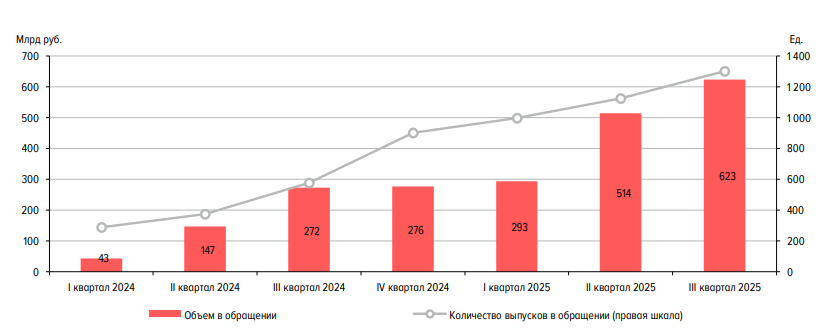
Объем рынка ЦФА и число обращающихся выпусков на конец квартала.
Объемы рынка ЦФА и количество выпусков, находящихся в обращении на конец квартала.

Две трети всех выпусков (66%) рассчитаны на срок до одного месяца, что говорит о спросе на краткосрочные инструменты для бизнеса.
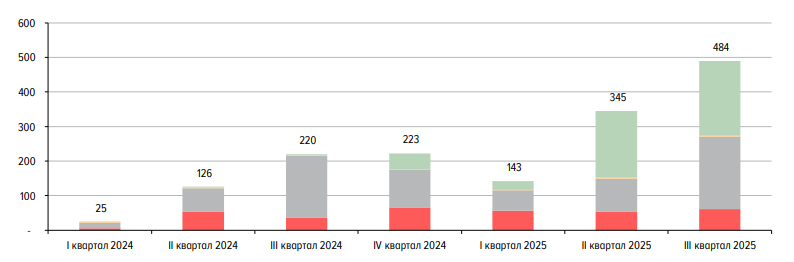
Распределение объемов размещений ЦФА между различными группами инвесторов.
Структура выпусков ЦФА по объему размещений в разрезе категорий инвесторов.

Кто выпускает и где размещают

Почти половина всех размещений приходится на платформы, которые принадлежат банкам. Еще по 24% занимают финтех-компании и биржевые площадки. Банки остаются основными игроками, но альтернативные платформы постепенно укрепляют позиции.
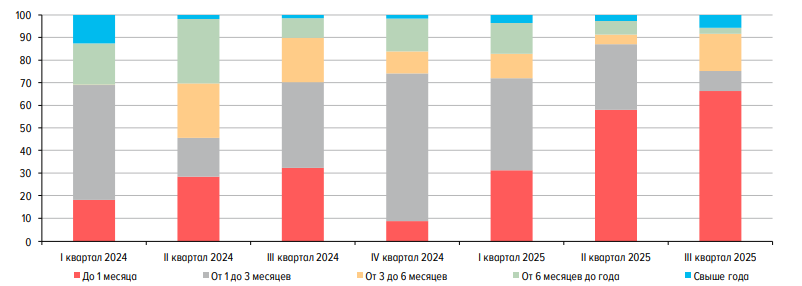
Распределение объемов размещений ЦФА по срокам обращения.
Структура рынка ЦФА по объемам размещений с учетом сроков обращения.

Кто покупает ЦФА и как меняется активность

Главные инвесторы на рынке — юридические лица. В третьем квартале доли квалифицированных и неквалифицированных юрлиц были примерно равны — 43% и 44%. Количество зарегистрированных пользователей платформ выросло до 546 тыс. (+31% за квартал), но активных стало меньше — 62 тыс. против 97 тыс. раньше (–36%). Доля активных пользователей снизилась с 23% до 11%, главным образом из-за снижения интереса со стороны частных инвесторов.
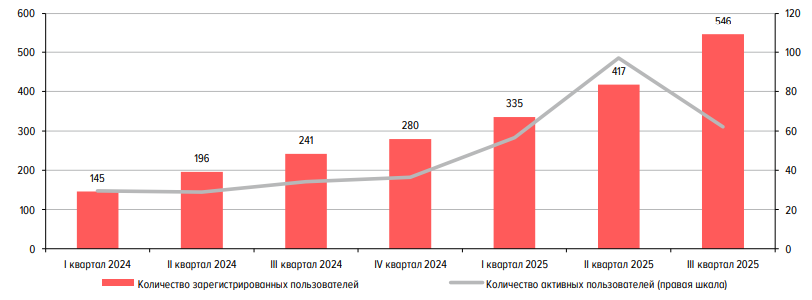
Изменение числа зарегистрированных и активных пользователей платформ, через которые выпускаются и обращаются ЦФА, на конец отчетного периода.
Динамика зарегистрированных и активных пользователей платформ операторов информационных систем, на которых осуществляется выпуск и обращение ЦФА, на конец отчетного периода.

Что рост рынка значит для участников

Эмитентам

ЦФА стали удобным инструментом для быстрого привлечения средств. Можно выпускать короткие серии бумаг на срок до месяца под фиксированную ставку. Основной спрос идет от юридических лиц, поэтому условия выпусков стоит подстраивать под их интересы.

Инвесторам-юрлицам

ЦФА позволяют гибко управлять ликвидностью и получать предсказуемый доход при минимальных рисках. Растущее число платформ делает выбор площадки и условий размещения особенно важным.

Частным инвесторам

Хотя общее число пользователей растет, активность физических лиц снижается. Сейчас рынок в основном ориентирован на корпоративных участников и краткосрочные инструменты.

Напомним, ранее редакция BeInCrypto поговорила с экспертом о том, почему ЦФА на самом деле не прижились в России.

Related Reads

Data of Almost 40,000 SafePal Hardware Wallet Users Exposed to Third Parties

Hardware crypto wallet manufacturer SafePal has disclosed a data breach affecting approximately 39,798 users. On August 16, the company announced that leaked information includes customer names, delivery addresses, phone numbers, email addresses, and order details. However, sensitive data such as seed phrases, private keys, passwords, bank details, and card numbers were not compromised, as SafePal states it does not collect or store this information. An internal investigation found no evidence that attackers accessed user wallets or funds. The primary risk for affected customers is targeted social engineering attacks. Scammers may use the leaked order details to pose as customer support, offering fake refunds, urging firmware updates, or sending phishing links. SafePal is monitoring and taking down such fraudulent sites and warns users to be cautious of any communication referencing their order information. The breach originated from an authorization vulnerability in a third-party order-tracking plugin, which allowed unauthorized access to other customers' order data. The issue affected orders placed between March 2, 2025, and April 11, 2026. The company has since patched the vulnerability and strengthened its system protections. In response, SafePal is conducting a joint investigation with an independent security firm and auditing its entire order processing system. Additional measures include reducing data retention in the affected system to 90 days and notifying logistics partners. While user crypto assets remain secure, the incident highlights a recurring pattern in the industry where breaches of customer data from hardware wallet companies lead to sophisticated phishing campaigns, similar to past incidents involving Ledger and Trezor. The vulnerability underscores that security risks often lie not in the wallet's cryptography but in auxiliary web services and third-party integrations.

cryptonews.ru13m ago

Data of Almost 40,000 SafePal Hardware Wallet Users Exposed to Third Parties

cryptonews.ru13m ago

Curve Founder Calls pump.fun a 'Casino with Scams' and Criticizes Phantom

Curve Finance founder Mikhail Egorov criticized the Solana ecosystem, calling the pump.fun platform a "casino with scams under the name of memecoins" and the Phantom wallet inconvenient to use. Egorov stated that pump.fun is essentially a casino of memecoin scams. He also negatively assessed Phantom's user experience, describing issues while trying to connect it to a hardware wallet and calling its UX worse than MetaMask's. However, he acknowledged that Solana does a very good job of supporting its ecosystem, though he added that its best examples are "not very good." An X user disagreed with the criticism of pump.fun, arguing the platform merely provides a tool and users decide how to use it, noting a large part of the crypto market operates like a casino on various blockchains. Regarding Phantom, the user suggested it might be one of the best options for average users despite personal non-use. In response, Egorov compared the situation to a common software pattern where initial quality and user support can later lead to developer "laziness" and product deterioration, a phenomenon he observed in both the Ethereum ecosystem and beyond. When asked about his favorite crypto wallet, Egorov named qeth, a project he developed himself using Claude AI. His motivation was dissatisfaction with JavaScript-based wallets, which he felt excessively burdened his laptop and drained its battery.

cryptonews.ru16m ago

Curve Founder Calls pump.fun a 'Casino with Scams' and Criticizes Phantom

cryptonews.ru16m ago

20% of American Workers Are Offloading Tasks to AI, Where Tasks Are Replaced, Not Jobs

A recent survey by Epoch AI and Ipsos reveals that 20% of US workers report that AI has now fully or mostly taken over at least one task they previously outsourced to colleagues or contractors. The key finding is that AI is currently replacing specific *tasks*, not entire *jobs*. The study examined ten common knowledge-work tasks. While AI usage is widespread—ranging from 25% for maintaining records to 57% for software design—it rarely handles a task completely. In software design, for instance, only 10% of workers reported AI doing most or all of the work. AI's impact on time efficiency is mixed: 53% of tasks where AI does most of the work see reduced time, but about one-sixth of all AI-assisted tasks actually become *more* time-consuming. Furthermore, while 66% of AI outputs are used with little or no modification, this does not necessarily indicate high quality. Researchers note that clearly defined, deliverable tasks—traditionally suited for outsourcing—are most susceptible to AI takeover. This shift pressures task-based contractors more than it eliminates full-time roles. Adoption is also uneven, concentrated among higher-income, college-educated white-collar workers. The report concludes that the core dynamic is a reorganization of work between humans and AI. The critical question for workers is not "Will AI replace me?" but "How many of my job's components can be packaged as discrete, outsourceable tasks?"

marsbit22m ago

20% of American Workers Are Offloading Tasks to AI, Where Tasks Are Replaced, Not Jobs

marsbit22m ago

Sam Altman Names Him: The Most Important Researcher in AI, But Almost No One Knows Him

In a recent interview, Sam Altman gave a rare and high praise, calling Alec Radford "perhaps the most important, yet least known, researcher in AI history." Widely regarded as the true father of GPT, Radford is the lead author of foundational papers including GPT-1, GPT-2, CLIP, and Whisper, and contributed significantly to GPT-3, DALL·E, Scaling Laws, and GPT-4. Despite this monumental impact, Radford remains highly private, holds no PhD, and rarely gives interviews. Altman credits OpenAI's rise to hiring the then-23-year-old in 2016. Radford's early experiments, like training a model on Amazon reviews, led to the discovery of the "unsupervised sentiment neuron," revealing that models can learn unintended capabilities from simple next-token prediction. His pivotal move was applying the Transformer architecture to language modeling, creating GPT-1 in 2018. This established the "scaling" direction—focusing on increasing model size, data, and compute—which became OpenAI's core strategy, leading to GPT-2, GPT-3, and beyond. Radford later applied the same principles beyond text. His early work on DCGAN laid groundwork for image generation. At OpenAI, he contributed to Image GPT, DALL·E, and CLIP, demonstrating that a simple, scalable training task (like matching images to text) could yield powerful, general capabilities. His work on Whisper applied this to robust speech recognition. Described by colleagues as a "once-in-a-generation genius" and exceptionally kind, Radford is known for his low profile. In late 2024, he left OpenAI for independent research. His latest project, "Talkie," is a 13-billion parameter language model trained *only* on texts published before 1931. This experiment tests if a model with no modern knowledge can quickly learn new skills (like basic Python) from few examples, probing the boundary between memorization and true learning. True to form, as the world catches up, Radford is likely already working on the next big question.

marsbit23m ago

Sam Altman Names Him: The Most Important Researcher in AI, But Almost No One Knows Him

marsbit23m ago

Trading

Spot
活动图片