With 319 Million Shares Facing Lifting of Trading Restrictions, Why Did SpaceX Drop Nearly 5% Intraday?

Published on 2026-08-21Last updated on 2026-08-21

Abstract

SpaceX's second round of post-IPO lock-up shares was lifted on August 20th, with approximately 319 million shares held by insiders becoming eligible for trading. The sudden potential expansion of the tradable share float led to a near 5% intraday drop in the stock price, as short-term supply pressure temporarily outweighed the market's long-term enthusiasm for its rocket, satellite, and AI infrastructure businesses.

Summary

SpaceX's second round of post-IPO lock-up shares were lifted on August 20, making approximately 319 million shares held by insiders eligible for trading. The sudden expansion of the potential float caused the stock price to drop nearly 5% intraday, as short-term supply pressure temporarily outweighed the market's long-term expectations for its rocket, satellite, and AI infrastructure businesses.

SpaceX saw the lifting of trading restrictions for its second round of post-IPO lock-up shares on August 20. According to a report by Zhitong Caijing, around 319 million shares held by insiders became eligible for trading starting that day. Following the announcement, SpaceX's stock fell nearly 5% intraday, touching $132.81 at one point; data from Investing.com showed a closing price of $134 for the day, representing a 4.05% decline.

This drop has a straightforward supply and demand context. Before the lock-up period ended, relevant shareholders, even if they had the intention to sell, could not trade freely on the public market. After the restrictions were lifted, these shares suddenly became eligible for circulation. The number of potential sellers the market faces consequently increased, and buy-side orders would preemptively lower their bids to account for the potential selling pressure, creating a discount for possible share disposals.

Lifting Restrictions Does Not Mean All 319 Million Shares Will Be Sold Immediately

The fact that 319 million shares can be traded does not mean all these shares will enter the market on the same day. Whether insiders sell depends on factors such as their cost basis, tax arrangements, personal cash needs, and their judgment of the company's future prospects. The downward pressure on the stock price reflects supply expectations, not the actual, confirmed volume of selling that has already occurred.

However, this expectation alone is sufficient to impact short-term prices. For a company that has recently gone public, the original tradable float is relatively limited. The unlocking of a large batch of restricted shares changes the perception of both buyers and sellers regarding the quantity of tradable shares. Some investors will reduce their positions before actual selling data appears, and market-making and arbitrage funds will also price in a discount for the anticipated new supply. Consequently, intraday declines can easily be amplified.

What deserves more attention next is trading volume and insider disclosure filings. If actual selling after the unlocking is limited, prices may digest the shock relatively quickly. However, if significant disposals occur continuously, the supply pressure will not be confined to just the unlocking day.

The Long-Term Story Remains, but Temporarily Takes a Back Seat to Supply Dynamics

The original report also mentioned that Wall Street remains optimistic about SpaceX's long-term growth potential. The businesses the market focuses on now extend beyond rocket launches and satellite internet, encompassing artificial intelligence and computing infrastructure. The global network capability brought by Starlink and the technology and assets accumulated from the launch business remain the core supports for its long-term valuation.

These expectations have not immediately changed due to a single unlocking event, but they also cannot prevent the short-term expansion of the tradable float. A company's growth narrative addresses how much money it can make in the future, while the lifting of lock-up shares affects how many shares might be sold in the immediate present. The price action on August 20 indicates that the market prioritized addressing the latter issue first.

Therefore, the recent pullback in SPCXUSDT is better understood from the perspective of share supply dynamics rather than interpreted as a sudden weakening of SpaceX's core business. The 319 million shares represent only the potential scale; what will ultimately determine how long the pressure lasts is how much of that translates into actual sell orders and the size of the discount the market requires to absorb those shares.

Related Reads

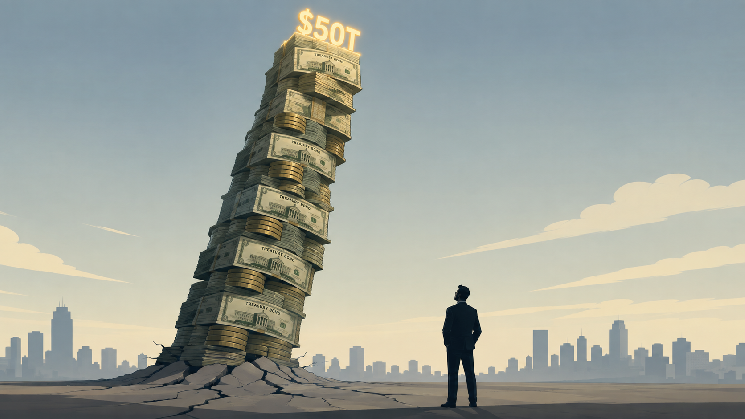
Musk Awaits $50 Trillion: Is There a Limit to the U.S. National Debt and What Comes Next?

Elon Musk reacted to a projection of US national debt reaching $50 trillion by 2030, labeling it a "precise timeline" with a laughing emoji. The debt has recently passed the $40 trillion mark. Skeptics note that specific debt thresholds have been breached before without immediate collapse. However, analysts warn the focus should shift from the nominal debt amount to its affordability. A key metric is when the average interest rate on the debt exceeds the economy's growth rate, a point the US Congressional Budget Office projects for 2031. Once this "debt spiral" begins, interest costs grow self-reinforcing. Currently, interest payments have already surpassed defense spending, exceeding $1 trillion annually. Ray Dalio warns a debt crisis could occur within "three years, plus or minus two," advising portfolio diversification into gold and some Bitcoin. Potential outcomes if debt becomes unmanageable include: 1) Financial repression and monetization (the "Japanese path" of controlled yields and inflation), seen as the most likely; 2) Severe austerity (the "Greek path" of spending cuts/tax hikes), considered politically unlikely; or 3) Technical default/restructuring, which would cause global financial shock. The most probable path is a hybrid of moderate financial repression and gradual inflation, leading not to a sudden crash but to long-term economic stagnation and a declining standard of living. By 2056, debt could reach 175% of GDP. Ultimately, the limit for US debt is not a fixed number but a function of market confidence in the dollar.

cryptonews.ru1h ago

Musk Awaits $50 Trillion: Is There a Limit to the U.S. National Debt and What Comes Next?

cryptonews.ru1h ago

Solana Developer Mert Mumtaz Highly Praises Altcoin!

In the world of cryptocurrencies and finance, where privacy is a major focus, significant developments are underway. Valor Group founder Dev and notable crypto ecosystem figure Mert Mumtaz participated in a program on The Rollup crypto broadcasting platform, discussing the latest developments for the Zcash (ZEC) network and its important future roadmap. The conversation covered network scalability, security updates, and measures taken against quantum threats. The recent Ironwood update implemented in the Zcash network is considered a crucial milestone for the project. During the event, Mert highlighted that internal security audits using 'red team' methods and AI identified a potential vulnerability in the Orchard pool that could have allowed the creation of counterfeit notes. Extensive work and formal verification proved the code mathematically perfect according to specifications. The seamless migration of funds from the Orchard pool to the new Ironwood pool has completely eliminated the risk of counterfeit coin creation in the network. Dev shared important technical details about Zcash's future vision, emphasizing that Valor Group's main goal is for Zcash to achieve transaction volumes comparable to credit cards. He stated they aim to process over 50,000 transactions per second with sub-second latency while maintaining the full proof-of-work mechanism. The main scaling bottleneck was identified not as the nodes themselves, but wallet scanning processes. A new wallet architecture and synchronization delay optimization are expected to resolve this issue. The upcoming Tachion update promises to provide complete protection for Zcash against quantum computing threats. This update will integrate recursive zero-knowledge proofs into the network. It is reported to reduce transaction sizes by more than five times, eliminate node data processing overhead, and address state growth issues. With Tachion, the network is claimed to achieve not just 'quantum-resilient' but a truly 'quantum-secure' privacy structure.

cryptonews.ru1h ago

Solana Developer Mert Mumtaz Highly Praises Altcoin!

cryptonews.ru1h ago

Trading

Spot
活动图片