Команда Monad назвала дату запуска основной сети и токена MON

cryptonews.ruPublished on 2025-11-20Last updated on 2025-11-20

Релиз мейннета EVM-совместимого блокчейна первого уровня Monad и его нативного токена MON запланирован на 24 ноября.

Monad Mainnet will launch on November 24th, 9am ET

Waiting room 👇 https://t.co/3yP2WucnxU

— Monad (mainnet arc) (@monad) November 5, 2025

Аирдроп для ранних пользователей ожидается одновременно с запуском. Монеты распределят между 225 000 юзеров, которые прошли проверку на сибилов. Портал для клейма MON открыли в середине октября.

В список получателей вошли активные участники сообщества, трейдеры с большими объемами торгов на DEX вроде Hyperliquid, долгосрочные держатели некоторых NFT-коллекций, контрибьюторы и разработчики.

Команда Monad Foundation и сотрудники Category Labs не участвуют в раздаче.

Официальной токеномики MON пока нет. Однако бессрочные премаркет-контракты на монету уже доступны на Hyperliquid. На момент написания цена составляет $0,05 при суточном объеме торгов в $4,3 млн. Открытый интерес достиг $10,6 млн.
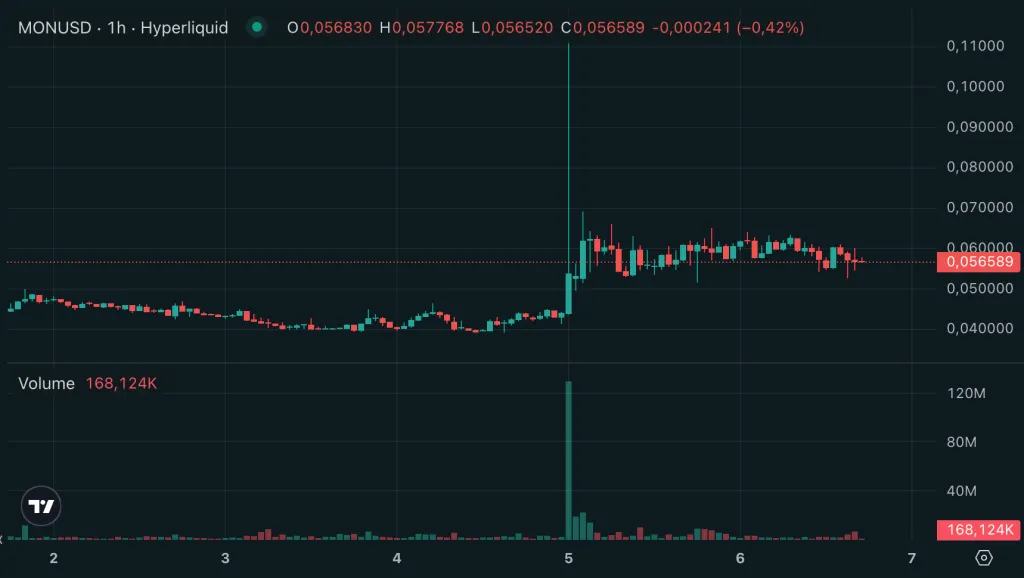
Часовой график MON/USD биржи Hyperliquid. Источник: Hyperliquid.

Проект был запущен в 2022 году как конкурент Solana и Ethereum. В рамках двух раундов финансирования он привлек более $240 млн.

Команда Monad запустила публичный тестнет в феврале 2025 года. Разработчики заявили о высокой пропускной способности сети — до 10 000 TPS и времени обработки блока на уровне одной секунды.

Напомним, в июле организация Monad Foundation приобрела компанию Portal Labs, которая стоит за разработкой инфраструктурной платформы для стейблкоинов Portal.


Related Reads

Who Makes the Best Use of Claude Code? The Answer Might Not Be Programmers

Claude Code Usage Report Summary (Based on ~400k sessions) Core Finding: In agentic programming with Claude Code, a clear division of labor has emerged: humans primarily decide *what* to build (planning decisions), while Claude decides *how* to build it (execution decisions). Key Insights: 1. **Effectiveness is not limited to programmers.** In code-generation tasks, success rates for users in non-technical fields (law, finance, management, research) are nearing those of software engineers. What matters most is the user's domain expertise and understanding of the problem to be solved. 2. **Domain expertise drives success and efficiency.** Sessions where users exhibited "expert" proficiency in the task's domain saw verified success rates double compared to "novice" sessions. Experts also delegated more work per instruction, with Claude executing more actions and producing more output. 3. **AI is amplifying, not replacing, domain knowledge.** Claude Code lowers the *implementation* barrier, not the *judgment* barrier. The value of knowing the "what" and "why" is increasing relative to just knowing the "how" to code. 4. **Usage is evolving.** Over a 7-month period (Oct '25 - Apr '26), the share of sessions for debugging halved, while use for software operations, data analysis, and non-code writing roughly doubled. The estimated economic value of typical tasks increased by ~25%. Conclusion: The data suggests coding agents are making programming background less critical for completing technical tasks. However, they reward and amplify deep domain understanding. The ability to successfully direct an AI agent stems more from mastery of a specific field than from coding skill itself. The primary gains come from being competent in a domain; deep specialization adds only marginal additional advantage. This may signal a shift where software creation becomes integrated into various professions.

marsbit8m ago

Who Makes the Best Use of Claude Code? The Answer Might Not Be Programmers

marsbit8m ago

Trading

Spot
Futures
活动图片