Почему биткоин рухнул ниже $100 000 впервые с июня

cryptonews.ruPublished on 2025-01-04Last updated on 2025-11-05

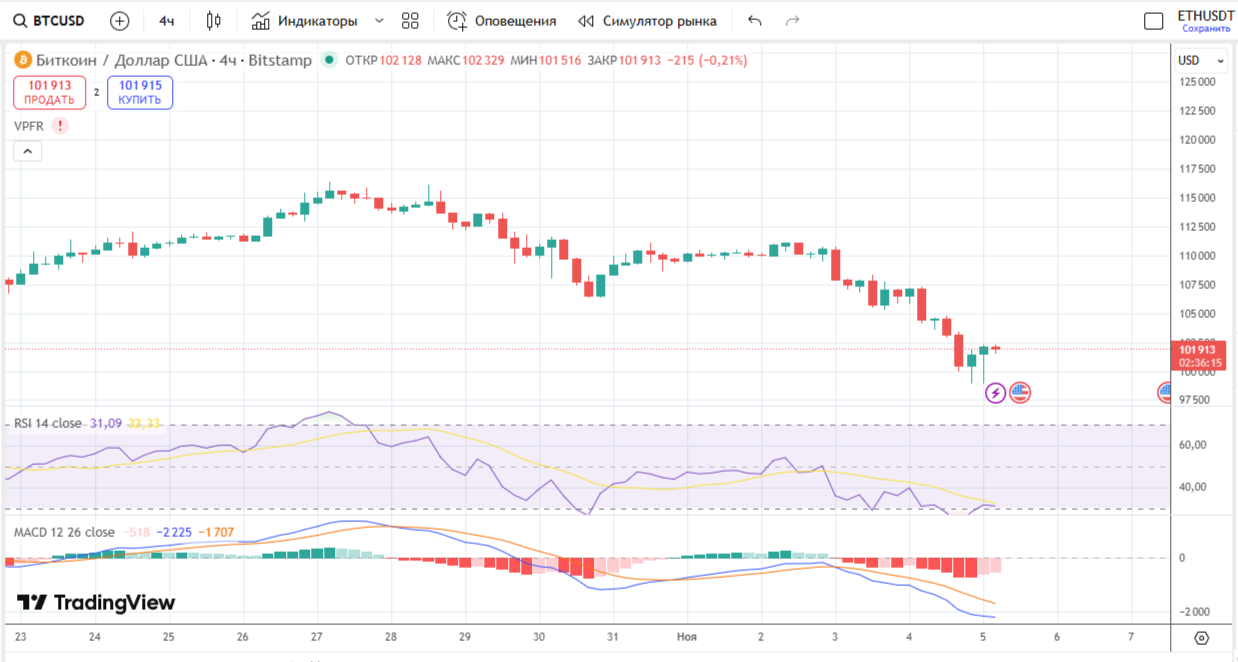
Биткоин опустился ниже $100 000 во вторник — впервые с июня — на фоне обширной распродажи криптовалютного рынка. С момента рекордного максимума около $126 182 6 октября он потерял почти 27 % за 29 дней.

  • В течение 24 часов биткоин упал примерно на 6,4 % до уровня около $99 705.
  • Общая капитализация рынка криптовалют за последний месяц сократилась примерно на $880 млрд.
  • Сопутствующие токены: Ethereum упал ~19,8 %, XRP ~17 %, BNB ~17 %, Solana ~21 %.
Основные причины падения

  1. Монетарная политика и ликвидность

Ралли биткоина наблюдалось на фоне низких процентных ставок и растущей ликвидности. Теперь же Federal Reserve сигнализирует о невысокой вероятности дальнейшего снижения ставок, что сдерживает рискованные активы.

  1. Слабость настроений и риск-аверсия

Инвесторы отходят от активов с высоким риском, переключаясь на золото и облигации — классические “убежища”.

  1. Каскад ликвидаций

Массовые продажи позиций в крипто­деривативах усилили спад. По оценкам, ликвидировано $19-30 млрд за короткий период.

  1. Истощение “бычьего” импульса и фиксация прибыли

После стремительного роста до $110-120 тыс. многие участники рынка начали фиксировать прибыль, что создало давление на цену.

Что дальше?

  • В техническом плане биткоин сейчас тестирует уровень поддержки около $99 044, а следующими целями снижения могут быть $97 839 и $94 049.
  • Мониторинг решений Fed и состояния ликвидности остаётся ключевым фактором. Если ставка будет удерживаться выше ожиданий — риск дальнейшего снижения возрастает.
  • Однако долгосрочно многие аналитики остаются оптимистичны: падение не означает отказ от каждой модели, а скорее коррекцию после экстремального подъёма.

Что это значит для участников рынка?

  • Если вы рассматриваете долгосрочное удержание биткоина — момент коррекции может быть точкой входа, но с пониманием повышенного рискового профиля.
  • Если вы активный трейдер — внимательно отслеживайте ликвидации, объёмы, уровни поддержки/сопротивления и макроразвитие событий.
  • Если вы оцениваете альтернативные монеты — важно понимать, что они в большинстве случаев следуют за движением биткоина, а корреляция сейчас усиливается.


Related Reads

Zuckerberg Gave the AI Bull Market a Fright

Mark Zuckerberg and Meta inadvertently sent shockwaves through the AI stock market. News that Meta plans to sell its "excess" AI computing power to external clients triggered a trillion-dollar sell-off in AI infrastructure stocks like Nvidia and AMD, while Meta's stock rose. This seemingly simple business move—renting out idle resources—shook a core assumption underpinning the two-year AI bull market: the belief that computing power ("compute") would be perpetually scarce. This scarcity narrative had fueled valuations across the entire supply chain, from GPUs to power suppliers. Meta's motivations are layered: improving hardware utilization during non-peak R&D periods, executing a strategic pivot, and redefining AI infrastructure. Unlike rivals selling APIs, Meta's open-source approach with Llama appears aimed at building an ecosystem where it ultimately profits from the underlying compute, similar to how AWS transformed from Amazon's internal capacity. Meta is essentially offering an integrated "AI factory" service, not just raw GPU rental. The market's fear wasn't Meta selling a few chips, but the signal that GPU supply might become more shareable and efficient, transitioning the industry from a Capex-driven "hoarding" model to an Opex-driven "utilization" model. This could fundamentally reset valuation logic from scarcity to efficiency. While the sell-off reversed somewhat as investors realized this shift is long-term, the direction is set. The move marks a potential inflection point: the era of easy valuation gains from simply buying GPUs may be ending, giving way to an era where operational efficiency and return on AI assets take center stage.

marsbit13m ago

Zuckerberg Gave the AI Bull Market a Fright

marsbit13m ago

Arcus Chooses "Stepfather" Robinhood Chain, "Biological Father" dYdX Awkwardly Attempts to Salvage the Situation

Robinhood officially launched its own Layer 2 network, Robinhood Chain. In response, many major DeFi protocols like Uniswap and Chainlink announced integration. A key point of discussion was Arcus, a new decentralized exchange (DEX) developed by the dYdX team, which chose to launch on Robinhood Chain instead of the native dYdX Chain. Arcus offers 24/7, zero-fee trading of 95 tokenized stocks and perpetual contracts. This move sparked community concerns about dYdX Chain potentially being sidelined, causing DYDX token's price to drop over 12%. Critics questioned if dYdX Labs' focus is shifting to Arcus and how DYDX token holders would benefit from Arcus's future growth, especially as its founder mentioned a future Arcus token would allocate a portion to the dYdX community. dYdX founder Antonio Juliano clarified that dYdX Chain will continue operating, but acknowledged its deep decentralization involved trade-offs in performance and user experience. He stated Arcus is a separate product led by a new CEO, responding to market demands for faster, simpler platforms. The dYdX Foundation also confirmed DYDX's role remains unchanged for dYdX Chain governance and staking, with no plans for token migration. However, the core uncertainty remains: if Arcus succeeds, how will that value flow back to dYdX Chain and its DYDX token holders?

Odaily星球日报1h ago

Arcus Chooses "Stepfather" Robinhood Chain, "Biological Father" dYdX Awkwardly Attempts to Salvage the Situation

Odaily星球日报1h ago

Trading

Spot
活动图片