Почему крипторынок не растет, несмотря на вливание ликвидности от ФРС на $37 млрд

cryptonews.ruPublished on 2025-11-24Last updated on 2025-11-24

Федеральная резервная система вливала около $37 млрд в банковскую систему США с прошлого пятницы.

Несмотря на такое значительное вливание капитала, настроения инвесторов в криптовалютных рынках упали до уровня крайнего страха. Крупнейшие активы демонстрируют резкие снижения, а общая капитализация сектора снизилась на 6,11% в этом месяце.

Ликвидность поступает, а цены падают: объяснение разрыва между ФРС и криптовалютой

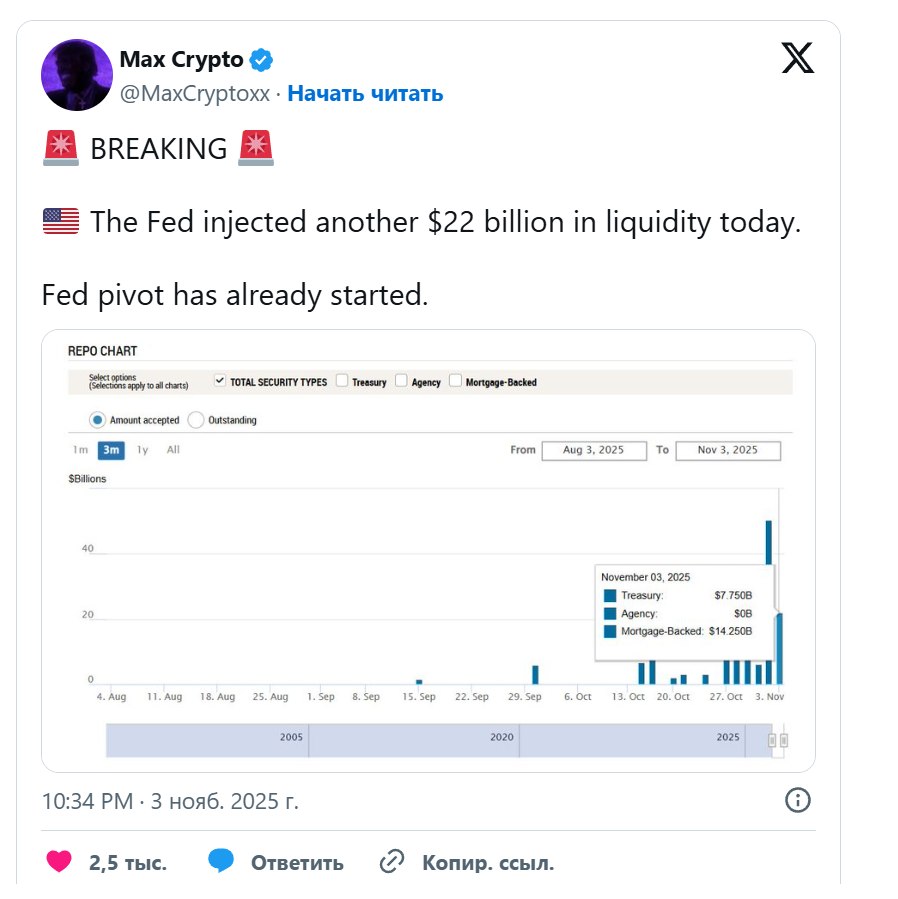
Согласно последним данным, 3 ноября Федеральная резервная система провела дополнительные операции репо на сумму $7,75 млрд. Этот шаг был предпринят вскоре после того, как в пятницу ФРС добавила $29,4 млрд в банковскую систему.
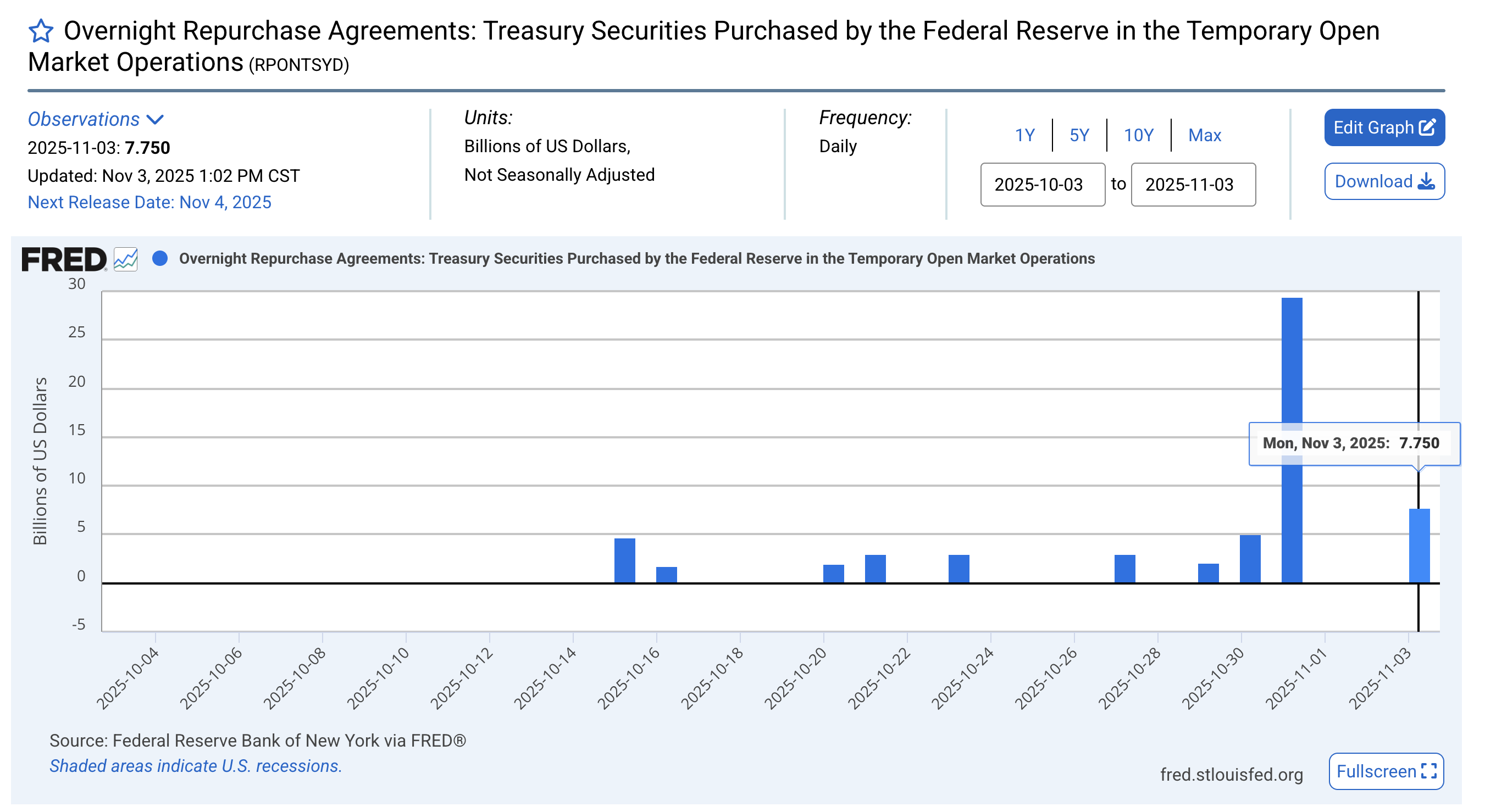
Federal Repo Agreements
Федеральные репо-соглашения. Источник: FRED Economic Data

Это было крупнейшее однодневное вливание ликвидности с эпохи доткомов. В совокупности сумма ликвидных вливаний составила около $37 млрд.

«Это самое крупное печатание денег за последние 5 лет. Рынок криптовалют готовится к параболическому росту», — написал Алекс Мейсон в своем сообщении.

Помимо казначейских облигаций, ФРС также влила $14,25 млрд в ликвидность через операции репо, обеспеченные ипотечными ценными бумагами в тот же день.
Когда Федеральная резервная система увеличивает ликвидность, это означает, что в финансовой системе обращается больше наличных средств. Банки и учреждения получают дополнительный капитал, который может быть направлен в более рисковые активы, такие как акции и криптовалюты. Теоретически, эта дополнительная ликвидность поддерживает рост цен.

«Все говорят о медвежьем рынке в самый неподходящий момент. Глобальная ликвидность готова выстрелить: поступления от репо ФРС, открытие шлюзов TGA, волна стимулирующих мер в Азии, смягчение кредитных условий. Весь этот цикл проходил без ликвидности. Поэтому только биткоин достиг новых высот. Когда ликвидность вернется, альткоины оживут. Макроэкономическая ситуация заряжена», — отметил Merlijn The Trader в своем комментарии.

Тем не менее, несмотря на недавнее увеличение ликвидности, криптовалютные рынки пока не ощутили положительного эффекта. Более того, настроения резко ухудшились.

Причины падения крипторынка во время вливания ликвидности ФРС

Читайте также: У биткоина всего два года, чтобы защититься от квантового взломастатья от BeInCrypto

Индекс страха и жадности крипторынка упал до отметки 21, что указывает на «Экстремальный страх». Это самый низкий показатель с апреля 2025 года, снизившись с нейтрального уровня 50 всего за неделю.

Кроме того, наблюдается снижение цен на активы. Биткоин (BTC) потерял почти 5% в ноябре, в то время как Ethereum (ETH) упал почти на 9% за тот же период.

Эта ситуация может быть связана с операциями обратного РЕПО Федеральной резервной системы. Согласно последним данным, с прошлой пятницы центральный банк провел обратные РЕПО более чем на $75 млрд, включая почти $24 млрд только 3 ноября.
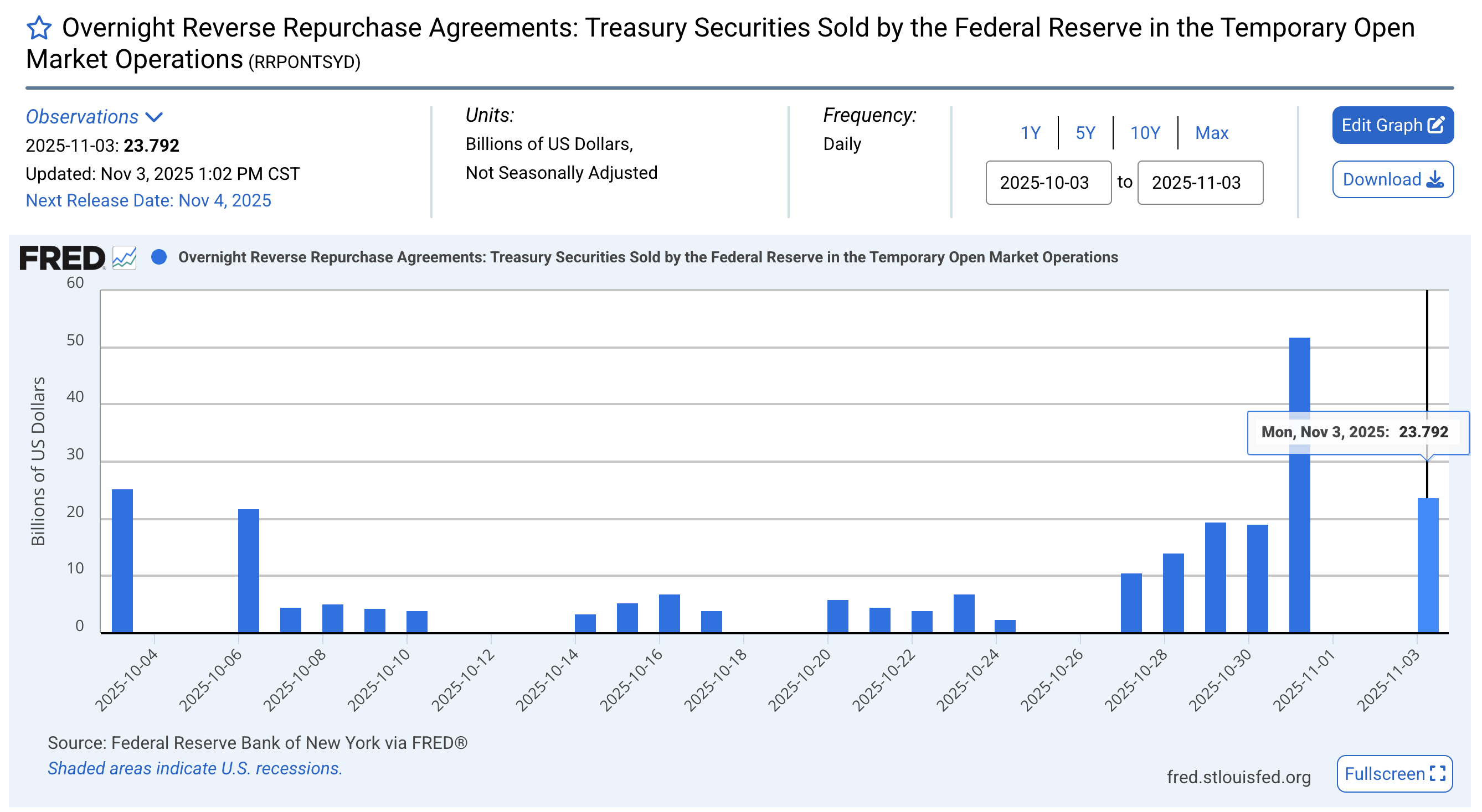
Соглашения об обратном РЕПО Федеральной резервной системы
Соглашения об обратном РЕПО Федеральной резервной системы. Источник: экономические данные FRED

В отличие от операций РЕПО, которые вводят ликвидность в финансовую систему, обратные РЕПО выводят наличность. В этих транзакциях Федеральный резерв берет деньги в долг у банков и фондов денежного рынка в обмен на казначейские облигации в качестве залога. Это фактически изымает ликвидность из обращения, ужесточая условия краткосрочного финансирования.

Резкий рост использования обратных РЕПО говорит о том, что финансовые учреждения ищут безопасности и паркуют излишки наличности в ФРС вместо того, чтобы вкладывать их на рынок. Эти смешанные сигналы — вклады через РЕПО, но одновременное изъятие ликвидности через обратные РЕПО — подчеркивают неопределенность в финансовой системе.

Для рискованных активов, таких как криптовалюта, это динамическое взаимодействие объясняет, почему рынки остаются волатильными: несмотря на новые вливания ликвидности, общее состояние все еще ощущается как жесткое, что держит инвесторов в напряжении.


Related Reads

No Sales Team, $20 Million in Revenue: How Did AI Employee Viktor Win Over 30,000 Companies?

The AI employee Viktor, developed by a team with DeepMind background, has achieved $20 million in annual revenue without a traditional sales team, serving over 30,000 companies. Its core innovation lies in positioning itself as a "Tier 3 AI Coworker" capable of "end-to-end execution and delivery of results," moving beyond the "draft and wait for human completion" model of typical AI assistants. Users can simply mention Viktor in Slack or Microsoft Teams using natural language commands, and it autonomously performs tasks like pulling sales data from a CRM, generating reports, or even cross-tool operations like creating board meeting PPTs by aggregating data from six different sources. Key to its growth is a pure Product-Led Growth (PLG) model, eliminating complex implementation cycles and per-seat licensing. Instead, it charges based on task credits or consumption, lowering the trial barrier with a $100 free credit offer and no credit card required. This enabled viral, bottom-up adoption within organizations. Viktor's interaction paradigm removes the barrier of prompt engineering, allowing non-technical employees to delegate complex workflows seamlessly. It also features proactive, automated task execution (e.g., overnight bookkeeping, scheduled reports) based on triggers, effectively embedding AI as an automated "process layer" within business operations. However, its expansion into Microsoft Teams—a platform with 320 million users—highlights challenges. Large enterprises require stringent IT compliance, security reviews (e.g., SOC 2), and governance, potentially hindering the frictionless, user-driven adoption that succeeded in Slack. Additionally, the "black box" nature of its autonomous decision-making raises concerns about operational risks, data integrity, and the need for robust audit logs and permission controls. Balancing efficiency gains with security and trust remains a critical hurdle for Viktor and similar AI agents aiming to become core enterprise infrastructure.

marsbit52m ago

No Sales Team, $20 Million in Revenue: How Did AI Employee Viktor Win Over 30,000 Companies?

marsbit52m ago

Manus Buyback Plan Emerges: Chinese Investors Plan to Repurchase Equity with $2 Billion, Path to Hong Kong IPO Becomes Clearer

According to a report by The Information, early Chinese investors of Manus, including Tencent, Sequoia Capital China, and ZhenFund, are planning to repurchase the company from Meta for $2 billion—the same price Meta paid in its acquisition last December. This move is a direct response to the Chinese government's prohibition of the foreign acquisition in April. As part of the repurchase plan, Manus is considering establishing a Sino-foreign joint venture within China. This structure is seen as a way to ensure regulatory compliance for its Chinese investors and to pave the way for a future IPO in Hong Kong. Notably, U.S. investor Benchmark will not participate in the buyback, which will concentrate ownership even more among Chinese capital. Since its acquisition by Meta, Manus's business has grown rapidly, with its annualized revenue run rate reportedly increasing four-to-fivefold to $400-$500 million in roughly six months. This strong growth underpins the investors' willingness to repurchase at the original price. Financially, the forced unwinding of the deal may benefit the early investors, allowing them to regain equity at a cost far below the company's current implied valuation, with the added prospect of an independent future listing. However, specific terms of the repurchase, including funding proportions and the joint venture's equity structure, are still under negotiation. This "repurchase-joint venture-Hong Kong IPO" approach could serve as a reference model for other Chinese AI startups navigating cross-border M&A regulations.

marsbit1h ago

Manus Buyback Plan Emerges: Chinese Investors Plan to Repurchase Equity with $2 Billion, Path to Hong Kong IPO Becomes Clearer

marsbit1h ago

STRC Loses Peg by 11%, Can Strategy's Perpetual Motion Machine Keep Running?

The article discusses the significant and concerning depegging of MicroStrategy's (MSTR) preferred stock, STRC. Designed to trade near its $100 target par value, STRC has recently fallen sharply, reaching a low of $83.26 and closing at $88.59, representing an over 11% discount. STRC is a core component of MicroStrategy's financial strategy. As a perpetual preferred stock, it allows the company to raise capital through an "at-the-market" (ATM) issuance program without diluting common shareholders (MSTR). This capital is primarily used to purchase Bitcoin, creating a "capital flywheel": issuing STRC → raising cash → buying BTC → increasing net assets → supporting STRC's value. The flywheel's operation depends on STRC maintaining its $100 price. To enforce this, MicroStrategy employs a dynamic dividend mechanism, recently raising the rate to 11.5% and increasing payout frequency. However, this has failed to halt the depegging, indicating market concerns extend beyond yield. Analysts cite two main reasons. First, technical factors like forced liquidations from leveraged arbitrage trades may have exacerbated the sell-off. Second, and more fundamentally, is waning confidence in MicroStrategy's financial resilience. A JPMorgan report highlighted the company's limited cash relative to its ~$1.7 billion annual dividend obligation, raising liquidity concerns. While MicroStrategy counters that its massive Bitcoin holdings provide decades of coverage, this argument relies on the potential need to sell BTC—a departure from its long-standing "never sell" narrative. The company's recent sale of a small amount of Bitcoin for "testing," despite being framed as minor, has intensified these fears. The persistent depegging threatens to cripple MicroStrategy's primary funding channel. If STRC remains discounted, the company's ability to fund further Bitcoin purchases weakens. Should cash reserves dwindle while financing is constrained, the market may increasingly price in the risk of MicroStrategy becoming a forced seller of Bitcoin to meet obligations. This shift from a major marginal buyer to a potential seller could pose significant downside risk to the broader Bitcoin market.

链捕手1h ago

STRC Loses Peg by 11%, Can Strategy's Perpetual Motion Machine Keep Running?

链捕手1h ago

Trading

Spot
Futures
活动图片