Рост реализованной капитализации биткоина на $8 млрд не подкреплен притоком в ETF

cryptonews.ruPublished on 2025-11-20Last updated on 2025-11-20

Внутрисетевые потоки биткоина свидетельствуют о устойчивом спросе на крупнейшую криптовалюту мира. Как инвесторы, так и майнеры наращивают активность, несмотря на негативные рыночные настроения после обвала крипторынка на $19 млрд.

За последнюю неделю реализованная капитализация биткоина выросла более чем на $8 млрд, превысив $1,1 трлн. При этом реализованная цена BTC поднялась выше $110 000, что указывает на значительные внутрисетевые поступления.

Реализованная капитализация биткоина измеряет долларовую стоимость всех монет по цене их последнего перемещения, раскрывая общий объем инвестиций, удерживаемых держателями биткоина.

Новые поступления в основном связаны с компаниями, формирующими биткоин-казначейства, и биржевыми фондами, сообщил основатель и генеральный директор аналитической платформы CryptoQuant Ки Янг Джу.

Однако восстановление цены биткоина останется ограниченным, пока биржевые фонды и компания MicroStrategy не возобновят крупномасштабные приобретения, написал Джу в публикации в социальной сети X в воскресенье. О

«Спрос в настоящее время в основном обеспечивается ETF и MicroStrategy, но обе стороны недавно замедлили покупки. Если эти два канала восстановятся, рыночный импульс, вероятно, вернется», — добавил он.
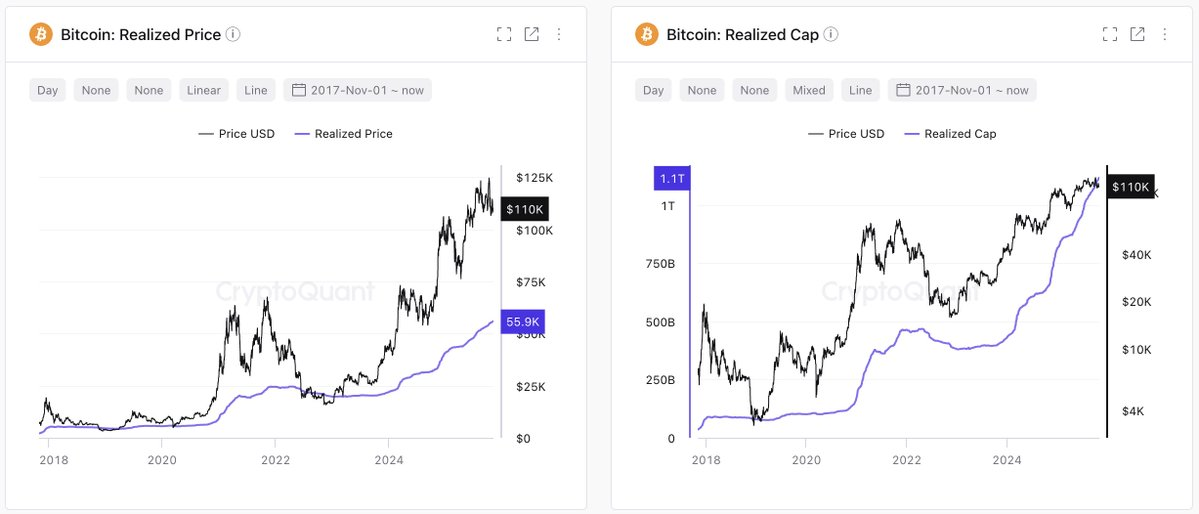

Источник: CryptoQuant.

Тем временем майнеры биткоина расширяют свои операции, что приводит к росту хешрейта. Это является «четким долгосрочным бычьим сигналом» для продолжающегося роста «денежного сосуда биткоина», пояснил Джу.

Несколько крупных майнеров биткоина недавно расширили свои майнинговые парки, включая связанную с семьей Трампа компанию American Bitcoin, которая в августе приобрела 17 280 устройств примерно за $314 млн.


Источник: CryptoQuant

Прогноз аналитиков: биткоин может достичь $140 000 в ноябре при восстановлении потоков в ETF

Несмотря на $8 млрд новых поступлений, настроения инвесторов не смогли восстановиться с территории «страха» после рекордного обвала рынка в начале октября.

Настроения инвесторов оставались слабыми, несмотря на публикацию Белым домом в субботу развернутого заявления с изложением достигнутого торгового соглашения между президентом Трампом и председателем Китая Си Цзиньпином.

Однако возобновление потоков в ETF и потенциальное заявление Федеральной резервной системы о смягчении денежно-кредитной политики могут подтолкнуть цену биткоина к $140 000 в ноябре, сообщили аналитики биржи Bitfinex.

«Наш базовый сценарий предполагает рост биткоина до $140 000, при этом общие потоки в ETF в размере от $10 до $15 млрд не станут неожиданностью», — говорится в сообщении.

«Катализаторами могут стать смягчение политики ФРС с двумя снижениями ставок в четвертом квартале, удвоение потоков в ETF и сезонная сила четвертого квартала, тогда как риски сохраняются вокруг пошлин и геополитики», — добавили аналитики.


Related Reads

Analysis of the Latest Portfolio Adjustment by the "Top Player" in the U.S. Stock Market: $9 Billion Short on NVIDIA, Shifting Focus to Power and Memory Sectors

AI investor Leopold Aschenbrenner has made a significant portfolio shift, taking a $9 billion nominal short position against top AI infrastructure stocks like NVIDIA, ASML, and Oracle. Simultaneously, he is redirecting capital towards what he sees as the next critical bottlenecks in the AI boom: power, memory, and data center networking, alongside private investments in AI model companies like Anthropic. This move is interpreted not as a call that the AI bubble has burst, but as a rotation within the infrastructure stack. The analysis highlights NVIDIA's recent $25 billion bond issuance as a potential signal, questioning why a cash-rich company would seek external debt despite high profits and increased dividends/buybacks. The core investment thesis is that the initial, crowded "picks and shovels" trade in semiconductors is maturing. The next wave of capital is expected to flow into the physical and logistical constraints of AI expansion: electricity supply, memory chip capacity, data center construction, and enabling technologies like optical networking (fiber) for high-bandwidth communication, where copper remains crucial for short distances. Aschenbrenner's substantial (approx. 20% of fund) private stake in Anthropic is noted as a key part of his strategy—investing directly in the "mine" (AI models) rather than just the "shovels." The discussion concludes that while certain segments may be overvalued, the overarching AI infrastructure demand driven by real product usage remains robust. The most promising long-term investments are seen in essential, non-sexy infrastructure—particularly energy and power companies—whose demand is viewed as a global constant irrespective of AI's cyclicality.

marsbit11m ago

Analysis of the Latest Portfolio Adjustment by the "Top Player" in the U.S. Stock Market: $9 Billion Short on NVIDIA, Shifting Focus to Power and Memory Sectors

marsbit11m ago

BIT Research: Liquidity is Disappearing, Will Bitcoin Replay the Bottoming Pattern of 2022?

The crypto market is currently in an adjustment phase driven by policy expectations and liquidity shifts. Despite a brief rebound fueled by geopolitical easing and SpaceX's strong IPO performance, unexpectedly hawkish signals from new Fed Chair Kevin Warsh have removed anticipated easing support. Concurrently, stablecoin liquidity is shrinking, with insufficient new capital inflows, pushing the market into a typically quiet summer period. Pricing lacks catalysts for a sustained rally. Daily trading volume has significantly contracted, stablecoin growth has slowed markedly, and the supportive effect of Strategy's (formerly MicroStrategy) STRC preferred stock-financed Bitcoin purchases is fading. Amid policy uncertainty, seasonal weakness, and liquidity contraction, Bitcoin faces near-term downward pressure. Warsh's hawkish pivot and refusal to provide a clear policy outlook have increased risk premiums, historically unfavorable for Bitcoin. Technically, the trend remains bearish below $73,700, with $62,446 as critical support. A break below could accelerate declines, though a prolonged consolidation phase, similar to 2022's bottoming process, is possible. Liquidity is a core constraint. Current daily volume is around $500 billion, roughly 25% of the peak during the July-Oct 2025 rally. The 12-month growth rates for USDT and USDC have fallen to ~20%, with 6-month growth near zero, indicating weak new inflows. Bitcoin ETF and Strategy-driven inflows have also weakened, with a 30-day rolling net outflow. With inflation at 4.2% above the Fed's target, combined hawkish policy, seasonal factors, and liquidity shortages challenge Bitcoin's ability to hold above $60,000. However, this adjustment phase may be forming a cyclical low this summer, potentially setting the stage for the next bull cycle.

marsbit40m ago

BIT Research: Liquidity is Disappearing, Will Bitcoin Replay the Bottoming Pattern of 2022?

marsbit40m ago

Who Makes the Best Use of Claude Code? The Answer Might Not Be Programmers

Claude Code Usage Report Summary (Based on ~400k sessions) Core Finding: In agentic programming with Claude Code, a clear division of labor has emerged: humans primarily decide *what* to build (planning decisions), while Claude decides *how* to build it (execution decisions). Key Insights: 1. **Effectiveness is not limited to programmers.** In code-generation tasks, success rates for users in non-technical fields (law, finance, management, research) are nearing those of software engineers. What matters most is the user's domain expertise and understanding of the problem to be solved. 2. **Domain expertise drives success and efficiency.** Sessions where users exhibited "expert" proficiency in the task's domain saw verified success rates double compared to "novice" sessions. Experts also delegated more work per instruction, with Claude executing more actions and producing more output. 3. **AI is amplifying, not replacing, domain knowledge.** Claude Code lowers the *implementation* barrier, not the *judgment* barrier. The value of knowing the "what" and "why" is increasing relative to just knowing the "how" to code. 4. **Usage is evolving.** Over a 7-month period (Oct '25 - Apr '26), the share of sessions for debugging halved, while use for software operations, data analysis, and non-code writing roughly doubled. The estimated economic value of typical tasks increased by ~25%. Conclusion: The data suggests coding agents are making programming background less critical for completing technical tasks. However, they reward and amplify deep domain understanding. The ability to successfully direct an AI agent stems more from mastery of a specific field than from coding skill itself. The primary gains come from being competent in a domain; deep specialization adds only marginal additional advantage. This may signal a shift where software creation becomes integrated into various professions.

marsbit1h ago

Who Makes the Best Use of Claude Code? The Answer Might Not Be Programmers

marsbit1h ago

Trading

Spot
Futures
活动图片