Is Zcash Quantum-Resistant Yet? Experts Weigh In

bitcoinistPublished on 2025-10-31Last updated on 2025-11-01

Abstract

A debate on X this week exposed a core question for on-chain privacy: when quantum computers are able to break...

Trusted Editorial content, reviewed by leading industry experts and seasoned editors. Ad Disclosure

A debate on X this week exposed a core question for on-chain privacy: when quantum computers are able to break elliptic-curve cryptography (ECC), will they be able to retroactively deanonymize every transaction ever made of privacy coins like Zcash?

Nic Carter, co-founder of Coin Metrics and partner at Castle Island Ventures, argued that the answer is effectively yes for most privacy coins. “For privacy coins, even if they migrate to post-quantum cryptographic schemes, all historical transactions prior to that migration can be decrypted,” he said on October 30, 2025. “So all historical txns will be stripped of privacy in >~5y. Everything is built on ECC.”

Carter’s point is based on “harvest now, decrypt later.” Attackers don’t need to break you today. They just copy the data now and crack it once quantum is strong enough. On blockchains, that problem is worse because the data is already public and permanent. “Blockchains are uniquely bad for quantum because normally the quantum thing is ‘harvest now decrypt later’ so adversaries have to be preemptively harvesting traffic but blockchains just.. publish.. everything.. forever.”

He warned specifically that even if a privacy coin upgrades to quantum-resistant signatures in the future, old activity is still exposed once ECC falls. “While privacy coins can adopt post quantum sigs, understand that all previously hidden addresses, relationships between addresses, etc, will be revealed once ECC is broken,” Carter said. “And obviously everything is on chain so you don’t even need to harvest traffic today.”

Is Zcash Already Quantum-Resistant?

That claim triggered pushback from Zcash supporters, who argue Zcash is structurally different from something like Monero.

Mert Mumtaz (Helius) agreed that Carter’s warning applies to “many privacy coins like Monero,” but said it’s “not necessarily true for zcash’s privacy, given advanced opsec.” He acknowledged that “advanced opsec is not the norm,” but said that if it is followed, Zcash users “get you certain guarantees w.r.t information leakage.” He also said “some things are in the works to make this even stronger,” pointing to research by Zcash engineer Sean Bowe.

Bowe’s position is that Zcash’s fully shielded pool simply does not put critical sender/receiver information on the ledger in the first place. “There is no quantum computer or powerful AI that will be able to look back at the Zcash blockchain 1000 years from now and figure out who made every fully shielded transaction,” Bowe said in July this year. “That information, among other things, never even touches the ledger. It’s already gone.” His condition is clear: “To be certain about your privacy you must start by using shielded Zcash. You almost cannot even begin otherwise.”

Carter partially credits that. “Zec is definitely ahead of anyone when it comes to quantum preparedness, not denying that,” he said. But he called the “already quantum-proof” framing unrealistic in practice.

He argued that Zcash’s long-term privacy story depends on very strong assumptions that often break in the real world: “assumes pubkey never being known. assumes: no metadata collection, no exchange key leaks, perfect metadata privacy.”

He added that Zcash’s shielded pools — Sprout, Sapling, Orchard — still “rely on ECC for key exchange, viewkeys, proof verification, which are all broken” under a powerful quantum adversary. His conclusion: “unrealistic to say zec privacy is perfectly q resistant. linkages between addrs are forever encoded on the blockchain, you and Sean know that. store now decrypt later still applies.”

In other words: Zcash builders say that if you stay fully shielded, the chain itself won’t hand quantum attackers a clean map of who paid whom. Carter says that in the real world, users leak, exchanges leak, metadata leaks — and once ECC breaks, those leaks plus the permanent ledger are enough to unwind the privacy anyway.

One final note: when asked directly, Carter denied holding ZEC. “Nope.”

At press time, ZEC traded at $366.
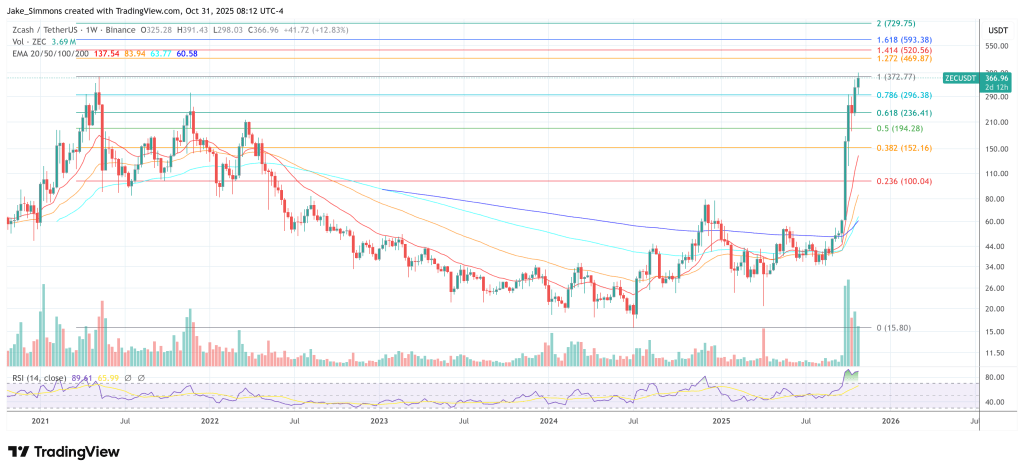
Zcash price
ZEC tries to break the 2021 high, 1-week chart | Source: ZECUSDT on TradingView.com
Featured image created with DALL.E, chart from TradingView.com
Editorial Process for bitcoinist is centered on delivering thoroughly researched, accurate, and unbiased content. We uphold strict sourcing standards, and each page undergoes diligent review by our team of top technology experts and seasoned editors. This process ensures the integrity, relevance, and value of our content for our readers.

Jake Simmons has been a Bitcoin enthusiast since 2016. Ever since he heard about Bitcoin, he has been studying the topic every day and trying to share his knowledge with others. His goal is to contribute to Bitcoin's financial revolution, which will replace the fiat money system. Besides BTC and crypto, Jake studied Business Informatics at a university. After graduation in 2017, he has been working in the blockchain and crypto sector. You can follow Jake on Twitter at @realJakeSimmons.

Related Reads

From Minting to Tape-Out: A First-Timer’s Guide to TapeOut

Title: From Mint to Tapeout: A First-Timer’s Guide to TapeOut **Summary:** This guide provides a risk-conscious, step-by-step introduction to TapeOut, a platform where users can mint logic components (NAND, LATCH) and use them to "tape out" on-chain circuits. It emphasizes a fundamental shift in mindset: instead of focusing first on prices or speculation, users should first understand how to use the platform's core functionality. The recommended path begins with preparation: use a separate, low-fund wallet on BNB Smart Chain for experimentation. The first step is to choose a "Processor"—the foundational unit for components and circuits—by examining its details (supply, mintage, creator) rather than chasing trends. If a Processor has remaining supply, users can mint a small number of components. The guide stresses that minting acquires specific components for a specific processor, not a generic asset. For sold-out Processors, trading occurs on an order book market. Users must carefully understand order prices, quantities, and the 1% fee, and always verify transactions on a block explorer. The core "play" experience is in the Canvas, where users can build and test logic circuits without a wallet. Before proceeding to tapeout—the irreversible, on-chain act of finalizing a circuit which consumes components—users must verify their design, component costs, and target processor. After taping out a circuit, the guide encourages users to interact with it, for example by calling its functions via BscScan's read contract feature, completing the "components -> circuit -> verification" loop. It concludes with critical safety checks to perform before any wallet signature, and cautions against misinterpreting demo pages (like the "on-chain BTC miner") as profit-generating services. The goal is to approach TapeOut as a hands-on lesson in on-chain logic, minimizing financial risk while learning its unique mechanics.

marsbit5m ago

From Minting to Tape-Out: A First-Timer’s Guide to TapeOut

marsbit5m ago

Wall Street Analyst Predicts SpaceX Stock Price Drop to $75

A Wall Street analyst from Phillip Securities, Glenn Tumm, has issued a "Sell" recommendation for SpaceX stock (SPCX), maintaining a 12-month price target of $75. This implies a potential 46.6% drop from the current price of $140.50. The bearish outlook is based on the company's significant capital expenditures, reliance on temporary cloud service contracts, and customer concentration in its AI services, suggesting a need for longer-term commitments to support its valuation. This stance contrasts sharply with the broader Wall Street consensus. An average of 31 analysts polled by TipRanks sets a 12-month price target of $232.35, implying 64% upside, with the highest forecast at $800 and the lowest at $75. The report follows SpaceX's impressive Q2 2026 results, where total revenue surged 92% year-over-year to $7.8 billion. Starlink subscriber count doubled to 12 million, driving communications revenue up 66% to $4.3 billion. AI-related revenue skyrocketed 247% to $2.6 billion, fueled by new cloud services and infrastructure deals. Despite the strong earnings, SPCX shares fell over 4% in the last 24 hours, reducing the company's market cap to $1.9 trillion. The stock had initially jumped over 17% post-earnings but faced resistance near $149. The analyst concludes that SpaceX's future trajectory hinges on securing more long-term contracts with its AI and Starlink customers. Success could validate Wall Street's bullish forecasts, while failure may render the recent stock rebound temporary.

cryptonews.ru53m ago

Wall Street Analyst Predicts SpaceX Stock Price Drop to $75

cryptonews.ru53m ago

Trading

Spot
活动图片