Мемкоины мертвы? Интерес снизился почти на 90% с 2024 года

cryptonews.ruPublished on 2025-02-27Last updated on 2025-10-29

Интерес к мемкоинам на рынке заметно остыл. Доля упоминаний сектора сократилась до 2,5%, что указывает на смену настроений инвесторов в криптовалютном пространстве.

Снижение числа запусков новых токенов и угасание интереса со стороны трейдеров вызвали активные обсуждения в криптосообществе. Одни считают текущее падение признаком «поколенческого дна», другие уверены, что эпоха мемкоинов подходит к концу.

Почему мемкоины теряют интерес на рынке?

По данным, собранным компанией KAITO и опубликованным в соцсетях, доля внимания к мемкоинам снизилась с примерно 20% в конце 2024 года до 2,5% в октябре 2025-го — почти на 90%.
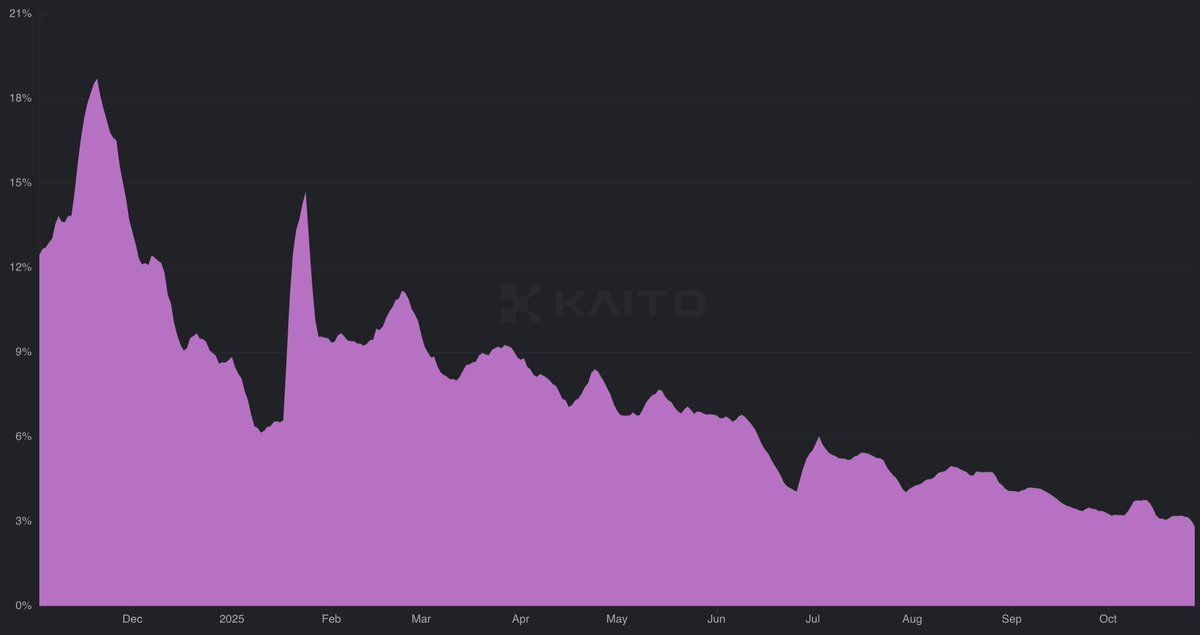
График, показывающий снижение доли мемкоинов с 20% до 2,5% с декабря 2024 по октябрь 2025
Доля мемкоинов за последний год. Источник: X/0xNairolf

Те же тенденции отражают и поисковые запросы. Согласно Google Trends, глобальный интерес к фразе «meme coins» упал с максимального показателя 100 в начале 2025 года до всего лишь 7 в октябре. Это говорит о явном снижении общественного внимания.

Уменьшение интереса проявляется и в торговой активности на ведущих блокчейнах. Если в начале 2025 года на долю мемкоинов приходилось около 60% торгов на децентрализованных биржах (DEX) сети Solana, то к октябрю показатель снизился до 30%, по данным Galaxy Research.

Ценовая динамика также следует этой тенденции. По информации CoinGecko, даже во время недавнего бычьего рынка, когда биткоин (BTC), Ethereum (ETH) и другие крупные активы обновляли исторические максимумы, лидеры сектора — Dogecoin (DOGE) и Shiba Inu (SHIB) — так и не смогли достичь прежних рекордов. Подкатегории мем-токенов также демонстрировали устойчивое падение в последние месяцы.

Рыночная капитализация внутри сектора стала заметно более концентрированной. В начале октября совокупная полностью разводнённая капитализация токенов, запущенных через платформу Pump.fun, превышала $4,8 млрд. Однако более 55% этой суммы приходилось всего на 12 токенов, что свидетельствует о слабом интересе и нехватке финансовой поддержки для большинства новых проектов.

Создание новых монет также замедлилось. За последний год было выпущено свыше 13 млн мемкоинов, но за последние месяцы активность резко упала: в сентябре их выпуск оказался на 56% ниже, чем в январе. Всё это говорит о затухании ажиотажа вокруг мемкоинов.

Почему это происходит? Согласно последнему отчету a16z,

«Здравомыслящая политика и двухпартийное законодательство открывают путь для более продуктивного использования блокчейна».

Теперь внимание рынка сместилось к новым трендам, таким как искусственный интеллект и автономные агенты. Токены из экосистемы x402 выросли в цене в несколько раз, а бессрочные DEX продемонстрировали взрывной рост в 2025 году, привлекая инвесторов.

Сообщество разделилось во мнениях о будущем сектора мемкоинов

Значит ли это, что мемкоины умерли? Мнения сообщества разделились. Некоторые аналитики уверенно заявляют: «Мемкоины никогда не умрут». Другие, наоборот, считают, что падение внимания — это сигнал дна, с которого может начаться новый виток интереса.

Аналитик Итан отметил, что текущее снижение может стать «поколенческим дном», то есть уровнем, после которого интерес к мемкоинам больше не способен сильно упасть и может начать расти.

«Не покупайте мемкоины, если вы здесь, чтобы жаловаться на их падение. Мемы такие. Риски высоки. Награды выше (иногда)», — добавил другой трейдер.

Несмотря на это, остаются скептики, считающие, что стремительное падение интереса означает завершение эры мемкоинов.

Будет ли нынешний спад концом целой эпохи или всего лишь очередным циклом — покажет время. Мемкоины по-прежнему отражают спекулятивную сторону крипторынка. А пока внимание инвесторов всё больше смещается к метаверсам, ИИ и DeFi-проектам, остаётся лишь наблюдать, смогут ли мемкоины восстановиться и вернуть влияние или окончательно уйдут в цифровую историю.

Related Reads

Apple and the Power Rebalancing with 'The Microns': Dissecting the Profit Ledger Behind the iPhone

The article analyzes the shifting profit dynamics and power balance between Apple and memory suppliers like Micron within the iPhone supply chain. It highlights a social media post criticizing Apple for raising iPhone prices while blaming memory chip cost increases, despite historically paying suppliers like Micron very little. An estimated iPhone 18 cost breakdown is referenced. Historically, memory was a minor cost component. In 2017's iPhone X, memory accounted for only about 1.6-2.3% of the price, with Apple capturing nearly 50% net profit. Over time, memory's share of the Bill-of-Materials (BOM) cost has grown significantly, reaching an estimated 12-15% for the iPhone 17 series. The core driver of this change is soaring demand for memory from the AI industry, particularly for High Bandwidth Memory (HBM) and AI servers, which is diverting production capacity and squeezing supply for consumer electronics. Memory manufacturers, after enduring periods of low profits, now hold greater pricing power. This is reflected in their recent strong financials, like Micron's 84.6% gross margin. Apple CEO Tim Cook initially described the memory price pressure as unprecedented in his 40-year career, later calling it a "once-in-a-century flood," before Apple announced price hikes across several product lines, causing a significant stock drop. Elon Musk echoed Cook's sentiment about the dramatic cost surge. The article concludes that the era of memory suppliers being at the mercy of Apple's pricing power has temporarily reversed, thanks to AI-driven demand. It notes Apple is reportedly seeking to diversify its supply chain, including exploring chips from China's CXMT.

Odaily星球日报1h ago

Apple and the Power Rebalancing with 'The Microns': Dissecting the Profit Ledger Behind the iPhone

Odaily星球日报1h ago

Conversation with the Founder of 42 Macro: The Fed's 'Boiling the Frog Slowly' and the K-Shaped Economy

In a conversation with Anthony Pompliano, Darius Dale, founder of 42 Macro, discusses the Federal Reserve's monetary policy and the K-shaped U.S. economy. Dale characterizes new Fed Chair Kevin Warsh as a "dove in hawk's clothing," expecting the Fed to signal or enact policy tightening in the coming quarters to create room for later easing. He argues current economic signals, including high deficit spending, debt monetization, and credit growth, strongly indicate inflation is not on a credible path back to 2%, forcing the Fed to act. The discussion highlights the stark "K-shaped" economic reality. While top earners, buoyed by massive cash savings (up ~$8 trillion since pre-pandemic), continue robust spending, those at the bottom face severe financial strain, with delinquency rates on consumer loans reaching crisis-era highs. Dale attributes much of the current social and political anxiety to this divergence, driven by the "Cantillon effects" of monetary expansion, which disproportionately benefits asset owners. He emphasizes that in this environment of "financial repression," individuals must participate in asset markets to avoid being left behind. On equities, Dale notes a rotation from the "Magnificent Seven" tech giants into broader AI-exposed companies, while warning that the tech giants' massive capital expenditure cycles could eventually puncture over-optimistic cash flow projections. Dale concludes by stressing that the core desire across all economic strata is simply the dignity to provide for one's family, a goal currently undermined by systemic policies that act as a "wealth siphon" from the bottom to the top.

marsbit1h ago

Conversation with the Founder of 42 Macro: The Fed's 'Boiling the Frog Slowly' and the K-Shaped Economy

marsbit1h ago

The Domestic Answer to Space Computing Power: Photonics Are More Efficient, Musk and Huang's Approaches Are Too Roundabout

The Space Computing Race: A Photonic Advantage The competition for space-based computing has intensified, with figures like Elon Musk and NVIDIA's Jensen Huang highlighting its potential. Musk predicts solar-powered AI satellites could offer the most cost-effective computing by 2032. However, space presents extreme challenges for traditional electronic chips: radiation from cosmic particles can cause errors, the vacuum environment hinders heat dissipation, and limited solar power constrains energy-hungry systems. Photonic computing, using light instead of electrons, offers a promising solution. Its core advantages for space are threefold: 1) **Radiation Resistance**: Photons are charge-neutral, making them inherently immune to particle interference. 2) **Low Heat Generation**: Light propagation in waveguides generates minimal heat, bypassing critical thermal management issues. 3) **Low Power Consumption**: Photonic chips have near-zero static power draw, aligning perfectly with the energy constraints of satellites. Furthermore, for a given payload weight and volume, photonic systems can potentially deliver higher total compute density. Since they require less bulky cooling and power infrastructure, more space can be allocated to the compute units themselves. While photonic computing holds great promise, current industry approaches face hurdles like the memory-compute bottleneck (separate storage and processing) and challenges in large-scale integration. Engineering for space—withstanding launch vibrations and validating full system operation in orbit—remains a critical step. The path forward resembles the evolution from single GPUs to computing clusters, but via a photonic route. As electronic chips approach physical limits in miniaturization, photonic computing and optical interconnects (光算光联) may provide a key alternative to bypass these constraints and define the next generation of space-based computing capabilities.

marsbit2h ago

The Domestic Answer to Space Computing Power: Photonics Are More Efficient, Musk and Huang's Approaches Are Too Roundabout

marsbit2h ago

Trading

Spot
活动图片