FalconX Acquires 21Shares, Expanding Into Crypto ETFs Market

bitcoinistPublished on 2025-10-23Last updated on 2025-10-23

Abstract

FalconX has announced an acquisition of 21Shares, combining prime brokerage infrastructure with the world's largest crypto ETP platform. FalconX Pushes...

Trusted Editorial content, reviewed by leading industry experts and seasoned editors. Ad Disclosure

FalconX has announced an acquisition of 21Shares, combining prime brokerage infrastructure with the world’s largest crypto ETP platform.

FalconX Pushes Into Crypto ETFs & ETPs With 21Shares Acquisition

As announced in a press release, FalconX has agreed to acquire 21Shares. FalconX is an institutional crypto prime brokerage that provides large clients with deep global liquidity, derivatives, financing, custody, and settlement across digital asset markets. It has facilitated over $2 trillion in trading volume and hosts a global client base of more than 2,000 institutions.

Meanwhile, 21Shares is the largest issuer of crypto exchange-traded funds and products (ETFs/ETPs). ETFs/ETPs refer to investment vehicles that allow investors to gain exposure to an underlying asset without directly having to own it. When a trader invests into one of these vehicles, the provider buys and custodies the asset on their behalf.

Some investors may be wary of navigating crypto exchanges and wallets, so products like ETFs and ETPs provide for a more regulated means of investment into digital assets, in a mode that’s more familiar.

21Shares has 55 of these products listed currently, across which it manages over $11 billion in assets. With the acquisition, its asset management product development and distribution capabilities will be combined with FalconX’s institutional-grade infrastructure.

The press release noted:

Together, the two firms will accelerate the creation of tailored investment products that meet growing institutional and retail demand for regulated digital asset exposure.

While FalconX is acquiring 21Shares, the latter will continue to operate independently, with Russell Barlow, its current CEO, remaining in charge. Barlow will work closely with FalconX leadership to advance a shared vision for the digital asset ecosystem. “No changes to the construction or investment objectives of the existing 21shares ETPs (Europe) or ETFs (US) are planned,” said the press release.

In some other news, the Bitcoin derivatives landscape has been changing recently, as on-chain analytics firm Glassnode has highlighted in an X post. Previously, the Futures market was dominant, but now the Options market is beginning to rival it in terms of Open Interest.

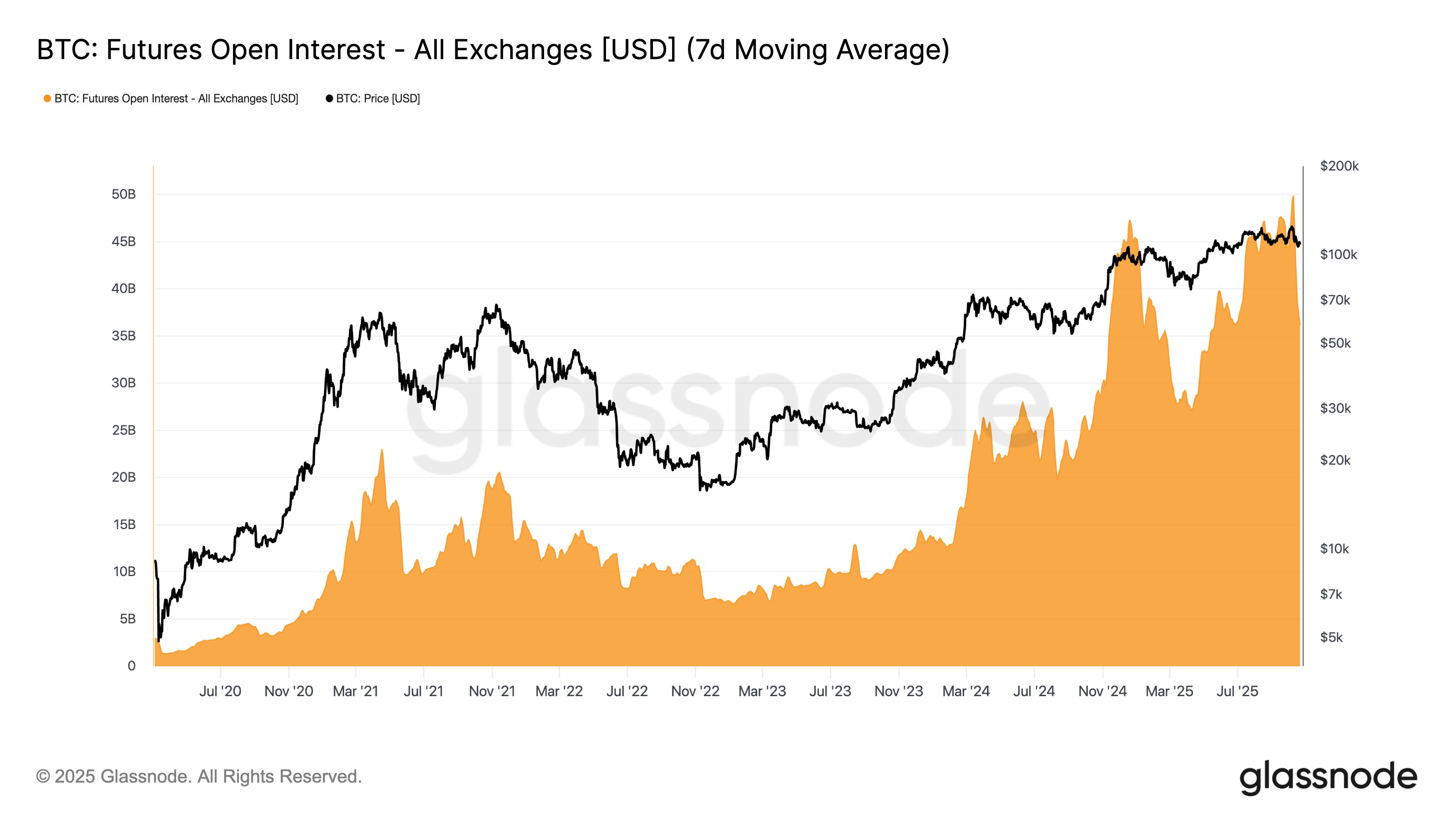
The Open Interest here is naturally a measure of the total amount of positions related to the crypto that are currently open on all derivatives exchanges. First, here is a chart that shows the trend in this metric for the Futures market:
Bitcoin Futures OI

The value of the metric seems to have plunged in recent days | Source: Glassnode on X

As displayed in the above graph, the Bitcoin Futures Open Interest saw peaks above $20 billion in the 2021 bull market and recently reached a high of about $50 billion.

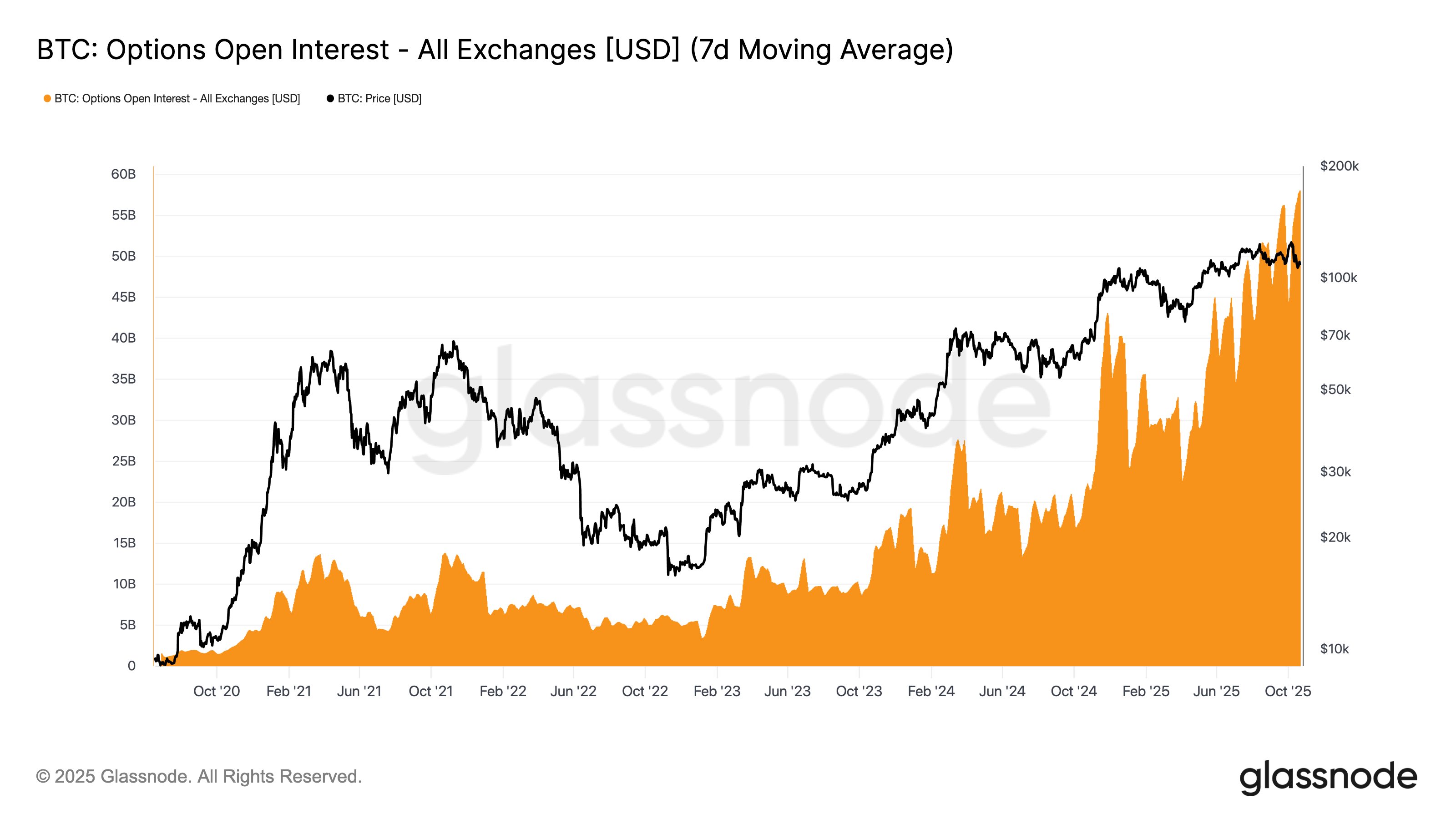
The Options Open Interest couldn’t even break $15 billion in the last cycle, but today its 7-day moving average (MA) value is floating around a new all-time high (ATH) of more than $55 billion.
Bitcoin Options OI

How the BTC Options OI has changed since the last bull market | Source: Glassnode on X

As the analytics firm has explained,

Markets are shifting toward defined-risk and volatility strategies, meaning options flows, rather than futures liquidations, are becoming a more influential force in shaping price action.

Bitcoin Price

At the time of writing, Bitcoin is floating around $107,800, down over 4% in the last 24 hours.

Bitcoin Crypto Price Chart

Looks like the price of the crypto has retraced its latest recovery | Source: BTCUSDT on TradingView
Featured image from Dall-E, Glassnode.com, chart from TradingView.com
Editorial Process for bitcoinist is centered on delivering thoroughly researched, accurate, and unbiased content. We uphold strict sourcing standards, and each page undergoes diligent review by our team of top technology experts and seasoned editors. This process ensures the integrity, relevance, and value of our content for our readers.

Keshav is a Physics graduate who has been employed as a writer with Bitcoinist since June 2021. He is passionate about writing and through the years, he has gained experience working in a variety of niches. Keshav holds an active interest in the cryptocurrency market, with on-chain analysis being an area he particularly likes to research and write about.

Related Reads

A Trillion-Dollar Frenzy for Memory Sellers, Halved Profits for Memory Buyers

Summary: A stark divide has emerged in the tech industry. While memory chipmaker Micron's stock soared 19% in a single day, pushing its market cap over $1 trillion, smartphone manufacturer Xiaomi reported a 43% plunge in adjusted net profit. The core driver is a severe supply crunch in memory chips, particularly for AI applications. Wall Street analysts, led by UBS and its unprecedented 204% target price hike for Micron, argue that long-term agreements (LTAs) from AI cloud giants are fundamentally ending the sector's notorious boom-and-bust cycles, justifying a re-rating from cyclical to infrastructure-like valuations. However, the "storage" market is now fragmented into three tiers. The first, AI-grade memory like HBM and server DDR5, faces extreme shortages and soaring prices driven by massive cloud capex. The second, mobile memory for smartphones, is also seeing sharp price hikes as manufacturers like Xiaomi are forced to pay more for remaining capacity, severely squeezing their margins. The third, PC retail channels, shows price declines due to existing inventory. The article questions the sustainability of the "supercycle" narrative. It highlights that Micron's revenue surge is driven almost entirely by price increases, not shipment volumes, making it vulnerable to a potential demand slowdown. While LTAs may dampen volatility, history suggests they are often tested during downturns. The current peak earnings, used to justify high valuations, represent a classic cyclical top. The piece concludes with a note of caution: when the entire Street chants "this time is different," it's wise to remember past bubbles, even as it acknowledges AI demand may indeed be structural.

marsbit45m ago

A Trillion-Dollar Frenzy for Memory Sellers, Halved Profits for Memory Buyers

marsbit45m ago

This New Generation of US Stock Trading Gods No Longer Read Financial Reports

The new generation of "stock gods" in the 2026 US AI bull market are not analyzing traditional financial reports. Instead of focusing on giants like NVIDIA, figures like the 22-year-old Leopold Aschenbrenner (who reportedly turned $200M into $14B) and influencers like Serenity on platforms like Reddit's WallStreetBets, X, and Substack are gaining fame and returns by targeting obscure, low-cap "micro-cap" stocks. Their strategy, dubbed "supply chain sniping," involves identifying critical, often monopolistic, bottlenecks in the AI hardware supply chain—such as specific materials or components essential for giants like Google and NVIDIA—that are missed by mainstream Wall Street analysts. Serenity's call on AXTI, a $700M company supplying indium phosphide substrates crucial for photonics and optical interconnects, saw the stock soar from ~$12 to nearly $150. Similarly, accounts like KawzInvests and PhotonCap focus on thematic, supply-chain-driven research in areas like AI infrastructure, optics, and cloud services for SMEs, bypassing traditional valuation metrics. This shift represents a cultural move away from Warren Buffett-style value investing based on deep financial statement analysis. The new approach thrives on low liquidity, early narratives, and strong community propagation on social media, similar to meme stocks or crypto. However, this "attention economy" strategy carries risks: it depends on sustained information gaps, the underlying companies' ability to deliver fundamental results, and the potential for crowded, volatile exits as narratives shift. The trend also shows crypto traders applying their narrative-sensing skills to US micro-caps, marking a significant evolution in trading culture.

marsbit47m ago

This New Generation of US Stock Trading Gods No Longer Read Financial Reports

marsbit47m ago

Trillion-Dollar Euphoria for Memory Sellers, Halved Profits for Memory Buyers

Title: The Trillion-Dollar Memory Seller's Carnival vs. The Buyer's Halved Profits On May 26, a stark contrast unfolded. While memory chipmaker Micron's market cap surged past $1 trillion, smartphone maker Xiaomi reported plummeting profits. Xiaomi's Q1 2026 profits fell 43% year-on-year. Executive Lu Weibing cited memory prices quadrupling from last year, adding roughly $210 to a phone's cost. To survive, Xiaomi is cutting entry-level models, sacrificing volume. Micron's stock, however, skyrocketed over 19% in a day, capping an 8x gain in a year. Major banks like UBS and JPMorgan issued bullish reports, raising price targets drastically. Their core thesis: Long-Term Agreements (LTAs) with AI cloud giants (Microsoft, Google, etc.) are eliminating the memory industry's notorious boom-bust cycle. By locking in fixed-price, multi-year contracts for AI-grade memory (HBM, server DDR5), these deals promise stable, utility-like earnings, justifying a higher valuation (20-30x P/E vs. the historical 8-15x). The article reveals a three-tiered memory market in 2026: 1) **AI Storage (HBM/DDR5/Enterprise SSD)**: Extreme shortage, soaring prices, LTAs. This is Micron's story. 2) **Mobile/Embedded Memory**: Also facing sharp price hikes as AI production crowds out capacity, severely pressuring phone makers like Xiaomi. 3) **PC Retail**: Some spot prices are falling due to channel inventory liquidation, creating a divergence from contract markets. The author questions if LTAs truly end the cycle. It hinges on sustained, hyper-growth AI demand. Micron's current profits are at a cycle peak, driven mostly by price hikes, not volume. If AI capital expenditure growth slows, the massive industry capacity expansion (e.g., Micron's $250B+ CapEx plan) could lead to a glut. Historically, using peak-cycle earnings for valuation is a classic trap. While the AI-driven structural shift might be real, the unanimous Wall Street euphoria warrants caution, echoing past bubbles like Cisco's in 2000. The memory seller's trillion-dollar狂欢 (carnival) continues, but the cycle's shadow remains.

链捕手54m ago

Trillion-Dollar Euphoria for Memory Sellers, Halved Profits for Memory Buyers

链捕手54m ago

Trading

Spot
Futures
活动图片