Pi Coin выделяется на падающем рынке — что будет с ценой дальше

cryptonews.ruPublished on 2025-05-14Last updated on 2025-10-15

Pi Coin показал себя лучше, чем многие крупные криптовалюты, несмотря на падение крипторынка более чем на 3%. Пока биткоин, Ethereum и BNB снижались на 3-12%, цена Pi Coin упала всего на 1,5% за последние сутки, демонстрируя редкую устойчивость. Однако трейдеры сейчас стоят перед выбором: на графике криптовалюты два противоположных сигнала

Рассказываем, будет ли следующий шаг восстановлением или инвесторам стоит подготовиться к новой волне падения Pi Coin.

Что такое Pi Network — скам или майнинг-революция

Два сигнала и неопределенный исход

График Pi Coin показывает интересное противостояние между силой покупок и слабостью импульса — двумя сигналами, которые обычно определяют краткосрочное движение цены.

Индекс денежного потока (MFI), отслеживающий движение денег в актив и из него, рос, даже когда цена Pi Coin достигла нового минимума с 1 августа по 9 октября. Такое положение считают бычьей дивергенцией. Она указывает на то, что, несмотря на падение цен, на рынок тихо вошли новые покупатели. Это отражает растущий интерес розничных инвесторов — медленный процесс накопления, который часто формирует основу для восстановления.
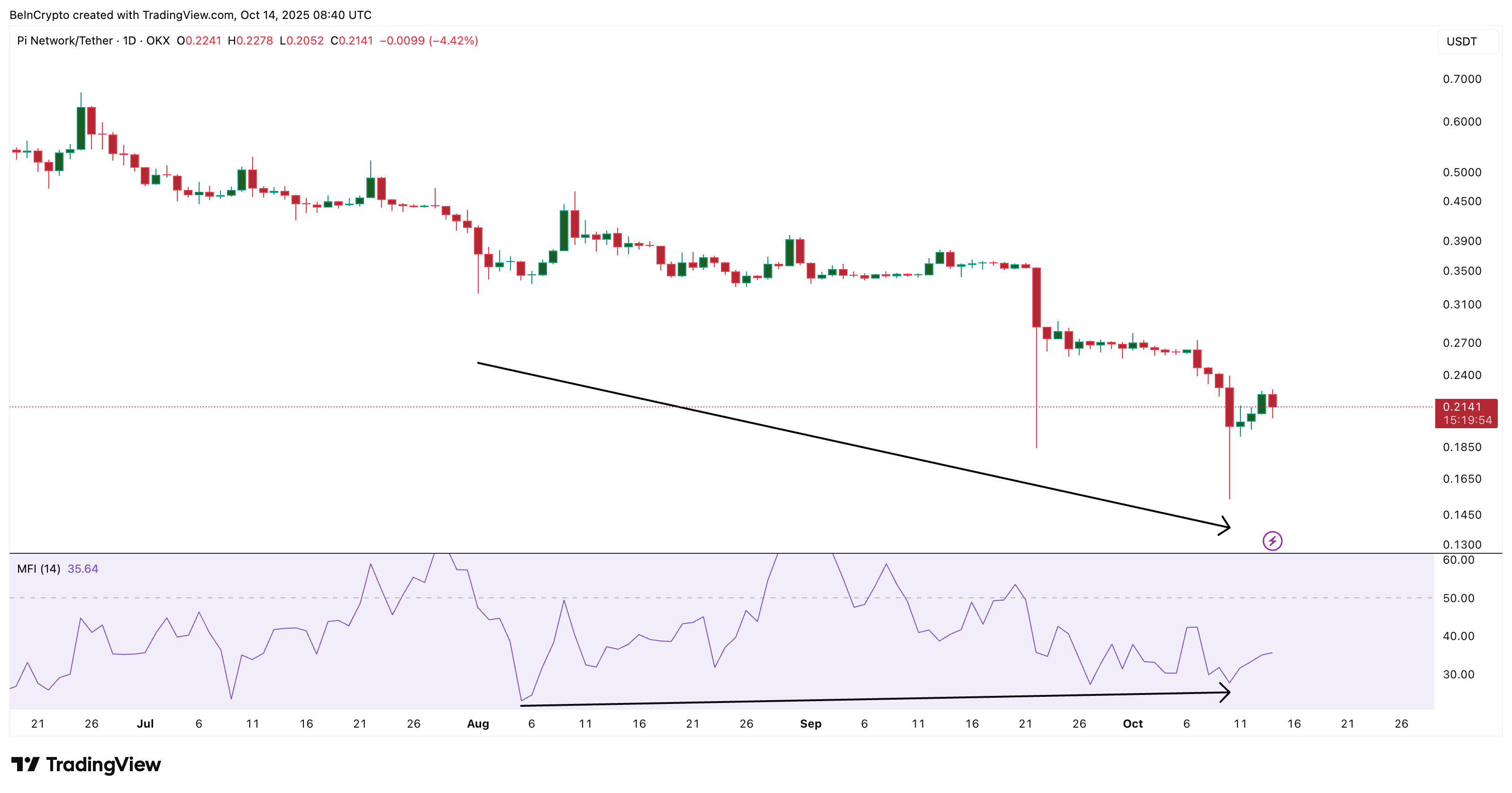
Pi Coin Showing Money Flow
Pi Coin показывает денежный поток: TradingView

С 6 по 13 октября индекс относительной силы (RSI) Pi Coin показал скрытую медвежью дивергенцию. Локальные максимумы продолжали снижаться, тогда как RSI поднялся выше. Такое положение указывает на ослабление покупательского импульса, несмотря на попытки краткосрочного восстановления.
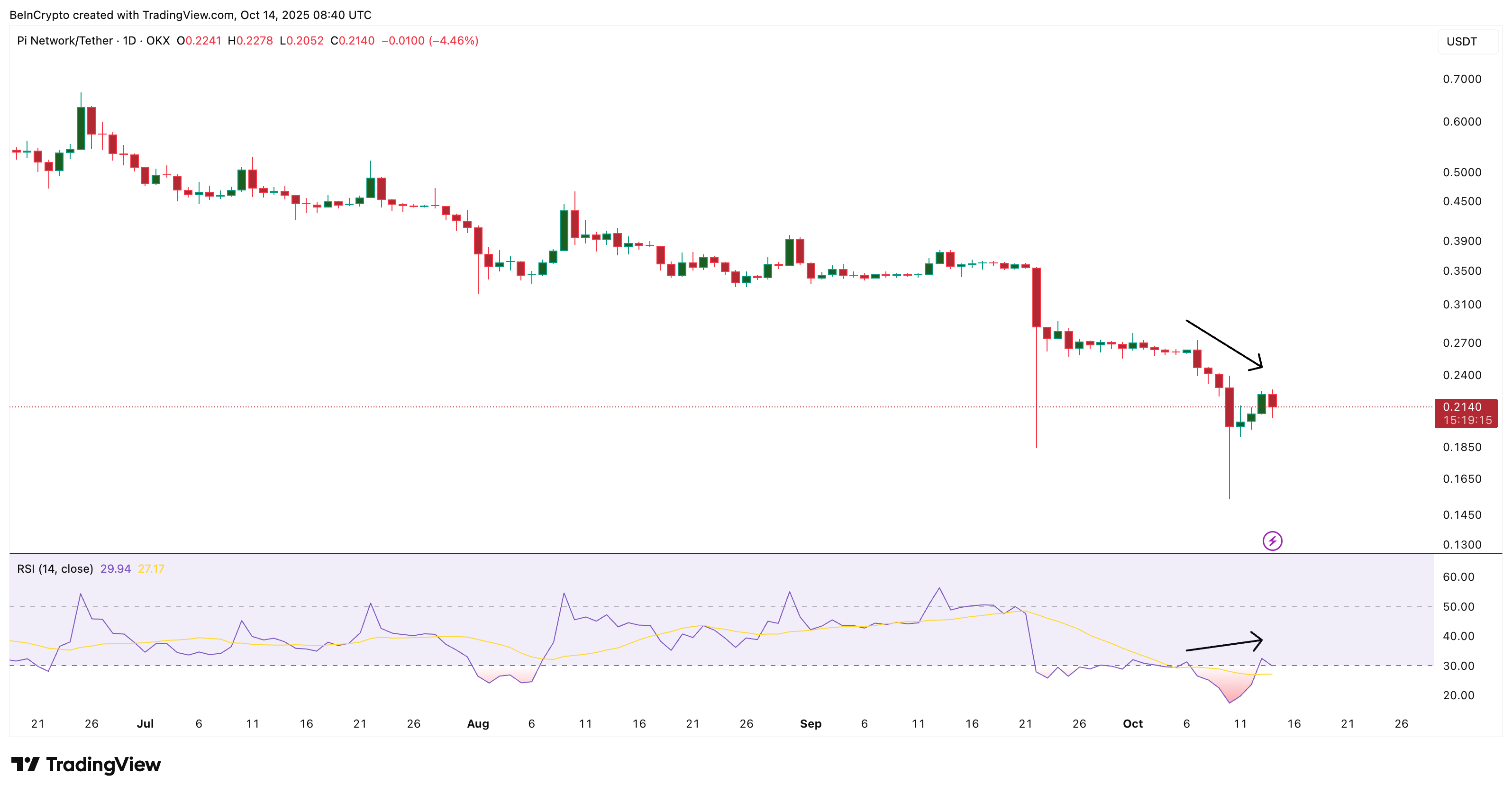
Pi Coin RSI показывает медвежий настрой
Pi Coin RSI показывает медвежий настрой: TradingView

Эти два показателя могут отражать разные стадии одного процесса: MFI указывает на раннее накопление, а RSI предупреждает о возможном сопротивлении при восстановлении. Для трейдеров это означает нейтральную ситуацию. Действовать нужно с осторожностью до подтверждения направления.

Падающий клин

Цена Pi Coin торгуется внутри нисходящего клина — паттерна, который часто указывает на возможный бычий разворот на дневном графике. Чтобы подтвердить силу быков, дневная свеча Pi Coin должна подняться выше $0,29. Изменения могут спровоцировать выход из клина и привлечь новый объем покупок.
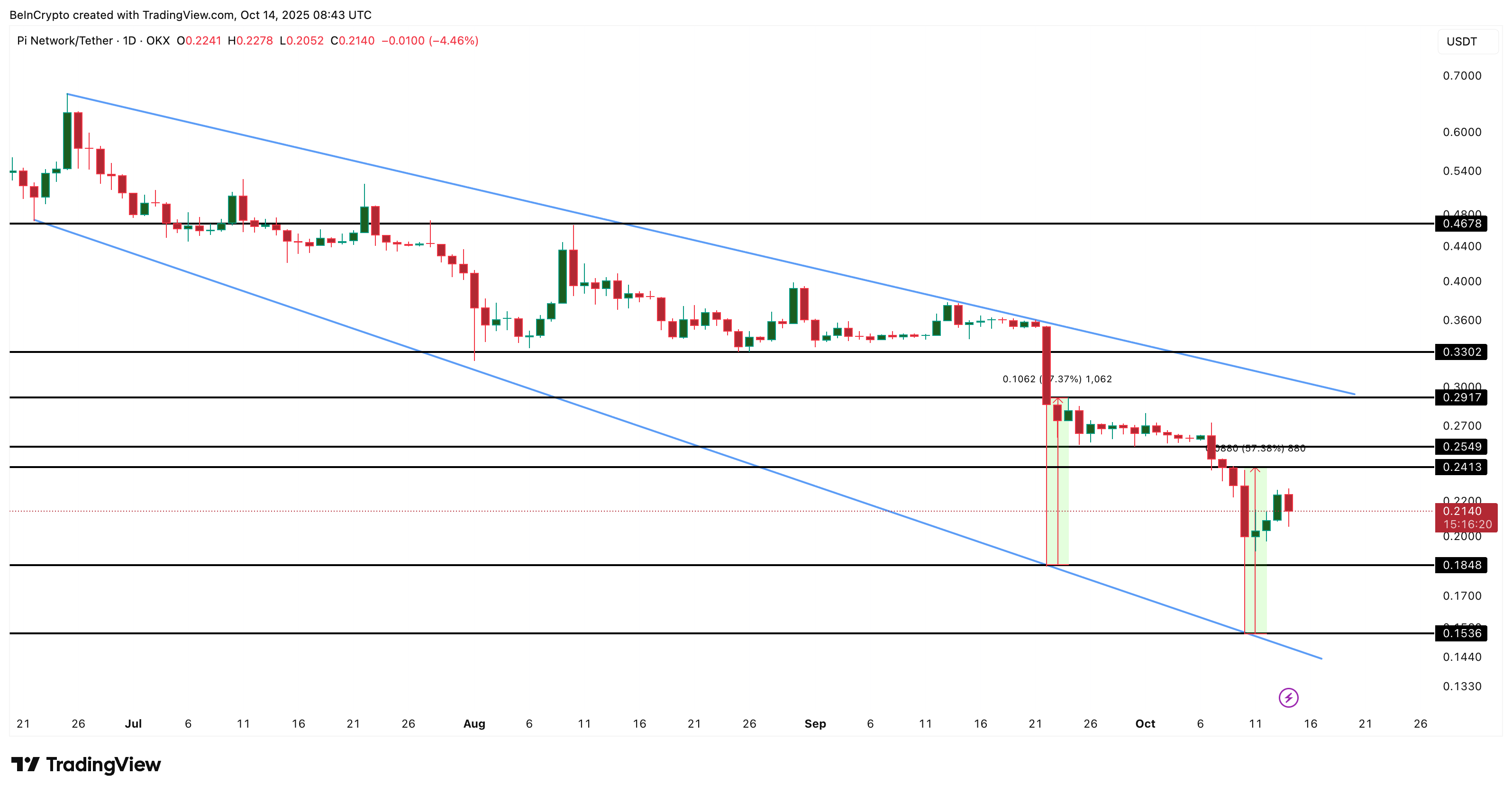
Анализ цены Pi Coin
Анализ цены Pi Coin: TradingView

Если взглянуть на историю поведения монеты, можно ожидать повторения отскока 22 сентября. Тогда PI вырос на 57% с $0,18 до $0,29. Такое положение указывает на краткосрочные цели около $0,24–$0,25, с возможным движением к $0,29, если импульс усилится. Пробой уровня $0,29 подтвердит бычий тренд для Pi Coin.

На момент написания Pi Coin (PI) торгуется около $0,21, с сильной поддержкой на уровнях $0,18 и $0,15. Закрытие ниже $0,15 приведет к пробою клина вниз, что отменит бычий сценарий.

Сейчас PI остается одной из немногих монет, которые превосходят рынок, но все еще балансируют на грани. Исход определит противостояние накопления по MFI против слабости по RSI. В первом случае быки получат дополнительный импульс, во втором — возможен откат.


Related Reads

The Entire Internet Hails Noam's Joining, But OpenAI's Loss Bill Just Got Thicker

While the AI community celebrates Noam Shazeer, co-author of the "Attention Is All You Need" paper, joining OpenAI as Head of Architectural Research, the company's audited financials reveal a starkly different reality. In 2025, OpenAI reported $13.07 billion in revenue but a massive $20.92 billion operating loss. Even excluding a one-time accounting charge, the cash burn is severe, with $3.7 billion consumed in Q1 2026 alone. This high-profile hiring occurs against a backdrop of significant internal research talent drain, with key founders and researchers departing as the company's focus shifts from exploratory research to product iteration. Meanwhile, OpenAI's fundamental business model faces a deep crisis. It paid Microsoft $10.59 billion for compute in 2025, while its vast user base of 9 billion weekly actives includes only 50 million paying customers, making growth a direct driver of escalating costs. The article argues Shazeer's recruitment is less about technical necessity and more about crafting a compelling narrative for OpenAI's upcoming IPO, aiming to justify a rumored $1 trillion valuation to future public market investors. It contrasts OpenAI's strategy with Anthropic's reported path to profitability, which relies on a strong enterprise customer base and cost control, rather than star-powered narratives. Ultimately, the piece concludes that while Shazeer's architectural work may take 1-2 years to materialize, OpenAI's financial clock is ticking much faster, with its massive losses undercutting the celebratory headlines.

marsbit20m ago

The Entire Internet Hails Noam's Joining, But OpenAI's Loss Bill Just Got Thicker

marsbit20m ago

Market Trend (June 19): US-Iran Deal Drives Out Geopolitical Premium; Chip Stocks Soar to New Highs; Energy Sector Leads Declines

U.S. Market Trends (June 19): U.S.-Iran Deal Eases Tensions, Chip Stocks Soar, Energy Sector Leads Declines. U.S. stocks rallied on Thursday as the signing of a temporary U.S.-Iran deal in Geneva de-escalated Middle East tensions, with Saudi oil tankers transiting the Strait of Hormuz. This geopolitical relief helped markets recover from recent Fed-driven volatility. The S&P 500 rose over 1%, the Nasdaq gained nearly 2%, and the Dow Jones Industrial Average closed at another record high. The Philadelphia Semiconductor Index surged over 6% to a historic peak. Chip stocks were the standout performers. Reports of an Apple-Intel design and foundry deal for certain products, alongside mentions of potential Nvidia and SpaceX collaborations with Intel, propelled the sector. Intel surged ~10.5%, while memory chip makers like Micron also saw significant gains, highlighting sustained confidence in long-term AI capital expenditure. In contrast, the energy sector was the day's sole loser, with the S&P 500 energy sub-index declining as WTI crude fell ~2% to around $74.29/barrel. The reopening of key shipping routes erased prior geopolitical risk premiums. SpaceX extended losses for a second day on news of a potential large bond offering. Market volatility (VIX) dropped sharply, indicating a swift reversal of post-Fed jitters. Treasury yields dipped slightly but remained elevated. The focus now shifts to upcoming economic data, including next week's PCE inflation report and Micron's earnings, which will serve as a key test for the AI trade's durability.

marsbit42m ago

Market Trend (June 19): US-Iran Deal Drives Out Geopolitical Premium; Chip Stocks Soar to New Highs; Energy Sector Leads Declines

marsbit42m ago

Will MicroStrategy Fall Into a Death Spiral? How Will the Macro Outlook Evolve in the Second Half of the Year?

**Summary:** The discussion centers on recent Bitcoin price declines and the evolving financial strategy of MicroStrategy (MSTR). The core argument is that the primary pressure is not from one-off Bitcoin sales by MSTR, but from the market's new expectation that MSTR may need to engage in *sustained, small-scale* Bitcoin sales to cover cash flow obligations for its growing portfolio of preferred shares and debt instruments (like STRC). This shift is driven by its stated goal of maintaining "bitcoins per share neutrality." The market is now testing whether it can absorb this potential ongoing selling pressure without entering a severe "death spiral" with Bitcoin's price. A resolution may involve MSTR softening its approach to avoid damaging both its stock and Bitcoin. The conversation then explores the parallel rise of AI-related stocks. The guest posits that AI is fundamentally restructuring labor, with "tokens" (representing access to AI models/compute) becoming a new form of capital and a substitute for human execution. This drives corporate efficiency and profits, benefiting upstream hardware providers (semiconductors, data centers), which explains the sustained rally. This represents the early stages of a "machine economy." Regarding crypto exchanges offering US stock trading, this is seen as a natural evolution. With few crypto-native assets generating lasting value, exchanges are pivoting to distribute valuable real-world assets (RWAs). This doesn't necessarily harm crypto's long-term prospects, as blockchain infrastructure may become crucial for future machine-to-machine economies. The analysis concludes that the era of rampant altcoin speculation is likely over, heavily damaged by the liquidity shock of the "1011" event (likely referring to a major market crash). Meme-driven capital has largely migrated to US equities. Looking ahead, macroeconomic uncertainty is rising due to potential large IPOs (e.g., SpaceX) and the US elections. While short-term market corrections are possible, the long-term trends of AI-driven productivity gains and the maturation of blockchain towards real-world utility and institutional adoption remain intact.

marsbit46m ago

Will MicroStrategy Fall Into a Death Spiral? How Will the Macro Outlook Evolve in the Second Half of the Year?

marsbit46m ago

Trading

Spot
Futures
活动图片