Best Crypto to Buy as FOMC Minutes Signal More Possible Rate Cuts and Bitcoin Continues to Climb

bitcoinistPublished on 2025-10-09Last updated on 2025-10-09

Abstract

Quick Facts: 1️⃣ The latest FOMC published minutes indicate general support for more rate cuts. 2️⃣ The ‘dual mandate’ remains...

Trusted Editorial content, reviewed by leading industry experts and seasoned editors. Ad Disclosure

Quick Facts:

  • 1️⃣ The latest FOMC published minutes indicate general support for more rate cuts.
  • 2️⃣ The ‘dual mandate’ remains in play, forcing the Fed to balance lowering inflation and increasing employment
  • 3️⃣ The Fed’s move sets up the best crypto to buy now to build on the market’s momentum, with the potential for two more cuts this year.

The much-anticipated minutes from the Fed’s September 16-17 meeting finally became public, and they’ve sparked renewed optimism across markets.

Since the quarter-point cut on September 17, Bitcoin has risen by approximately 6.5%. The FOMC minutes suggest that additional rate cuts could be ahead, potentially boosting Bitcoin – and the broader crypto market – even further. That macro shift could make these tokens – $HYPER, $PEPENODE, and $MNT – among the best crypto to buy now.

The minutes suggest a Fed increasingly open to further easing. Several officials indicated willingness to consider additional rate cuts this year, and a notable number of participants expect around two more quarter-point reductions.

That’s a modestly dovish tilt when compared to earlier stances.

But the minutes also reveal the Fed’s perpetual dilemma: balancing employment and interest rates. The Fed has only one tool to impact the market – and that’s interest rates. But lowering or raising interest rates has more or less the opposite effect on each.
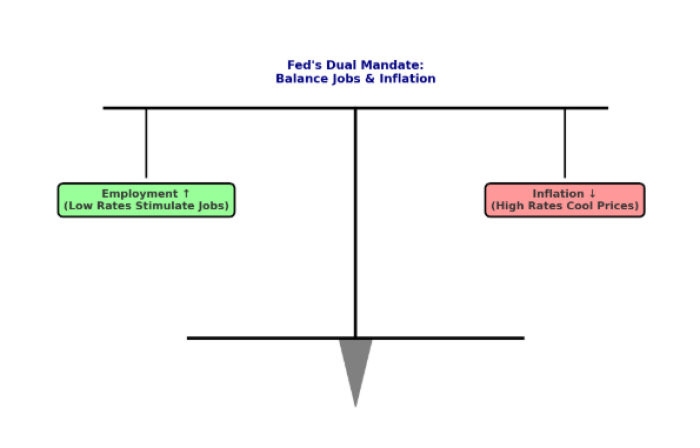
The Fed's dual mandate to balance jobs and inflation.

Raise interest rates, and you reduce consumer spending by prompting people to save more, in the hope of eventually cooling inflation. With inflation well above the Fed’s target of 2%, this helps explain why the Fed has kept interest rates high.

But unemployment is a thornier problem. Keep interest rates too high for too long and economic vibrancy falls, with fewer new jobs and less growth. That causes unemployment to climb back up.

With a nine-month streak of no rate cuts, the Fed clearly thought for a while that inflation was the greater concern. But that has changed as unemployment has slowly, steadily ticked upwards:
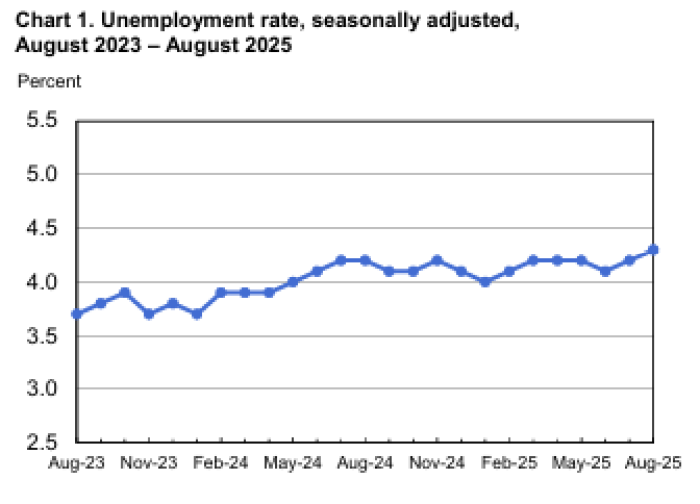
Unemployment rates, seasonally adjusted, for 2023-2025.

The so-called ‘dual mandate’ is nothing new, but eventually dovish heads prevailed, causing the Fed to issue its first rate cut in nine months in September. The minutes reveal that some governors argued for more drastic reductions – one even favored a half-point cut rather than the standard quarter-point cut.

Bitcoin Responds Bullishly

Crypto markets, always sensitive to monetary policy shifts, reacted positively. Bitcoin recorded a bounce as traders clearly hoped that looser policy would flow liquidity into risk assets. The reasoning is straightforward: lower interest rates ease the burden on growth and raise the appeal of alternative assets.

In this light, the minutes seem to support a positive backdrop for crypto.

At the same time, the release makes clear that future moves will depend heavily on economic data. The dual mandate remains in effect, and inflation and employment figures will be crucial. If inflation persists or job markets remain robust, the Fed may hold back on future rate cuts.

The market currently expects another rate cut; if that expectation isn’t met, there could be even more recoil.
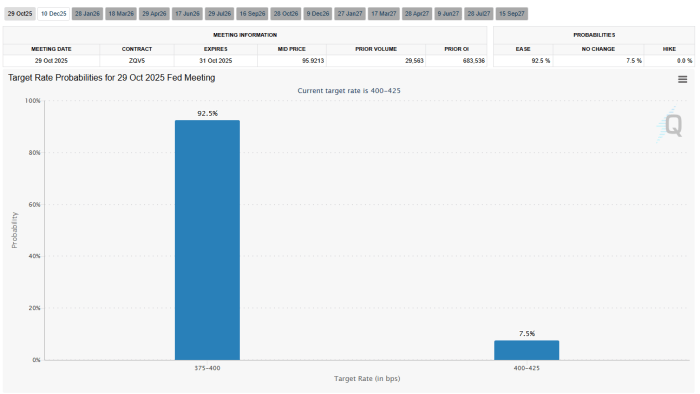
Fedwatch expected rate cuts at next Fed meeting.

The FOMC minutes nudged markets toward an expectation of a more accommodative Fed that invigorates crypto momentum. But with the road ahead still uncertain, it’s more important than ever to find the best crypto to buy now to take advantage of the volatility.

Here are three you can’t miss – a utility token, a meme coin with mega-ambitions, and an altcoin on the rise.

1. Bitcoin Hyper ($HYPER) – Bitcoin Layer 2 for Faster, Cheaper Bitcoin Transactions

Bitcoin is reliable, secure, and slow. That makes it fantastic as a store of value, but less than ideal for everyday transactions.

Bitcoin needs to speed up dramatically in order to really break through as an ‘everyday’ crypto. Fortunately, there’s a blockchain out there with speeds a lot higher than Bitcoin’s average of 7 TPS.

That’s Solana – and by extension, the Solana Virtual Machine (SVM) – which regularly executes thousands of transactions per second.

Bitcoin Hyper ($HYPER) leverages a Canonical Bridge to move $BTC to the Hyper Layer 2, creating wrapped Bitcoin that can be swapped and traded with minimal fees and at lightning-quick speeds.
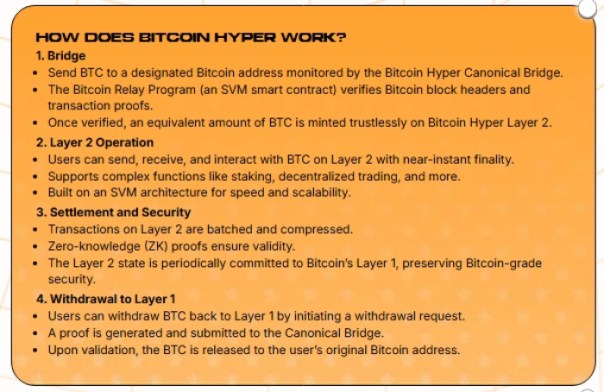
How does Bitcoin Hyper work?

What is Bitcoin Hyper? It’s a hybrid Layer 2 solution that opens up the full range of everyday transactions for Bitcoin.

🧠 Learn how to buy $HYPER and see why our price prediction shows the token could reach $0.32 by the end of the year, up 2345% from its current $0.013085.

Check out the Hyper presale page for the latest info.

2. PepeNode ($PEPENODE) – Gamified Meme Coin Mining

You don’t mine memes; they make them. At least, that’s until now. With PepeNode ($PEPENODE), investors stake $PEPENODE to upgrade their own virtual mining rig and earn rewards in meme coins.

How it works: You buy and stake your PEPENODE in the presale stage. Not only do you get 731% rewards APY during the presale, but once it ends, you can also mine to earn $PEPENODE and in other popular meme coins like $FARTCOIN and $PEPE.

Mine-to-earn Memecoin: PEPENODE presale is live.

🪙 Learn how to buy PepeNode with our guide.

Investors can upgrade their rigs, adding more nodes to mine memes faster. You get different kinds of nodes, and can combine them to supercharge your mining capabilities and $PEPENODE yield.

Gamifying meme coin earning could boost the prospects for this little green frog meme.

The presale has raised $1.7M from early backers. If momentum continues to grow, this price prediction indicates that $PEPENODE could reach $0.0023 by the end of the year, up from its current value of $0.0010918.

That’s a potential return of over 110% and puts PepeNode firmly on our list of the best cheap crypto to buy.

Try your hand at meme coining mining at the PepeNode website.

Mantle ($MNT) – Ethereum Layer 2 for the Future of DeFi

DeFi provides ample opportunities for yield farming and staking, but the ecosystem is fractured, with a few big players (like Hyperliquid) and numerous up-and-comers.

Mantle ($MNT) is one of the latter. The $MNT token is up over 300% since last year, with over $255M in TVL on the protocol.
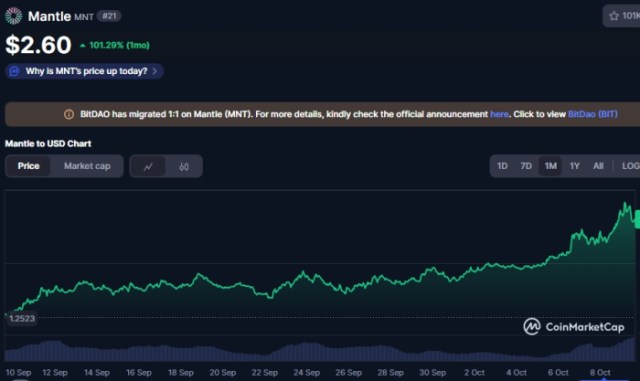
Mantle ($MNT) price performance on Coinmarketcap.
Source: CoinMarketCap

The network provides a blockchain for building more apps, and a liquid staking protocol for yield farming. There are also tools – such as the Mantle Index Four – focused on building out institutional DeFi adoption.

The surge in $MNT reflects rising confidence in the protocol and the token’s upside potential. With more rate cuts on the horizon, appetite for risk assets like crypto is heating up, with $MNT clearly in the spotlight.

Looking ahead, further cuts – perhaps one in October, another in December – require the data to cooperate. Surprises in inflation or employment could force a market reset.

Either way, $HYPER, $PEPENODE, and $MNT could turn out to be some of the best cryptos to buy in the months to come.

As always, do your own research. This isn’t financial advice.

Authored by Bogdan Patru for Bitcoinist — https://bitcoinist.com/fomc-minutes-signal-more-possible-rate-cuts-as-bitcoin-continues-to-climb

Editorial Process for bitcoinist is centered on delivering thoroughly researched, accurate, and unbiased content. We uphold strict sourcing standards, and each page undergoes diligent review by our team of top technology experts and seasoned editors. This process ensures the integrity, relevance, and value of our content for our readers.

As a crypto writer, Bogdan’s responsibilities are split between researching and writing articles and entertaining the team with his humor bordering on the politically incorrect, an aspiring Bill Burr, if you will. Thanks to his 12+ years of writing experience in just as many fields, including tech, cybersecurity, modelling, fitness, crypto, and other topics-that-shall-not-be-named, he's become a genuine asset to the team. While his position as a senior writer at PrivacyAffairs thought him valuable lessons about the power of self-management, his entire writing career was and is an exercise in self-improvement. Now, he's ready to sink his teeth into crypto and teach people how to take control of their own money on the blockchain. With fiat as an eternally devaluing currency, Bitcoin and altcoins seem like the best-fitting alternative for Bogdan. Bogdan’s biggest professional accomplishment, aside from securing a position as a main writer for Bitcoinist, was his 5-year run as a writing manager at Blackwood Productions, where he coordinated a team of four writers. During that time, he learned the value of teamwork and that of creating a working environment that breeds efficiency, positivity, and friendship.

Related Reads

Three Years Later: Looking Back at My Predictions About ChatGPT in 2023

Three Years Later: Revisiting My 2023 Predictions on ChatGPT In March 2023, shortly after ChatGPT's launch, I made 20 predictions about its future. Now, in mid-2026, I've used AI agents to fact-check each one against the latest data. Overall, most major directional forecasts were correct, with only one outright error (incorrectly stating GPT-4 had 100 trillion parameters). Key successes included predicting that RAG and retrieval architectures would become the standard for handling knowledge and hallucinations, that natural language interfaces (LUI) would create a massive new industry layer beyond the models themselves, and that China would develop viable large language models, significantly closing the performance gap with Western counterparts within about three years. Predictions about the absence of mass unemployment, the rise of a new "robot network" for agent communication, and ChatGPT not possessing consciousness also held true in their core arguments. However, the "devil was in the details." Errors frequently involved specific numbers, timelines, or overlooking distributional effects. I tended to overestimate the speed of adoption (e.g., for agent networks) while underestimating the ultimate scale of capabilities or costs (e.g., AI winning IMO gold without tools, or the extreme capital required for frontier models). Other misjudgments included: underestimating how AI would reinforce, not dissolve, information filter bubbles; incorrectly assuming AI-generated content would easily circumvent copyright (it has instead triggered record-breaking settlements); and misidentifying where value would be captured (it accrued overwhelmingly to the compute layer, like Nvidia, not just the application or model layers). Key lessons from reviewing these predictions are: 1) Directional and mechanistic insights are far more reliable than precise numbers or absolute statements. 2) There's a consistent bias to overestimate short-term speed but underestimate long-term magnitude. 3) Errors often lie in missing distributional impacts within a generally correct aggregate trend. 4) Predictions phrased with nuance and caveats aged the best. 5) Some fundamental debates (e.g., on machine consciousness or the ultimate value chain) remain unresolved even after three years. This exercise is less about scoring the past and more about establishing rules for clearer thinking about the next three years of AI.

marsbit3m ago

Three Years Later: Looking Back at My Predictions About ChatGPT in 2023

marsbit3m ago

Three Years Later: Looking Back on My 2023 Predictions for ChatGPT

Looking Back After Three Years: Revisiting My 2023 Predictions on ChatGPT In March 2023, shortly after ChatGPT's debut and before GPT-4's release, I made over twenty predictions about AI's future based on limited information and intuition. Now, in May 2026, I revisited those forecasts using an AI-driven analysis with 41 Opus 4.8 agents to cross-reference them with the latest data. The assessment used symbols: ✅ Correct, 🟢 Mostly Correct, 🟡 Partially Correct, ❌ Incorrect. Overall, the directional judgments held up well, with only one major factual error regarding GPT-4's rumored parameter size (incorrectly cited as 100T). However, nuances and degrees of accuracy revealed more. **What Was Largely Correct:** Predictions about mechanisms and directions proved accurate. The rise of RAG (Retrieval-Augmented Generation) as the standard architecture for combating AI hallucination was confirmed, as was the transformative potential of LUI (Language User Interface) in creating a new industry layer atop GUIs. The emergence of "robot networks" (agent-to-agent communication protocols) and China's rapid catch-up in developing capable large models (closing the performance gap with top models to ~2.7%) were also on point. The analysis affirmed that LLMs lack consciousness and that the Turing Test merely measures perceived intelligence. **What Was Off Target:** Errors often involved specific numbers, over-optimistic timelines, or misjudged distributions. The prediction that value would primarily accrue to the application layer was half-right but missed NVIDIA's dominance as the profitable infrastructure layer. Forecasts about AI circumventing copyright issues and fostering a "global common ground" by averaging human viewpoints were incorrect; instead, major copyright settlements occurred and AI personalization is increasing. Estimates for model training costs ("$5-10 billion cap") were significantly off, underestimating frontier costs and overestimating replication costs. The notion that LLMs could never do complex math without tools was disproven by later models winning IMO gold. **Key Patterns from the Review:** 1. **Direction over precision:** Judgments about mechanisms and trends were more reliable than specific numbers or definitive statements. 2. **Timing bias:** There was a tendency to overestimate short-term speed but underestimate long-term magnitude and transformation. 3. **The distribution blind spot:** Aggregate-level correctness often masked uneven impacts (e.g., on young professionals' employment). 4. **The value of qualifiers:** Predictions framed with caution (e.g., "reportedly," "for now," "prototype in 2-3 years") aged better. 5. **Some debates continue:** Issues like the nature of "emergent abilities" or machine consciousness remain unresolved. This three-year review highlights that while seeing the big picture is crucial, humility regarding specifics, timelines, and disparate impacts is essential for future forecasting.

链捕手2h ago

Three Years Later: Looking Back on My 2023 Predictions for ChatGPT

链捕手2h ago

AI Bubble Warning: AI Investments Are Negative Returns for Most Tech Giants

The article issues a stark warning about a potential AI investment bubble. It notes that while the AI boom shares similarities with the TMT bubble of the late 1990s, its scale is vastly larger, currently driving 93% of U.S. GDP growth. Major hyperscale cloud providers like Microsoft, Alphabet, Amazon, Meta, and Oracle are planning to invest trillions in AI data centers over the coming years. However, calculations based on analyst projections for 2025-2030 reveal a concerning math problem: expected capital expenditure growth far outpaces projected revenue growth. Even under an extremely optimistic scenario of zero costs, the implied return on investment for most of these tech giants (except Amazon) is deeply negative. This suggests that the current trajectory could lead to one of history's largest shareholder value destruction events. The piece outlines two potential escapes: AI generating vastly more revenue than currently anticipated—a near-impossible task—or a significant cutback in the planned investment splurge. The latter scenario could trigger a domino effect, severely impacting the entire tech supply chain (from Nvidia to TSMC), potentially pushing the U.S. economy into recession, and causing a major stock market downturn. The author suggests upcoming high-profile IPOs by companies like OpenAI and Anthropic might represent a transfer of risk from early investors to public market participants. While the peak of the hype cycle might sustain investment through 2026, the fundamental financial dilemma remains unresolved, setting the stage for a potential market correction in 2027 or 2028, similar to the years following Alan Greenspan's "irrational exuberance" warning.

marsbit3h ago

AI Bubble Warning: AI Investments Are Negative Returns for Most Tech Giants

marsbit3h ago

From Tokens to Machine Labor: AI is Shifting from Tool to "Worker"

The article "From Token to Machine Labor: AI is Evolving from Tool to 'Worker'" argues that the business model for AI is shifting beyond simply selling computational resources (tokens, GPU hours) or model access. Instead, a new "machine labor market" is emerging, where the core economic transaction is the purchase of economically useful work directly performed by software. The central thesis is that AI pricing will evolve through four stages: 1) raw tokens, 2) standardized LLM capabilities (e.g., text generation), 3) industry-specific labor markets (e.g., legal review, radiology), and finally 4) a programmable results market where tasks like resolving a support ticket are bid on and priced based on outcome. In this future, buyers will care less about *which* model or GPU completes a task and more about whether the work meets specified standards for accuracy, latency, and cost. This transition reframes the impact of AI on human labor. Rather than simple replacement, it suggests a re-coordination where machines handle standardized, verifiable work, freeing humans for roles involving oversight, context management, responsibility, and final judgment. In some cases, this "last 1%" of human input becomes more valuable as it enables the other 99% to be automated. Furthermore, as AI reduces the cost of work, demand may expand, creating larger markets (e.g., 24/7 customer service) rather than just cheaper versions of existing ones. The article concludes that while infrastructure (GPUs, models, tokens) remains crucial upstream, the market is converging on a simpler, tradeable unit: machine labor that can be defined, measured, priced, and procured based on contractible specifications.

marsbit3h ago

From Tokens to Machine Labor: AI is Shifting from Tool to "Worker"

marsbit3h ago

Xiaomi MiMo's 99% Price Cut is Not Marketing! Luo Fuli Posts on X to Refute Critics

The price of Xiaomi's MiMo-V2.5 series API has been permanently reduced by up to 99%, specifically for the "Input (Cache Hit)" cost, which covers users re-reading historical context in long conversations. MiMo's head, Luo Fuli, published a detailed technical blog to clarify that this drastic price cut stems from genuine engineering breakthroughs, not a marketing stunt or a simple price war. The core of the achievement lies in six key engineering optimizations. First, the model architecture adopts a Hybrid Sliding Window Attention (SWA), reducing the memory footprint (KVCache) to 1/7th of a traditional model. Second, a dual-pool memory management system actually utilizes these savings, allowing a single GPU to handle over 5 times more concurrent users. Third, an upgraded prefix caching mechanism achieves a cache hit rate of 93-95% for repeated reads, meaning most such requests bypass GPU computation entirely. Fourth, a self-developed distributed cache (GCache) utilizes idle SSD space on existing GPU servers, eliminating additional storage costs. Fifth, an intelligent scheduling system (LLM-Router) efficiently routes requests to maximize cache reuse and performance. Sixth, Multi-Token Prediction (MTP) accelerates the model's text generation ("output") side. Together, these systemic optimizations dramatically lower the real computational cost per request, enabling the 99% price reduction for cached inputs while reportedly maintaining positive gross margins. Luo Fuli's disclosure aims to shift the narrative from "price war" to a demonstration of substantive AI engineering progress.

marsbit5h ago

Xiaomi MiMo's 99% Price Cut is Not Marketing! Luo Fuli Posts on X to Refute Critics

marsbit5h ago

Trading

Spot
Futures
活动图片