CleanCore Boosts Dogecoin Holdings To 710M Tokens With $20M in Profits

TheCryptoTimesPublished on 2025-10-07Last updated on 2025-10-07

CleanCore Solutions (Nasdaq: BNC) has updated investors on its Dogecoin Treasury, revealing holdings of 710 million DOGE valued at roughly $182 million, with over $20 million in unrealized gains. The company said it remains on track toward its near-term milestone of acquiring 1 billion DOGE, a plan backed by the Dogecoin Foundation and its corporate division, House of Doge.

In its latest press release, CleanCore said that the firm raised $175 million in September through a private placement to fund the Treasury, which it calls a “disciplined and phased approach” to long-term value creation. The sequential Dogecoin purchases are executed through Bitstamp by Robinhood, which it named as its designated trading venue for transparency and custody.
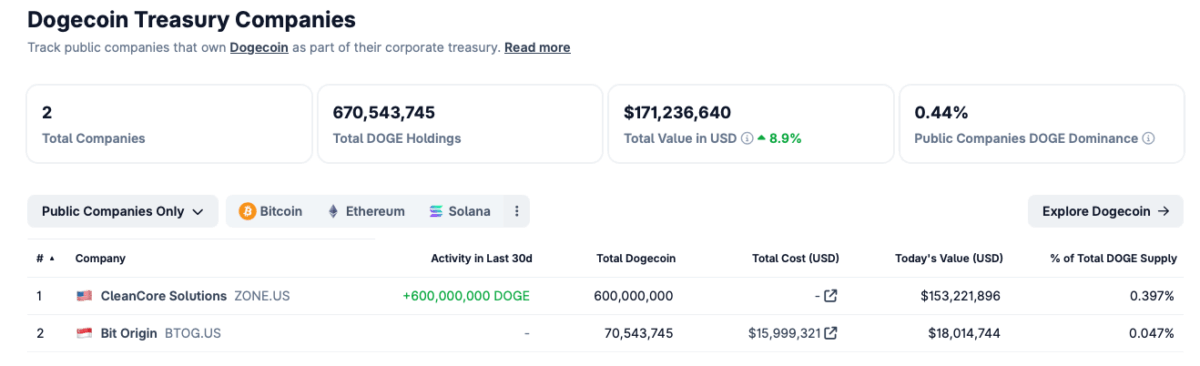
Cleancore Solutions Doge Holdings
CleanCore Solutions DOGE Holdings. Source: CoinGecko

CleanCore CEO Clayton Adams said that the company is closely watching short interest as it awaits SEC approval to register private placement shares. He added that the firm’s strategy “goes beyond a simple NAV play,” focusing on utility-driven growth.

Treasury growth fuels push to DOGE’s legitimacy

This update builds directly on last month’s progress, when CleanCore announced it had crossed 500 million DOGE, marking the halfway point to its 1 billion goal. At that time, CIO Marco Margiotta highlighted the firm’s ambition to hold 5% of Dogecoin’s circulating supply, establishing itself as one of the first corporate Dogecoin treasuries.

The company’s latest milestone underscores how quickly its accumulation strategy has advanced. From half billion meme coins in early September to 710M today, CleanCore’s Treasury growth mirrors rising institutional interest in Dogecoin’s liquidity and utility narrative. 

As the House of Doge rolls out new products and partnerships, the effort appears aimed at reshaping DOGE’s perception—from a speculative meme coin to a structured digital reserve asset.

CleanCore’s relentless Dogecoin hoarding, backed by the foundation and Bitstamp oversight, puts it at the center of DOGE’s institutional experiment. The real test now? Whether a corporate treasury can turn a meme into a credible reserve asset.


Also read: Bitwise Files Amended S-1 for U.S. Dogecoin ETF


Mobile Only Image

Related Reads

Treasury Secretary's Move to Suppress Treasury Yields Ignites 'Currency Debasement Trade'! Gold Hits Three-Month High, Bitcoin Surges Over 25% in a Single Week

US Treasury Secretary Besant's efforts to lower long-term Treasury yields by announcing expanded buybacks had only a brief market impact. However, this move fueled a "currency devaluation trade," weakening the US dollar while boosting both gold (to a three-month high) and Bitcoin (up over 25% for the week). Analysts attribute this reaction to deepening market concerns over the massive US fiscal deficit and structural pressures keeping long-term rates elevated, including fierce competition for capital from global government borrowing and massive AI sector financing. Despite the Treasury's actions, fundamental forces like growth, inflation, and capital demand are seen as limiting its ability to sustainably suppress yields. Bitcoin's strong positive correlation with gold has reinforced its narrative as a hedge against devaluation. While equity markets have shown resilience, some strategists warn that Treasury yields nearing 5% increase pressure on the dollar and high-leverage assets. Figures like Ray Dalio have advised reducing bond exposure in favor of gold and some Bitcoin, citing US debt risks. Market opinions are divided on the sustainability of the devaluation trade, with some noting the lack of a near-term catalyst for its next leg higher. The underlying tension between the Treasury's desire for lower borrowing costs and the Federal Reserve's focus on inflation and reducing market intervention remains a key theme. Upcoming events like Nvidia's earnings and the Jackson Hole symposium will test whether AI profits can continue supporting stocks and if the Fed aligns more with Washington's preference for easier financial conditions.

华尔街日报4m ago

Treasury Secretary's Move to Suppress Treasury Yields Ignites 'Currency Debasement Trade'! Gold Hits Three-Month High, Bitcoin Surges Over 25% in a Single Week

华尔街日报4m ago

Alexander Shokhin: Business Needs an Interest Rate Below 10% and the Dollar at 90-95 Rubles

Alexander Shokhin, head of the Russian Union of Industrialists and Entrepreneurs (RSPP), has advocated for potentially using "non-market" tools to keep the ruble within a target exchange rate corridor. This, he argues on August 21, would help avoid excessive volatility, though he called the topic a separate discussion. Shokhin had previously raised the idea of a currency corridor in late May, noting the ruble's current exchange rate is not fully market-driven due to a limited currency segment and reduced foreign currency demand. He stated that many business community colleagues propose fixing a corridor, even through non-market methods, to ensure predictability. The business community's key targets, as outlined by Shokhin in late December 2025, are a Central Bank key rate of 12%, inflation of 4–5%, and a US dollar exchange rate of 90–95 rubles by the end of 2026. A turning point for investment, he said, would be lowering the rate to 12% with 6% inflation, though truly comfortable business conditions would require a rate below 10%. He stressed the critical importance of currency predictability for corporate investment decisions. From a data analysis perspective, the idea of a ruble corridor is not new. A similar mechanism was used in Russia from 1995 to 1998, where the central bank held the dollar within fixed boundaries through regular interventions. This regime lasted three years before ending abruptly during the 1998 default, illustrating the fragility of rigid targets under external shocks. The macro-economic link is clear: stricter corridors require more reserves to defend against currency pressure. The key unresolved technical aspect is the specific sources and volume of such interventions given the current market's limited liquidity. Whether this discussion remains theoretical or leads to concrete corridor parameters will be seen in the coming months.

cryptonews.ru1h ago

Alexander Shokhin: Business Needs an Interest Rate Below 10% and the Dollar at 90-95 Rubles

cryptonews.ru1h ago

Trading

Spot
活动图片





