Blockchain Earnings Take A Dip — 16% Drop In Just 1 Month: Report

bitcoinistPublished on 2025-10-05Last updated on 2025-10-06

Abstract

Tron pulled ahead of rivals in blockchain earnings last year, generating $3.6 billion, a figure that highlights how stablecoin activity...

Trusted Editorial content, reviewed by leading industry experts and seasoned editors. Ad Disclosure

Tron pulled ahead of rivals in blockchain earnings last year, generating $3.6 billion, a figure that highlights how stablecoin activity can outweigh sheer market value when it comes to network income. According to Token Terminal, that tally places Tron well above larger rivals on pure revenue terms.

Tron Tops Revenue Charts

Tron’s lead stems largely from stablecoin settlements, with reports showing about 51% of circulating Tether USDT has been issued on the Tron network.

Ethereum, by comparison, recorded roughly $1 billion in revenue over the same period, even as ETH’s market cap was around $540 billion — more than 16x the TRX market cap, which sits just north of $32 billion. The gap between market value and on-chain revenue is stark.

Total crypto market cap currently at $4.14 trillion. Chart: TradingView

Revenues Down In September: VanEck

Network revenues across blockchains fell 16% month-over-month in September, according to a VanEck report. Traders had fewer reasons to pay for priority processing because markets calmed, and that drop in activity hit fee income.
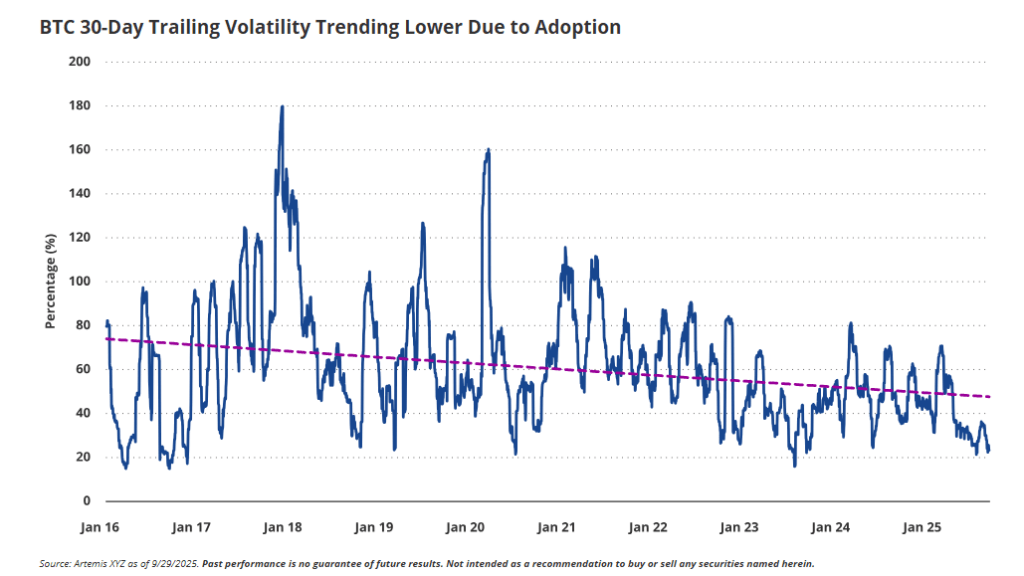
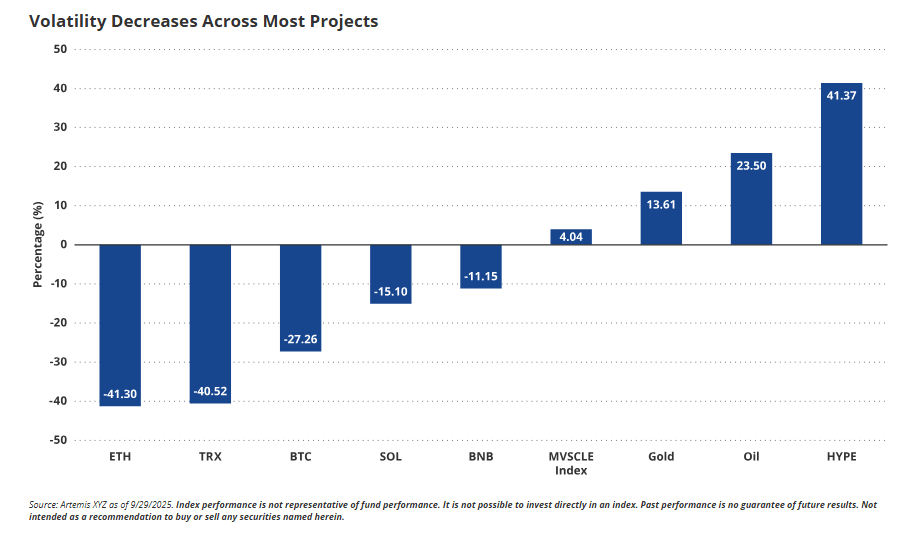
Volatility measures fell sharply: Ether volatility dropped 40%, SOL slid 16%, and Bitcoin volatility fell 26% in that month. Lower price swings mean fewer quick trades and fewer high-fee transactions.

Fees Fell As Volatility Cooled

Ethereum network revenue declined by 6% in September. Solana’s receipts slipped by 11%. Tron’s fees plunged 37%, but that figure was driven partly by a governance change: a proposal reduced gas charges by over 50% in August, and those lower costs showed up in September’s numbers. In short, both market quiet and policy moves combined to trim what users paid to move assets on chain.
Stablecoins And Settlement Activity Mattered More Than Hype

The stablecoin market also continued to grow, with data from RWA.XYZ showing the total stablecoin market cap crossed $290 billion in October 2025.

That expanding pool of tokenized dollar balances tends to favor blockchains with cheap, fast transfers. For Tron, heavy stablecoin issuance has translated into steady transaction volumes and a different kind of economic engine than networks that rely more on DeFi or speculative trading.

Stablecoins Drive Transaction Flows

Stablecoins let value move across borders with near-instant settlement and low fees. They trade round the clock and do not require a bank account, which helps explain why on-chain volumes can diverge from pure token market caps.

Reports have disclosed that this utility-based demand is a major reason Tron outpaced others in revenue, even if its native token remains far smaller by market value.

Featured image from Unsplash, chart from TradingView

Editorial Process for bitcoinist is centered on delivering thoroughly researched, accurate, and unbiased content. We uphold strict sourcing standards, and each page undergoes diligent review by our team of top technology experts and seasoned editors. This process ensures the integrity, relevance, and value of our content for our readers.

Christian, a journalist and editor with leadership roles in Philippine and Canadian media, is fueled by his love for writing and cryptocurrency. Off-screen, he's a cook and cinephile who's constantly intrigued by the size of the universe.

Related Reads

Interpreting Investment Opportunities in the Age of Great Navigation, Invesco Great Wall Fund Releases '2026 Report on Chinese Enterprises Going Global'

Invesco Great Wall Fund has released its "2026 China Corporate Globalization Report," titled "The 'Great Navigation Era' of Chinese Enterprises." The report analyzes the new trends and investment opportunities as Chinese companies expand globally, moving from simple product exports to comprehensive overseas operations involving services, branding, and local production. Driven by factors like trade friction, the pursuit of higher profit margins abroad, and policy support, globalization is becoming essential for Chinese companies. The report outlines an evolution: from early product export ("Globalization 1.0") to the current "Globalization 2.0," characterized by overseas capacity, capital goods investment, consumer brand expansion, and service exports. Chinese firms' competitive advantages are highlighted, including a vast engineer talent pool, low-cost and robust infrastructure, and complete industrial clusters. Specific sectors with significant出海 potential are identified: * **Capital Goods** (e.g., engineering machinery, power equipment): Benefiting from global demand, especially in Belt & Road markets and the AI-driven power grid upgrade cycle. * **Consumer Brands**: Transitioning from cost to brand advantage, leveraging供应链 efficiency. * **Technology & Innovation**: Including AI applications, optical modules within global tech supply chains, and new energy vehicles focusing on local production. * **Pharmaceuticals**: Chinese biotech firms are becoming preferred partners for global pharma, with potential for breakthrough drugs in areas like oncology and weight loss. The report concludes that corporate globalization represents a sustained, core theme for China's capital markets, though companies must navigate challenges like geopolitics and localization.

marsbit3m ago

Interpreting Investment Opportunities in the Age of Great Navigation, Invesco Great Wall Fund Releases '2026 Report on Chinese Enterprises Going Global'

marsbit3m ago

GitHub, Transfixed by AI

On the night of February 9th, GitHub suffered a major outage caused by a simple configuration change—reducing a cache refresh interval from 12 to 2 hours—that triggered a cascade of failures. This was not an isolated event, but part of a broader pattern. In early 2026, GitHub experienced at least 8 major incidents, failing to meet its promised 99.9% availability. These outages stemmed from structural issues: explosive growth in load, tight service coupling, and insufficient protection against abnormal traffic. This unprecedented load is driven by AI Agents. In 2025, GitHub handled ~1 billion commits. By 2026, weekly commits reached 275 million, projecting to ~14 billion for the year—a 14x increase. AI tools like Claude Code now contribute 4.5% of all public repository commits, with weekly submissions surging 25x in just three months. AI-generated pull requests jumped from 4 million to 17 million per month in half a year. Unlike human developers, AI Agents work continuously, generating commits at a scale that overwhelms infrastructure designed for human rhythms. The surge also shattered GitHub's business model. Copilot's flat-rate pricing, based on assisting human developers, became unsustainable as Agentic AI sessions consumed resources worth hundreds of dollars for a few dollars in fees. In response, GitHub imposed usage limits and, by June 1st, shifted to a pay-per-use "AI Credits" system. Facing this new reality, GitHub realized a 10x scaling plan was insufficient. It announced a need to *redesign* its architecture for 30x current scale—decoupling services, adding fault isolation, and improving change management to prevent cascading failures. Other platforms like Stripe and AWS are facing similar challenges with AI Agents. Fundamentally, GitHub is transitioning from a human collaboration platform to an "exhaust pipe" for automated AI workflows. Its detailed post-mortem reports aim to maintain trust during this turbulent rebuild. The February outage was not just a technical glitch, but a signal of the software industry's entry into a new, AI-driven era.

marsbit43m ago

GitHub, Transfixed by AI

marsbit43m ago

Both Suffer Massive Losses Exceeding $90 Billion, Which Is in Greater Peril: Strategy or Bitmine?

Facing massive paper losses exceeding $90 billion each amidst a sharp market downturn, "Digital Asset Treasury" (DAT) giants Strategy and Bitmine find themselves in a precarious position, but with different underlying risks. Strategy, heavily invested in Bitcoin (BTC), faces significant financial strain. Its strategy relies heavily on debt, including convertible notes and preferred stock (STRC) requiring substantial dividend payments. With its cash reserves dwindling and BTC offering no staking yield for cash flow, Strategy's high leverage makes it vulnerable. A continued price decline could force asset sales to meet obligations, potentially creating a negative feedback loop. Its market value has already fallen sharply. In contrast, Bitmine, an Ethereum (ETH) holder, appears on firmer financial ground. It primarily funds its purchases through equity offerings (like ATM programs), avoiding debt pressure. It also generates income by staking a large portion of its ETH holdings. While not immune to market drops and shareholder dilution concerns, Bitmine maintains more flexibility, recently announcing a new preferred share offering to raise further capital. The core divergence lies in their financing: Bitmine uses equity (investor money), while Strategy uses debt (borrowed money). Consequently, Bitmine currently faces less immediate liquidity pressure than Strategy, which must navigate the dual challenge of servicing debt/dividends and a declining core asset (BTC) price.

marsbit50m ago

Both Suffer Massive Losses Exceeding $90 Billion, Which Is in Greater Peril: Strategy or Bitmine?

marsbit50m ago

Trading

Spot
Futures
活动图片