Uptober начался: биткоин достиг 7-недельного максимума в $120 000

cryptonews.ruPublished on 2025-05-02Last updated on 2025-10-03

За последние сутки криптовалютные рынки продемонстрировали рост, достигнув семинедельного максимума для биткоина в начале исторически оптимистичного октября.

Цена биткоина взлетела на 4% за последние 24 часа. По данным TradingView, в четверг на Coinbase в начале торгов цена ведущего цифрового актива в мире достигла $120 450.

Это самая высокая цена биткоина с 14 августа, семь недель назад, когда он начал корректироваться с исторического максимума.

Биткоин преодолел сопротивление на уровне $117 500, но на уровне $120 000 его ожидает большее сопротивление. Прорыв этого уровня открыл бы путь к новым пиковым ценам, но на момент написания статьи курс немного снизился, опустившись до $118 947.

Этот значительный рост привел к увеличению общей рыночной капитализации на 3,5% до $4,16 трлн и возродил оптимизм в отношении бычьего месяца «Uptober». Этот рост также увеличил рыночную капитализацию биткоина до $2,37 трлн, что выше капитализации Amazon, согласно данным CompaniesMarketCap.

По данным CoinGlass, октябрь является самым оптимистичным месяцем для биткоина в году: 10 из последних 12 октября он демонстрировал рост.
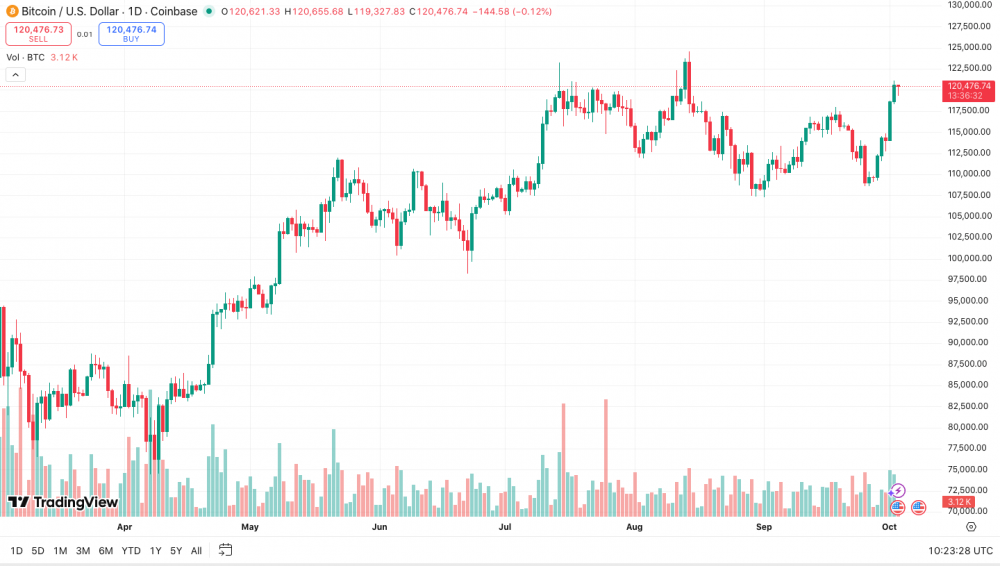

BTC достиг семинедельного максимума на Coinbase. Источник: Tradingview

Слабость рынка труда привела к снижению ставок

Согласно данным, опубликованным на этой неделе Бюро статистики труда, число вакансий в США в августе незначительно увеличилось, в то время как число нанимаемых сотрудников сократилось.

Это усугубило проблемы на рынке труда, что может побудить Федеральную резервную систему вновь снизить процентные ставки в конце этого месяца. Такое решение является позитивным фактором для высокорисковых классов активов, таких как криптовалюты.

«Я думаю, что в первую очередь это связано со слабым отчетом ADP по занятости, который последовал за снижением потребительских настроений ранее на этой неделе, когда дифференциация на рынке труда сократилась», — заявил аналитик IG Market Тони Сикамор.

Он добавил, что это говорит о том, что уровень безработицы, вероятно, вырастет с 4,3% до 4,4% в сентябре, «гарантируя дальнейшее снижение ставок ФРС».

«На фоне ослабления традиционных экономических показателей рост биткоина выше $118 000 демонстрирует его растущую чувствительность к перспективам денежно-кредитной политики и его привлекательность в качестве инструмента хеджирования экономической неопределенности», — отметил Ник Рак, директор LVRG Research.

Прогнозы фьючерсов на CME теперь показывают 99% вероятность снижения ставки на 0,25% на следующем заседании ФРС 29 октября, по сравнению с 96,2% в понедельник.

Альткоины также в тренде

Биткоин лидирует в росте рынка, но Ethereum также прибавил более 5% за день, подняв цену до $4390, самого высокого уровня с 22 сентября.

Другие альткоины, которые сейчас демонстрируют еще более высокий рост, включают Solana (SOL), Dogecoin (DOGE), Cardano (ADA), Chainlink (LINK) и Hyperliquid (HYPE). Эти активы выросли более чем на 6% за день.


Related Reads

How Does Codex Use a Computer? Three Entry Points and Permission Boundaries

This article explains the three primary methods for Codex to interact with a computer, each with distinct use cases, permission boundaries, and trust levels. **1. Computer Use:** This offers the broadest access, allowing Codex to visually control and interact with the graphical user interface of authorized macOS/Windows apps, system settings, and even iOS simulators. It's ideal for tasks lacking APIs or structured tools, such as operating legacy software or multi-app workflows. However, it's the slowest method and has the widest permission scope, requiring careful supervision for sensitive actions. **2. Chrome Extension:** This grants Codex access to the user's logged-in Chrome browser state, including cookies, profiles, and open tabs. It's best for tasks requiring user identity across websites like Gmail, LinkedIn, Salesforce, or internal dashboards. Its key advantage is multi-tab control for complex workflows. While more powerful for browser-based tasks than Computer Use, it carries higher sensitivity as actions are performed under the user's identity. **3. In-App Browser:** This is a browser isolated within the Codex thread, separate from the user's personal browsing data. It excels in web development and debugging scenarios—previewing local servers, testing responsive layouts, or annotating designs directly on the page. Its isolation is a strength for development but a limitation for tasks requiring login sessions. The core principle is to choose the narrowest, safest, and most structured interface for the task. Use plugins or MCPs first, resort to visual control (Computer Use) only for GUI-dependent tasks, employ the Chrome extension for identity-reliant browser work, and prefer the In-App Browser for isolated development. **Appshots** are clarified as a fourth, complementary tool for *inputting* context—capturing a screenshot of a window to point Codex to something—rather than a method for Codex to *act*. Together, this layered approach highlights a key to AI agent productization: not granting unlimited permissions, but constraining them within clear boundaries for specific tasks while preserving user oversight.

marsbit47m ago

How Does Codex Use a Computer? Three Entry Points and Permission Boundaries

marsbit47m ago

The "Iron Rule" of Chip Equipment Is Being Broken

For years, the semiconductor equipment industry followed an unwritten "iron rule": suppliers offered steep discounts for new tool introductions (Design-in) and faced consistent price pressure during repeat orders, especially during market downturns. This long-standing buyer's market dynamic is now being upended. Recently, SK Hynix's primary equipment suppliers have reportedly requested a 3-4% price *increase*, a nearly unprecedented move. This shift is driven by a severe supply-demand imbalance fueled by the AI compute boom. Securing equipment has become an urgent arms race as chipmakers' expansion speed dictates their ability to fulfill massive AI chip orders. Key areas feeling the strain include: **TCB (Thermal Compression Bonding) Equipment:** Demand is exploding, driven by the simultaneous needs of HBM4 memory stacking, AI chip Chip-on-Substrate (C2S), and logic Chiplet Chip-on-Wafer (C2W) packaging. Players like Hanmi Semiconductor, Hanwha Semitech, and ASMPT are receiving major orders. While hybrid bonding is seen as the future, TCB remains the pragmatic choice for HBM4 mass production, with its lifecycle extended by relaxed specifications and ongoing technological upgrades. **Test Equipment Bottlenecks:** Ironically, AI-driven shortages are now crippling test equipment manufacturing. Critical components like FPGAs, Driver ICs, and CPUs face severe shortages and extended lead times (up to 52 weeks for FPGAs), as AI data center and server vendors prioritize supply. This creates a paradoxical cycle: AI chip shortages drive fab expansion, which requires more test equipment, whose production is delayed because its key parts are diverted to make AI chips. The industry is entering a broad, AI-powered upcycle. SEMI forecasts global semiconductor equipment sales to hit a record $156 billion by 2027, fueled by investment in advanced logic/foundry, HBM-driven DRAM, and advanced packaging (like CoWoS). Major players like TSMC, SK Hynix, and Micron are aggressively ramping capital expenditure. In conclusion, leading equipment vendors are no longer just selling tools; they are selling the critical capability to deliver AI-era capacity. Pricing power is shifting decisively to those with indispensable technology in key process nodes like advanced logic, HBM, and advanced packaging, rewriting the industry's traditional power structure.

marsbit1h ago

The "Iron Rule" of Chip Equipment Is Being Broken

marsbit1h ago

Trading

Spot
Futures
活动图片